Building a Minimum Viable Product The Smart Way
Launching a minimum viable product (MVP) is all about creating the simplest, most essential version of your product that effectively solves one specific problem for a well-defined group of people. The goal isn't to build a perfect, feature-packed product from day one. Instead, it's about getting to market quickly to see if your core idea actually holds water with real users.
This strategy forces you to test your most critical business assumptions before you sink a ton of time and money into a full-blown development cycle.
Why an MVP Is Your Startup's Smartest First Move
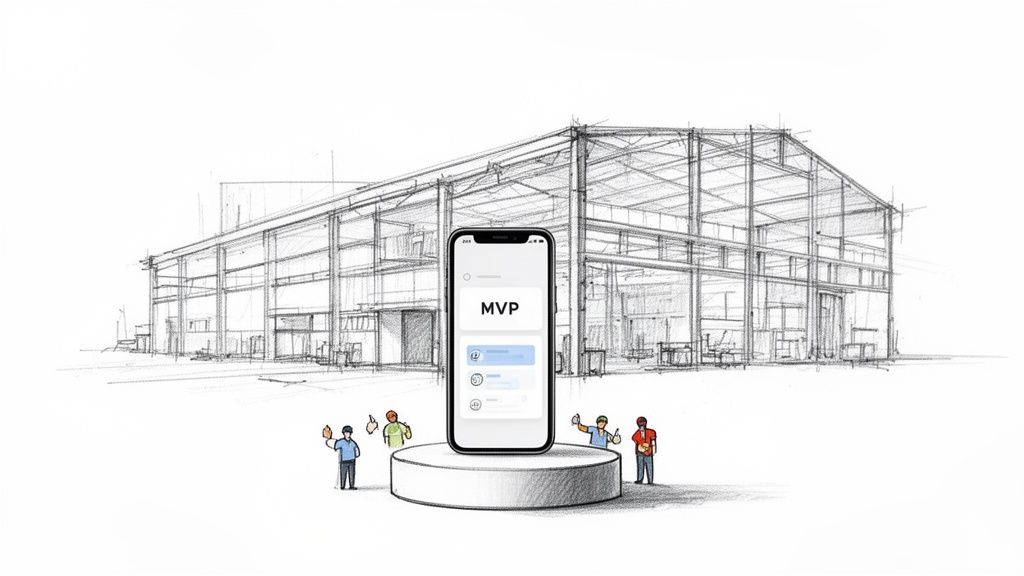
Diving straight into full-scale development without first validating your idea is one of the biggest—and most common—gambles a startup can make. The MVP approach was born directly out of the ashes of startups that learned this lesson the hard way. When you look at why most startups fail, it's rarely due to a lack of funding or a bad team. It’s because they built something nobody actually wanted.
The data is pretty sobering. Post-mortem analyses consistently show that around 42% of startups fail because there’s simply "no market need" for what they built. An MVP is your best defense against becoming another statistic. In fact, development firms have found that projects starting with an MVP can reach the market 3–4 times faster and have failure rates 60% lower than those using traditional methods. You can dig into more of these powerful startup statistics and trends to see just how much of an edge this gives you.
To really see the difference, it helps to compare the two philosophies side-by-side.
MVP Approach vs. Traditional Development
| Factor | MVP Approach | Traditional Development |
|---|---|---|
| Primary Goal | Validated learning and market testing | Launch a complete, feature-rich product |
| Initial Cost | Low; focused on core functionality | High; significant upfront investment |
| Time to Market | Fast (weeks or a few months) | Slow (many months or years) |
| Risk Level | Low; fail fast and cheap, pivot easily | High; "all-or-nothing" bet on the initial idea |
| User Feedback | Gathered early and continuously | Collected late in the process, after launch |
| Development Focus | Solving one core problem | Building a comprehensive, "perfect" solution |
This table makes it clear: the MVP path isn't just about saving money, it's about building a smarter, more resilient business from the ground up.
Find Product-Market Fit Faster
The MVP philosophy isn't an excuse to launch a buggy or half-baked product. It's about being strategic. You're focusing on a tight, continuous feedback loop: build, measure, learn. This cycle is the engine that drives you toward product-market fit.
Here’s what that looks like in practice:
- Validate Your Core Assumptions: You can finally get a real answer to the question, "Will people actually use and pay for this?"
- Gather Real User Feedback: Early adopters are a goldmine of insights. Their feedback will guide every future development decision you make.
- Reduce Upfront Investment: You stop wasting money and engineering hours on features that sound cool in a meeting but that users don't actually care about.
- Attract Early Investors: Nothing gets an investor's attention like a working product with real, happy users and positive metrics. It proves you're onto something.
An MVP is your primary learning tool. It's not just a stripped-down version of your final product; it's an experiment designed to test a specific hypothesis about your customers and the market.
Ultimately, building an MVP shifts your entire mindset. You stop building what you think your users want and start building what they prove they need. By aligning your work with genuine market demand right from the start, you dramatically stack the odds of long-term success in your favor.
Validating Your Idea Before You Write Any Code
A great idea is a fantastic start, but that's all it is—a start. The real work of building a successful MVP happens long before a developer ever touches the keyboard. It all begins with validation: gathering hard proof that people not only want your product but actually need it.
Jumping straight into development without this evidence is a classic, and often fatal, startup mistake. You have to test your core assumptions first, using as few resources as possible, to confirm you’re solving a real problem for a real audience. This whole phase is about learning—quickly and cheaply.
Gauging Interest with Low-Fidelity Tests
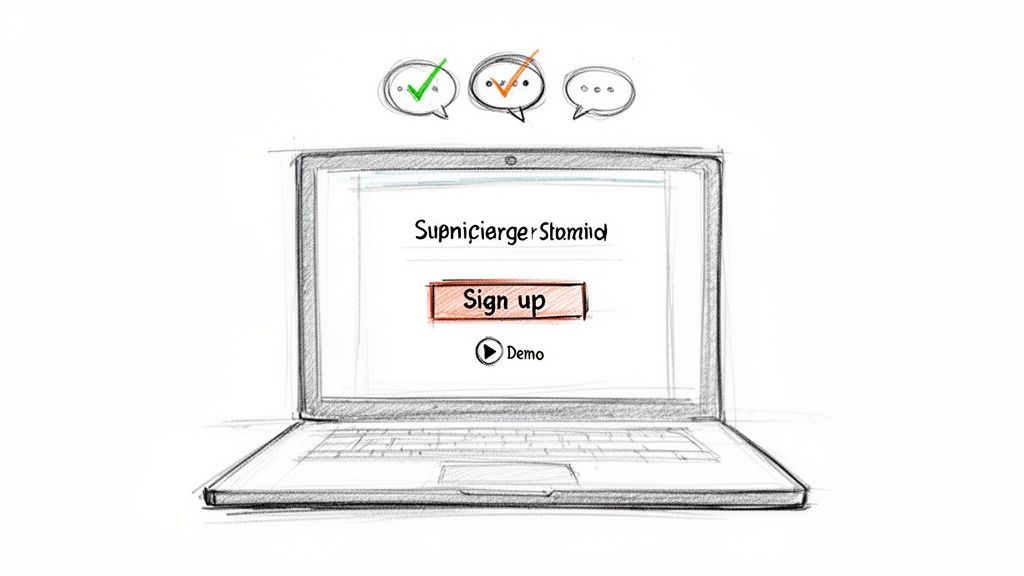
Before you sink time and money into building anything, you can run some simple experiments to see if anyone even cares. One of the most effective ways to do this is with a "smoke test" landing page. It's just a single webpage that spells out your product's value and asks visitors to do something, like "Sign up for early access."
The team behind Buffer, the social media scheduler, did this perfectly. They launched a simple two-page site. Page one explained the product, and if you clicked "Plans and Pricing," you landed on a second page explaining it wasn't ready yet but offering a spot on the waitlist. That simple test proved people were ready to open their wallets for the solution.
Dropbox is another legendary example. Instead of building their incredibly complex file-syncing tech, the founders made a short explainer video showing how it would work. They posted it on Hacker News, and their beta waitlist shot up from 5,000 to 75,000 people overnight. That video was all the proof they needed.
Talking Directly to Potential Customers
A landing page can tell you if people are interested, but talking to them tells you why. You absolutely have to get out there and speak with your target audience to understand their day-to-day frustrations, their current workflows, and where the real pain points are.
The goal of these early conversations isn't to sell your idea. It's to listen. Ask open-ended questions about the problems you think your product solves, and see if their reality matches your assumptions.
This kind of qualitative feedback is gold. To make these conversations count, you need to know how to conduct user research the right way. A few well-structured interviews can tell you whether your solution is a perfect fit or if you need to go back to the drawing board.
Here are a few ways to get that feedback:
- Surveys: Tools like Google Forms or SurveyMonkey are great for gathering data from a wider audience. You can ask specific questions about their current tools and what drives them crazy.
- Interviews: Nothing beats a one-on-one chat, whether it's over video or in person. This is where you can dig deep and understand the context behind their answers.
- Forums and Communities: Find your people where they already hang out. Look for relevant subreddits or industry forums where potential users are already complaining about the very problem you want to solve.
As you gather this evidence, it helps to formalize your findings and overall strategy. For many founders, putting together a comprehensive business plan is a crucial step. By combining these validation methods, you build an airtight case for your product, ensuring you’re building something people will actually use.
Defining Your Core Features and Product Scope
You’ve validated your idea. The initial excitement is buzzing. But then a tough question hits: "What do we actually build first?" This is where even the best-laid plans can go sideways. It's the moment the dreaded feature creep monster rears its head—that relentless temptation to add just one more thing until your "minimum" product is anything but.
The real art of an MVP is learning to be ruthless. Your goal isn't to build a little bit of everything. It's to build one thing perfectly. That one thing must solve the single most painful problem your users have. If you're building a task management app, that means users can create a task and mark it complete. That's it. Forget collaboration, notifications, and third-party integrations for now. Those can wait.
Using Frameworks to Find Your Focus
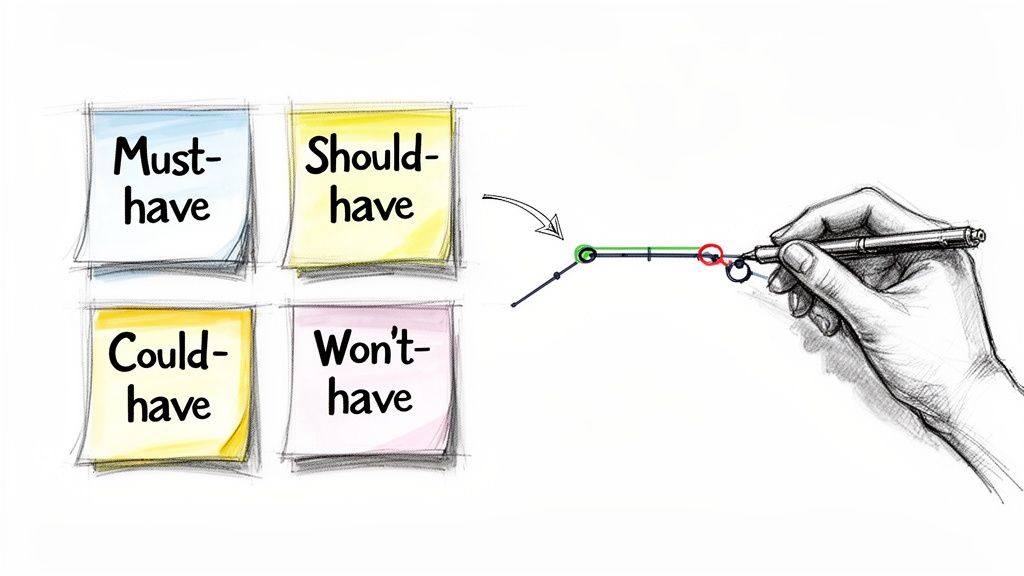
To keep your team honest and focused, you need a framework. One of the most practical tools for this job is the MoSCoW method. It's a simple but powerful technique that forces you and your team to sort every feature idea into one of four buckets:
- Must-have: These are the absolute, non-negotiable features. The product simply won't work or solve the core problem without them.
- Should-have: These are important and add a ton of value, but the product can still launch without them. They're at the top of the list for the next version.
- Could-have: Think of these as the "nice-to-haves." They're great ideas, but you'll only tackle them if you have extra time and resources. They are the sprinkles on the cupcake.
- Won't-have: These features are officially out of scope for this release. Putting them here is a conscious decision to prevent them from sneaking back into the plan.
This isn't just a list-making exercise. It’s a strategic conversation that gets everyone aligned on what truly matters. It also provides the foundation you need to create a product roadmap that’s based in reality, not wishful thinking.
Mapping the Core User Journey
Alongside prioritization, you need to map out the primary user flow. What is the single, essential path a user needs to follow to get value from your product? This is often called the "happy path."
Every single feature you decide to build for your MVP must directly serve this one journey. Anything that complicates it, distracts from it, or adds a side-quest should be cut without mercy.
The discipline to say "no" to good ideas is what separates a focused MVP launch from a bloated, delayed one. Your first version should do one thing exceptionally well.
The financial stakes here are incredibly high. Teams that overload their first version often see budget overruns of 40–60% thanks to constant rework and mounting technical debt. A disciplined MVP, on the other hand, follows the Pareto principle: it’s the 20% of functionality that solves 80% of user needs.
By being strategic and disciplined about your scope, you’ll avoid wasting money, keep your development on schedule, and get a genuinely valuable product into users' hands much, much faster.
Designing and Developing a Lean But Lovable Product
You've got your core features locked in. Now comes the fun part: turning those abstract ideas into something real that people can actually use. This is where your MVP starts to breathe.
The goal isn't to build a visual masterpiece right out of the gate. Forget that. What you're aiming for is a product that's clean, intuitive, and works flawlessly. A simple, well-executed user experience is infinitely more valuable than a beautiful interface that’s riddled with bugs.
Remember, your first users are here to validate your core idea. If they can't even figure out how to use the product, all you'll get is feedback about your confusing design, not whether your concept has legs.
From Sketch to Interactive Prototype
Before a single line of code gets written, you need a blueprint. This is all about mapping out the user experience (UX). I always start with low-fidelity wireframes—basic, black-and-white sketches that are all about function over form. You can literally do this with a pen and paper, or use a tool like Balsamiq to keep things simple.
This step is critical because it forces you to focus only on the layout and flow. You're not distracted by colors, fonts, or logos. It’s pure structure.
Once that basic skeleton feels right, it’s time to add a bit of skin and muscle. Move into a higher-fidelity, interactive prototype using a tool like Figma or Adobe XD. This isn’t the final product, but it feels like it. Users can click through screens, tap buttons, and navigate the app, which is your chance to spot awkward workflows or confusing dead-ends before they become expensive coding problems.
Pro Tip: Testing an interactive prototype is one of the biggest money-savers in the entire process. Finding and fixing a usability issue here costs pennies compared to rewriting code after development is already underway.
Understanding the critical role of UX design is what separates an MVP that people tolerate from one they genuinely enjoy using.
Embracing Agile Development
When it’s time to actually build, throw any rigid, long-term plans out the window. They're your enemy here. The whole point of an MVP is to learn and adapt quickly, which is why agile methodologies are a perfect match.
Instead of a massive, months-long development plan, agile breaks the work into small, manageable cycles called "sprints." These typically last just one or two weeks.
At the end of each sprint, you have a tiny, working piece of your product. This isn't just theory; it has real, tangible benefits for building an MVP:
- You stay flexible. New feedback from your prototype tests? No problem. You can easily pivot and adjust priorities for the next sprint.
- You build momentum. Seeing tangible progress every couple of weeks keeps everyone motivated and moving forward. There's no six-month tunnel with no light at the end.
- You maintain focus. The team hones in on a small set of tasks, ensuring they get done right and to a high standard.
Choosing the Right Tech Stack
Picking the technology for your MVP boils down to a classic trade-off: speed of development versus long-term scalability. For an MVP, speed is almost always the right answer. You have to get to market and start learning, fast.
Look into frameworks famous for rapid development, like Ruby on Rails, Django, or a modern JavaScript stack like MERN (MongoDB, Express.js, React, Node.js). Don’t be afraid to lean on pre-built components or even "no-code" platforms to get you off the ground even faster.
The tech you choose today doesn't have to be the tech you use forever. It just needs to be solid enough to build a reliable product that delivers on its promise and gets you the validation you need to take the next step.
Learning from Titans: What Successful MVP Launches Can Teach Us
It’s one thing to talk about MVP theory, but the real magic happens when you see it in action. If you pull back the curtain on today's tech giants, you’ll find a surprisingly similar origin story: they all started with a simple, focused product built to test one core idea.
These companies didn't launch with a sprawling feature set. They zeroed in on the most painful problem, built just enough to solve it for a niche audience, and then listened like their lives depended on it—because, in a way, they did. Their journeys prove that you don't need to build a masterpiece on day one. You just need to start.
Uber's Simple Ride-Hailing MVP
Think about Uber. The app on your phone today is a complex beast, but it started as something far simpler. Back in 2009, UberCab launched in San Francisco with a single, laser-focused mission: connect a handful of professional drivers with passengers via text message.
There was no real-time map tracking, no surge pricing, no Uber Eats. It was just a barebones way to get a reliable black car. This stripped-down service was the perfect experiment. It validated their most critical assumption: people would absolutely pay more for the convenience of calling a car from their phone. That initial positive signal from a small group of users was all they needed to secure funding and start building.
The Power of One Problem: Duolingo and Basecamp
This "solve one problem first" approach isn't an anomaly. You see it everywhere.
The language-learning app Duolingo launched its MVP in 2012 with a gamified learning model that resonated instantly. It hit over 10 million downloads in its first year and has since grown to more than 500 million users worldwide.
The project management tool Basecamp began as an internal tool to fix one team's messy communication. They built it for themselves, proved it worked, and then scaled it to serve over 3 million users.
The common thread is impossible to miss: solve one high-value problem exceptionally well before you do anything else. These companies fought the temptation to add bells and whistles until they had undeniable proof that their core concept worked.
Starting small helped them manage risk and accelerate learning. They built momentum, turned early adopters into vocal champions, and used real data—not guesswork—to decide what to build next.
Their stories aren't just for inspiration; they're a practical playbook. If you want to see how other successful companies got their start, we've put together a collection of other great minimum viable product examples that are well worth a read.
Launching and Mastering the Feedback Loop
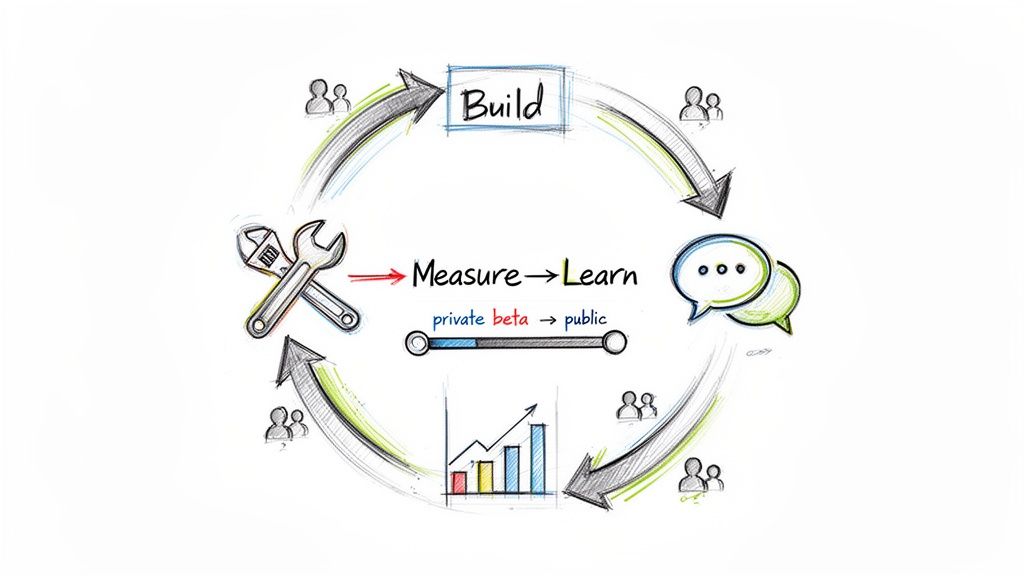
Here's the thing about your launch day: it isn't the finish line. It’s actually the starting pistol for the most critical part of building your product—the learning phase. This is the moment your hard-built assumptions finally collide with market reality. Your job shifts from building to listening, and listening intently.
A big, splashy public launch can be a recipe for being overwhelmed. I've seen it happen. Instead, think about a phased rollout. A private beta, for example, is a fantastic way to invite a small, curated group of early adopters to the party. These folks are usually more forgiving of a few rough edges and are often eager to give you the kind of detailed, constructive feedback that is pure gold for ironing out kinks before you go wide.
Turning User Behavior into Actionable Data
Once your MVP is out in the wild, you have to look past what users say they do and focus on what they actually do. This means getting the right tools in place to track behavior and measure what’s really going on. The aim is to blend hard numbers with human stories to see the full picture.
Here are a few tools that should absolutely be in your stack from day one:
- Analytics Platforms: You need the numbers. Tools like Google Analytics or Mixpanel will show you how many people are signing up, which features are getting all the attention, and, crucially, where users are dropping off.
- Session Recording: This is my favorite. Using a tool like Hotjar or FullStory is like getting to look over your user’s shoulder. You can watch anonymized recordings of their sessions and see exactly where they get confused, frustrated, or lost.
- Surveys and Feedback Forms: Don't forget to just ask. A simple form from Typeform or a small in-app feedback widget can capture direct insights right when a user has something to say.
When you combine these data sources, you get a powerful, multi-dimensional view of how your product is performing. It’ll shine a light on what’s working and what’s critically broken.
The purpose of an MVP is to validate assumptions. Expecting it to instantly bring massive traction often leads to disappointment. Its real value is in helping you learn what to build next.
Creating a Build-Measure-Learn Cycle
All the data in the world is useless if you don't have a system for acting on it. This is where the build-measure-learn loop comes in—it’s the engine that will drive your product's evolution. It’s a simple but powerful cycle for turning raw feedback into real product improvements.
First, collect every piece of feedback you can get your hands on—analytics data, interview notes, survey responses, support tickets, you name it. Then, analyze it all to find the patterns. Are 10 people a day getting stuck on the same screen? Is one feature request coming up in every single conversation?
Finally, use those insights to prioritize your product backlog. This feedback should directly shape your next development sprint. This ensures you're not just building more features, but building the right features that deliver real, user-validated value. This is the iterative process that turns a bare-bones MVP into a product people can't live without.
Common MVP Questions Answered
How "Minimum" Should an MVP Be?
This is the classic balancing act, and honestly, it trips up a lot of founders. The "minimum" in MVP means you're solving just one core problem for your target user, but you have to solve it well. It has to be truly viable.
Think of it this way: if you strip out a feature and the product can no longer accomplish its primary goal, that feature has to stay. The whole point is to find that sweet spot between launching fast to get feedback and offering enough real value to make those first users stick around.
Isn't an MVP Just a Prototype?
Not at all, and it's a crucial distinction. A prototype is usually just a model, a non-functional mockup. It's an internal tool that helps you figure out how the product might look and feel.
An MVP, on the other hand, is a real, working product that you put into the hands of actual users. It’s built to test a fundamental business hypothesis—answering the far more critical question of if you should even be building this thing in the first place.