A Guide to Digital Marketing for SaaS Companies
When you're marketing a SaaS company, you're not just making a single sale. You're building a system designed to attract, activate, and keep users for the long haul. The entire game is about recurring revenue and customer lifetime value (CLV), and that means your product isn't just the destination—it’s a core part of the marketing engine itself.
Why SaaS Marketing Demands a Specialized Approach
Trying to market a SaaS product with a generic strategy is like using a map for the wrong city. Sure, you'll be moving, but you'll never get where you need to go. The difference is baked right into the business model. Unlike selling a physical product, SaaS success lives and dies by keeping customers subscribed, month after month. This completely changes the focus from a one-time transaction to the entire customer lifecycle.
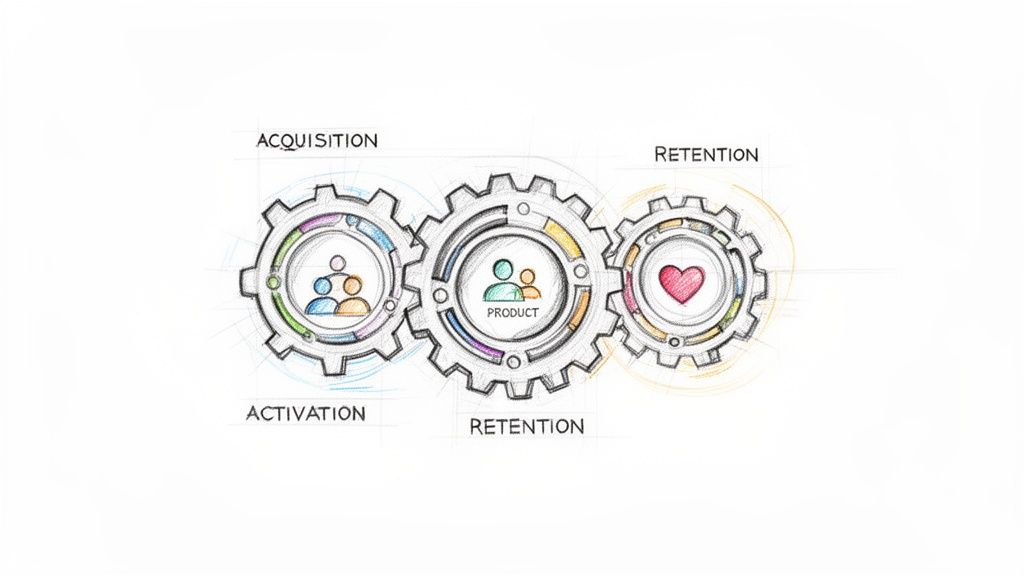
Think of it like building a high-performance engine. Every gear—from acquisition and activation to retention—has to mesh perfectly to generate sustainable momentum. If all your effort goes into getting new users in the door (acquisition) but they never see the value and bail (poor retention), you’re just pouring water into a leaky bucket.
The Integrated System of SaaS Growth
Truly effective digital marketing for SaaS is an integrated system built to manage this entire customer journey. With the global SaaS market projected to soar past $300 billion in revenue by 2025 and expected to command 85% of all business software markets, a specialized playbook is non-negotiable. Check out more SaaS marketing statistics to see just how competitive this space is.
This system is always working toward three main goals:
- Attract Ideal Users: It's not about casting a wide net. The goal is to bring in prospects who perfectly match your ideal customer profile (ICP) and have the exact problem your software solves.
- Guide Them to Value: The journey doesn't stop at the sign-up form. Great SaaS marketing extends right into the product, helping new users find that "aha!" moment where they truly get why your tool is essential.
- Build a Lasting Relationship: Marketing's job is to nurture the relationship through continuous engagement, great support, and new value. This is how you keep customers subscribed and turn them into your biggest fans.
At its core, SaaS marketing isn't just selling software. It's about selling an evolving solution and a continuous partnership that helps customers achieve their goals.
Making this shift—from thinking in one-off campaigns to building a holistic, lifecycle-focused growth machine—is what separates the companies that thrive from those that just survive. It's about engineering predictable growth, not just hoping the next campaign is a hit.
Your Blueprint for Sustainable Customer Acquisition
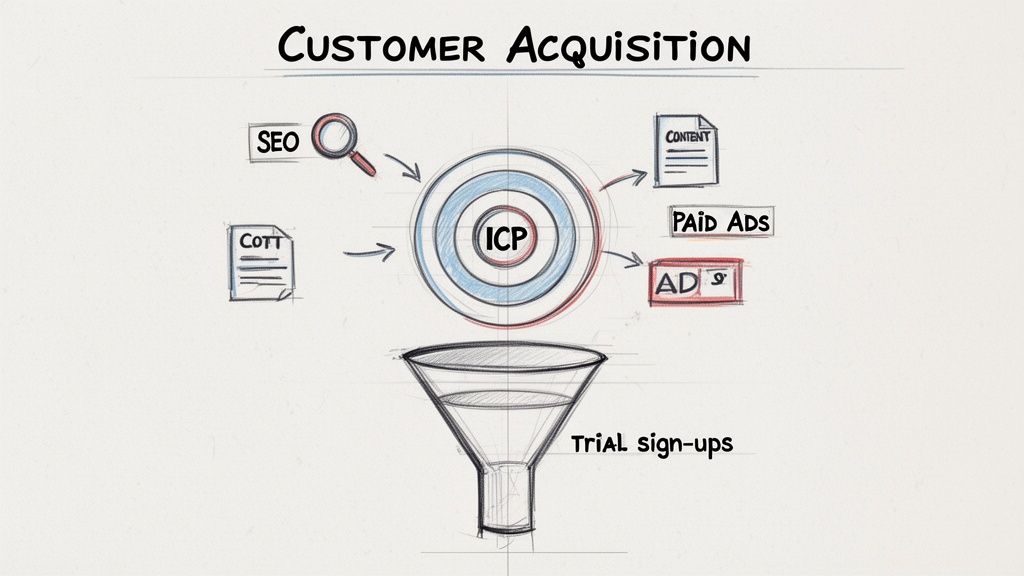
Bringing in the right kind of users is where it all begins for a SaaS company. Forget just chasing traffic; the real goal is to build a reliable, scalable machine that consistently delivers qualified leads who actually convert and stick around. This means getting specific and designing a multi-channel strategy where every piece is aimed squarely at your Ideal Customer Profile (ICP).
You're aiming to create a predictable pipeline of potential customers. To do that, you need to focus on channels that build momentum and deliver results for the long haul. Each one has a different job to do, from establishing your authority to capturing people who are ready to buy right now.
Mastering SEO for High-Intent Traffic
SEO is the bedrock of any sustainable acquisition strategy. Unlike paid ads that vanish the second you stop paying, a solid SEO presence is an asset that grows in value over time. For SaaS, the name of the game is capturing users with high purchase intent—the people actively searching for a solution to a problem your software solves.
This is all about targeting bottom-of-the-funnel keywords. We're not talking about broad, generic terms. We're talking about the specific phrases people type into Google when they're pulling out their credit cards.
- Comparison Keywords: Think "Your Product vs. Competitor" or "Best [Software Category] for [Use Case]."
- "Jobs-to-be-Done" Keywords: Things like "How to automate social media scheduling" or "Software to manage client invoices."
- Integration Keywords: Phrases such as "[Your Product] integration with Salesforce."
Another game-changer is programmatic SEO. This is where you create hundreds or even thousands of targeted pages based on structured data. For instance, a project management tool could auto-generate pages for "[Tool Name] alternatives for [Specific Industry]" or "[Tool Name] templates for [Specific Task]." It’s a powerful way to capture an enormous amount of long-tail traffic without an enormous amount of manual work.
A core component of your blueprint for sustainable growth involves accurately calculating your Customer Acquisition Cost (CAC), ensuring your marketing efforts are profitable. Understanding this metric helps you decide which channels are providing the best return on investment.
Creating Content That Genuinely Solves Problems
In the SaaS world, content marketing is all about being useful. Your content should feel like an extension of your product itself, solving real-world problems for your audience and proving you know what you're talking about. Generic, fluffy blog posts just don't move the needle. You need to create genuinely valuable assets that prospects will gladly trade their email for.
This is how you build trust and educate your market before they ever see a "buy now" button. Consider creating some of these high-impact pieces:
- In-depth Whitepapers: Tackle a major industry pain point with data-backed insights, positioning your product as the logical solution.
- Interactive Tools: Build simple calculators, checklists, or quick assessment tools that give immediate value and capture highly qualified leads.
- Comprehensive Guides: Aim to create the single best resource on a core topic related to what your software does.
The trick is to map your content to where people are in their buying journey. Broader educational content is great for grabbing the attention of those who are just realizing they have a problem. Later on, detailed case studies and comparison guides can help seal the deal for those who are close to making a decision. Using a digital marketing strategy template can be a huge help in keeping all these moving parts organized across the funnel.
Comparing SaaS Customer Acquisition Channels
Choosing the right marketing channels is a balancing act between budget, speed, and long-term goals. Some channels deliver quick wins, while others are a slow burn that builds a lasting foundation. This table breaks down the pros and cons of the most common options.
| Channel | Average Cost (CAC) | Time to Results | Scalability | Best For |
|---|---|---|---|---|
| SEO | Low to Medium | 6-12 months | High | Building a sustainable, long-term lead generation engine and capturing high-intent search traffic. |
| Content Marketing | Low to Medium | 3-6 months | High | Establishing thought leadership, building brand trust, and generating top-of-funnel leads. |
| Paid Search (PPC) | Medium to High | Immediate | Medium | Capturing immediate bottom-of-funnel demand and driving trial sign-ups or demo requests quickly. |
| Paid Social | Medium to High | Weeks | High | Precise audience targeting based on firmographics and behavior, ideal for reaching niche B2B audiences. |
Ultimately, the best strategies don't rely on a single channel. They weave them together, using paid channels to get quick feedback and drive initial growth while SEO and content build a compounding, cost-effective advantage over time.
Optimizing Paid Acquisition for Conversions
Paid channels like Google Ads and LinkedIn offer two things SaaS marketers love: speed and precision. You can put your message directly in front of your ideal customer almost instantly. But remember, the goal isn't just clicks—it’s trial sign-ups and demo requests.
On a platform like LinkedIn, you can get incredibly granular, targeting users by job title, company size, industry, or even specific skills they list on their profile. You want to build your campaigns around a crystal-clear call-to-action that pushes them toward a conversion, like a free trial. For Google Ads, you should pour your budget into those high-intent keywords you already identified during your SEO research.
A winning paid strategy depends on relentless testing. You have to constantly tweak your ad copy, landing pages, and offers to drive your CAC down. For many B2B SaaS companies, sales and marketing spend is a huge line item. In fact, research shows that equity-backed firms often spend 100% more on marketing than their bootstrapped competitors just to keep the growth engine running. That kind of investment has to be tied directly to tangible acquisition goals, ensuring every dollar spent brings in users who will become valuable, long-term customers.
Using Your Product as a Powerful Marketing Tool
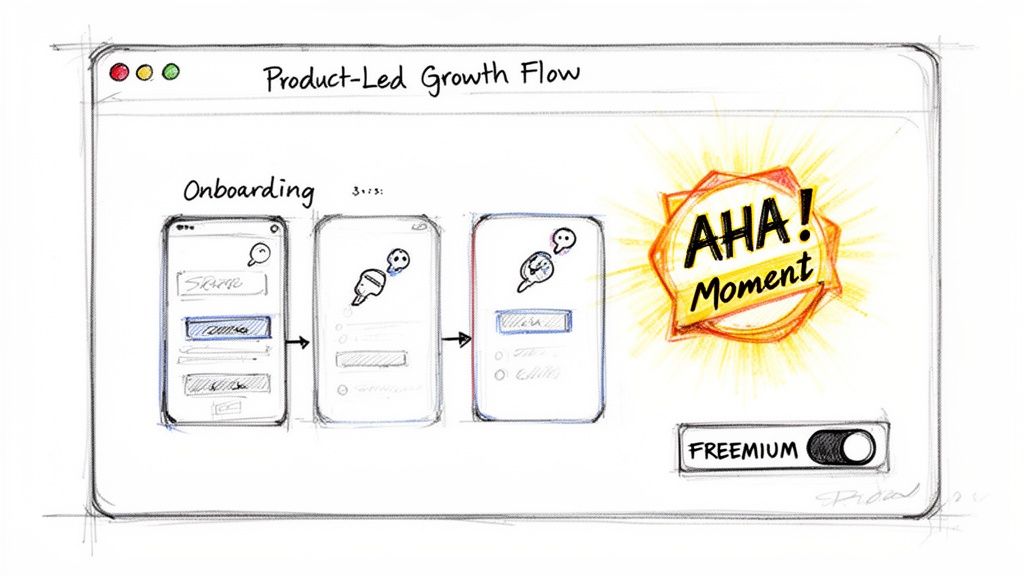
What if your product could sell itself? That’s not just a nice idea; it’s the entire premise behind Product-Led Growth (PLG). This is a go-to-market strategy where your product experience does the heavy lifting for acquiring, converting, and keeping customers. Instead of just talking about value in sales demos, you let people experience it for themselves.
The classic sales model is like a car salesman describing every feature of a new car. A PLG model is like getting handed the keys for a test drive. Users get to feel how it handles and see if it’s the right fit on their own terms. This hands-on approach is absolutely essential for modern SaaS companies because it puts the product right where it belongs: at the center of the customer's world.
Designing a Frictionless Entry Point
The gateway to any good PLG strategy is making it unbelievably easy to get started. This usually means a freemium plan or a free trial. The entire point is to remove every possible barrier so trying your product is an effortless "yes."
But don't mistake "free" for "not strategic." This is one of your most important marketing channels.
- Free Trial: This gives users access to everything (or almost everything) for a limited time, like 14 or 30 days. It builds a little urgency and works great for complex tools where the core value can be understood relatively quickly.
- Freemium: This offers a basic version of your product that's free forever, just with limits on features or usage. It’s perfect for tools with broad appeal, letting you build a massive user base that can be nurtured toward an upgrade over time.
Whichever path you take, the sign-up process needs to be dead simple. Every extra field is a new reason for someone to give up and leave. Only ask for what you absolutely need to get them into the product.
Guiding Users to Their 'Aha!' Moment
A sign-up is just the start. The real magic happens when you guide a new user to their 'aha!' moment—that flash of insight where they get it. It’s the point where they see exactly how your product solves their problem. This is where user onboarding stops being a product function and becomes a critical marketing activity.
The best onboarding doesn’t just show people how to use features. It shows them why those features are the solution to their problem and helps them get a quick win. Success isn't about getting a user to click every button; it's about helping them solve a real-world problem in their very first session.
A great onboarding flow is a mix of well-timed nudges. The welcome email should set the stage and have one clear call-to-action: get back in the app. Once they're in, use things like in-app tours, helpful tooltips, and simple checklists to steer them toward the actions that unlock value.
Think about a project management tool. The onboarding would be laser-focused on getting the user to create their first project and invite a colleague. Why? Because that action is a massive indicator of long-term success. This kind of practical guidance is a core principle in many strategies for digital marketing for tech companies.
By treating your product as your star player and building an onboarding flow that proves its value, you create a powerful, self-sustaining growth loop. Users who find that 'aha!' moment on their own are far more likely to become paying customers who stick around and tell others. Your product becomes your best salesperson.
Driving Retention to Maximize Lifetime Value
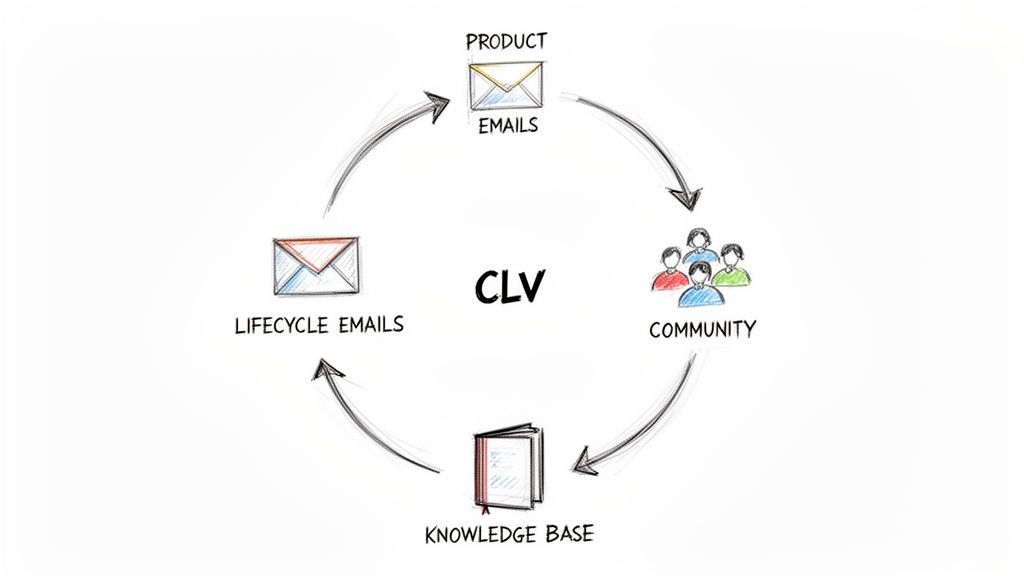
Getting a new customer through the door is just the beginning of the journey. The real magic—and profitability—in SaaS comes from keeping those customers engaged and subscribed month after month. This is where retention marketing steps into the spotlight, directly pumping up your Customer Lifetime Value (CLV) and turning growth into a compounding force.
Your main goal here is to fight churn, which is just a term for the rate at which customers cancel. Think of high churn as a leaky bucket; you're constantly scrambling to pour new customers in just to keep the water level from dropping. Smart retention plugs those leaks by making your product an indispensable part of a customer's world.
Creating a Sticky Product Experience
The absolute best way to keep a customer is to make your product "sticky." This isn't about trapping them; it's about weaving your tool so deeply into their daily operations that the thought of leaving feels like a massive headache. Stickiness is earned by delivering consistent, undeniable value.
Here are a few ways to build that kind of loyalty right into your product:
- Proactive Customer Success: Don't just sit back and wait for help tickets to roll in. Reach out to customers with best practices, check in on their progress, and offer a hand before they even know they need it.
- Celebrate Wins: Did a user just complete a big project or hit a usage milestone? Let them know! A simple in-app notification or a congratulatory email goes a long way in reinforcing your product's value.
- Gather and Act on Feedback: Ask for feedback through surveys and interviews, but don't stop there. The crucial part is showing customers you're listening by actually implementing their suggestions and letting them know you did.
Lifecycle Email Marketing That Delivers Value
Email is still a heavyweight champion in the SaaS retention ring, but you have to be smart about it. Forget generic newsletters. We're talking about lifecycle email marketing—sending automated, perfectly timed messages based on what a user is (or isn't) doing in your app.
A brand new user might get a welcome series full of quick tips, while a power user could get a heads-up about an advanced feature they haven't touched yet. This way, every email feels like a helpful nudge, not an interruption.
An effective lifecycle email strategy is like having a helpful guide whisper the right advice at the perfect moment. It anticipates user needs, demonstrates ongoing value, and keeps your product top-of-mind, dramatically reducing the likelihood of churn.
The Power of Community and Self-Service
Building a community around your product is a game-changer for retention. It gives your users a place to connect, trade tips, and help each other out. This not only builds a powerful sense of belonging but also takes a huge load off your support team.
A well-stocked knowledge base is just as vital. By creating easy-to-find tutorials, guides, and FAQs, you empower people to solve their own problems, whenever they want. This self-service approach makes for happier customers and frees up your internal experts to tackle the truly tough questions. When done right, you can significantly increase user retention and build a loyal following.
Modern tech can give you a serious edge here. For instance, AI can help slash support requests by 10-35% and give retention a bump of 8-15%. Marketing agencies that fuse digital strategy with development can build systems that personalize messages on the fly, lifting upsell rates by a healthy 12-25%. You can discover more insights about how AI impacts SaaS marketing and is reshaping how we engage with customers.
Putting It All Together: Your Go-To-Market Playbook
Think of all your marketing tactics—SEO, paid ads, social media—as individual musicians in an orchestra. Each one might be playing a beautiful tune on its own, but without a conductor and a single piece of sheet music, all you get is noise.
Your Go-to-Market (GTM) strategy is that sheet music. It's the master plan that gets your marketing, sales, and product teams to play in perfect harmony, creating a predictable, scalable engine for growth.
This is where you weave every single effort, from your first ad impression to the final step of your onboarding flow, into one powerful playbook. A solid GTM strategy doesn't just list what you'll do; it defines who you're selling to, the unique value you bring to the table, and exactly how you'll deliver that value at every single touchpoint.
Start with Your Strategic Foundation
Before you can draw the map, you need to know your destination and who you’re bringing along for the ride. This starts with getting crystal clear on three core elements. If you get these wrong, everything else you build will be on shaky ground.
Think of these as living pillars—they aren't set in stone. You should constantly revisit and refine them as you learn more about your market and customers.
Ideal Customer Profile (ICP): Forget basic demographics. Your ICP is a laser-focused portrait of the perfect company for your product. What’s their industry, size, annual revenue, and tech stack? The ICP is the company that gets the most value from you, and in turn, gives the most value back.
Buyer Personas: Now, zoom in on the people inside that ideal company. Who are the actual human beings you need to convince? You've got the Champion who fights for your tool internally, the Economic Buyer who holds the purse strings, and the End User who will be in the trenches with it every day. Each has their own pains, goals, and definition of success.
Value Proposition: This is your promise, boiled down to a single, powerful statement. What tangible, real-world result does a customer get from your product? It's not a feature list. It’s the solution to their biggest headache, phrased in a way that speaks directly to your ICP.
Choosing the Right GTM Model
Not all SaaS products are sold the same way. The complexity of your product and the kind of customers you're targeting will determine the best way to sell it. Picking the right model means aligning your entire company with how your customers actually prefer to buy.
There are really three main models to consider, each with its own playbook.
Sales-Led Growth (SLG): This is the classic approach, perfect for expensive, complex products that need a human touch. Here, the customer journey is guided by a sales team through demos, custom proposals, and contract negotiations.
Product-Led Growth (PLG): In this model, the product does the selling. Users sign up for a freemium or free trial account and experience its value firsthand, often before ever talking to a human. This works wonders for lower-priced products where users can see the "aha!" moment quickly.
The Hybrid Model: This approach gives you the best of both worlds. You might use a PLG motion to attract thousands of users and then unleash a sales team to find the high-value enterprise accounts hiding within that user base and convert them to bigger deals.
A huge mistake I see teams make is choosing a GTM model based on what’s trendy, not what fits their product. The best strategy is the one that creates the least friction for your ideal customer to find you, try you, and buy from you.
Mapping the Entire Customer Journey
Once you’ve got your ICP, value prop, and GTM model locked in, it's time to map the entire customer journey from start to finish. This means detailing every tactic and touchpoint you’ll use at each stage, from a prospect who’s never heard of you to a superfan who tells everyone about you. This is how you make sure no one falls through the cracks.
For instance, at the very top of the funnel, you'll be deciding where to invest your energy. A key decision might involve evaluating short-form video platforms to see whether TikTok or YouTube Shorts is a better fit for getting your brand in front of your ICP.
Your GTM playbook should be a living document that spells out the plan for each stage:
- Awareness: How will people discover you exist? (SEO, paid ads, content, social media)
- Consideration: How will you show them you're the best choice? (Webinars, case studies, detailed guides)
- Conversion: What’s the final step to becoming a customer? (A seamless trial signup, a killer sales demo)
- Retention: How will you keep them happy and successful? (Lifecycle emails, a killer support team, a user community)
- Advocacy: How do you turn happy customers into your best marketers? (Referral programs, featuring them in case studies)
By tying all these pieces together, you move from random acts of marketing to a strategic, repeatable process that gets the whole company rowing in the same direction toward sustainable growth.
SaaS Marketing FAQ: Your Questions Answered
When you're deep in the trenches of growing a SaaS business, a lot of questions pop up. It's totally normal to wonder if you're focusing on the right things, especially when the digital playbook seems to change every few months. This section is all about giving you straight, no-nonsense answers to the most common questions I hear from SaaS founders and marketers.
Think of this as the final check-up for your marketing engine. We’ve already covered the big pieces—acquisition, retention, and go-to-market plans. Now, let’s fine-tune the details to make sure everything is running at peak performance.
What Are the Most Important Metrics to Track in SaaS Marketing?
It's incredibly easy to drown in data. The trick is knowing which numbers actually tell you if the business is healthy. Forget vanity metrics like raw website traffic; you need to zero in on the KPIs that connect your marketing spend directly to revenue and customer happiness.
If I could only look at a handful of numbers, these would be it:
- Monthly Recurring Revenue (MRR): This is the heartbeat of your business. It’s the predictable, recurring income you can count on every single month.
- Customer Acquisition Cost (CAC): Simply put, how much does it cost you to get a new paying customer? You need to know this number cold.
- Customer Lifetime Value (CLV): This is a forecast of the total amount of money you can expect to make from a single customer over their entire time with you.
- Churn Rate: The percentage of customers who leave each month or year. A high churn rate is like trying to fill a leaky bucket—it makes growth nearly impossible.
The real magic happens when you look at the CLV-to-CAC Ratio. A healthy SaaS business should be aiming for a 3:1 ratio. This means for every dollar you spend to acquire a customer, you get at least three dollars back over their lifetime. That’s the sign of a sustainable, profitable model.
Should My SaaS Focus on SEO or Paid Ads First?
Ah, the classic question. The honest answer is "it depends," but it really boils down to speed versus sustainability. It’s like choosing between a speedboat and a cargo ship.
Paid ads are your speedboat. They get you results—fast. If you're just starting out and need to validate your product, test a new message, or just get leads in the door right now, paid channels are your best friend. The catch? The second you stop paying, the traffic disappears. You're essentially renting your audience.
SEO is the cargo ship. It’s a slow, steady, long-term play. You're building an asset that will pay dividends for years. It can easily take 6-12 months to see a real impact, but once that organic traffic starts flowing, it’s a powerful, low-cost lead source that works for you 24/7.
So, what's the best move? Use them together. Start with paid ads to get some quick wins and gather crucial data on what keywords and messages resonate with your audience. At the same time, invest in a solid SEO and content strategy that will eventually become the bedrock of your growth.
How Does Product-Led Growth Change a Marketing Team's Role?
In a traditional company, marketing's job is to tee up leads for the sales team to knock down. But in a Product-Led Growth (PLG) company, the entire game changes. The product itself becomes the primary sales tool.
This completely reshapes the marketing team's mission. Instead of focusing on MQLs (Marketing Qualified Leads) for sales, their number one job is to get people to actually use the product. Success isn't measured by how many demos you book, but by how many users sign up and find value.
This shift demands a much tighter partnership between the marketing and product teams. Suddenly, they're sharing the same goals:
- Driving Trial and Freemium Sign-ups: The main call-to-action on the website changes from "Talk to Sales" to "Start Your Free Trial."
- Optimizing User Onboarding: Marketing gets involved in creating an onboarding flow that helps users experience that "aha!" moment as fast as possible.
- Boosting Feature Adoption: Using email, in-app messages, and other channels, marketing’s job is to highlight valuable features and encourage deeper engagement.
- Increasing Conversion Rates: By analyzing user behavior, the team can spot where people get stuck and create campaigns to gently nudge free users toward a paid subscription.
In the PLG world, marketing’s ultimate goal is to make the product so good and so easy to understand that it basically sells itself.