Digital Marketing Strategy for Startups: A Proven Playbook for Growth
A winning marketing strategy isn’t about chasing the latest shiny tactic; it’s built on a rock-solid foundation. Before you even think about spending a dollar on ads, you have to get crystal clear on who you're selling to, what makes you different, and where you fit into the bigger picture. This groundwork is what separates the campaigns that take off from the ones that just burn cash.
Laying Your Startup's Marketing Foundation

Jumping straight into choosing channels is a classic startup mistake. It’s like trying to build a house without a blueprint—sure, you can start nailing boards together, but you’ll end up with a mess. A strong foundation ensures every dollar and hour you invest actually pushes your business forward.
It all starts with a simple question that has a surprisingly complex answer: who are you really selling to? Without this clarity, your message will be generic, and your campaigns will fall flat.
Getting these fundamentals right isn't just a box to check; it’s the most important work you'll do in your early days. It sets the stage for everything that follows.
This table breaks down the core components you need to nail down before you go any further.
Core Components of a Startup Marketing Foundation
| Component | Objective | Key Action |
|---|---|---|
| Buyer Persona | To deeply understand your ideal customer's motivations, challenges, and goals. | Conduct interviews, surveys, and research to create a detailed semi-fictional profile. |
| Competitor Analysis | To identify market gaps, understand competitive messaging, and find opportunities. | Analyze competitors' websites, content, social media, and customer reviews. |
| Unique Value Prop (UVP) | To clearly and concisely state why you're the best choice for your target customer. | Draft a single, powerful sentence that defines your unique benefit and audience. |
Nailing these three elements gives you a strategic filter for every marketing decision you make, from ad copy to content creation.
Define Your Ideal Customer with Buyer Personas
You can’t hit a target you can’t see. A buyer persona is a detailed profile of your ideal customer, but it goes way beyond basic demographics like age and location. It’s about getting inside their head so you can speak their language.
To build a persona that’s actually useful, dig into these questions:
- What are their biggest professional or personal pain points? What truly keeps them up at night? What frustrations can your product or service make disappear?
- Where do they get their information? Pinpoint the specific blogs, podcasts, social media platforms, and industry leaders they trust. That's exactly where you need to show up.
- What does success look like for them? Understand their goals and aspirations. You need to frame your solution as the bridge that helps them get from where they are to where they want to be.
This exercise transforms your marketing from shouting into a void to having a meaningful conversation with a specific person.
Key Takeaway: A well-defined buyer persona is the compass for your entire marketing strategy. It ensures your message resonates because it’s tailored to solve a real, specific problem for a real person.
Analyze Your Competitors to Find Your Opening
Your competitors are a treasure trove of market data. The goal isn't to copy them—it's to spot their weaknesses and identify the gaps in the market where you can shine.
Start by snooping around in a few key areas:
- Their Messaging: What value proposition are they leading with? Are they all about price, features, or service? Notice what they emphasize and, more importantly, what they seem to be ignoring.
- Their Content Strategy: What topics are they covering on their blog or social media? Look for underserved topics or angles they've missed. For a deeper dive, this social media marketing for startups: a growth playbook is a great resource.
- Their Customer Reviews: Head over to sites like G2, Capterra, or even just Google reviews. This is unfiltered customer feedback. What do people love? What are the recurring complaints? Those complaints are your golden opportunities.
Craft a Compelling Unique Value Proposition
Your Unique Value Proposition (UVP) is a clear, punchy statement that explains what benefit you provide, who you provide it for, and how you do it better than anyone else. It’s your answer to a potential customer’s most important question: "Why should I pick you?"
A powerful UVP is not a vague slogan. It should be the first thing a visitor sees on your website. For example, instead of a generic headline like "The Best Project Management Software," a strong UVP might be: "The Project Management Tool for Freelancers Who Hate Admin Work."
See the difference? It's specific, it’s benefit-driven, and it speaks directly to a niche audience. This is the cornerstone of an effective marketing strategy.
Building Your Digital Foundation with SEO and Content

Think of your website as your digital headquarters. It's your storefront, your brand brochure, and your hardest-working salesperson, all rolled into one. But a great website is useless without visitors. That’s where Search Engine Optimization (SEO) and content come in—they’re the engine that drives a steady stream of qualified traffic to your door.
This isn't just about chasing rankings. It's about methodically building a long-term asset that generates leads, establishes your authority, and works for you 24/7.
Ignoring this is a classic startup mistake. With 93% of all website traffic originating from search engines, skipping SEO is like building a retail store with no roads leading to it. You’re simply invisible to the vast majority of your potential customers.
A key decision early on is choosing the right website builder, as it directly affects your SEO and content management capabilities. For a deep dive, this comparison of Framer vs. Webflow: Choosing a Website Builder is a fantastic resource.
Find Your Customers' Language with Keyword Research
Great SEO begins with empathy. You need to get inside your customers' heads and understand the exact words and phrases they type into Google when they're looking for a solution like yours. This is keyword research, and it’s all about uncovering intent, not just stringing together popular words.
It’s tempting to go after broad, high-volume terms like "project management software," but that's a battle you won't win early on. Instead, your goldmine lies in long-tail keywords. These are longer, more specific phrases that signal a user is much closer to making a decision.
Let's look at the difference:
- Broad Keyword: "CRM" (Insanely competitive, vague intent)
- Long-Tail Keyword: "best CRM for small real estate teams" (Less competition, crystal-clear purchase intent)
Tools like AnswerThePublic or even the free version of Google Keyword Planner are perfect for digging up these long-tail gems. This focus ensures the traffic you attract is actually looking for what you offer.
Create a Content Engine, Not Just Content
Content is the fuel for your entire SEO strategy. The biggest misstep I see startups make is creating random blog posts with no real plan. A winning content strategy has two jobs: attract a new audience and convert them into customers.
Your content should be a healthy mix of top-of-funnel (ToFu) and bottom-of-funnel (BoFu) pieces.
- ToFu Content (Attraction): Think helpful guides, blog posts, and checklists that solve a broader problem for your audience without a hard sell. For instance, a fintech startup could publish a guide on "5 Common Budgeting Mistakes for Freelancers."
- BoFu Content (Conversion): This is for people who are ready to buy. Think case studies, detailed product pages, or pages comparing your solution against a key competitor.
Pro Tip: Before you write anything, ask these three questions: Who is this for? What problem does it solve for them? What do I want them to do next?
This dual approach creates a natural pathway, guiding visitors from their first point of awareness all the way to becoming a paying customer. To take this further, you can explore these powerful content marketing techniques to really build out your plan.
Master the On-Page SEO Basics
Once you have your keywords and a content plan, you need to make sure search engines can actually understand what your pages are about. This is On-page SEO—optimizing individual web pages to rank higher and earn more relevant traffic.
You don't need to be a technical genius to get the fundamentals right. Just focus on these four elements for every important page:
- Compelling Title Tags: This is the clickable headline in Google search results. It must include your main keyword and be interesting enough to make someone click.
- Informative Meta Descriptions: This is the little blurb of text under the title. It doesn't directly impact rankings, but a great one acts like ad copy, convincing users your page has the answer.
- Logical URL Structure: Keep URLs clean and descriptive. A URL like
yourstartup.com/blog/freelancer-budgeting-tipsis infinitely better thanyourstartup.com/p?id=123. - Strategic Internal Linking: Whenever you publish a new piece of content, link to other relevant pages on your site. This helps Google discover your content and understand how it all connects.
Nailing these basics sends strong signals to Google that your site is high-quality and user-friendly.
Earning Your First High-Quality Backlinks
Backlinks are essentially votes of confidence from other websites. When a reputable site links to yours, it tells search engines that you're a credible source of information. For a new startup, this can seem intimidating, but you don't need a huge PR budget to get started.
One of the most effective tactics is guest blogging. Find non-competing blogs that your ideal customers already read and trust. Pitch them a high-value article idea that their audience would love. In exchange, you'll almost always get a link back to your site in your author bio.
This simple strategy achieves two huge goals at once: you earn a valuable backlink and you introduce your brand to a perfectly targeted new audience. It’s a classic win-win.
Finding Your First Customers with Smart Channel Selection

When you're a startup, your budget is tight and your time is even tighter. It's so tempting to try and be everywhere at once, but that's a surefire way to burn through cash and energy with little to show for it. A winning digital marketing strategy for startups isn’t about plastering your brand on every platform imaginable. It's about showing up and making a real impact where it matters most.
Forget the "spray and pray" method. Your first customers will come from a handful of carefully chosen channels where you can actually compete and win. The goal here is to find where your ideal customers are already gathered and join the conversation.
Match Your Channels to Your Audience
The first question you should ask isn't, "Do we need a TikTok?" but rather, "Where are our ideal customers hanging out online, and what are they doing there?" Your buyer personas are the key to unlocking this.
If you’re a B2B SaaS startup trying to reach CTOs, your time is far better spent on LinkedIn and niche tech forums than on Instagram. On the flip side, if you're a direct-to-consumer brand selling sustainable fashion, highly visual platforms like Instagram and Pinterest are your natural home turf.
Get practical with it. Make a short list of the top 3-5 channels where you suspect your audience lives. To do this, think through a few categories:
- Social Media: Which platforms fit their demographics? Think LinkedIn for professionals, TikTok for Gen Z, or Facebook Groups for specific hobbies.
- Search Engines: Are people actively Googling the problem you solve? That’s a massive green light for focusing on SEO and paid search ads.
- Communities: Do they participate in specific Reddit subreddits, Slack communities, or industry-specific forums? Being a helpful voice there can be invaluable.
- Email: How do they feel about hearing from brands directly in their inbox after showing some initial interest?
This simple exercise forces you to move from a vague idea of what you should do to a concrete list of high-potential channels you can start digging into.
The Undeniable Power of Social Proof
Social media has become a primary engine for discovery and trust, especially for startups. People look to social content to inform what they buy. In fact, a whopping 76% of users say social content influences their purchasing decisions. That number skyrockets to 90% among Gen Z.
This trend makes platforms like TikTok, with its massive organic reach, a fascinating and low-cost place to test ideas. But here's the catch: you have to be real. 51% of customers admit they'll unfollow brands that come off as irritating or too corporate. You can dive deeper into these digital marketing statistics to get a better feel for these trends.
Key Insight: The goal isn't to just post at your audience; it's to engage with them. Ask questions. Respond to every comment. Share content from your users. An engaged community is the most powerful marketing asset you can build.
How to Run Low-Budget Channel Experiments
Once you have your shortlist of channels, it’s time to test your assumptions without risking your entire marketing budget. You need to find out if a channel actually works for you before you go all-in. This is where small, scrappy experiments are your best friend.
Here’s a simple framework to get you started:
- State Your Hypothesis: For each channel, write a clear, testable statement. For example: "I believe we can get beta users for our project management app for under $50 per signup by running targeted ads on LinkedIn."
- Set a Micro-Budget: Allocate a small amount of money you are completely willing to lose. This could be anywhere from $100 to $500 per experiment. This constraint forces you to be disciplined and creative.
- Define What Success Looks Like: What's the one metric that tells you this worked? It could be a specific number of sign-ups, a click-through rate above 2%, or a target cost-per-lead.
- Run a Time-Bound Test: Run your experiment for a short, defined period—usually one or two weeks is plenty. This gives you enough data to make a call without letting a failing test drain your resources.
- Analyze and Decide: When the test is over, look at the results. Did you hit your success metric? If so, you've found a promising channel worth a bigger investment. If not, you learned a valuable lesson on the cheap and can move on to testing your next idea.
For instance, a B2C mobile app could test Instagram by running a $200 ad campaign for one week. Their success metric might be a cost per install (CPI) under $2.00. If they hit a $1.50 CPI, that’s a big win—the channel is validated. But if the CPI comes in at $7.00, they know to either rethink their creative or cut their losses and test another platform. This data-driven process replaces guesswork with evidence, making sure every dollar you spend is working as hard as possible.
Budgeting Smart and Measuring What Matters
A marketing plan without a budget and clear metrics is just a dream. You’re essentially flying blind, burning through cash with no real idea if you're getting closer to your destination or just running out of fuel. For a startup, that's a death sentence.
We're not talking about being cheap. This is about being strategic. It’s about making every single dollar you spend work for you, proving its value through cold, hard data. Because in the early days, you simply can't afford to guess.
Setting a Realistic Startup Marketing Budget
Your first marketing budget isn't a number you just pull out of a hat. It has to be grounded in reality—your business goals and what's actually in the bank.
For startups with some early traction, a common rule of thumb is to set aside 10-20% of your projected revenue for marketing. If you're still pre-revenue, it's about being ruthless with how you allocate your seed funding.
I always tell founders to think of their budget in two buckets:
- Fixed Costs: These are your non-negotiables, the recurring expenses you know you'll have every month. Think subscriptions for your email marketing software, your CRM, or a social media scheduler.
- Variable Costs: This is your "growth fuel." It's the money you pour into things like paid ads, creating that killer piece of content, or testing an influencer partnership. This is the part of your budget that should be flexible, ready to scale up when something works or get cut when it doesn't.
If you're bootstrapping, a practical starting point is often around $500-$1,500 per month. The goal here isn't to hit a home run on day one. It's to buy data. You're spending just enough to see if a channel has potential before you even think about committing serious money.
Identify KPIs That Actually Drive Growth
It’s easy to get distracted by vanity metrics. A spike in website visits or a viral-ish social media post feels great, but those things don't keep the lights on. Your focus has to be on the Key Performance Indicators (KPIs) that truly signal the health of your business.
Your north star isn't "more traffic"—it's "more profitable customers." Every metric you track should help you answer whether you are achieving that goal efficiently.
Every founder should be absolutely obsessed with these two numbers:
- Customer Acquisition Cost (CAC): How much does it cost you, in total, to get one new paying customer? To figure this out, just divide your total marketing and sales spend for a specific period by the number of new customers you brought in during that same time.
- Lifetime Value (LTV): What's the total amount of money you expect to make from a single customer over their entire time with you? A basic way to estimate this is (Average Purchase Value) x (Average Purchase Frequency) x (Average Customer Lifespan).
For your business to have a future, your LTV has to be much higher than your CAC. The gold standard is a ratio of 3:1 or better. If you’re spending $100 to acquire a customer who will only ever spend $50, you have a very expensive hobby, not a business. For a deeper look into this, our guide on how to measure marketing ROI breaks down the numbers even further.
Essential Tools for Tracking Your Success
You don't need a six-figure martech stack to get started. In fact, you can get incredibly far with a handful of powerful and (mostly) free tools.
Here’s the starter kit I recommend for every startup:
| Tool | Primary Use | Why It's Essential |
|---|---|---|
| Google Analytics 4 | Website Traffic & User Behavior | It’s the source of truth for understanding who is visiting your site, where they came from, and what they do once they're there. |
| Google Search Console | SEO Performance | This shows you how Google sees your site. You can track keyword rankings, see the exact queries people use to find you, and fix technical issues. |
| Native Social Analytics | Platform Engagement | Every platform from LinkedIn to Instagram has its own free analytics. It's the best place to see post reach, engagement, and who your audience is. |
Do this one thing from day one: set up conversion tracking in Google Analytics. A "conversion" is any action that matters to your business—a demo request, a newsletter signup, a purchase. This single step is what turns a mountain of data into real, actionable intelligence.
Your First 90-Day Marketing Launch Plan
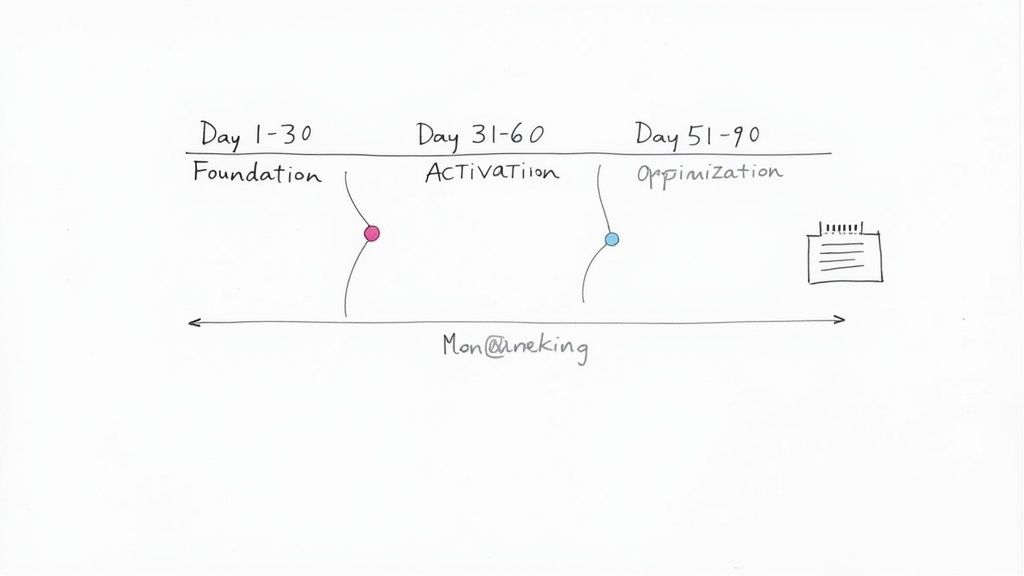
A great strategy is worthless if it just sits in a Google Doc. This 90-day plan is your bridge from theory to reality, built to create momentum and show real results inside a single quarter. It’s all about taking a phased approach, so you can focus your limited time and money where it counts most.
We’re going to break this down into three 30-day sprints. This structure is designed to stop you from falling into the classic startup trap: trying to do everything at once and accomplishing nothing.
Phase 1: The Foundation (Days 1-30)
The first month is purely about getting your house in order. Think of it as laying the groundwork and building the infrastructure you’ll need for every marketing push that comes later. If you rush this part, everything you build on top of it will be wobbly.
Your primary goal here isn't to get a flood of leads; it's to get set up for success. That means getting your analytics dialed in, creating your first essential pieces of content, and making sure your website is ready for visitors.
Here’s what to focus on for the first 30 days:
- Get Your Analytics Right: Install Google Analytics 4 and Google Search Console. This is non-negotiable. More importantly, define and set up your key conversion goals—like tracking a "demo request" click or a "newsletter signup."
- Nail Down Your Core Message: Solidify your Unique Value Proposition (UVP) and splash it across your website’s homepage and key social media profiles. It should be impossible to miss.
- Publish Foundational Content: Get your first 3-5 cornerstone blog posts written and live. These aren’t just any posts; they should be SEO-focused articles that tackle the biggest pain points of your ideal customer.
- Polish Your Social Profiles: Create or completely overhaul your profiles on the one or two social channels you've decided to focus on. We're talking professional branding, a sharp bio featuring your UVP, and a clear link back to your site.
The Goal for Day 30: You should have a working website with some solid content, analytics that actually track conversions, and a polished presence on your main social platforms. Now you're ready to open the floodgates (a little).
Phase 2: Activation (Days 31-60)
Okay, the foundation is poured. Month two is about flipping the switch and starting to drive your first trickles of traffic. This is where you shift from building to promoting and start learning from how real people interact with your brand.
The focus here is on small, controlled experiments. You'll dip your toes in the water with a low-budget ad campaign and start sharing your content to see what people actually care about. The goal is to get data, not to go viral overnight.
Your action plan for this month:
- Launch a Micro-Ad Campaign: Start a small, laser-focused paid search or social media campaign. I’m talking a tiny budget of just $10-$20 per day. Point that traffic to one of your new blog posts or a simple landing page.
- Start Distributing Content: Manually share your articles in relevant online communities. Think niche subreddits, targeted LinkedIn groups, or Slack communities. Don't just drop a link and run—actually talk to people.
- Build Your Email List: Add a clear newsletter signup CTA on your blog and homepage. You need to start capturing the email addresses of anyone who shows even a flicker of interest.
- Engage on Social Daily: Commit 15-30 minutes every single day to engaging on your chosen platforms. That means replying, asking questions, and sharing other people's stuff. It’s a conversation, not a monologue.
For a more detailed breakdown of this phase, a pre-built framework can save you a ton of time. You can see how these moving parts fit together in a comprehensive digital marketing plan template that details each step.
Phase 3: Optimization (Days 61-90)
Welcome to the final month of your launch plan. This is where the magic happens, and it’s all about data. You now have a month's worth of traffic and engagement stats from your activation phase. It’s time to look at what worked, what flopped, and double down on the winners.
Optimization is simply about making your marketing smarter and more efficient. You’ll use the insights from Phase 2 to sharpen your ad targeting, tweak your messaging, and put your money where it gets the best results. This is how you build a real growth engine.
Here’s your focus for the final 30 days:
- Analyze Campaign Performance: Get into your ad platform's dashboard. Which ad copy got the best click-through rate? Which audience delivered the cheapest leads? Pause what isn't working. Be ruthless.
- Double Down on Winners: Shift your budget from the losers to the winners. If one blog post is getting all the love, write more content on that topic. Feed the fire.
- Send Your First Newsletter: You’ve got leads! Time to nurture them. Send out your first email newsletter with your best content and a friendly CTA.
- Review Your Website Analytics: Jump into Google Analytics. Which traffic sources are bringing you the best visitors? Find the pages where people are leaving immediately (high bounce rate) and figure out how to improve them.
By the time you hit Day 90, you’ll have gone from an idea to a living, breathing marketing system that’s generating real data and real leads. You'll have a much clearer picture of what actually moves the needle for your startup, which is the perfect launchpad for everything that comes next.
Answering the Tough Questions: A Startup Marketing FAQ
Even with the best-laid plans, the early days of marketing are a minefield of tough calls and trade-offs. You're constantly making big decisions with very little data and even less cash. This section is designed to cut through that noise and give you straight, practical answers to the questions that keep founders up at night.
Think of this as your go-to guide for navigating those critical early choices. Let's dive into the hurdles every startup founder faces.
How Much Should We Actually Spend on Marketing?
Forget any rigid rules you've heard, like "always spend X percent of revenue." When you're pre-revenue, that advice is useless. A much smarter approach is to think about your spending as buying data, not just customers.
The key is to start lean. I always advise founders to pick one or two channels that feel like a strong fit and test them with a small, contained budget. We're talking $500 to $1,500 a month to start. The goal here isn't to scale immediately; it's to get a real-world read on your Customer Acquisition Cost (CAC). Once you find a channel that brings in customers profitably, that's your signal to pour more fuel on the fire.
My Two Cents: In the beginning, your best friends are sweat equity channels. Think SEO and content marketing. They take time, yes, but you're building a valuable, long-term asset that will generate leads for years, all while preserving that precious early-stage cash.
What's the One Marketing Channel We Can't Ignore?
This is a trick question. The single most important channel is simply wherever your ideal customer is already hanging out. There's no magic bullet or universal "best" platform—it all comes down to your audience.
For instance, if you're a B2B SaaS startup selling a tool for developers, you’ll find your people on GitHub, Stack Overflow, and niche subreddits—not Facebook. On the flip side, a D2C brand selling artisan jewelry is going to live and die on highly visual platforms like Instagram and Pinterest.
Your first job isn't to pick a channel; it's to prove where your audience spends their time.
- Form a hypothesis: "I bet our target user, a busy project manager, looks for new tools on LinkedIn."
- Run a small, cheap test: Put $200 behind a hyper-targeted LinkedIn ad campaign.
- Look at the data: Did you get clicks? Did anyone sign up? The results will tell you the real story.
This simple process replaces blind guessing with actual evidence, making sure you put your limited resources where they’ll make a real difference.
Should We Hire an Agency or Build Our Own Team?
Ah, the classic startup dilemma. The right answer actually changes as your company grows.
In the very beginning, I firmly believe the founders need to be the marketers. Getting your hands dirty gives you priceless, firsthand insights into what messages actually connect with your first customers. You can't outsource that initial learning.
As you start to get some traction, a hybrid approach is often the most capital-efficient way forward. An agency can give you instant access to deep, specialized expertise in areas like paid search or technical SEO. This is perfect for executing specific campaigns without the cost and commitment of a full-time hire.
The long-term goal is usually an in-house team. Nothing beats having people who live and breathe your brand and product every single day. A path I’ve seen work incredibly well is to first hire a versatile marketing generalist. This person owns the strategy and can then bring in agencies or freelancers for specific projects, giving you the best of both worlds.