Digital Transformation for Small Businesses: A Practical Growth Guide
Let’s be honest, the term "digital transformation" gets thrown around a lot, and it can sound intimidating, expensive, and frankly, like something only giant corporations need to worry about. But for a small business, it's much simpler and more practical.
It’s not about scrapping everything you’ve built and starting over. It’s about strategically weaving technology into your business to enhance what you already do best, making you more efficient, competitive, and better equipped to serve your customers.
What Digital Transformation Really Means for Your Business
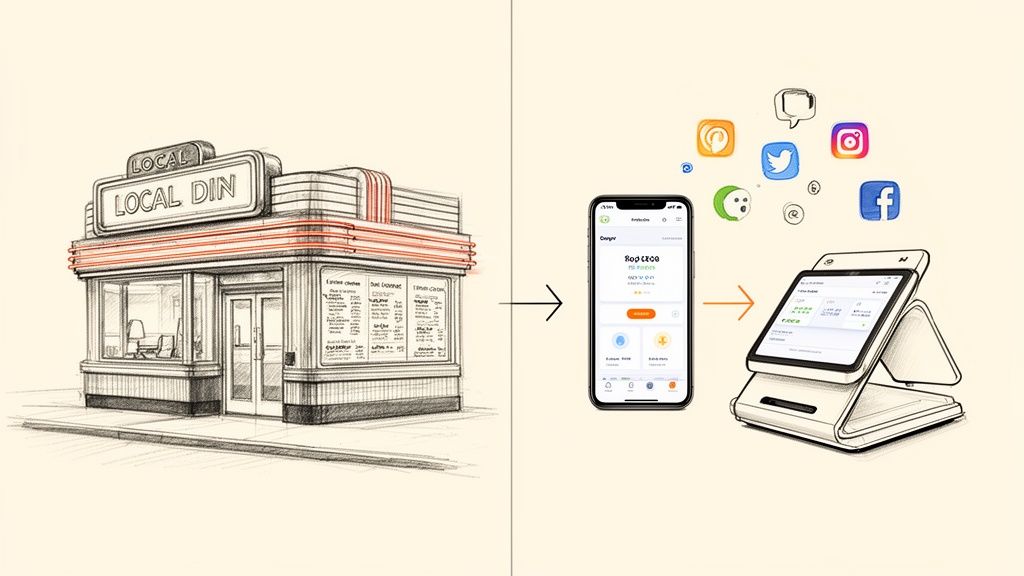
Let's cut through the jargon with a simple analogy. Imagine your business is a beloved local diner. You’re known for your amazing burgers and personal service—that’s the heart of your business, and it should never change. Digital transformation is like adding a modern online ordering system, a tablet-based POS for faster checkouts, and an Instagram account to show off your daily specials.
You haven't changed the secret sauce in your burgers. You've just made it easier for more people to find you, order from you, and love what you do. That, in a nutshell, is digital transformation for small businesses. It’s about rethinking how you run things and deliver value in a world that’s increasingly online.
At its core, digital transformation is a cultural shift. It means moving from traditional, often manual, processes to a mindset where technology is a core part of your strategy for efficiency, customer satisfaction, and decision-making.
This shift empowers you and your team to work smarter, not just harder.
The Three Core Pillars of Transformation
To make this idea more concrete, let's break it down into three key areas where you can focus your efforts. Getting these right often starts with a fundamental change in perspective, which is why it's so important to cultivate a digital-first mindset from the very beginning.
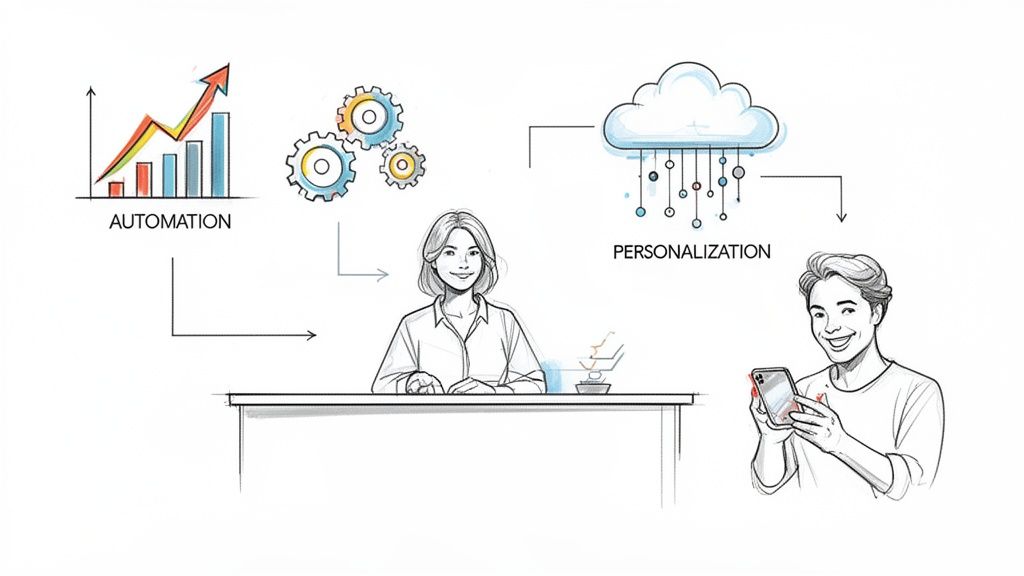
Digitizing Operations for Efficiency: This is all about automating the tedious, repetitive tasks that eat up your day. Think about using accounting software to chase invoices for you or a project management tool that ends the "who's doing what?" confusion. The goal here is simple: free up your team’s time to focus on what really grows the business.
Enhancing the Customer Experience: Technology gives you incredible new ways to connect with your customers and meet them where they are. This could be as simple as setting up an e-commerce store, offering quick support through a website chatbot, or using a CRM to send personalized offers that make your customers feel seen.
Using Data for Smarter Decisions: Gut feelings are great, but data is better. Instead of guessing, digital tools give you real-world insights. Website analytics can tell you which products are flying off the shelves, while sales data can pinpoint your busiest hours. This information is gold—it helps you make informed, strategic decisions that lead to actual growth.
The Real-World Benefits of Going Digital
Jumping into new technology isn't just about looking modern. It's about unlocking real, tangible rewards that show up on your bottom line. A smart digital shift delivers measurable improvements, turning fuzzy goals into solid business results.
Think of it like adding a turbocharger to your company’s engine. You aren't replacing the whole engine, just making it faster, more powerful, and a heck of a lot more efficient. These improvements ripple through every part of your operation.
One of the first places you'll see a difference is with automation. Repetitive tasks that used to eat up the clock can be handled automatically, freeing up your team for more important work. If you want to dig deeper, this guide on Business Process Automation Benefits is a great resource that shows how much of an impact this one change can make.
Boost Your Team’s Productivity
Manual, repetitive tasks are the silent killers of productivity. They drain hours your team could be using to build customer relationships, dream up new ideas, or actually execute your growth strategy. The right digital tools can lift that weight.
Imagine a small accounting firm. By switching to cloud-based software, they can automate invoice reminders and expense tracking. Instantly, their accountants are free to offer high-value advice to clients instead of getting buried in paperwork.
It's the same with a good project management tool. It brings all communication and tasks into one place, ending the confusing email chains and constant "who's doing what?" questions. Everyone can just focus on getting things done.
Create Unforgettable Customer Experiences
Customers today expect smooth, personalized service. Digital tools give you the power to meet—and even exceed—those expectations. This is how you build real loyalty and turn one-time buyers into fans for life.
Take a small retail shop, for example. An e-commerce site lets them sell to customers far beyond their local neighborhood. But the real magic happens when they use the data from that site to:
- Send personalized emails with products a customer has already looked at.
- Add a live chat feature for instant help.
- Create a loyalty program that actually rewards people for coming back.
These touchpoints make customers feel seen and valued. It changes a simple purchase into a genuinely positive experience they'll remember.
According to a recent survey, 52% of small business leaders expect AI and other digital tools to streamline operations, automate tasks, and significantly reduce manual efforts, allowing their companies to operate at full potential.
Make Confident Decisions Backed by Data
Gut feelings are important, but decisions backed by data give you a much clearer path to growth. Going digital puts powerful analytics right at your fingertips, letting you swap guesswork for confident, evidence-based strategy.
Stop wondering which marketing campaigns are actually working—now you can track clicks, conversions, and engagement in real time. Instead of guessing your busiest hours, an online scheduling tool can show you precise booking patterns.
This kind of information lets you put your resources where they'll have the biggest impact, fine-tune your services, and pivot quickly when you need to. Put it all together, and you've got a serious competitive edge that leads to higher revenue and a business that's built to last.
Navigating Common Roadblocks on Your Digital Journey
Every big move in business has its challenges, and shifting to a more digital operation is no different. You see the potential rewards, but the path forward can look like a minefield of potential problems. The trick is to see these obstacles not as stop signs, but as signals to find a smarter way around.
Many small business owners get stuck right at the start. They’re wrestling with tight budgets, a team that lacks specific tech skills, and maybe even a bit of resistance from employees who like things the way they are. Sometimes, it's just the overwhelming feeling of not knowing where to even begin.
The good news? For every common roadblock, there's a practical solution to keep you moving.
Overcoming Budgetary Constraints
Let’s be honest: the fear of cost is usually the biggest hurdle. When small business owners hear "digital transformation," their minds often jump to eye-watering price tags for massive enterprise software. But that’s a myth. You don’t need a Fortune 500 budget to make a real difference.
The key is to think in small, smart steps. Instead of a complete, disruptive overhaul, focus on low-cost, high-impact changes first. This lets you see a return on your initial efforts, and that return can help fund the bigger projects later on. It’s a self-feeding cycle.
Start with tools that solve your biggest headaches without draining your bank account:
- Free or Freemium CRMs: Tools like HubSpot or Zoho offer fantastic free versions to get your customer data organized.
- Affordable Automation: A service like Zapier can be a lifesaver, connecting the apps you already use to automate simple, repetitive tasks.
- Cloud-Based Accounting: Moving from clunky desktop software to a subscription-based tool reduces that big upfront cost.
Bridging the Technical Skills Gap
"We're not a tech company—we don't have an IT department." This is a perfectly valid point for most small businesses. Your team is great at what they do, but they probably aren't software developers or data scientists. This skills gap can make adopting new technology feel like an impossible leap.
This is where flexible talent solutions come into play. Forget the massive overhead of hiring a full-time, in-house tech expert. You can bring in specialized skills precisely when and where you need them.
Partnering with a nearshore development team is an incredibly effective strategy here. It gives you access to a pool of vetted, expert talent in a compatible time zone, all without the long-term commitment and high cost of a full-time hire. It’s like having a world-class tech team on speed dial.
Managing Team Resistance to Change
Even the most brilliant technology is worthless if your team won’t use it. Resistance to new ways of working is completely normal. People get comfortable in their routines. The secret to getting everyone on board is clear communication, making them part of the process, and showing them what's in it for them.
Don't just drop a new tool on their desks. Explain the "why" behind it. Show them how this new system will make their jobs easier, not just different. Ask for their input when choosing a solution and provide plenty of hands-on training. When a newly automated report saves someone three hours, celebrate that win! It’s those small victories that turn skeptics into champions.
This isn't just a local trend; it's a global shift. Digital adoption has become essential for survival and growth. In fact, a staggering 70% of SMBs are already planning to modernize their operations with digital tools. With worldwide spending on this projected to hit $3.9 trillion by 2027, it's obvious that getting past these internal hurdles is critical. You can read more about these global business trends to understand the bigger picture.
Building Your Actionable Digital Transformation Roadmap
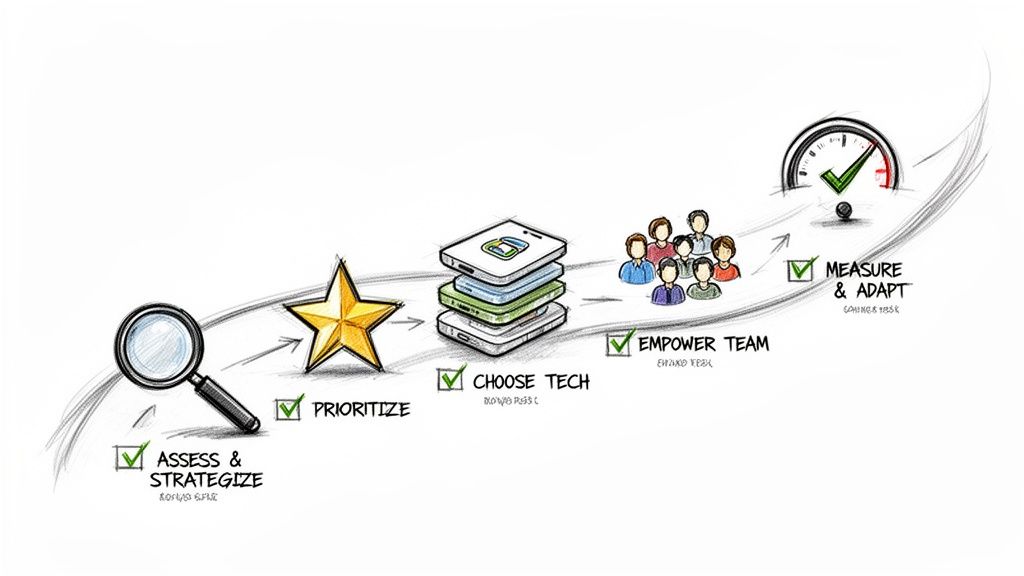
Jumping into a digital transformation doesn't mean you have to overhaul your entire business overnight. That’s a recipe for chaos. The real secret is having a clear, step-by-step plan. Think of it less as a giant leap and more as a series of deliberate, well-planned steps forward.
This roadmap breaks the journey down into five manageable phases. Each one builds on the last, helping you make smart decisions that deliver real value without breaking the bank. It turns a huge, intimidating goal into a series of achievable wins.
Phase 1: Assess and Strategize
You can't plan a route without knowing where you're starting from. This first phase is all about taking an honest look at how your business runs right now. Where are the bottlenecks? What tedious, manual tasks are sucking up your team's time and energy?
Get your team in a room and map out your core processes, from lead generation to final delivery. This is where you need to be brutally honest. The goal is to find the exact spots where a digital tool or a refined process could make the biggest impact on your efficiency and your customers' happiness.
Once you’ve got a handle on the pain points, you need to define what "better" actually looks like. Set clear, specific, and measurable goals.
- Vague goal: "We need to improve our marketing."
- Strong goal: "Increase qualified leads from our website by 20% within six months."
This kind of clarity is everything. It turns a fuzzy wish into a concrete target that will steer every decision you make from here on out.
Phase 2: Prioritize Your Initiatives
With a list of goals in hand, the temptation is to charge ahead and do it all at once. That’s a classic mistake that leads to burnout and half-baked results. Instead, you have to be ruthless about prioritizing.
Focus on what I call the "quick wins"—the initiatives that will give you the most bang for your buck with the least amount of effort.
A simple impact/effort matrix is perfect for this. Plot each idea on a grid. Anything that lands in the "high-impact, low-effort" quadrant goes straight to the top of your list. These wins build momentum and prove to your team that this whole digital thing actually works.
For instance, if your team is drowning in back-and-forth emails just to schedule meetings, setting up an automated booking system is a no-brainer. It's a classic high-impact, low-effort move that frees up staff and makes life easier for your customers almost instantly. This kind of structured thinking is crucial, much like when you learn how to create a product roadmap for a new software feature.
Phase 3: Choose Your Technology Stack
Okay, now for the fun part: picking the tools. The market is absolutely flooded with software for every problem imaginable, which is both a blessing and a curse. The trick is to find technology that truly fits your needs and budget, not just the shiniest new toy on the market.
My advice? Start by looking for tools that are scalable and easy for real people to use. Cloud-based software is a game-changer for most small businesses. It replaces a huge upfront cost with a predictable monthly subscription and outsources all the headaches of security and updates.
Remember, the goal is to find the right tools, not the most tools. A few well-chosen, integrated platforms will serve you far better than a dozen disconnected apps that create more work than they save.
Trying to run a business today without AI is like trying to drive cross-country without a map. In fact, a staggering 88% of small businesses are already using AI in some capacity. And it's not just hype; 73% of those owners say AI has been essential for their growth. It's clear that AI is no longer a futuristic concept—it's a fundamental business tool.
To put this into action, we've outlined the core phases of a digital journey in the table below. It provides a simple framework to guide your thinking from initial assessment to ongoing improvement.
Digital Transformation Roadmap for Small Businesses
| Phase | Primary Focus | Key Actions | Example Tools & Services |
|---|---|---|---|
| 1. Assessment & Strategy | Understanding current state and defining future goals. | Conduct internal audits, map workflows, identify bottlenecks, set clear KPIs. | SWOT Analysis, Process Mapping Software (Lucidchart), Surveys. |
| 2. Prioritization | Identifying high-impact, low-effort initiatives. | Use an impact/effort matrix, focus on "quick wins," create a phased timeline. | Project Management tools (Trello), Brainstorming sessions. |
| 3. Tech Selection | Choosing the right tools for the job. | Research vendors, conduct demos, focus on integration and scalability. | CRM (HubSpot), Accounting (QuickBooks), Team Augmentation. |
| 4. Team Empowerment | Ensuring user adoption and building a digital culture. | Develop training programs, create feedback channels, communicate the "why." | Learning Platforms (Udemy), Internal Wikis (Notion). |
| 5. Measurement & Adaptation | Tracking progress and making data-driven adjustments. | Monitor KPIs, gather user feedback, iterate on processes and tools. | Analytics (Google Analytics), BI Dashboards (Tableau). |
This table serves as your high-level guide. Each phase is a critical step toward building a more resilient, efficient, and competitive business.
Phase 4: Empower Your Team
Here’s a hard truth: technology is only half the battle. Your team is the other half. The most brilliant software in the world is completely useless if your people don’t know how—or don't want—to use it. This is about building a culture that embraces change, not just implementing a tool.
Start by being crystal clear about the "why." Explain how these new tools will make their jobs easier, not just add another task to their plate. When you can, involve them in the decision-making process. Then, provide real, hands-on training to make them feel confident and capable.
Key Actions for Team Empowerment:
- Communicate Transparently: Share your vision and the real-world reasons for every change.
- Provide Robust Training: Don't just send a link to a tutorial. Offer workshops and ongoing support.
- Encourage Feedback: Create a safe space for your team to share what's working and what's not.
- Celebrate Successes: Publicly recognize people who are leading the charge and making the new tech work.
Phase 5: Measure and Adapt
Finally, digital transformation is never "done." It’s an ongoing process of improvement. Once your new systems are live, you have to track your progress against those goals you set way back in Phase 1. This is where data becomes your best friend.
Define the key performance indicators (KPIs) that actually matter for each project. For a new CRM, that might be lead response time. For a new project management tool, it might be the average time to project completion.
Look at these numbers regularly. What’s working? What’s a flop? This constant feedback loop lets you make smart adjustments, double down on what's driving results, and quickly ditch what isn't. This agile mindset is what will keep your business thriving for years to come.
How Nearshore Teams Can Bridge Your Talent Gap

Let's be honest: one of the biggest roadblocks for any small business diving into digital transformation is the talent gap. You've got a brilliant idea for a new mobile app or a much-needed e-commerce overhaul, but the technical expertise just isn't on your payroll. And hiring senior-level developers? That's often a budget-breaker, not to mention a long, drawn-out process.
This is where a strategy called nearshore staff augmentation comes in and completely changes the game. Think of it as having an elite tech squad on speed dial, ready to jump in, mesh with your team, and bring your vision to life without the heavy cost of a full-time hire.
Nearshore partners give you direct access to expert developers, designers, and project managers in nearby countries. The time zones are similar, the talent is top-notch, and the collaboration feels natural. It’s the perfect mix of skill, cost-efficiency, and smooth communication for any small business ready to punch above its weight.
Access a Wider Pool of Vetted Experts
Trying to find a local developer with the exact skills you need can feel like searching for a needle in a haystack. The talent pool is small, and the competition is intense. A nearshore partnership instantly throws the doors open, connecting you to a global community of specialists.
These experts come pre-vetted for their technical prowess, communication skills, and professional track record. Need a Python guru for data analysis or a React Native whiz for a new app? A nearshore provider finds the right person for the job, fast.
This approach takes a huge amount of risk out of the hiring process. You get to skip the endless résumés and interviews and bring on professionals who can start creating value from day one.
The core benefit is agility. Nearshore teams allow you to scale your development capacity up or down based on project needs, providing the exact expertise you need, precisely when you need it.
This kind of flexibility is a superpower for small businesses. You can take on ambitious projects without locking yourself into long-term financial commitments. To see how this fits into a modern business strategy, you can explore the advantages of nearshore software development in more detail.
Achieve Significant Cost Savings and Efficiency
Now, let's talk about the bottom line. The cost of hiring a single senior developer in North America or Western Europe is eye-watering, especially after you add in benefits, taxes, and overhead. Nearshore teams deliver the same level of quality at a much more manageable price point.
By tapping into talent from regions with a lower cost of living, you can secure world-class expertise for a fraction of what you'd pay locally. This isn't about finding the cheapest labor; it's about getting the absolute best value for your investment.
This isn’t just a small-business trick; it’s part of a massive global trend. IT spending on digital transformation is expected to hit $3.9 trillion by 2027. Businesses are seeing real results, with CEOs reporting profit increases of 56% from their digital investments. They're often able to cut project costs and timelines by 40-50% by using smart strategies like agile teams and automation. You can dig into more insights on how digital investments drive profits on walkme.com.
Seamless Collaboration with Cultural and Time Zone Alignment
One of the most practical perks of the nearshore model is just how simple it is. Working with a team in a similar time zone means you can say goodbye to the frustrating communication lags that often come with offshore partnerships.
- Real-Time Problem-Solving: When your teams are on the clock at the same time, questions get answered in minutes, not days. Problems get solved on the spot.
- Cultural Affinity: Nearshore partners often share cultural norms and business etiquette, which makes for smoother conversations and a stronger sense of teamwork.
- Integrated Workflows: Your new team members can join daily stand-ups, brainstorming sessions, and strategy meetings, becoming a true extension of your in-house crew.
This alignment keeps your projects moving forward without a hitch. Everyone stays on the same page, pushing toward the same goal. It's the closest thing to having a bigger in-house team, but with far more flexibility and a much healthier impact on your budget.
Real-World Wins: Success Stories from Small Businesses Like Yours
Roadmaps and theory are great, but nothing beats seeing how this all plays out in the real world. Let's look at a few stories of small businesses that took on common challenges, made smart digital moves, and saw incredible results.
These aren't tales of massive corporations with unlimited budgets. These are regular businesses that prove you don't need a huge IT department to make a real difference. Sometimes, it’s just about finding the right tool or a better way of working to spark major growth.
For even more examples of what's possible, you can Explore inspiring digital success stories and see how other companies found their footing.
From Main Street Shop to Online Sensation
Imagine a boutique clothing store, a local favorite, but completely capped by the size of its town. Their growth was stuck, limited by foot traffic and the fact that their amazing inventory was hidden from the world. In-person sales were their entire business.
They decided to build a simple, clean e-commerce website that synced directly with their in-store inventory. At the same time, they started using social media to show off new arrivals with beautiful photography, reaching people far beyond their zip code. It was a straightforward move that completely changed the game.
The outcome was incredible. In just one year, online sales made up 40% of their total revenue. This wasn't just about more money; it gave them a steady stream of income that made the business tougher and more resilient, especially during quiet weeks at the physical store.
How a Small Agency Got Its Time Back
We've all been there. A small marketing agency was practically drowning in paperwork. Their talented team was burning hours on manual admin—scheduling meetings, chasing up emails, and logging project time. All that busywork was stealing time from the creative, billable work that actually pays the bills.
Their fix was two-pronged. First, they brought in a project management tool to get all client communications and tasks in one place. Second, they set up an automated scheduling system so clients could book calls themselves, right into their calendars.
This simple dose of automation cut the time spent on manual admin tasks by a whopping 50%. Suddenly, the team was free to take on more client projects, which boosted profitability without having to hire anyone new.
A Local Restaurant's Recipe for Data-Driven Success
A family-run restaurant knew they had loyal customers, but they were flying blind. They had no idea who their regulars were or what they really wanted. Marketing and menu decisions were pure guesswork, and the results were all over the place.
They switched to a modern point-of-sale (POS) system that did more than just take orders—it collected valuable data. They paired this with a simple email loyalty program, offering a small discount for signing up.
This gave them a direct line to their customers and a goldmine of information about popular dishes and peak hours. By looking at the data, they started running targeted promotions on slow nights and tweaked the menu based on what was actually selling. This smart, data-driven strategy led to a 25% increase in repeat visits and a healthy bump in their mid-week revenue.
Your Top Digital Transformation Questions, Answered
Even with a solid plan, it's natural to have questions. Let's tackle some of the most common concerns small business owners have when they start thinking about making a real digital shift.
Is This Going to Be Too Expensive for My Business?
This is usually the first question I hear, and the answer is a definite no. Digital transformation isn't a single, massive expense you have to swallow all at once. It's a scalable journey.
You can start small with changes that pack a big punch for a low cost. Think about adding a simple customer relationship management (CRM) tool to track your leads or plugging an e-commerce feature into your website. The trick is to focus on what gives you the best and fastest return. Plus, modern hiring models like nearshore staff augmentation mean you can bring on expert developers for a specific project without the high cost of a full-time hire.
Where on Earth Do I Even Begin?
The best place to start is wherever the biggest headache is. Seriously. Don't just chase the latest tech trend; find a real, nagging problem in your business and solve it.
Are your people wasting hours every week on manual data entry? Look into automation tools. Are you having trouble getting new leads in the door? Your first move should be digital marketing and SEO.
Take an honest look at your biggest operational weakness. That weak spot will point you directly to the most impactful first step you can take. Starting there guarantees your first project will deliver real, immediate value.
How Can I Get My Team to Go Along with All This?
Getting your team on board is non-negotiable. The fanciest software in the world is just a paperweight if no one wants to use it.
Start by explaining the "why" behind the change. Show them how a new tool will make their work easier or more meaningful, not just add another item to their checklist. Let them have a say in picking the software and give them great training so they feel comfortable. And when a new process saves the team 10 hours a week? Celebrate that win! Little victories build momentum and can turn your biggest skeptics into your strongest supporters.
How Long Is This Whole Thing Going to Take?
This isn't a project with a finish line. Think of digital transformation as an ongoing process of getting better, smarter, and more efficient.
That said, the individual projects within your transformation have clear timelines. A website refresh might take a couple of months. Rolling out a new project management tool could be done in a few weeks. The key is to think in phases. This approach gets value into your business faster and lets you learn as you go, making sure every step you take is a confident one.