8 Email Drip Campaign Examples to Master Automation in 2025
Email automation is more than just sending scheduled messages; it's about delivering the right information to the right person at the perfect moment. A well-crafted drip campaign is a powerful engine for growth, capable of transforming a cold lead into a loyal customer, re-engaging subscribers who have gone quiet, and guiding new users to that crucial 'aha!' moment with your product. It’s the difference between shouting into a void and having a meaningful, one-on-one conversation at scale.
But moving from theory to practice can be challenging. How do you structure a sequence that feels personal and timely, not robotic and intrusive? What triggers should you use? How long should you wait between emails? The success is in the details, and studying what works is the fastest way to master them.
This guide breaks down the strategy behind effective automation by exploring a curated collection of powerful email drip campaign examples. Instead of just showing you the final product, we'll dissect the underlying mechanics of each one. You will get a behind-the-scenes look at the specific timing, triggers, copy, and psychology that make these sequences drive conversions and build relationships. We'll cover everything from welcome series and lead nurturing to abandoned cart recovery and re-engagement flows.
Think of this as a replicable blueprint. You will leave with actionable takeaways and a clear understanding of how to build automated campaigns that deliver measurable results for your business. Let’s dive into the mechanics of high-performing email automation.
1. Welcome Series for New Subscribers
A welcome series is one of the most critical email drip campaign examples for any business. This automated sequence is your first, best chance to make a strong impression on a new subscriber who has just opted into your email list. It's designed to nurture this initial interest, introduce your brand's personality, set expectations for future communications, and guide the new contact toward a specific first action.
This campaign is triggered immediately after a user subscribes via a form on your website, a lead magnet download, or a webinar registration. The goal is to capitalize on the moment when their engagement is at its peak. By delivering a series of valuable, curated messages over the first one to two weeks, you build trust and establish a positive relationship from the very beginning. For a deeper dive into foundational strategies, you can explore other successful email marketing campaign examples that build on these principles.
Strategic Breakdown
- Automation Trigger: A user submits a signup form on the website or blog.
- Audience: All new email subscribers who haven't made a purchase or started a trial.
- Goal: Build brand trust, set communication expectations, and drive a key first conversion (e.g., visit a key page, follow on social media, or make an initial purchase).
Sample Campaign Cadence & Content
A typical welcome sequence spans 5 to 10 days and includes 3 to 5 emails.
Email 1 (Immediate):
- Subject: Welcome to [Brand Name]! Here's what to expect.
- Content: A warm, personalized welcome using the subscriber's first name. Confirm their subscription, briefly restate your brand's value proposition, and tell them how often you'll be emailing. This email often includes the promised lead magnet if one was offered.
Email 2 (Day 3):
- Subject: Your first [Benefit] is waiting for you
- Content: Provide pure value. Share your most popular blog post, a helpful guide, or a quick-win tutorial. The key is to educate and solve a problem without a hard sales pitch.
Email 3 (Day 5):
- Subject: Did you know? [Interesting fact or social proof]
- Content: Build credibility by sharing a customer testimonial, a case study, or a link to your community forum. This shifts the focus from what you say to what others say about you.
Email 4 (Day 7):
- Subject: A special offer just for you, [First Name]
- Content: Introduce a soft call-to-action (CTA). This could be a special introductory discount, an invitation to a webinar, or a prompt to explore your product or service categories. This is your first "ask."
2. Product Launch Campaign
A product launch drip campaign is a meticulously planned email sequence designed to build anticipation, educate an audience, and drive initial sales or adoption for a new product or feature. Unlike a single announcement email, this campaign strategically nurtures interest over time, transforming cold leads and existing customers into eager early adopters. It's a powerful tool for maximizing impact on launch day and ensuring a new offering doesn't get lost in the noise.
This campaign is triggered manually to a specific, curated list of prospects, existing customers, or waitlist signups in the weeks leading up to a launch. The core objective is to create a narrative around the product, moving subscribers from awareness to excitement and, finally, to action. By revealing information piece by piece, you build momentum and create a sense of being an "insider," which is a key psychological driver for adoption.
Strategic Breakdown
- Automation Trigger: A manual list import or a segment of users who signed up for a "launch waitlist."
- Audience: Can be segmented into two groups: existing customers (for a new feature) and warm prospects (for a new product).
- Goal: Generate buzz, educate subscribers on the new product's value, drive pre-orders or early sales, and maximize adoption on launch day.
Sample Campaign Cadence & Content
A typical launch sequence can last from 1 to 3 weeks and includes 4 to 6 emails.
Email 1 (Teaser - 7-10 days before launch):
- Subject: Something big is coming...
- Content: A short, mysterious email hinting at a new solution to a common customer pain point. Use a GIF or a single compelling image to build curiosity without revealing the product itself. The goal is to get subscribers intrigued.
Email 2 (The Reveal - 5 days before launch):
- Subject: It's official: Introducing [Product Name]!
- Content: Announce the new product. Clearly state what it is and the primary benefit it provides. Include a high-quality video or GIF showing the product in action and direct users to a dedicated landing page for more information.
Email 3 (Deep Dive - 3 days before launch):
- Subject: How [Product Name] solves [Specific Problem]
- Content: Focus on education. Break down 2-3 key features and explain how they directly benefit the user. Use bullet points, customer quotes, or a short case study to make the value tangible.
Email 4 (Launch Day - Go Live):
- Subject: It’s here! Get your hands on [Product Name] now!
- Content: A high-energy announcement that the product is officially available. Use a countdown timer to create urgency and a clear, bold CTA button. Include a limited-time "early bird" discount to incentivize immediate action.
3. Abandoned Cart Recovery Campaign
An abandoned cart sequence is one of the highest-return email drip campaign examples for any e-commerce business. This automated campaign targets shoppers who add products to their cart but leave the site without completing the purchase. The primary goal is to recover potentially lost revenue by reminding customers of their items and nudging them back toward the checkout page.
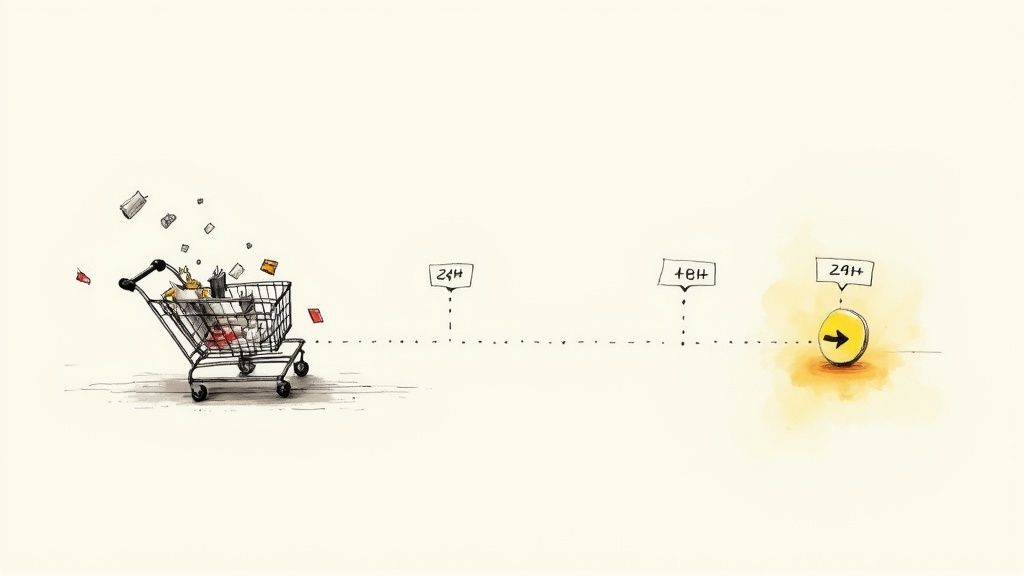
This drip is triggered when a user with an identifiable email adds an item to their cart and then abandons the session. By reaching out at this critical moment of high intent, you can address common purchase hesitations like shipping costs, distractions, or a need for more social proof. A well-executed abandoned cart series is a powerful tool to boost your bottom line; in fact, mastering this flow is a key strategy for those learning how to increase website conversions effectively.
Strategic Breakdown
- Automation Trigger: A known user adds a product to their online shopping cart but does not complete the checkout process within a set time (e.g., 1 hour).
- Audience: Website visitors who are logged in or have previously provided their email and have an active, non-purchased cart.
- Goal: Recover the sale by reminding the user of their cart, overcoming objections, and providing a clear path back to checkout.
Sample Campaign Cadence & Content
A standard abandoned cart sequence is short and impactful, typically consisting of 2 to 3 emails sent over 24 to 72 hours.
Email 1 (1-4 hours after abandonment):
- Subject: Did you forget something?
- Content: A simple, helpful reminder. Display images of the exact products left in the cart. Use a friendly, low-pressure tone and provide a direct, one-click link back to their pre-filled cart. Avoid offering a discount in this first email to capture sales from those who were simply distracted.
Email 2 (24 hours after abandonment):
- Subject: Still thinking it over? Your items are waiting.
- Content: Re-engage by adding social proof. Include customer reviews or star ratings for the specific items in their cart. You can also address common questions by linking to your FAQ, shipping policy, or return information.
Email 3 (48-72 hours after abandonment):
- Subject: A special 10% off to complete your order!
- Content: Create urgency with a final, time-sensitive incentive. Offer a small discount (e.g., 10% off or free shipping) that expires soon. Including a countdown timer can significantly boost the conversion rate of this last-ditch effort.
4. Re-engagement Campaign for Inactive Subscribers
A re-engagement campaign, often called a win-back series, is a vital tool for maintaining a healthy and engaged email list. This automated sequence targets subscribers who have become inactive, meaning they haven't opened or clicked on your emails for a specific period (typically 60-180 days). Instead of letting these contacts go cold, the campaign attempts to reignite their interest, remind them of your brand's value, and prompt them to re-engage before you consider removing them from your list.
This campaign is triggered by a lack of engagement over time. Its primary goal isn't necessarily an immediate sale but simply getting the subscriber to open an email, confirming their continued interest. By systematically targeting disengaged users with compelling, personalized content, you can win back a portion of your audience, improve your overall email deliverability rates, and ensure your messages are reaching people who truly want to hear from you. This is one of the most important email drip campaign examples for long-term list hygiene.
Strategic Breakdown
- Automation Trigger: A subscriber has not opened or clicked an email in the last 90 days.
- Audience: Subscribers who previously showed engagement but have recently become inactive. This segment should exclude brand-new subscribers and consistently active users.
- Goal: Prompt an open or click to confirm interest, update subscriber preferences, or cleanly remove unengaged contacts to improve list health and deliverability.
Sample Campaign Cadence & Content
A re-engagement sequence is typically shorter and more spread out, spanning 10 to 15 days.
Email 1 (Day 1):
- Subject: We miss you, [First Name]!
- Content: A gentle, friendly check-in. Use a simple, emotion-driven message acknowledging their absence. You can highlight what they've missed, such as a popular new feature or a top-performing piece of content. The CTA should be low-commitment, like "See what's new."
Email 2 (Day 5):
- Subject: A special offer to welcome you back
- Content: Introduce a compelling incentive. This is a powerful tactic to jolt subscribers back to attention. Offer an exclusive discount, free shipping, or a valuable piece of content that is not available elsewhere. Make the offer time-sensitive to create urgency.
Email 3 (Day 10):
- Subject: Still want to hear from us?
- Content: A direct, preference-focused message. Ask the user if they want to remain on the list and provide a clear, one-click button to confirm their subscription. You can also offer a link to a preference center where they can adjust email frequency or topics.
Email 4 (Day 15):
- Subject: Goodbye for now (and how to resubscribe)
- Content: The final "breakup" email. Politely inform them that you will be removing them from your active mailing list to respect their inbox. Provide a clear path to resubscribe in the future if they change their mind. This final step is crucial for maintaining a clean list.
5. Lead Nurture Campaign for B2B Sales
In the world of B2B sales, where purchase decisions are complex and involve multiple stakeholders, a lead nurture campaign is an essential tool. This sophisticated, multi-touch drip sequence is designed to guide qualified leads through a longer consideration phase, building trust and demonstrating value over time. Instead of a hard sell, it focuses on education, providing relevant content like case studies, ROI calculators, and industry reports to move prospects closer to a sales-ready state.
This campaign is triggered when a user shows initial interest, such as by downloading a whitepaper or requesting a demo, but isn't yet ready to speak with a sales representative. The goal is to stay top-of-mind and position your company as a trusted advisor, not just a vendor. For those specifically looking to leverage drip campaigns in a business-to-business context, understanding the broader landscape of B2B marketing strategy can be invaluable.
Strategic Breakdown
- Automation Trigger: A lead downloads gated content (e.g., ebook, webinar recording), or a lead score reaches a predefined threshold.
- Audience: Marketing Qualified Leads (MQLs) who have shown interest but are not yet sales-ready. This audience is often segmented by industry, role, or pain point.
- Goal: Educate the prospect, build credibility, overcome objections, and warm the lead until they are ready to engage with the sales team.
Sample Campaign Cadence & Content
A typical B2B nurture sequence can last anywhere from two weeks to several months, with emails spaced 5 to 7 days apart.
Email 1 (Immediate):
- Subject: Here's the [Resource Name] you requested
- Content: Deliver the promised content immediately. Keep the email focused and simple. Briefly introduce a related problem that your next email will help solve, setting the stage for the sequence.
Email 2 (Day 5):
- Subject: 3 Mistakes Companies in [Lead's Industry] Make
- Content: Provide problem-focused educational content. Share an insightful blog post, a short video, or an infographic that addresses a key pain point relevant to their industry or role. Reinforce your expertise.
Email 3 (Day 12):
- Subject: How [Competitor/Similar Company] solved [Problem]
- Content: Introduce social proof. Share a compelling, one-page case study or customer success story. This email shifts from a theoretical discussion to tangible, real-world results, building trust and credibility.
Email 4 (Day 18):
- Subject: A question about your goals for [Current Quarter/Year]
- Content: Transition toward a solution-oriented message. This email can offer a more in-depth resource like a webinar invitation or a detailed guide. It includes a soft call-to-action, such as asking if they'd be open to a brief 15-minute exploratory call.
6. Post-Purchase Onboarding Campaign
A post-purchase onboarding campaign is a critical sequence for converting a new buyer into a successful, long-term user. Triggered immediately after a sale, this drip campaign’s purpose is to guide the customer through setup, highlight key features, and ensure they achieve their first "win" with your product as quickly as possible. It's designed to reduce buyer's remorse, minimize early-stage support tickets, and build the foundation for high retention.
This campaign moves beyond the initial welcome to focus on practical application and value realization. For SaaS companies like Asana or Slack, this involves showing users how to set up their first project or invite team members. For e-commerce, it might mean providing care instructions or usage tips for a physical product. By proactively educating new customers, you demonstrate a commitment to their success and reinforce the value of their purchase.
Strategic Breakdown
- Automation Trigger: A customer completes a purchase or signs up for a paid plan.
- Audience: All first-time paying customers. This can be further segmented by the specific product, plan, or tier purchased.
- Goal: Increase product adoption, reduce churn, decrease support requests, and guide customers toward achieving key activation milestones.
Sample Campaign Cadence & Content
A strong onboarding sequence typically runs for 1 to 4 weeks, depending on the complexity of the product.
Email 1 (Immediate):
- Subject: Getting Started with [Product Name] - Your First Step
- Content: A warm thank you and confirmation of the purchase. Provide immediate, clear instructions on the single most important first action, such as logging in, downloading software, or setting up a profile. Include links to your help center or a quick-start guide.
Email 2 (Day 3):
- Subject: Pro-Tip: Get more from [Product Name] with this feature
- Content: Focus on a core feature that delivers an "aha!" moment. Use a short video tutorial or an animated GIF to demonstrate how it works and explain the benefit. Celebrate their progress if you can track initial usage.
Email 3 (Day 7):
- Subject: [First Name], here's how others are succeeding with [Product Name]
- Content: Build confidence with social proof. Share a mini-case study or a powerful testimonial from a customer who solved a similar problem. This helps the new user envision their own success and reinforces their decision to buy.
Email 4 (Day 14):
- Subject: Unlock advanced features in your [Plan Name] plan
- Content: Introduce a more advanced or secondary feature they may not have discovered yet. This is an excellent opportunity to segment based on their usage data, offering tips relevant to how they are actually using the product. Include an invitation to a live Q&A webinar or a link to book a call with a customer success manager.
7. Behavioral Trigger Campaign Based on Website Activity
Behavioral trigger campaigns are dynamic email sequences activated by a user's specific actions on your website or within your product. Instead of relying on a time-based schedule, these drips respond directly to demonstrated interest, such as viewing a pricing page, using a specific feature, or clicking a link in a previous email. This makes them one of the most powerful and highly relevant email drip campaign examples you can implement.
This campaign is triggered by user events tracked through your marketing automation or analytics platform. The core principle is to deliver a message that is a direct, logical next step based on the user's most recent action. By doing so, you capitalize on their immediate intent, providing timely information or assistance that feels helpful rather than intrusive. To see how these triggers fit into a larger strategy, you can explore various marketing automation workflow examples that leverage similar principles.
Strategic Breakdown
- Automation Trigger: A user visits a specific URL (e.g.,
/pricing), clicks a tagged link, or uses a key in-app feature multiple times. - Audience: Segmented users who have performed a high-intent action but have not yet converted.
- Goal: Nurture user interest based on their demonstrated behavior, overcome potential objections, and guide them toward a conversion relevant to their action.
Sample Campaign Cadence & Content
This sequence is highly contextual and can range from a single email to a multi-touch campaign, often with a slight delay to feel natural.
Trigger: User views the pricing page for more than 15 seconds but doesn't sign up for a trial.
- Email (1 Hour Later):
- Subject: Questions about our pricing?
- Content: Acknowledge their interest directly but gently. Provide a clear breakdown of the value included in each plan, link to a detailed FAQ page, and offer a direct line to sales or a link to book a demo. For example: "We saw you were checking out our plans. Here’s a quick guide to help you choose the right one for your goals."
- Email (1 Hour Later):
Trigger: A trial user engages with an advanced feature for the first time.
- Email (3 Hours Later):
- Subject: Get the most out of [Feature Name]
- Content: Provide pure value related to the action. Offer a short video tutorial, a link to an advanced guide, or best practices for using that specific feature. This reinforces the value of your product and encourages deeper adoption.
- Email (3 Hours Later):
Trigger: A user clicks a link to a case study about a specific industry.
- Email (1 Day Later):
- Subject: More stories from the [Industry Name] sector
- Content: Nurture their specific interest by sending another relevant piece of content. Share another case study, a blog post, or a webinar recording that speaks directly to their industry’s pain points. This builds your authority in that niche.
- Email (1 Day Later):
8. Survey and Feedback Follow-Up Campaign
A survey and feedback follow-up is a strategic email drip campaign designed to systematically gather customer insights and measure satisfaction. Instead of a one-off request, this automated sequence engages users at key moments in their journey, asks for their opinions, and then follows up based on their responses. It's a powerful tool for making customers feel heard while collecting invaluable data to improve your products, services, and overall experience.
This campaign is triggered after a significant customer interaction, such as a purchase, a support ticket resolution, or a major product milestone. The goal is to capture feedback when the experience is fresh. By segmenting responses (e.g., NPS promoters, passives, and detractors) and sending tailored follow-up emails, you can thank advocates, nurture fence-sitters, and proactively address the concerns of unhappy customers, turning a simple survey into a relationship-building opportunity.
Strategic Breakdown
- Automation Trigger: A customer completes a purchase, has a support ticket closed, or has been using a feature for 30 days.
- Audience: Active customers who have recently completed a key action or reached a specific milestone.
- Goal: Collect actionable product/service feedback, measure customer satisfaction (NPS, CSAT), and strengthen customer relationships by "closing the loop" on their input.
Sample Campaign Cadence & Content
This sequence typically involves an initial request and segmented follow-ups based on the response.
Email 1 (24-48 hours post-event):
- Subject: Got a minute, [First Name]? Share your thoughts on [Product/Experience].
- Content: A brief, direct email asking for feedback. Explain why their opinion matters and how it will be used. Include a clear, single CTA button that links to a short survey (2-5 questions max).
Email 2 (Follow-up based on NPS Score):
- For Promoters (Score 9-10):
- Subject: Thanks for the high five! Could you do one more thing?
- Content: Thank them for their positive feedback. Ask if they'd be willing to write a public review, provide a testimonial, or join a referral program. Make it easy with direct links.
- For Passives (Score 7-8):
- Subject: Thanks for your feedback! Here's how we can help you get more value.
- Content: Acknowledge their input and ask a specific open-ended question like, "What's one thing we could do to make your experience a '10'?" Offer resources like a tutorial or case study to help them succeed.
- For Detractors (Score 0-6):
- Subject: We're sorry & we want to make it right.
- Content: Apologize for their poor experience and show you're taking it seriously. Offer to connect them with a senior support member or product manager. This personal touch can often salvage the relationship.
- For Promoters (Score 9-10):
Email 3 (30-60 days later - to all respondents):
- Subject: You spoke, we listened. Here's what's new.
- Content: "Close the loop" by sharing the overall survey findings and detailing the specific product improvements or process changes you made based on the collective feedback. This demonstrates that you value customer input and builds immense long-term trust.
8 Email Drip Campaigns Comparison
| Campaign | 🔄 Implementation complexity | ⚡ Resource requirements | 📊 Expected outcomes | 💡 Ideal use cases | ⭐ Key advantages |
|---|---|---|---|---|---|
| Welcome Series for New Subscribers | Medium — automated triggers, segmentation, continuous A/B testing | Low–Medium — email platform, copy/design, basic segmentation | High engagement: CTR 20–35%, conversion 5–15% | New signups, onboarding, brand introductions | Sets tone, high open rates, cost-effective early conversions |
| Product Launch Campaign | High — multi-week, cross-channel coordination and timing | High — creative assets, PR, landing pages, video, dedicated team | Awareness + sales spike: conversion 8–12%, 2–3x AOV | New product/feature rollouts, major updates | Creates buzz, drives concentrated sales, builds early-adopter community |
| Abandoned Cart Recovery Campaign | Low–Medium — event-triggered sequence, simple logic | Medium — cart tracking, product imagery, discount rules | Recover sales: 5–15% recovery rate; high ROI on incentives | E‑commerce with cart dropoff, high-intent buyers | Recovers high-intent shoppers, scalable automation, measurable ROI |
| Re-engagement Campaign for Inactive Subscribers | Low — segment by inactivity, gentler cadence | Low — list hygiene tools, light content, optional incentives | Re-engagement 10–20%; conversion post-reengagement 0.5–2% | Inactive lists, list-cleaning, improving deliverability | Improves list health, reduces fatigue, surfaces interested users |
| Lead Nurture Campaign for B2B Sales | High — multi-track, lead scoring, CRM & sales coordination | High — long-form content, webinars, sales enablement, analytics | Progression to sales 15–25%; close rate 3–8% | Complex B2B sales cycles, high-ticket solutions | Shortens sales cycle, improves lead quality, delivers measurable ROI |
| Post-Purchase Onboarding Campaign | Medium — purchase-triggered timing, conditional content | Medium — product guides, videos, support coordination | Reduces churn 25–35%; higher adoption and 20%+ upsell potential | SaaS, subscription products, complex purchases | Boosts retention, reduces support load, accelerates product adoption |
| Behavioral Trigger Campaign Based on Website Activity | High — real-time triggers, dynamic personalization, multi-path logic | High — advanced analytics, CRM integration, dynamic content | Very high relevance: open 30–50%, CTR 5–15%, conversion 2–5% | High-intent behaviors (pricing views, demos), personalization drives | Best engagement, real-time responsiveness, scalable personalization |
| Survey and Feedback Follow-Up Campaign | Medium — response-based routing, follow-up segmentation | Medium — survey tools, analysis resources, response workflows | Survey completion 8–18%; improved retention and actionable insights | Product improvements, NPS tracking, customer experience optimization | Gathers actionable feedback, identifies promoters/detractors, informs product decisions |
From Examples to Execution: Your Next Steps in Automation
We've journeyed through a comprehensive collection of email drip campaign examples, dissecting everything from the initial welcome series to intricate lead nurturing and re-engagement flows. Each example, whether it's an abandoned cart recovery sequence or a post-purchase onboarding campaign, highlights a core strategic principle: automation's true power lies not in its ability to send emails, but in its capacity to deliver the right message to the right person at precisely the right moment.
The campaigns we analyzed weren't just a series of disconnected emails. They were thoughtfully constructed conversations, designed to guide a user from one stage of their lifecycle to the next. The common thread weaving them together is a deep commitment to relevance, personalization, and value delivery, transforming a monologue into a meaningful dialogue.
Synthesizing the Core Strategies
As you reflect on these diverse campaigns, several key themes emerge as non-negotiable pillars of success. Mastering these concepts is what separates a generic, noisy email sequence from a high-performing revenue engine.
Trigger-Based Precision: The most effective drip campaigns are not time-based alone; they are behavior-based. A user's action (or inaction) is the most powerful signal you have. From a product manager downloading a whitepaper to a user who hasn't logged in for 30 days, these triggers are the starting pistol for your most relevant communication.
Segmentation is Your Superpower: A one-size-fits-all approach is a recipe for low engagement. The success of the lead nurture and upsell examples hinges on smart segmentation. By dividing your audience based on behavior, purchase history, or expressed interests, you can tailor your copy, offers, and cadence to resonate deeply with each specific group.
Value Before the Ask: Notice how the best welcome series and lead nurture campaigns focus on providing educational content, helpful resources, or exclusive insights first. They build trust and establish authority long before pushing for a sale. This "give, give, get" approach warms up leads and creates loyal brand advocates.
Iterative Optimization: A drip campaign is not a "set it and forget it" tool. It's a living system. Success depends on a continuous cycle of monitoring, testing, and refining. Pay close attention to your open rates, click-through rates, and conversion metrics to identify weak links in your sequence and A/B test elements like subject lines and calls to action.
Your Actionable Roadmap to Implementation
Seeing these email drip campaign examples is inspiring, but turning inspiration into action is where real growth happens. Don't feel pressured to build ten complex sequences overnight. Instead, adopt a focused, strategic approach.
Identify Your Biggest Opportunity: Where is the most significant drop-off or opportunity in your customer journey right now? Is it converting new trial sign-ups? Recovering abandoned carts? Re-engaging dormant users? Pick one high-impact area to start.
Map the Ideal Journey: Before writing a single word, storyboard the campaign. What is the trigger? What is the end goal? What are the key messages you need to communicate in between? How many emails will it take? Define the cadence and timing for each touchpoint.
Craft Compelling, Personalized Content: Use the sample copy from our examples as a foundation. Write for a single person, addressing their specific pain points or goals. Leverage personalization tokens (like
{{first_name}}) and dynamic content based on the data you have.Define and Measure Success: How will you know if your campaign is working? Establish clear key performance indicators (KPIs) before you launch. This could be trial-to-paid conversion rate, average order value from recovered carts, or the percentage of users re-engaged.
Building these automated systems is foundational for any startup, SME, or enterprise looking to scale efficiently. For businesses in the ecommerce space, this is especially critical. To effectively implement the strategies discussed, understanding how to build powerful ecommerce email marketing automation workflows is paramount for scaling your efforts.
Ultimately, these examples serve as your strategic blueprint. Use them not as rigid templates to be copied, but as a framework for your own creative, data-driven, and customer-centric automated campaigns. Start small, measure everything, and build momentum. The thoughtful, automated journeys you create today will become the predictable revenue streams and loyal customer relationships of tomorrow.