Hire Dedicated Mobile App Developers Like a Pro

Deciding when to bring on dedicated mobile app developers is more than just a hiring decision—it's a major strategic move. It’s that pivotal moment when your project’s ambition, complexity, and long-term vision start to outstrip what freelancers or short-term teams can handle. This isn't just about filling a seat; it's about building a sustainable, scalable product for the future.
Is It Time to Hire a Dedicated Mobile Team?

The signs are usually pretty clear. Are you trying to manage a complex product roadmap filled with continuous feature rollouts and ongoing maintenance? A dedicated team offers the deep, uninterrupted focus you need to make that happen. A freelancer juggling multiple clients simply can't provide that level of immersion. This model ensures your developers live and breathe your project's goals, codebase, and culture.
That deep integration creates a sense of ownership that's incredibly hard to replicate. Your dedicated developers aren't just writing code; they're actively contributing to your product's evolution, spotting opportunities for improvement, and solving problems before they escalate.
When Quick Scaling Is Non-Negotiable
The other big trigger is when you need to ramp up your development capacity—fast. You just can’t afford the lengthy, expensive process of traditional in-house recruitment. Finding, vetting, and hiring a full-time employee can take months, which can be a death blow to your go-to-market timeline. When you hire dedicated mobile app developers through a trusted partner, you can often get pre-vetted, highly skilled professionals on board in just a few weeks.
That kind of speed is a game-changer. The global mobile app development market was valued at USD 269.49 billion in 2024 and is expected to rocket to USD 753.34 billion by 2033. In a market that fierce, you need the agility to seize opportunities, and a scalable team is how you get it.
Comparing Your Hiring Options
The choice between hiring models really boils down to three things: control, cost, and commitment. Freelancers can be great for specific, one-off tasks and are often cost-effective, but they rarely offer the long-term commitment needed for a core product. On the other end of the spectrum, an in-house team gives you maximum control but comes with massive overheads and administrative headaches.
The dedicated team model hits that sweet spot right in the middle. You get the focus and control of an in-house team with the flexibility and cost-efficiency of working with an external partner. It's a structure built for sustained momentum.
Key Takeaway: A dedicated team is your best bet when you have a long-term product vision, require specialized and continuous expertise, and need to scale your development resources efficiently without the burdens of direct hiring.
To really get this right, you need to understand the fine print of external hiring models. For a closer look, our detailed comparison of staff augmentation vs outsourcing can help you decide which strategy is the perfect fit for your project.
Hiring Model Comparison In-House vs Freelancer vs Dedicated Team
Choosing the right hiring model is critical to your project's success. Each approach—building an in-house team, hiring freelancers, or partnering for a dedicated team—comes with its own set of trade-offs in terms of cost, control, and scalability. This table breaks down the key differences to help you see which one aligns with your goals.
| Factor | In-House Team | Freelancers | Dedicated Team |
|---|---|---|---|
| Control | High | Low | High |
| Cost | High (salaries, benefits, overhead) | Low (project-based) | Medium (predictable monthly fee) |
| Commitment | Long-term | Short-term | Long-term |
| Scalability | Slow and difficult | Quick for small tasks | Fast and flexible |
| Expertise | Limited to current hires | Specific to task | Access to a wide talent pool |
| Onboarding | Slow and resource-intensive | Fast | Fast (partner handles it) |
| Integration | Fully integrated | Loosely integrated | Deeply integrated |
Ultimately, the best choice depends on your specific needs. If you're building a flagship product that requires ongoing development and deep technical expertise, a dedicated team offers a balanced, powerful solution that's hard to beat.
Finding and Sourcing Your Development Team

So, you've decided it's time to hire dedicated mobile app developers. Now for the big question: where do you actually find them? Forget about casting a wide, generic net on traditional job boards. The real key is to pinpoint the channels where top-tier talent actually gathers, whether you need one specialist or an entire team.
The talent pool today is huge and incredibly varied. You’ve got freelance platforms, professional networks, and specialized agencies, and each one offers something different. The trick is to match your sourcing strategy to your project's specific needs, your timeline, and your budget.
Freelance Platforms vs. Specialized Agencies
Freelance marketplaces like Upwork or Toptal can be great for small, well-defined tasks or for finding an individual contributor fast. But when you’re building a cohesive, long-term dedicated team, partnering with a specialized development agency is almost always the more strategic move.
Why? Because a good agency does the heavy lifting for you. They handle the initial screening, verify technical skills, and usually provide a project manager to keep communication and workflows running smoothly. This frees you up to focus on your product strategy while they handle the talent logistics.
A slick website is easy to build; a proven track record of shipping complex mobile apps is not. When you're vetting an agency, dig deeper than their marketing talk. Ask about their process, their team culture, and always, always verify their client feedback on trusted review platforms.
Sites like Clutch are indispensable for this. They provide verified, in-depth reviews from actual clients, giving you an unfiltered look at an agency's real-world performance—both the good and the bad. This is where you can quickly build a shortlist of qualified partners by looking at their project history, client satisfaction, and areas of expertise.
Tapping Into Professional Networks
Never underestimate the power of your professional network, especially a platform like LinkedIn. It’s so much more than a place to post a job opening; it’s a powerful tool for targeted outreach. You can search for developers with specific skills—think Swift, Kotlin, or React Native—and connect with them directly or see who works at the agencies on your radar.
For a more focused approach, check out dedicated platforms for remote software developer jobs. These niche sites are magnets for developers who are actively looking for remote, dedicated roles. This means you’re connecting with a more relevant and engaged pool of candidates right from the start.
Assembling Your Ideal Team Structure
Before you even think about outreach, you need a crystal-clear picture of who you need. A typical dedicated mobile app team is a blend of technical and management pros. The exact mix will depend on your project, but a well-rounded team usually includes:
- Project Manager (PM): The person who connects your business goals with the development team. They own the timelines, resources, and communication.
- iOS Developer(s): The Swift or Objective-C experts building your app for Apple’s ecosystem.
- Android Developer(s): The Kotlin or Java specialists crafting the experience for the wide world of Android devices.
- Backend Developer(s): The engineers behind the curtain, building the server-side logic, databases, and APIs that make your app work.
- UI/UX Designer: The creative force who designs an intuitive, engaging, and beautiful user experience.
- Quality Assurance (QA) Engineer: The detail-obsessed pro who hunts down bugs and ensures you ship a polished, stable product.
Knowing these roles helps you articulate your needs to potential partners and sets the stage for a much more productive conversation. For a deeper look at team dynamics, check out our guide on how to successfully hire a remote development team.
How to Vet Technical Skills and Cultural Fit
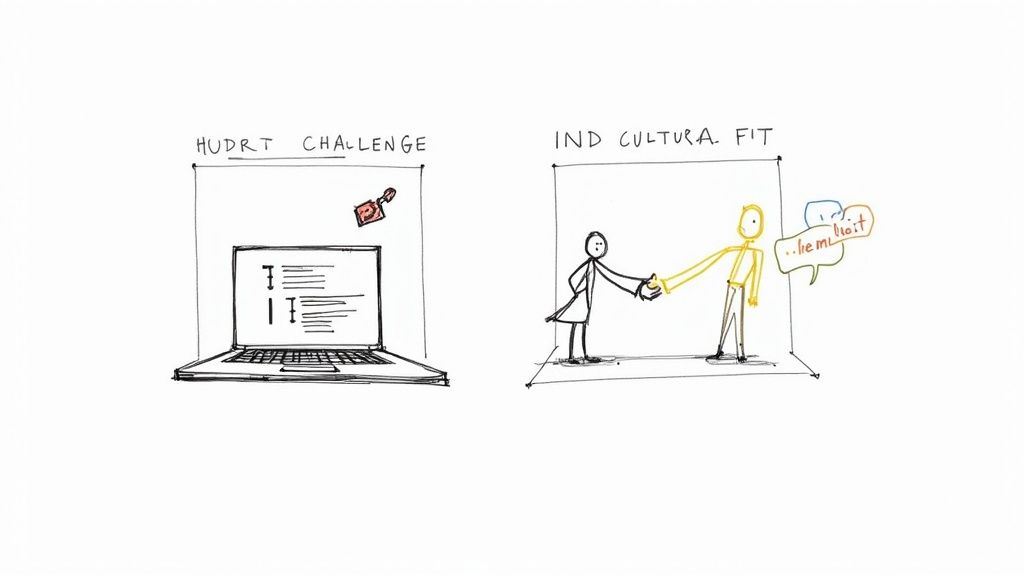
Okay, you’ve got a shortlist of candidates. Now the real work begins. This is the stage where you look past the polished resumes and impressive portfolios to figure out who can actually build the robust, scalable, and user-friendly app you need.
Vetting is a two-sided coin. Technical skill gets a candidate in the door, but it’s the cultural fit that determines if they’ll be a great long-term partner. A great developer doesn't just write code; they solve problems. Your whole vetting process should be designed to see how they think, communicate, and handle the inevitable curveballs of a real project.
Assessing Core Technical Abilities
Forget the abstract brain teasers. Your technical assessment needs to mirror the actual work the developer will be doing for you. The best way to do this is with a practical coding challenge that tests their ability to solve a relevant problem.
For an iOS developer, you could ask them to build a simple app that pulls data from a public API (like a movie database), shows it in a list, and lets the user tap an item for a detail view. This one task tells you a lot:
- API Integration: Can they handle asynchronous network requests and parse JSON data with Swift’s
Codable? - UI Development: How comfortable are they using SwiftUI or UIKit to create a clean, responsive interface?
- Architectural Patterns: Do they structure the code logically? Are they using a pattern like MVVM (Model-View-ViewModel) to keep things clean?
For an Android developer using Kotlin, you could assign a similar task, maybe asking them to build a feature with Jetpack Compose that interacts with a local Room database. This quickly reveals their grasp of modern Android practices, state management, and data persistence.
The goal of a coding challenge isn't to see if they can finish it perfectly. It's to see how they approach it. Pay attention to the questions they ask, how they structure their code, and whether they write tests. This reveals more than a perfect solution ever could.
Probing Deeper with Strategic Interview Questions
The coding challenge shows you what they can do; the technical interview tells you why they do it. This is your chance to dig into their experience and understand their decision-making process. For a broader look at this, our guide on how to hire software engineers covers the general process and key questions in more detail.
Don't ask, "Do you know MVVM?" Instead, try something like, "Describe a situation where MVVM was the right choice for a project, and one where it might not have been." This separates genuine understanding from textbook memorization.
Here are a few questions I’ve found that really separate the experienced developers from the rest:
- "Walk me through the most complex API integration you've ever worked on. What made it so difficult, and how did you overcome the challenges?"
- "Describe your process for optimizing app performance. What tools do you use to diagnose and fix issues like slow load times or high memory usage?"
- "How do you ensure a consistent user experience across different screen sizes and OS versions on Android/iOS?"
- "Tell me about a time you disagreed with a design or product decision. How did you handle it?"
Evaluating Cultural and Team Fit
When you hire dedicated mobile app developers, technical chops are only half the story. Cultural fit is what determines whether a new hire will mesh with your team or become a source of friction—something that’s especially critical in a remote, agile environment where clear communication is everything.
The app market is incredibly competitive. In 2025, the Google Play Store and Apple App Store are projected to host over 3.6 million applications, supported by an ecosystem of over 1.2 million developers. In a space that crowded, a team that works together seamlessly can easily out-innovate the competition. For more insights, you can check out these mobile app download statistics on tekrevol.com.
To get a feel for this, I lean on behavioral questions that reveal their soft skills and work habits.
Questions for Gauging Cultural Alignment
| Category | Sample Question | What It Reveals |
|---|---|---|
| Communication | "How do you prefer to give and receive feedback on your code?" | Their openness to collaboration and constructive criticism. |
| Problem-Solving | "Tell me about a time a project went off the rails. What was your role and how did you contribute to getting it back on track?" | Their accountability, resilience, and ability to handle pressure. |
| Adaptability | "Imagine the project requirements change suddenly mid-sprint. How would you react and what would be your first steps?" | Their flexibility and ability to adapt to the realities of product development. |
| Collaboration | "Describe your ideal team environment. What role do you typically play in a team setting?" | Whether their preferred work style aligns with your team's culture. |
At the end of the day, you're not just looking for a skilled coder. You're looking for a proactive communicator, a creative problem-solver, and a genuine team player. Finding someone who checks all those boxes is the real key to building a high-performing mobile team.
Sorting Out Pricing Models and Contracts
After you've found developers who have the right technical chops, the conversation naturally shifts to the bottom line: money and legal paperwork. This phase is just as crucial as the technical vetting. When you hire dedicated mobile app developers, getting the pricing and contract right sets the stage for a smooth, productive partnership and protects your most valuable asset—your idea.
Choosing the Right Engagement Model
For a dedicated team, the financial arrangement is usually pretty straightforward. You're not just buying a finished product; you're securing a team's dedicated time and brainpower. That’s why the monthly retainer model is the standard. It provides a predictable, recurring cost that covers salaries and overhead, giving you a team that's 100% focused on your project.
This is a world away from other common pricing structures you might encounter:
- Fixed-Price: This only works for small, crystal-clear projects where nothing will ever change. It’s a terrible fit for dedicated teams because it stifles the very flexibility and iterative progress that agile development thrives on.
- Time & Material (T&M): This model offers flexibility, sure, but it can also lead to runaway costs. It’s better suited for projects with a foggy scope where you don't necessarily need a full-time, dedicated resource.
The monthly retainer really gives you the best of both worlds: you get the cost predictability you need for budgeting and the dedicated focus required to build a complex, high-quality app.
A Look at Global Rate Variations
Where your developers live will have a massive impact on your budget. Rates swing wildly from one region to another, and knowing the landscape helps you make a financially sound decision without compromising on talent. This is why nearshore hubs in Eastern Europe and Latin America have become so popular—they offer an incredible balance of skilled developers and competitive pricing.
A word of advice I've learned the hard way: the cheapest option is almost never the best. Paying a bit more for a senior developer who communicates well and works efficiently will deliver a far better ROI than hiring a less expensive junior who needs constant hand-holding.
To help you get a feel for budgeting, here’s a quick overview of what you can expect.
Estimated Hourly Rates for Mobile App Developers by Region
This table provides a general snapshot of average hourly rates across different global talent pools. It’s a useful starting point for understanding how geography influences your budget when hiring dedicated developers.
| Region | Junior Developer Rate (USD) | Mid-Level Developer Rate (USD) | Senior Developer Rate (USD) |
|---|---|---|---|
| North America | $70 - $120 | $120 - $180 | $180 - $250+ |
| Western Europe | $60 - $100 | $100 - $160 | $160 - $220+ |
| Eastern Europe | $35 - $50 | $50 - $80 | $80 - $110+ |
| Latin America | $40 - $60 | $60 - $90 | $90 - $120+ |
| Asia | $25 - $40 | $40 - $65 | $65 - $90+ |
As you can see, hiring a seasoned developer from a region like Eastern Europe can often cost less than bringing on a junior developer in North America. This is precisely why nearshoring has become such a compelling strategy for so many companies.
The Non-Negotiable Clauses in Your Contract
Think of your contract as your project's ultimate safety net. A solid agreement protects your business, your code, and your entire investment. While you'll see plenty of standard legal boilerplate, a few clauses are absolutely critical for any mobile app development project.
The mobile app market is a behemoth. In 2024, global revenue blew past USD 530 billion, and it's on track to hit USD 585 billion in 2025. With that much money flowing through the ecosystem, you simply can't afford to be casual about your legal protections. You can learn more about the growth of the mobile app market on blog.udonis.co.
Make sure your contract has these essentials locked down:
- Statement of Work (SOW): This isn't just a formality. It's the blueprint that details the project scope, deliverables, timelines, and who's on the team. It needs to be specific enough to prevent scope creep but also have enough wiggle room to support an agile workflow.
- Intellectual Property (IP) Rights: This is the big one. The contract must state, without any ambiguity, that your company owns 100% of the source code and everything else the developers create once you've paid for it. Without this, you could wake up one day to find that your development partner legally owns your app. It’s a nightmare scenario you must avoid at all costs.
- Confidentiality (NDA): A Non-Disclosure Agreement is non-negotiable. It’s a legal commitment from the development team to keep your business secrets, proprietary logic, and all project details under wraps.
- Payment Terms: Get specific here. Outline the monthly retainer amount, the payment due dates (e.g., net 30), and how you'll pay. This section should also cover how any out-of-scope work or extra expenses will be approved and billed.
- Termination Clause: Things don't always work out. This clause defines how either party can end the agreement, including the required notice period and the process for a clean handover of all code, documents, and project assets.
Signing the contract might feel like the last step, but it’s one of the most important business decisions you'll make. Don't rush it. Read every word, and if something doesn't feel right, get a lawyer to look it over.
Onboarding and Managing Your Remote Team
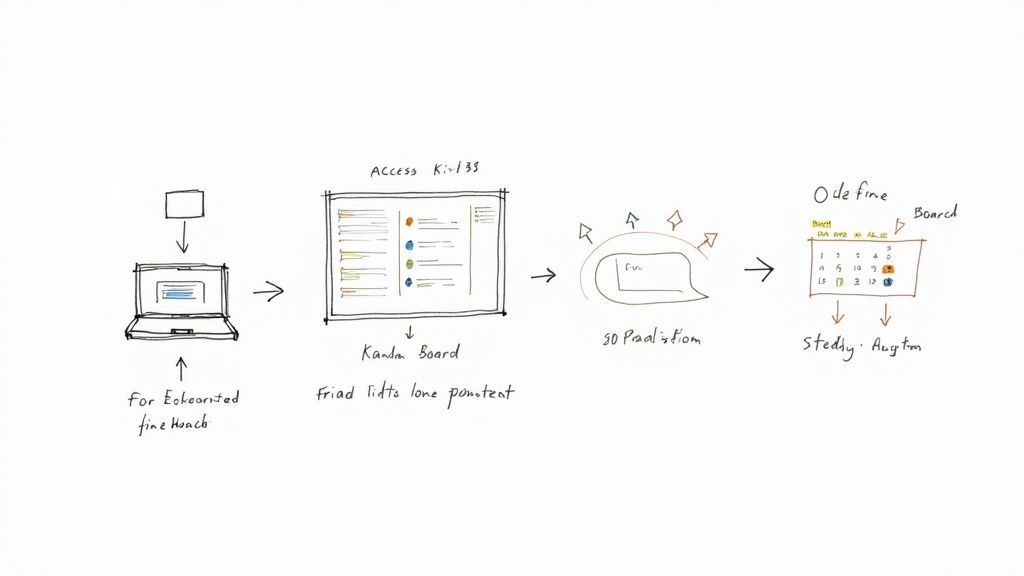
The contracts are signed and your team is assembled. It’s easy to feel like you’ve reached the finish line, but this is really where the hard work begins—turning a group of talented developers into a cohesive, high-performing unit. When you hire dedicated mobile app developers, a smooth start isn't just nice to have; it's essential for long-term success. That first week really sets the tone.
A well-planned onboarding process cuts through the initial confusion and gets your new developers contributing almost immediately. Don't leave them guessing. The best approach is to create a simple, comprehensive onboarding kit that gives them everything they need from day one.
Building Your Onboarding Kit
Your goal here is to get your team from zero to productive as fast as humanly possible. Think of this kit as a one-stop shop for all the essential info, granting them access to your entire toolchain and project context.
- Tool Access: Get those invites out right away for your core platforms. This means Jira for task management, Slack for communication, and GitHub or Bitbucket for version control.
- Documentation: Hand over the keys to the kingdom. Share links to the product roadmap, technical specifications, API docs, and any existing design mockups in Figma or Sketch.
- Key Introductions: Get a kickoff call on the calendar to introduce the new developers to your internal product owner, project manager, and anyone else they’ll be working with day-to-day.
To really nail this, it helps to lean on proven best practices for effective employee onboarding. A structured approach here pays off big time in both productivity and team morale down the line.
Managing Your Team Without Micromanagement
Good remote management isn't about constant check-ins. It's about establishing clear processes and then trusting your team to deliver. The trick is to implement agile rituals that foster communication and transparency without becoming a massive time-sink.
Daily stand-ups, for instance, are non-negotiable. But keep them short—no more than 15 minutes—and laser-focused on three simple questions: What did you do yesterday? What will you do today? Are there any blockers? This simple ceremony keeps everyone aligned and surfaces problems before they have a chance to derail a sprint.
Sprint planning and retrospectives are the bookends of your development cycle. They make sure the team knows what to build next and create a space for continuously improving how you all work together.
The most successful remote teams operate on a foundation of trust and clear expectations. Provide your developers with the goals and the tools, then give them the autonomy to solve the problems. Your job is to remove roadblocks, not to dictate every line of code.
Measuring What Truly Matters
To keep your project on the rails, you need to be tracking the right Key Performance Indicators (KPIs). These aren't just vanity metrics; they give you an objective view of your team's health and productivity, helping you make decisions based on data, not just gut feelings.
I've found these four KPIs give the most valuable insight:
- Team Velocity: An old-school agile metric, but a good one. It tracks the average amount of work a team gets done in a sprint. A stable or increasing velocity is a great sign of a healthy, productive team.
- Cycle Time: This is all about speed. It measures how long it takes for a task to get from "In Progress" to "Done." Shorter cycle times mean your team is shipping features faster.
- Bug Rate: Keep an eye on the number of bugs found after a feature goes live. A consistently low bug rate points to high-quality code and solid testing.
- Code Churn: This metric looks at how often code is rewritten or deleted shortly after being committed. High churn can be a red flag for unclear requirements or mounting technical debt.
By focusing on these indicators, you can get a real sense of performance, spot bottlenecks early, and make sure the team you hired is delivering the value you expect—keeping your app development on budget and on schedule.
Common Hiring Mistakes to Avoid
Hiring is tricky territory, and a few common missteps can easily sink your project before it even gets off the ground. Sidestepping these pitfalls is just as crucial as finding the right talent. I've seen too many companies learn these lessons the hard way, but with a little foresight, you don't have to.
One of the most tempting traps is chasing the lowest price tag. The allure of a $25/hour developer versus a $75/hour one is powerful, but it's often a mirage. A cheaper, less experienced developer might eat up your time with constant hand-holding, write messy code that needs a total overhaul later, and ultimately take twice as long to finish the job. Any money you thought you saved vanishes pretty quickly.
Overlooking a Vague Project Scope
Another classic blunder is diving into the hiring pool with a fuzzy project scope. If you can’t clearly explain your app's core features, user journeys, and technical needs, how can you expect someone else to build it? This kind of ambiguity is a recipe for disaster—it leads to endless revisions, scope creep, and a whole lot of frustration.
Before you even think about writing a job description, spend a few days hammering out a basic product requirements document. This simple exercise forces you to get specific. It gives candidates a real sense of the challenge and allows them to provide much more accurate timelines and cost estimates.
My Two Cents: A well-defined scope is your best defense against blown budgets and missed deadlines. It turns a vague idea into a concrete roadmap and gets everyone on the same page from day one.
Underestimating Cultural and Contractual Details
We all focus on technical skills—they’re easy to test. But cultural fit is what really holds a team together, especially a remote one. Ignoring how a developer communicates, takes feedback, or meshes with your team's workflow can create constant friction. A coding genius who can't collaborate is a bottleneck, not an asset.
Just as dangerous is treating the contract as a formality. In the rush to get started, it's easy to skim the legal docs, but that's a huge mistake. The single most important clause to lock down is Intellectual Property (IP) ownership.
Your contract absolutely must state that all code and related work created for the project becomes your company's exclusive property once you've paid for it. Without this clear language, you could end up in a legal nightmare where the developer you hired technically owns your app.
Make sure your agreement also nails down these other non-negotiables:
- A detailed Statement of Work (SOW).
- A rock-solid non-disclosure agreement (NDA).
- Clear rules for termination and what happens during project handover.
Avoiding these common mistakes helps ensure that when you hire dedicated mobile app developers, you're setting up a partnership for success, not just crossing your fingers and hoping for the best.
Got Questions? Here Are Some Common Ones
When you're thinking about bringing on dedicated mobile app developers, a few key questions always seem to pop up. Let's tackle them head-on so you can move forward with clarity and confidence.
Dedicated Developer vs. Freelancer: What’s the Real Difference?
The biggest difference boils down to commitment and integration. Think of a freelancer as a specialist you bring in for a specific, well-defined task—they're great for short-term projects. They usually have multiple clients and aren't deeply woven into your team's day-to-day rhythm or long-term vision.
A dedicated developer, on the other hand, is essentially a full-time member of your team who just happens to work remotely. They're 100% focused on your project, which means they get completely immersed in your goals, your workflow, and your company culture. This kind of arrangement builds a sense of ownership that you just don't get with a typical freelance gig.
How Long Does It Realistically Take to Hire a Developer?
You should probably budget between two and six weeks from start to finish. It’s not an overnight process, and it usually unfolds in a few phases.
Here’s a rough breakdown of what that looks like:
- Sourcing & Screening (1-2 weeks): Finding good people and having those initial "get to know you" conversations.
- Technical Vetting (1-2 weeks): This is where the rubber meets the road—coding tests, technical deep dives, and system design challenges.
- Contracts & Onboarding (1-2 weeks): Getting the paperwork signed and plugging your new developer into your systems and team.
Working with a specialized agency can definitely shave some time off this, since they often have a bench of pre-vetted developers ready to go.
My Two Cents: Don't rush the technical vetting. Seriously. Taking an extra week here to be absolutely sure you have the right person will save you months of pain and expensive rework later.
What Are the Must-Have Tools for Managing a Remote Dev Team?
To keep a remote team running smoothly, you need a solid set of tools. While everyone has their favorites, there are a few essentials that are pretty much non-negotiable for keeping everyone on the same page.
I always recommend starting with this core stack:
- Project Management: You need a central hub for tasks. Jira and Trello are the go-to choices for managing sprints and tracking progress.
- Communication: For all the day-to-day chatter and quick questions, you can't go wrong with Slack or Microsoft Teams.
- Version Control: This is critical for collaborative coding. GitHub or Bitbucket are the industry standards.
Can I Start by Hiring Just One Developer?
Absolutely. One of the best things about the dedicated model is how flexible it is. You can easily start by bringing on a single expert to plug a specific gap—maybe you need a senior iOS developer to spearhead a new feature.
Then, as your project grows and the needs evolve, you can scale up your team. It’s common to add a project manager, a few more developers, designers, and QA engineers over time, building out a full, cross-functional team at your own pace.