How to Find App Developers That Fit Your Vision

Before you even think about searching for a developer, you need to get your own house in order. Seriously. The most critical work happens long before you post a job ad or contact an agency.
Having a rock-solid plan—knowing exactly what you want to build—is the single most important thing you can do to attract top talent and get quotes that are actually accurate.
Laying the Groundwork Before Your Search
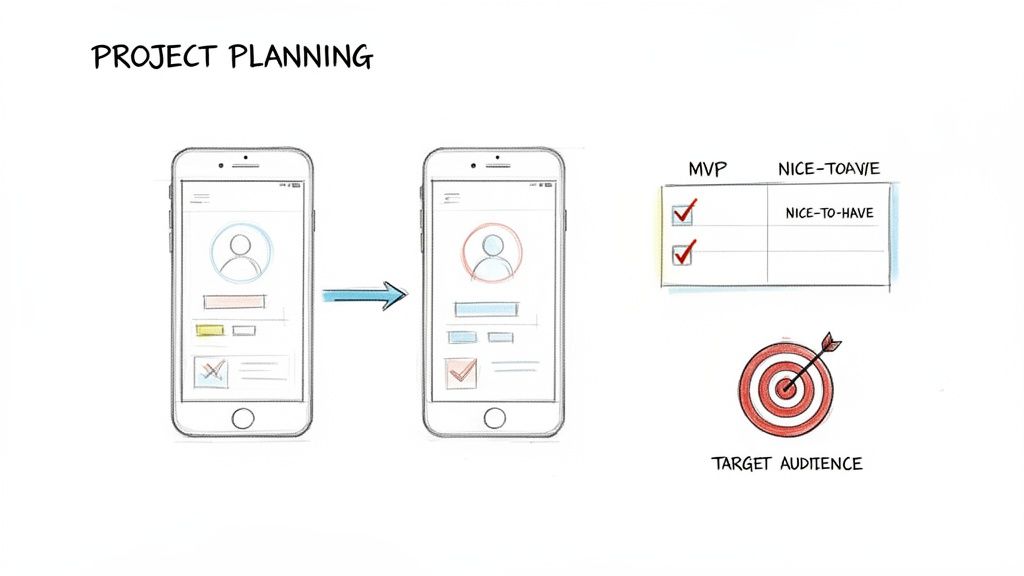
Hopping onto a freelance platform with a half-baked idea like "an app like Instagram, but for dogs" is a one-way ticket to frustration. It guarantees miscommunication, scope creep, and a whole lot of wasted money.
Believe me, experienced developers can spot an unprepared client from a mile away.
If you want to attract the pros, you have to speak their language. That means turning your big vision into a clear, concise project brief that lays out your goals, who your users are, and the app's core functions. This isn't just busywork; it's the blueprint for your entire project.
Define Your Minimum Viable Product (MVP)
First things first: you have to be ruthless with your feature list. What is the absolute bare-minimum set of features your app needs to launch and be useful to your very first users? That’s your Minimum Viable Product, or MVP.
Don't think of an MVP as a cheap or incomplete version of your app. It's the smartest version. It gets your idea into the real world quickly so you can start getting feedback from actual users.
- Core Features: List the absolute must-haves. For our dog-focused social app, this would probably be user profiles, photo uploads, and a "like" button.
- "Nice-to-Haves": Everything else goes on the back burner for now. Features like direct messaging, event planning, or fancy photo filters can wait for a later version.
Making this distinction is non-negotiable. A developer needs to know exactly what they're building for version 1.0 to give you a timeline and budget you can trust.
"Trying to build everything at once is the fastest way to build nothing at all. A well-defined MVP gets your product into the hands of users faster, providing the real-world feedback you need to build what they actually want."
Create Simple Wireframes and User Flows
You don't need to be a professional designer to map out your app. Wireframes are just simple, bare-bones sketches of each screen, and they are incredibly powerful communication tools. They show a developer how a user will navigate your app, which is often far clearer than a page of text.
User flows are just as important. They map out the step-by-step journey a person takes to do something, like signing up or posting a picture. You can use tools like Miro or just a good old-fashioned pen and paper.
These simple visuals cut through the noise, eliminate ambiguity, and make sure you and your future developer are picturing the same thing from day one. If you want to go deeper, you can learn more about how to define your project scope in our detailed guide.
Essential Project Definition Checklist
Use this checklist to confirm you've defined all the crucial elements of your app before you start looking for a developer or team.
| Component | Key Questions to Answer | Example |
|---|---|---|
| Problem Statement | What specific user problem are you solving? | "Dog owners want a dedicated, positive space to share photos of their pets without the clutter of other social networks." |
| Target Audience | Who are your ideal first users? Be specific. | "Millennial and Gen Z dog owners (ages 22-35) in urban areas who are highly active on social media." |
| Core Value Prop | What is the #1 reason someone will use your app? | "The simplest, most joyful way to create a social profile exclusively for your dog and connect with other local dog lovers." |
| MVP Feature List | What are the 3-5 absolute must-have features? | 1. Dog profile creation. 2. Photo/video feed. 3. Like & comment functions. 4. Simple user search. |
| Key User Flows | What are the main paths users will take? | Onboarding/Sign-up, Posting a Photo, Following Another User. |
| Platform(s) | Where will this app live? iOS, Android, Web? | "Initially, we are building for iOS only to test the market." |
Having clear answers to these questions will put you miles ahead of most founders and make your project infinitely more attractive to high-quality developers.
Choosing Your Hiring Model: Freelancers vs. Agencies vs. Nearshore Partners
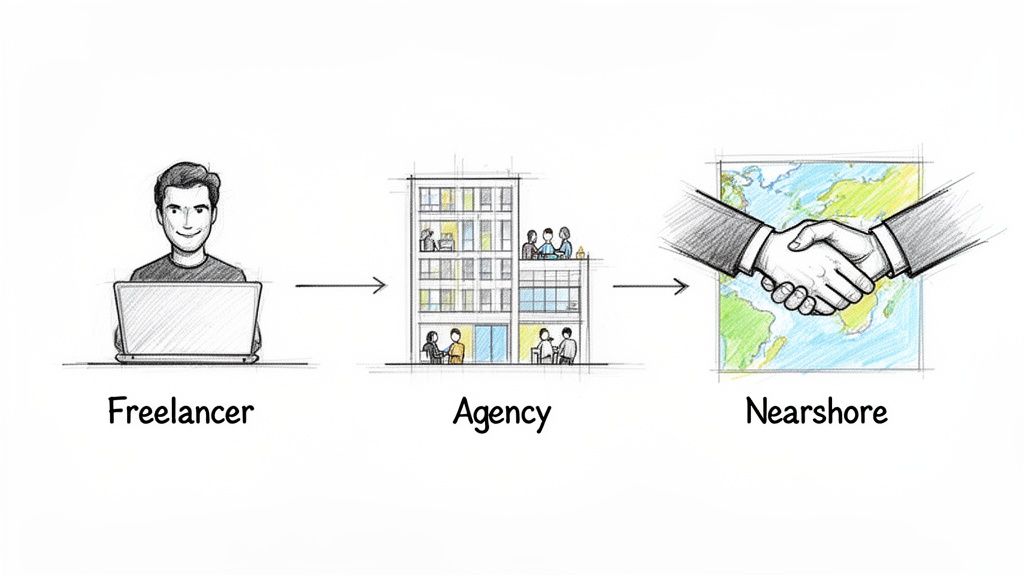
Alright, you’ve got your project scoped out. Now comes the big decision: who is actually going to build this thing? This isn't just about hiring a coder; it’s about picking a partnership model that fits your budget, your management style, and where you see your product going long-term.
You're essentially deciding how to engage your contingent workforce, and each path—freelancer, agency, or nearshore partner—comes with its own set of pros and cons. Let's break them down.
The Freelancer Route
Going with a freelancer from a platform like Upwork or Toptal gives you incredible flexibility. It can be a fantastic, budget-friendly option for well-defined tasks, specific features, or smaller projects. You get direct lines to specialists all over the world without having to make a long-term hire.
But here’s the trade-off: you become the project manager. The entire responsibility for sourcing, vetting, onboarding, and day-to-day management falls squarely on your shoulders. It demands a significant investment of your own time and expertise.
Partnering with a Development Agency
A full-service agency is the all-in-one package. They bring a whole team to the table—strategists, designers, developers, QA testers—and manage the entire lifecycle from concept to launch. If you want a single point of contact to handle everything, this is your model.
The main catch is the cost. Agencies have significant overhead, and their comprehensive service comes with a much higher price tag. You also give up some direct control, as communication is often funneled through an account manager, which can sometimes slow things down.
The Nearshore Staff Augmentation Advantage
This is where things get interesting. Nearshore partnerships offer a powerful middle ground, combining the direct control of hiring a freelancer with the robust support of an agency. The idea is to integrate pre-vetted, highly skilled remote developers from nearby countries directly into your team.
We’ve seen this model transform how startups build their products, especially with the rise of Latin America as a tech hub. The region now accounts for 7% of global mobile talent—that's about 805,000 developers—and its close proximity is a game-changer for U.S. and European companies. No more wrestling with a 12-hour time difference that kills collaboration.
This is the model we specialize in at Nerdify, and for good reason. It delivers some serious benefits:
- Time-Zone Alignment: When your developers are only an hour or two behind, you can actually collaborate in real-time.
- Cultural Synergy: Working with talent from similar cultural contexts makes for much smoother communication and a more cohesive team.
- Cost-Effectiveness: You get access to world-class developers at more competitive rates than you'd find at home, without ever compromising on quality.
With nearshore developers, you aren't just farming out tasks. You're strategically extending your in-house team's muscle with top-tier professionals who work when you work.
This approach is perfect for companies that have some technical leadership in-house but need to scale their development firepower quickly and efficiently. If you're weighing your options, our guide on https://getnerdify.com/blog/staff-augmentation-vs-outsourcing breaks down the nuances even further. Ultimately, the best choice is the one that aligns with your specific resources and project goals.
Where to Find Top-Tier App Development Talent
Alright, you've got a solid project brief. Now for the hard part: where do you actually find the people who can build this thing? The search for great developers has gone global, and your local job board is just a drop in the ocean.
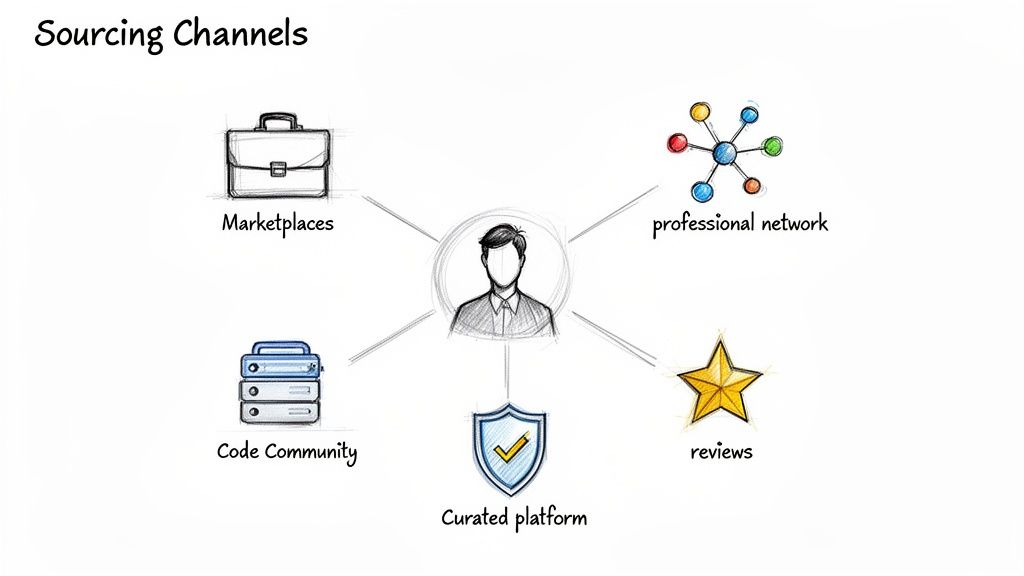
These days, everything happens on digital platforms and freelance marketplaces. With a staggering 79% of global app spending and downloads happening across borders, you have to think remotely. The trick is knowing which channels are worth your time and how to work them to your advantage.
Navigating Freelance Marketplaces
Let's start with the big ones. Platforms like Upwork and Fiverr have completely changed the game for finding developers. They give you instant access to a massive global talent pool, which is perfect if you're a startup trying to build an MVP or just need one specific feature.
But you can't just post a job and hope for the best. That's a recipe for disaster. To find the real gems buried in there, you have to be deliberate.
- Write an excellent job post. Use that project scope you built. The more detail you provide, the better the applicants you'll get. Vague posts attract vague, low-quality proposals.
- Ignore the lowest bid. Seriously. The cheapest offer is almost never the best value. Dig into their portfolios, look for projects similar to yours, and read every single client review.
- Always do a paid trial. Before you hand over the keys to your big project, hire your top candidate for a small, paid task. This is the single best way to test their real-world skills, communication, and reliability.
Your job description on a freelance site is your first line of defense. A great one filters out the noise and attracts serious professionals who can see you know what you're doing.
Tapping into Professional Networks and Code Communities
Here’s a pro tip: the best talent often isn't actively browsing job boards. They're busy contributing to open-source projects or swapping ideas with their peers. This is where places like LinkedIn and GitHub become absolute goldmines for sourcing.
On LinkedIn, get familiar with the advanced search filters to pinpoint developers with the exact skills you need. When you reach out, make it personal. Mention a specific project they worked on or a post they wrote. It shows you've done your homework and you're not just spamming.
GitHub, on the other hand, is where you see the proof. A developer’s profile is their living, breathing portfolio. You can browse their public repositories to get a feel for their coding style, the kind of problems they enjoy solving, and how they collaborate with others. It’s an unfiltered look at their work.
Leveraging Curated Platforms and Review Sites
If you're short on time and need to cut through the noise, curated platforms and review sites are your best friend. They do a lot of the heavy lifting for you.
- Curated Talent Platforms: Services like Toptal are incredibly efficient. They put all their developers through a rigorous vetting process before you ever see them. This means you’re only talking to the top few percent of talent, saving you countless hours of screening.
- Agency Review Sites: When you're thinking about hiring an agency or a nearshore partner like Nerdify, sites like Clutch are non-negotiable. You’ll find verified client reviews, detailed project write-ups, and portfolios that give you a transparent look at a company’s history and capabilities.
The global pool of over 35 million professional mobile developers can feel overwhelming, but it doesn't have to be. With the right strategy, you can find the perfect developer for your project. If you want to dive deeper, you can discover key insights about mobile app development statistics and trends.
How to Vet and Interview Your Candidates
You've got a promising list of candidates. Great. But finding those résumés is the easy part. The real work is figuring out who can actually build what you need. A disciplined vetting process is what separates a fantastic hire from a costly mistake.
This isn't about creating an intimidating gauntlet. It's about methodically confirming that a developer’s skills, work style, and problem-solving chops are a true match for your project.
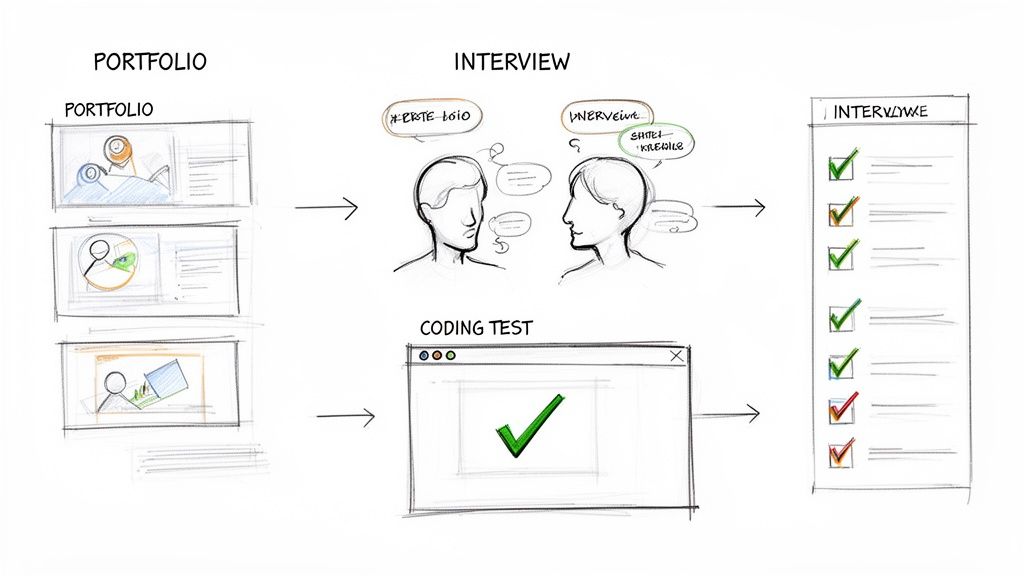
Step 1: Deep-Dive into Their Portfolio
Before a single email is sent to schedule an interview, you need to become an expert on their past work. A portfolio is far more than a gallery of pretty screenshots; it’s a tangible history of their capabilities. Look beyond the flashy App Store descriptions and hunt for evidence of their specific contributions.
Here’s what I focus on:
- Direct Relevance: Have they built apps with similar core features or for the same type of user you're targeting? Seeing experience in your specific tech stack—like Swift for iOS or Kotlin for Android—is a huge green flag.
- Hands-On Quality Check: If their apps are live, download them. Immediately. Is the UX smooth and intuitive? Does it feel snappy and stable, or is it a buggy mess? A clunky app speaks volumes.
- Real Complexity: I look for projects that show they can do more than skin a template. Can you spot sophisticated API integrations? Custom UI components? Evidence of performance tuning for large datasets?
There are roughly 28.7 million software developers worldwide, but the reality is that only about 40% focus on mobile apps. To find the best of that group, you need to see portfolios that reflect modern demands like AI/ML integration or multiexperience design. That’s the kind of background that signals they can build a high-performance app today. You can get more context on these trends from the global app development market report.
Step 2: The Interview Is More Than a Quiz
The interview isn’t a technical trivia game. The goal is to understand how a candidate thinks, communicates, and collaborates. A genius coder who can't explain their work or take feedback is a net negative for any team.
I always split the interview into two parts:
- Real-World Scenarios: This is where you test soft skills. Ask about a time they had a technical disagreement with a project manager. How did they handle a critical bug found hours before a launch? What’s their process for getting up to speed on a new framework?
- A Technical Walkthrough: Forget syntax questions. Have them walk you through the architecture of a project they're proud of. Why did they choose that particular database? What was the gnarliest technical challenge they faced, and how did they crack it?
A great developer doesn't just write code; they solve problems. The interview is your chance to see their problem-solving mind in action, not just quiz them on syntax.
For a deeper look into structuring these conversations, check out our guide on how to hire exceptional software engineers.
Step 3: The Paid Trial Task
Finally, you need to see them work. A well-designed technical assessment is the single most accurate predictor of how someone will perform on the job. Ditch the abstract whiteboard algorithm challenges and give them a task that mirrors the actual work.
My go-to method is a small, paid trial task. Ask them to build one self-contained feature from your MVP, fix a known bug in a sample project you provide, or refactor a block of inefficient code.
Paying for their time is crucial—it shows you respect their expertise and gets you a much more engaged effort. In return, you get a real work sample that makes the final "yes" or "no" incredibly clear.
To ensure a well-rounded evaluation, it's helpful to view the entire vetting journey as a series of distinct stages, each with a clear purpose. The table below breaks down this process into manageable steps.
Key Stages of the Developer Vetting Process
| Vetting Stage | Objective | Key Action |
|---|---|---|
| Portfolio Review | Assess past work for relevance and quality. | Download their live apps. Look for complex features and a polished UX. |
| Behavioral Interview | Evaluate soft skills and problem-solving approach. | Ask situational questions about past challenges and team disagreements. |
| Technical Discussion | Understand their architectural and strategic thinking. | Have them walk you through a past project's technical decisions. |
| Paid Trial Task | Validate coding skills in a real-world scenario. | Assign a small, self-contained task that mirrors your project's work. |
Following these distinct phases gives you a complete picture of a candidate, moving far beyond what a résumé alone can tell you. This structured approach helps ensure your final decision is based on tangible evidence of skill and fit.
Finalizing the Hire: Contracts, Pricing, and Onboarding
You've found your developer. The interviews went great, the technical challenge was aced, and you feel confident they're the right fit. Now comes the part that turns a promising candidate into a productive partner: setting up the business side of the relationship.
This stage is all about creating clarity. It’s where you formalize expectations, agree on financials, and set the legal guardrails that protect everyone involved. Getting this right prevents headaches down the road and builds a solid foundation for your project.
How to Pay Your Developers: A Look at Pricing Models
Figuring out the right payment structure is less about finding a universal "best" option and more about matching the model to your project's specific needs. Is your scope locked in, or do you expect it to change? The answer will point you to the right model.
Of course, before you make an offer, you need to know if it's competitive. Doing your homework with tools for salary benchmarking is a non-negotiable step to ensure you're offering fair market rates.
Here are the three main ways you’ll see projects priced:
Fixed-Price: This is your go-to for projects with a meticulously defined scope. You know exactly what needs to be built, down to the last detail. You agree on one total price for the entire job. It’s predictable for budgeting but offers zero flexibility—any change means a new negotiation.
Time & Materials (T&M): Perfect for projects that need to be agile and responsive. If your requirements are likely to evolve as you build and test, this is your model. You pay a set hourly or daily rate for the time spent. It’s incredibly flexible, but you absolutely must have strong project management to keep an eye on the budget.
Retainer: Think of this as having a developer "on call." It's the best choice for long-term partnerships, ongoing feature development, or critical maintenance. You pay a recurring fee (usually monthly) to reserve a block of their time, ensuring you have dedicated support when you need it.
For early-stage startups building their first product, the Time & Materials model is often the sweet spot. It works hand-in-glove with agile development, giving you the freedom to pivot based on user feedback without being locked into an outdated plan.
The Must-Have Legal Paperwork
Don't let the legal documents overwhelm you. They aren't just formalities; they are the rulebook for your collaboration, protecting your intellectual property and defining how you'll work together.
A well-drafted Statement of Work isn't just a contract; it's your single best defense against scope creep. Treat it as the project's constitution—if it's not in the SOW, it's not in the project.
Here’s a quick rundown of the essential trio you'll need:
Non-Disclosure Agreement (NDA): This is your first move. Before you share any sensitive details about your "secret sauce," get this signed. It’s a simple document that legally obligates the developer to keep your confidential information under wraps.
Master Service Agreement (MSA): This is the foundational contract that outlines the overall terms of your relationship. It covers the big-picture stuff like IP ownership, confidentiality, liability, and payment schedules. You sign it once, and it governs all future work.
Statement of Work (SOW): This is where the rubber meets the road. For each specific project, you'll create a new SOW that lives under the MSA. It breaks down the what, when, and how, detailing the exact tasks, deliverables, timelines, and costs for that particular phase of work.
Onboarding: Setting Them Up for a Fast Start
How you bring a new developer into the fold in the first week sets the precedent for the entire project. A great onboarding experience isn't about a welcome email; it's about systematically removing roadblocks so they can start contributing immediately.
Think of it as a checklist to get them from zero to productive as fast as possible:
Day One Access: Get them into all your systems right away. This means the project management board (Jira, Trello), the code repository (GitHub, GitLab), and your team's communication hub (Slack, Microsoft Teams).
The Brain Dump: Hand over all the project documentation you have. This includes the product roadmap, wireframes, user stories, and any existing technical diagrams.
The Kick-Off Call: Get the key players on a call. This is the time to introduce the team, walk through the high-level project goals, and establish the rhythm for communication (e.g., daily standups, weekly check-ins).
The First Win: Give them a clear, manageable goal for their first 30 days. It could be a small feature or a specific bug fix. This allows them to learn the codebase and score an early victory, which builds incredible momentum.
Frequently Asked Questions About Finding App Developers
Even with a great roadmap, hiring developers for the first time is bound to stir up some questions. Let's tackle some of the most common ones I hear from founders and PMs. The goal here is to give you straight answers so you can move forward without the guesswork.
What’s the Real Cost to Hire an App Developer?
This is the million-dollar question, and the honest answer is: it's all over the map. The final cost comes down to a developer’s location, their years in the trenches, and how you decide to hire them.
Here’s a quick breakdown:
- Location, Location, Location: A senior freelance developer based in North America could quote you anywhere from $75 to $250 per hour. But you can find an equally talented developer from a top nearshore hub in Latin America for something closer to the $40 to $100 per hour range.
- The Hiring Model: If you go the full-service agency route, a simple app might start at $50,000, while a complex platform with all the bells and whistles can easily soar past $500,000.
This is where nearshore partners like Nerdify really shine. They offer a sweet spot, giving you access to pre-vetted, top-tier talent at a much more manageable price point. You get agency-level expertise without the agency-level price tag, all while maintaining quality and smooth communication.
What Are the Biggest Red Flags When Hiring?
Spotting trouble early will save you a massive headache down the line. Technical skills are one thing, but it’s the non-technical red flags that often tell the real story.
A candidate's communication style is a direct preview of your future working relationship. Consistent delays, vague answers, or an unwillingness to ask clarifying questions during the hiring process will only get worse once the project starts.
Be skeptical of a portfolio that looks too generic or doesn't have a single project even remotely related to your field. Another huge warning sign is an unusually low price. It might seem tempting, but it often signals inexperience that will cost you more in the long run with endless bugs and revisions.
And finally, if a developer pushes back on signing a standard Non-Disclosure Agreement (NDA) or refuses to do a small, paid technical test, walk away. Professionals get it. These are standard parts of doing business, and any resistance is a major red flag.
How Long Does It Take to Find a Good Developer?
The timeline can be anywhere from a few days to a couple of months—it really depends on what you're looking for and where you're looking. Need a freelancer for a quick, clearly defined task? You could probably find someone on a platform in less than a week.
But if you're hiring for a core project or a long-term role, you need to be more patient. The whole process of sourcing, vetting, interviewing, and technical testing usually takes a solid four to eight weeks.
This is one of the biggest arguments for working with a curated talent partner. They’ve already done the heavy lifting by building a bench of pre-vetted developers. Tapping into their network can easily cut your hiring time in half, letting you get to work much faster.