How to Increase Customer Engagement That Lasts
To truly boost customer engagement, you need to think beyond one-off interactions. It's about building a genuine, ongoing relationship with your customers by making every touchpoint valuable and meaningful. This means getting to know what they need, personalizing their journey, and making them feel like part of something bigger. The real goal is to turn passive users into active, loyal fans of your brand.
Why Customer Engagement Really Matters
Let's be clear: customer engagement isn't just another buzzword to throw around in meetings. It's the engine of a healthy, growing business, impacting everything from your revenue to your brand's reputation. It’s the critical difference between a customer who buys from you once and one who becomes a true advocate.
An engaged customer is light-years more valuable than one who is merely satisfied. Satisfaction is temporary and transactional. Engagement, on the other hand, is about an emotional connection—a long-term investment in what you're building.
The numbers back this up. Research consistently shows that companies with solid omnichannel engagement strategies hold onto an average of 89% of their customers. Compare that to the measly 33% retention rate for companies that neglect it.
The Business Impact of True Engagement
When customers feel seen, heard, and valued, their behavior changes in ways that directly pad your bottom line. This isn't about warm fuzzies; it's a strategic move that delivers real, measurable growth. If you want to dive deeper into the nuts and bolts, check out this complete guide to customer engagement for a comprehensive roadmap.
Here’s a breakdown of how strong engagement creates tangible business results:
- Higher Customer Lifetime Value (CLV): Engaged customers simply buy more, more often. They're also the first to upgrade to premium plans and stick around for the long haul, massively boosting their total value to your business.
- Increased Retention and Less Churn: When a customer feels connected to your brand, they're far less likely to jump ship for a competitor's discount. This loyalty builds a stable, predictable revenue base you can count on.
- Powerful Word-of-Mouth Marketing: Happy, engaged customers become your best salespeople. They'll shout your praises in reviews, recommend you to friends, and even defend your brand online. That's authentic marketing you can't buy.
- Invaluable Product Feedback: Active users are a goldmine of insights. They willingly provide a steady stream of feedback, helping you pinpoint issues, uncover new feature ideas, and build a product that people actually want.
In essence, investing in customer engagement is investing in a more resilient, profitable, and customer-centric business. It shifts your focus from short-term acquisition to long-term relationship building.
To get there, we've broken down the core strategic areas you need to focus on. These pillars form the foundation of any successful engagement effort.
Core Pillars of a Customer Engagement Strategy
| Pillar | Objective | Key Tactics |
|---|---|---|
| UX/UI & Onboarding | Create a frictionless, intuitive, and welcoming user experience from the very first interaction. | Simplified navigation, clear calls-to-action (CTAs), interactive product tours, and a streamlined sign-up process. |
| Product Features | Build features that solve real problems and encourage repeat usage and deeper interaction. | Personalization, in-app messaging, push notifications, gamification elements, and progress indicators. |
| Content & Community | Provide value beyond the product itself, fostering a sense of belonging and shared identity. | Educational blog posts, video tutorials, user forums, webinars, social media groups, and user-generated content campaigns. |
| Measurement & Feedback | Continuously track engagement metrics and gather user feedback to inform product and marketing decisions. | A/B testing, user surveys, Net Promoter Score (NPS), session analytics, and direct customer interviews. |
This guide will walk you through each of these pillars, starting with the foundational metrics and moving into practical advice on user experience, product features, and community building. We'll explore what great engagement looks like for different business models—from SaaS and e-commerce to mobile apps—so you can build a strategy that truly works for you.
First Things First: What Does "Engagement" Actually Mean to You?
Before you write a single line of code or design a new feature, you have to ask the most important question: what does customer engagement really look like for your business? If you skip this step, you’ll end up just throwing random tactics at the wall, hoping something sticks. That's a surefire way to waste time, confuse your users, and have your team running in circles.
Engagement isn't some universal metric. A deeply engaged user for a B2B project management tool behaves completely differently than a power user of a mobile game. One might log in daily and use advanced reporting features, while the other might be all about session length and the number of levels completed. The context is everything.
Turning Ambition into Actionable Metrics
So, how do you get from a fuzzy idea like "we want more engagement" to a real strategy? You need a solid framework. This is where something like Google's HEART framework comes in handy. It’s a brilliant way to break down the user experience into five key areas, which helps you figure out precisely what to measure.
- Happiness: How do your users feel when they use your product? This is all about sentiment. (Think NPS, satisfaction surveys, app store ratings).
- Engagement: How deeply and frequently are people interacting? This gets into usage intensity. (Tracked with DAU/MAU, session duration, key actions per user).
- Adoption: Are new users trying your product or a specific feature? This is about growth and discovery. (Look at new sign-ups and feature adoption rates).
- Retention: Are users coming back? This is the ultimate test of value. (Measured with cohort analysis and churn rate).
- Task Success: Can people actually get done what they came to do, easily and efficiently? (Measured by task completion rates, error rates).
Using a model like HEART pushes you beyond just chasing a high Daily Active User (DAU) count. It forces you to ask why people are active and whether they’re actually succeeding.
Match Your KPIs to Your Business Model
The metrics you track have to be tied directly to how your business works. Applying e-commerce KPIs to a subscription service is like trying to use a hammer to drive a screw—it just doesn't work. Your Key Performance Indicators (KPIs) need to reflect the core value you provide to your customers.
Let's look at a few real-world scenarios:
- For a Project Management SaaS: The goal is to become essential to a team's daily workflow. Your key metrics wouldn't just be logins. You’d focus on the adoption rate of core features (like task assignments), the number of new projects created, and the daily collaboration actions per team (comments, file uploads). A high DAU is nice, but a high number of collaborative actions is what really shows stickiness.
- For an E-commerce App: Here, it’s all about driving sales and encouraging repeat purchases. The most important KPIs are conversion rate, average order value (AOV), and customer lifetime value (CLV). You might measure engagement by tracking how many items are added to wishlists or how many users opt into push notifications for sales.
- For a Content Subscription Service: If you run a news app or streaming platform, engagement is all about consumption. The critical numbers are session length, content completion rate (e.g., articles read, videos watched to the end), and the frequency of visits. The mission is to become a daily habit for your users.
A classic mistake is getting obsessed with "vanity metrics." These are numbers that look great on a dashboard but have zero correlation with actual business success. Ditch the noise and focus on a handful of core KPIs that prove you have a healthy, growing user base.
Once you’ve clearly defined what engagement means, you're ready to start building the experience that drives it. A great place to start is with your messaging and assets. For some practical tips on creating truly engaging content, this is an excellent resource. By aligning your goals, metrics, and content from the very beginning, you build a powerful, cohesive strategy that drives real growth.
Designing an Experience That Hooks Users
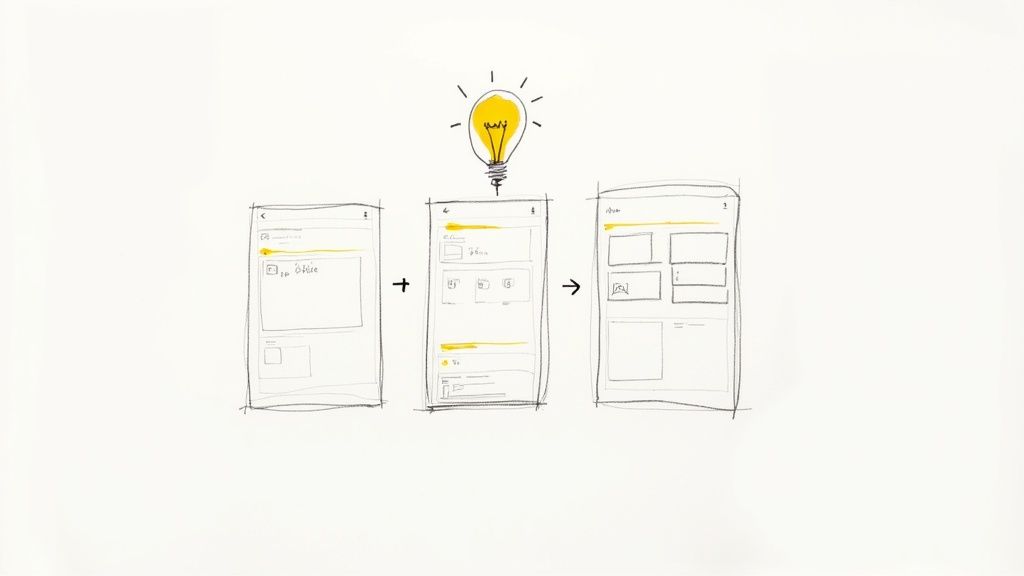
Let's be blunt: a clunky or confusing user experience is the fastest way to lose a customer. It doesn't matter how powerful your product is on the back end; if people can't figure it out, they'll leave. Good design isn't just about looking good—it’s about creating an intuitive path that guides users to value without them even realizing it.
That journey starts with a frictionless onboarding process. This is your one shot at a great first impression. The goal? Get users to their 'Aha!' moment—that instant they truly get what you're about—as quickly as humanly possible.
The Critical First Five Minutes
The first few moments a user spends with your product set the stage for everything that follows. A long sign-up form, a bewildering dashboard, or a lack of clear direction will send them packing before they've even started.
To get this right, you need to be ruthless in your simplicity:
- Minimize Steps: Only ask for the absolute essentials upfront. You can always collect more information later, once they're hooked.
- Show, Don't Just Tell: Ditch the text-heavy manual. Instead, use interactive product tours or contextual tooltips that pop up right where they're needed.
- Offer Quick Wins: Design the onboarding to help the user complete one small, meaningful task immediately. For a project management tool, this might be as simple as creating their first task. It's about providing instant gratification and building momentum.
The real goal of onboarding is to shrink the time it takes for a user to get a meaningful result. When they see the value right away, they're far more motivated to stick around and explore.
Once they're in, the challenge shifts from introduction to immersion. This is where your UI design and information architecture really shine.
Building an Intuitive and Rewarding Interface
A truly great interface feels invisible. It lets people achieve their goals without ever having to stop and think about how the app works. This feeling of effortlessness is what encourages people to dig deeper and use your product more often.
Look at Duolingo, the language-learning app. It's a masterclass in using gamification to keep users engaged. Things like visual progress bars, daily streak counters, and the little celebratory animations after a correct answer are all powerful feedback loops. These tiny interactions provide a constant stream of positive reinforcement, making a chore feel more like a game.
You can bake these same psychological drivers into your own design:
- Provide Clear Feedback: When someone clicks a button or completes an action, the interface should immediately confirm it. A simple checkmark, a subtle color change, or a quick animation builds a user's confidence.
- Visualize Progress: For any task that takes more than one step, show people where they are in the process. Progress bars and checklists are fantastic motivators because they show users how close they are to the finish line.
- Make Navigation Effortless: Your menus and layouts need to be logical and predictable. Use clear labels and group related functions together. A user should never have to guess where something is.
Another great example is Notion. Its real power is in its flexible, block-based system. A new user can start with a simple note, but as they get comfortable, they can discover how to build entire databases and dashboards. The design grows with them, creating a natural path toward deeper, long-term engagement.
Ultimately, designing for engagement means putting yourself in the user's shoes. Anticipate their needs, clear away any potential roadblocks, and build a journey that makes them feel successful every step of the way. When a product just feels good to use, people will keep coming back.
Building Product Features That Drive Interaction
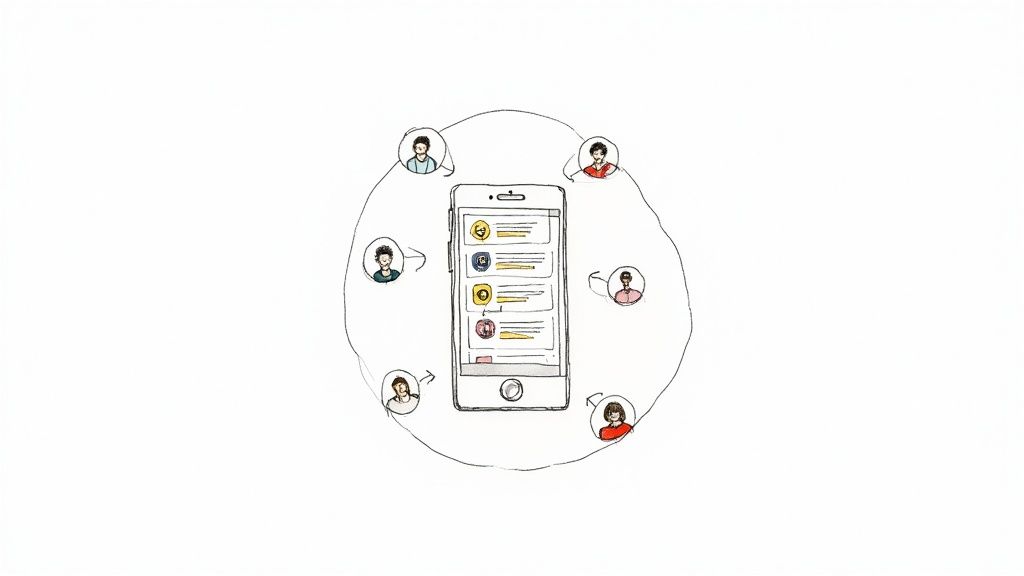
While a great design might get users in the door, it’s your product's core features that give them a reason to stick around. These features are your most direct and powerful tools for boosting engagement. They have the power to transform your product from a simple utility into an indispensable part of a user's daily life.
This isn’t about just tacking on more functionality. It's about intentionally weaving interaction into the user experience, creating natural loops that pull people back, encourage them to explore, and help them connect with your brand on a much deeper level.
Harnessing AI for True Personalization
One-size-fits-all experiences are dead. Users today expect products that understand them, anticipate what they need, and adapt to how they behave. This is exactly where AI-driven personalization becomes your secret weapon.
By analyzing user data—everything from click patterns and session times to purchase history—you can craft a completely unique journey for every single person. Personalization is a proven powerhouse for engagement. Companies using AI for this purpose report a 20% increase in customer satisfaction scores, and predictive analysis can boost the ability to anticipate customer needs by another 20%. You can find even more compelling customer engagement statistics that back this up.
So what does this look like in the real world?
- Smart Recommendations: Think about how Netflix suggests shows based on what you’ve watched, or how Amazon’s homepage is different for everyone. This isn’t just a nice-to-have; it’s a core feature that keeps people discovering new value.
- Tailored Content Feeds: For a news app or social platform, an AI algorithm can curate a feed that prioritizes the topics, authors, and content formats a specific user loves most.
- Dynamic User Journeys: An e-commerce site can dynamically reorder its homepage to feature categories a user frequently browses, making their shopping experience faster and far more relevant.
Personalization makes users feel seen and understood. It’s the difference between a tool that’s useful and one that feels like it was built just for them—a key driver of long-term loyalty.
The Art of Strategic Notifications
Notifications are a double-edged sword. When done right, they are a fantastic tool for re-engagement. But when done poorly, they are the number one reason people uninstall an app. The trick is to be strategic, timely, and above all, valuable.
A great notification isn't an interruption; it's a helpful nudge at just the right moment. It delivers information the user genuinely cares about, right when they need it, bringing them back into your product for a specific, meaningful reason.
Different situations call for different types of alerts:
| Notification Type | Primary Use Case | Best Practice Example |
|---|---|---|
| Push Notifications | Re-engaging inactive users and delivering time-sensitive alerts. | A project management app like Asana alerting you that a teammate has assigned you a new task. |
| In-App Messages | Guiding active users and announcing new features or updates. | A pop-up that appears after you first try a new feature, offering a quick tip on how to use it better. |
| Email Prompts | Sharing detailed updates, sending weekly summaries, or confirming transactions. | A fitness app sending a weekly progress report email with your stats and a bit of encouragement. |
To make your notifications stick, always let users customize their preferences. Giving them control over what alerts they get and how often they get them builds trust and dramatically reduces the chance they’ll just turn everything off.
Fostering Community with Social Features
At our core, humans are social creatures. When you build social elements directly into your product, you tap into this fundamental desire for connection and community. This is how you can turn passive users into active, vocal contributors.
These features create a powerful network effect—the product literally becomes more valuable as more people use it. This creates a strong defense against competitors and becomes a massive engine for organic growth.
Even simple social features can be incredibly effective:
- User Profiles: Allowing people to create a personalized profile gives them a sense of identity and ownership within your ecosystem.
- Comments and Reactions: Giving users the ability to comment on content or react to others’ activity sparks conversation and keeps them coming back to check on responses.
- Sharing Capabilities: Make it dead simple for users to share content or achievements from your product to their social networks. This turns your most engaged users into brand ambassadors.
Look at an app like Strava. On the surface, it’s a run-tracking app, but its real power is in its community features. The ability to share workouts, give each other "kudos," and comment on activities has built a fiercely passionate global community. That sense of shared experience and friendly competition is what keeps millions of users opening the app day after day.
Creating a Community Beyond Your Product

The stickiest, most durable customer engagement doesn't actually happen inside your app—it happens in the ecosystem you build around your brand.
When a user closes your product, the conversation shouldn't just stop. The real goal is to create a space where they feel connected, supported, and part of something bigger. It's about shifting your mindset from purely transactional interactions to fostering genuine relationships.
This transforms customers from passive users into active, enthusiastic participants in your brand’s journey. That kind of loyalty creates a powerful defensive moat that competitors simply can't cross with a new feature or a lower price point.
Fueling Engagement with Valuable Content
Every strong community is built on a foundation of value. Before people will gather, you have to give them a compelling reason to show up. This is where a strategic content plan becomes mission-critical, helping you cement your authority and solve real-world problems for your audience.
Your content should serve your users, not just sell to them. Think of it as an extension of your customer support—a way to proactively answer questions and provide guidance before they even have to ask.
- Insightful Blog Posts: Dig deeper than the usual surface-level topics. Write in-depth articles that tackle your customers' most complex challenges, offering practical, step-by-step solutions they can use immediately.
- Practical Tutorials and Webinars: Show, don't just tell. Create video tutorials that walk users through advanced features or host live webinars with industry experts to discuss relevant trends. This delivers direct value while naturally showcasing your product's capabilities.
- Actionable Case Studies: Nothing is more powerful than social proof. Highlight how other customers are finding success with your product. This gives new users a clear roadmap for achieving their own goals.
By consistently creating content that educates and empowers, you become a trusted resource. You’re building a relationship based on expertise and generosity, which is far stronger than one based on transactions alone.
Sparking a Two-Way Conversation
A community isn't a monologue; it's a dynamic, two-way conversation. You need to open up channels where customers can not only talk to you but, more importantly, talk to each other. This peer-to-peer support is one of the most powerful assets a community can offer.
Of course, facilitating these conversations requires dedicated spaces and active participation from your team. You can't just launch a forum and expect it to thrive on its own.
True community building happens when customers feel heard, not just marketed to. It’s about creating an open dialogue where feedback is welcomed, questions are answered, and users feel like genuine partners in your product’s evolution.
Launching a Thriving User Community
Ready to build your own ecosystem? A dedicated user community or a well-structured loyalty program can be an absolute game-changer. These initiatives empower your most passionate fans and turn them into powerful advocates.
Here’s a simple framework to get you started:
- Choose the Right Platform: First, decide where your community will live. This could be a dedicated forum using software like Discourse, a private Slack or Discord server, or even a well-managed Facebook Group. The key is to pick a platform where your target audience already feels comfortable.
- Seed the Conversation: In the early days, your team needs to be the most active members. Post interesting discussion prompts, ask engaging questions, and be the first to welcome new people. That initial energy sets the tone and encourages others to jump in.
- Empower Your Superfans: Pay attention and identify your most active and helpful users. Give them special recognition, early access to new features, or even a formal "ambassador" title. Empowering these advocates encourages them to help mentor new users, which drastically scales your support efforts.
- Establish Clear Feedback Loops: Make it incredibly obvious how community feedback influences your product roadmap. When you implement a feature suggested by the community, celebrate it publicly! This shows you're actually listening and makes users feel truly invested in your success.
How to Measure and Refined Your Strategy
Boosting customer engagement isn't a "set it and forget it" kind of deal. It's a living, breathing process of listening to your users, testing your assumptions, and constantly adapting. The strategies you launch with are just your best first guess. The real magic—and the real growth—comes from building a feedback loop to measure what’s working, figure out why, and then double down on it.
This is what separates the companies that see a temporary spike in engagement from those that build genuine, long-term loyalty. It’s about shifting from gut feelings to data-backed decisions. When you embrace this mindset, every change, no matter how small, becomes a learning opportunity.
Implementing a Smart A/B Testing Program
A/B testing is your secret weapon for getting out of conference room debates. Instead of arguing about which headline is better, you can just let your users tell you with their clicks. A disciplined testing program lets you validate changes with real data, not just opinions.
If you're just starting out, don't try to test everything at once. Focus your energy on the parts of your product that have the biggest potential impact on your core engagement metrics.
Here are a few high-leverage areas to start with:
- Your Onboarding Flow: Try different welcome messages, tooltips, or tutorials. The goal is to see which version gets more new users to that "aha!" moment faster.
- Feature Discovery: Got a powerful feature that nobody seems to use? Experiment with different in-app prompts or UI changes to guide people toward it.
- Messaging and CTAs: Test variations of your button copy, email subject lines, or push notification text. Small tweaks here can often lead to big wins in click-through rates.
The golden rule of A/B testing is to only change one thing at a time. This is how you know for sure that the new button color, and not something else, was responsible for the lift in conversions. It’s the difference between guessing and knowing.
Uncovering Insights with Cohort Analysis
While A/B tests are great for telling you what happened, you need to dig deeper into the data to understand why. This is where cohort analysis comes in. It’s a powerful way to group users by a common trait—usually their sign-up date—and then watch how they behave over time.
Looking at your users in cohorts helps you see patterns that a simple "average user" metric would completely hide.
For instance, you might run a cohort analysis and discover that users who signed up after your latest onboarding redesign are retaining 30% better after their first month than any group before them. That’s not just a vanity metric; it’s hard evidence that your changes are making the product stickier and driving real value. This is the kind of insight that truly shows you how to increase customer engagement for the long haul.
Your Top Customer Engagement Questions, Answered
Even the best-laid plans come with questions. When teams get serious about boosting customer engagement, a few common queries always seem to surface. Let's tackle them head-on.
What’s the Real Difference Between Engagement and Satisfaction?
It's easy to mix these two up, but they measure completely different things. Customer satisfaction is a snapshot—it’s how a customer feels about a specific transaction or interaction right now. Think of it as a one-time thumbs-up.
Customer engagement, on the other hand, is the long game. It’s the ongoing, back-and-forth relationship you build with a customer, reflecting their emotional investment and active participation with your brand over time. A satisfied customer might never come back, but an engaged one almost certainly will.
Satisfaction is a customer thinking, "Hey, that was a decent cup of coffee." Engagement is that same person coming back every morning, using your app to pre-order, and telling their coworkers you have the best cold brew in the city.
How Quickly Can We Expect to See Results?
You'll likely see some quick wins. A revamped onboarding flow or a well-timed push notification campaign can lift specific metrics in just a few weeks. These short-term boosts are great for momentum.
But building deep, lasting engagement—the kind that turns users into advocates—is a marathon, not a sprint. Seeing a real, measurable impact on major KPIs like customer lifetime value and long-term retention usually takes a solid 6-12 months of consistent effort.
What Tools Should We Be Using to Measure All This?
You can't improve what you don't measure. A solid tech stack is non-negotiable for tracking your progress and understanding what's actually working. Here are a few must-haves:
Product Analytics: You need to see exactly what users are doing inside your product. Tools like Mixpanel or Amplitude are the gold standard for tracking user flows, feature adoption, and behavioral cohorts.
User Feedback & Sentiment: To get the "why" behind the "what," you need qualitative insights. Hotjar is fantastic for heatmaps and on-site surveys, while a tool like Delighted makes it simple to track your Net Promoter Score (NPS).
Community Platforms: If you’re serious about building a community, you need a dedicated space for it. Platforms like Discourse or Circle.so provide the infrastructure to get users talking to each other and your team.