Local SEO Optimization Playbook for Growing Businesses
A local service business can have a polished website, strong customer satisfaction, and a recognizable brand, yet still disappear when nearby customers search. The usual cause isn't a lack of content. It's operational friction: an incomplete Google Business Profile, conflicting phone numbers, outdated hours, weak review coverage, or service pages that don't clearly connect the company to the neighborhoods it serves.
Local SEO optimization now requires two related but different systems. The first is the traditional local pack, where relevance, distance, prominence, profile quality, and reviews determine visibility. Google confirms that local results are mainly based on those three core factors, with links, reviews, and positive ratings contributing to prominence in local search (Google Business Profile guidance). The second is AI-driven discovery, where consistent entity data, third-party mentions, review language, and structured website information help systems identify which businesses deserve to appear in generated answers.
The practical priority is clear: fix the business data before producing more content. A team that treats local SEO as an operational growth channel can connect search visibility to calls, directions, bookings, and revenue instead of celebrating rankings that never create pipeline.
Table of Contents
- Auditing Your Current Local SEO Footprint
- Optimizing Google Business Profile for Maximum Visibility
- Local On-Page SEO and Schema Markup Essentials
- Building Citations and Local Link Authority
- Turning Reviews into a Ranking and Conversion Lever
- Measuring Local SEO Performance the Right Way
- Your 90-Day Local SEO Rollout and Next Steps
Auditing Your Current Local SEO Footprint
A multi-location cleaning company may have one partly completed Google Business Profile, different phone numbers across directories, and no pages for its service areas. Commissioning a large content calendar at that point wastes effort. Audit the operational data first, then separate problems affecting classic local-pack visibility from gaps that make the business harder for AI systems to identify and cite.
Start with the profile and category
Begin inside Google Business Profile. Check the business name, primary and secondary categories, hours, service list, attributes, photos, description, contact details, service area, and verification status. The primary category deserves close review because a 1.8-million-profile analysis associated a specific primary category with approximately 36% higher top-10 presence, with 12.5% compared with 9.2% for the analyzed category choices (Search Engine Land's local ranking-factor survey).
Use the category that accurately describes the core offering. A commercial cleaner should not choose a broad facilities category just because it sounds larger. Relevance supports local-pack matching, while accurate service labels and consistent entity details also give AI-driven discovery systems clearer signals.
Validate NAP across important directories
Compare the canonical business name, address, and phone number against high-value listings. Run a BrightLocal or Moz Local scan to find duplicates, missing profiles, old addresses, and formatting differences. Check Apple Maps, Bing Places, major industry directories, review platforms, and credible local organizations as well.
For a sector-specific reference, teams building a cleaning search program can review this guide to local SEO for cleaning companies. The operating rule is simple: every directory should confirm the same entity, service coverage, and contact path. Conflicting records create cleanup work and weaken confidence in the business identity.
Inspect the website and search experience
Use Screaming Frog to surface missing titles, duplicate headings, broken internal links, and local schema errors. Then run incognito searches for primary services in target ZIP codes. Record Maps visibility, competing businesses, the landing page shown for each query, and whether the profile displays accurate hours and customer actions.
Useful audit inputs include:
- GBP Insights: Review calls, website visits, direction requests, and search behavior by location.
- BrightLocal or Moz Local: Compare citations, duplicates, and NAP inconsistencies.
- Screaming Frog: Crawl service-area pages and check technical elements.
- Manual searches: Test primary services and city modifiers from relevant ZIP codes.
Practical rule: Rank findings by pipeline impact. A wrong phone number that blocks calls matters more than a metadata issue that only improves a report.
The final audit should identify the few defects most likely to affect calls, directions, form fills, and bookings. Assign an owner and deadline to each fix, then track the operational change separately from content production. More pages cannot compensate for unreliable business data.
Optimizing Google Business Profile for Maximum Visibility
Google Business Profile is the most impactful setup in a local program because it feeds Maps, local results, and the business information that other discovery systems may reuse. Google reports that customers are 2.7 times more likely to consider a business reputable when they find a complete profile, 70% more likely to visit it, and 50% more likely to consider purchasing from it (BrightLocal's local SEO statistics roundup).
Complete the fields that affect decisions
Start with the primary category, then add only secondary categories that describe genuine services. A plumbing company might use a plumbing-related primary category and add accurately supported specialties, but it shouldn't select categories only because competitors use them.
The operating data needs to match the website exactly:
- Name and contact details: Use the same canonical format in the profile and site footer.
- Hours: Include regular, holiday, and special hours, especially for businesses that depend on urgent demand.
- Services: List actual offerings with clear descriptions, such as water-heater repair, drain cleaning, or leak detection.
- Attributes: Add relevant details, including wheelchair access, languages, payment options, or appointment requirements.
- Photos: Upload genuine storefront, team, equipment, completed-work, and interior images. Stock photography weakens trust because it doesn't show the business customers will encounter.
Google Posts should support the profile rather than become a social media production burden. A weekly cadence can rotate seasonal offers, service updates, hiring news, community activity, and practical customer reminders. Each post should have a clear action and avoid repeating generic brand language.
Build answers before customers ask
The Q&A area can address objections that prevent calls. The business owner should seed three to five common pre-purchase questions, answer them accurately, and update them when policies change. Questions might cover emergency availability, accepted payment methods, service areas, parking, or appointment timing.
Service-area businesses and multi-location brands need careful verification. A service-area business must represent its eligible service area without implying a staffed storefront that doesn't exist. A multi-location organization needs distinct, accurate profiles for legitimate locations, with location-specific phone numbers, hours, reviews, and landing pages.
A plumbing profile that consistently ranks near the top treats the listing as a living landing page. Its category remains accurate, its service list reflects current operations, its photos document real work, its hours stay current, and its posts answer seasonal demand. The profile isn't completed once. It's maintained as part of the operating system that turns discovery into action.
Local On-Page SEO and Schema Markup Essentials
Website pages provide the context that a profile alone can't. They connect the business entity to specific services, neighborhoods, operating details, and supporting evidence. The strongest local on-page SEO programs don't publish dozens of interchangeable city pages. They build a small set of useful pages that clearly satisfy distinct search intent.
Give every service-area page a real purpose
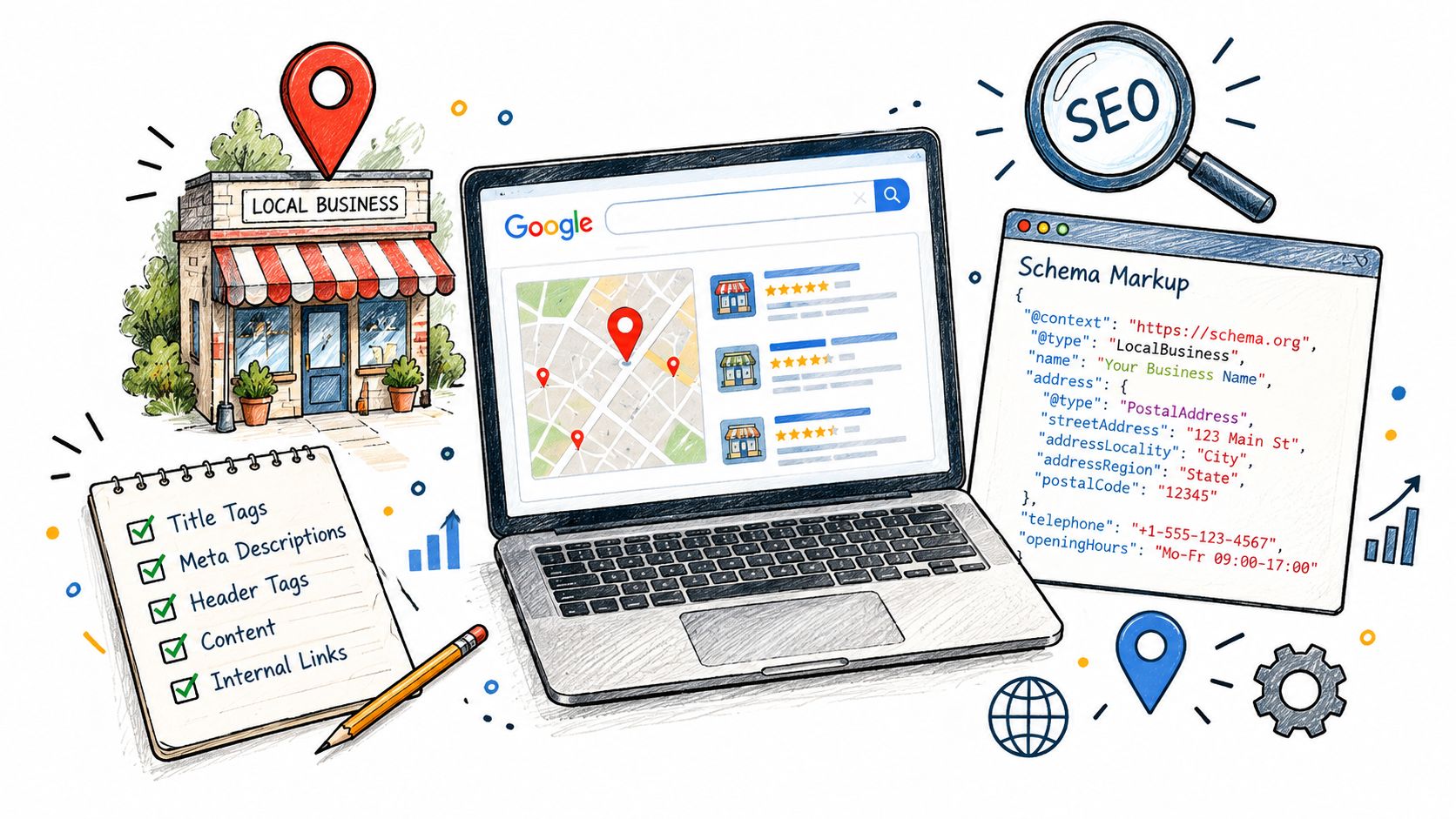
Each page should have a unique title tag and H1 that combine the service with the location naturally. A dentist serving three suburbs shouldn't place identical copy at three URLs and replace only the suburb name. Each page needs a distinct reason to exist.
For example, a practice could create separate pages for:
- Emergency dentistry in Suburb A, with local appointment information and access details.
- Family dentistry in Suburb B, with relevant services, transit guidance, and patient FAQs.
- Cosmetic dentistry in Suburb C, with treatment information and locally relevant proof.
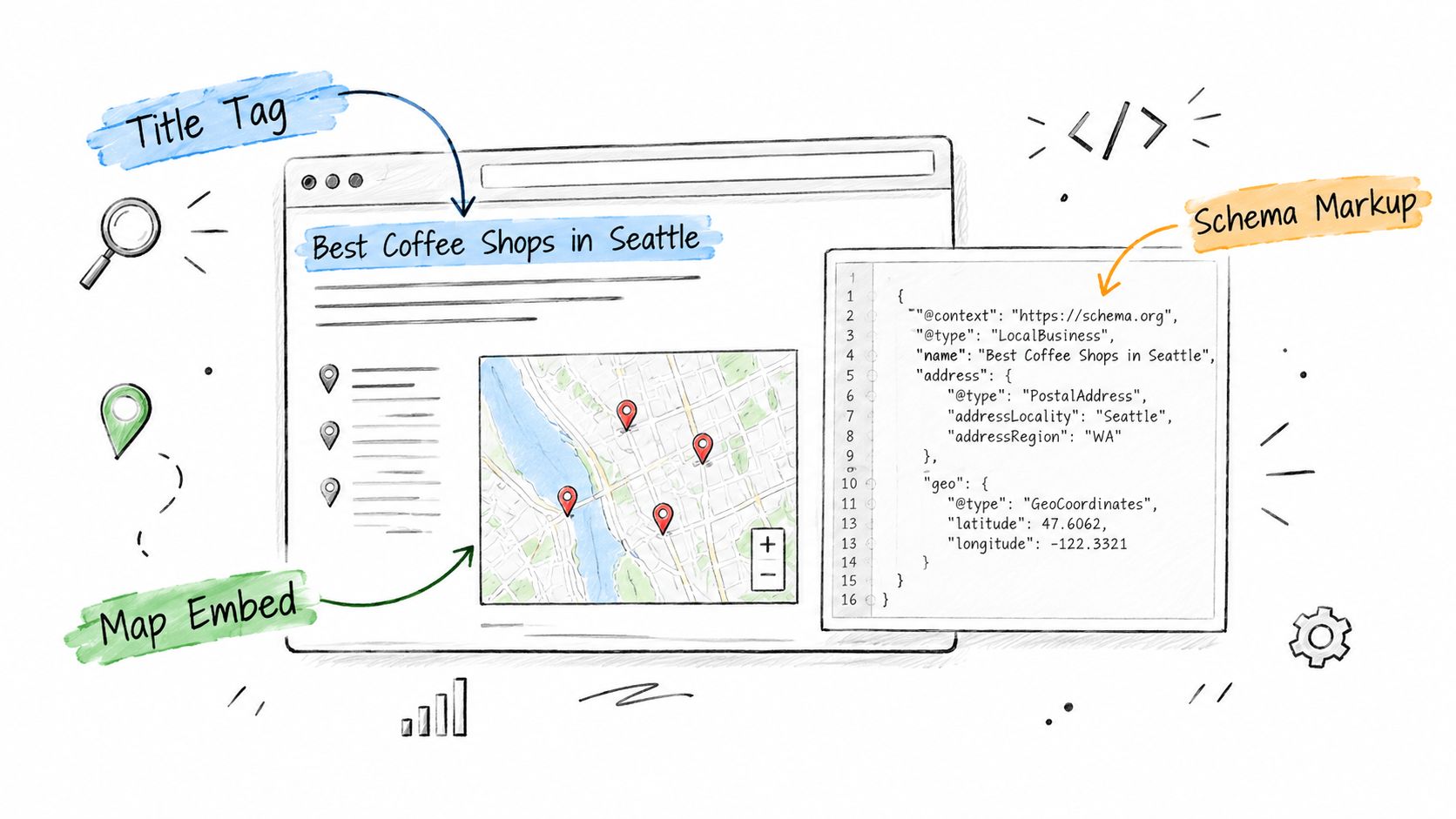
Each page should use a unique introduction, an embedded map where appropriate, accurate contact information, dentist-specific schema, and internal links from relevant neighborhood resources. A blog post about oral health events in Suburb B can link to the practice's family dentistry page using descriptive anchor text.
Make the entity legible to search systems
The footer and contact page should display the same name, address, and phone number as the profile in crawlable HTML. LocalBusiness JSON-LD can then describe the entity with verified information such as location coordinates, hours, areaServed, services, and review data. An aggregateRating field should come from genuine, verifiable reviews, not manually selected claims.
Schema doesn't replace relevance or authority. It reduces ambiguity. AI systems and search engines can interpret a clearly structured business more confidently when the website, profile, and third-party references describe the same organization.
Teams planning conversational discovery can also consult Nerdify's guide to voice search optimization for considerations around local trust signals, natural-language questions, and profile consistency.
Doorway pages and templated city spam create the wrong kind of scale. If a page offers no meaningful local information, no distinct service value, and no clear conversion path, more URLs won't solve the visibility problem. The better approach is fewer, stronger pages supported by internal links, accurate schema, and genuine local relevance.
Building Citations and Local Link Authority
Citations and links reinforce what the Google Business Profile and website already establish. They rarely compensate for incorrect hours, an unsuitable category, missing services, or weak review coverage. For classic local-pack visibility, profile accuracy and review signals carry more weight than a large citation count. Local organic visibility also depends on on-page relevance and authority. For AI-generated overviews, consistent references across directories, publishers, and community organizations help systems connect the business to the correct entity.
Use a tiered citation system
Choose one canonical NAP format first. Keep the business name, address, phone number, category, URL, and service details consistent, then publish them through directories in descending order of relevance and trust.
| Tier | Directory | Category Fit | Trust Score | Update SLA |
|---|---|---|---|---|
| Core aggregators | Data Axle | Broad business data | High | Quarterly |
| Core aggregators | Localeze | Broad business data | High | Quarterly |
| Core aggregators | Foursquare | Broad and location data | High | Quarterly |
| Vertical | Avvo | Legal practices | High | Monthly |
| Vertical | Houzz | Contractors and design | High | Monthly |
| Vertical | Healthgrades | Clinics and providers | High | Monthly |
| Local authority | Chamber of commerce | Community businesses | High | Quarterly |
| Local authority | BBB | Established local businesses | High | Quarterly |
| Local authority | Regional newspaper | Local relevance | Variable | Quarterly |
A working priority list may contain twenty rows, but it should not be twenty random submissions. Include core aggregators, strong vertical platforms, local organizations, and credible publications covering the target neighborhoods. Assign an owner and update schedule to each important listing. Low-trust directories can create duplicate or spam associations, so citation volume is not a substitute for authority or data quality.
Earn links through local relevance
Local links work best when they support a real relationship, resource, or event. A regional HVAC company could provide a seasonal maintenance guide to a property manager association, sponsor a community event, offer expert commentary to a journalist, or contribute data to a neighborhood publication. The outreach should explain the audience benefit, not frame the request as a ranking tactic.
A practical three-touch process looks like this:
- Build the prospect list: Include sponsors, suppliers, event organizers, local journalists, chambers, associations, and complementary businesses.
- Lead with value: Offer a useful guide, local story, community initiative, or expert contribution before asking for a link.
- Track coverage gaps: Map referring domains by neighborhood and service area, then find locations where competitors have local authority and the business has none.
Unlinked brand mentions provide another efficient source of opportunities. Each quarter, review articles, event pages, supplier references, and community posts that name the company without linking to its website. A short, courteous request can convert some mentions without producing another batch of thin content. Prioritize references that also identify the company's service, location, or relationship to the community, since those details strengthen entity clarity for both search results and AI summaries.
Turning Reviews into a Ranking and Conversion Lever
Reviews affect local-pack visibility and customer confidence, but review volume by itself is not a program. Review count, recency, velocity, rating quality, and topical relevance should develop together. Reviews and positive ratings can contribute to prominence, which supports local ranking, as noted in Google Business Profile guidance.
Design the request around the customer journey
Ask for a review at the point of satisfaction, not weeks afterward. For a service business, that trigger might be job completion, a successful installation, a resolved support issue, or a confirmed appointment outcome. Set targets by location and completed transactions, such as a defined share of finished jobs, instead of assigning an arbitrary monthly quota.
A short SMS containing a direct Google review link reduces friction. Email remains useful for customers who prefer more context, but every request should be direct, optional, and consistent with platform policies. Do not offer incentives for positive reviews or pressure customers to revise honest feedback.
Review quality also depends on operational consistency. Sudden clusters of generic five-star reviews, bursts from distant users, or accounts with only one review warrant investigation. The objective is a reliable record of customer experiences, not manufactured praise.
Make responses useful, not robotic
Owner responses serve both customer service and public reputation. Create frameworks for each service line, then tailor the opening to the customer's actual wording. A response to a drain-cleaning review could thank the customer for feedback about the emergency drain service and confirm that the issue was resolved promptly. Mentioning the service naturally supports entity clarity. Repeating keywords does not.
Response speed and specificity matter more than a large library of templates. Managers can use a simple review-activity view to identify gaps:
| Period | Review activity | Operational question |
|---|---|---|
| Days 1–30 | Requests begin after completed jobs | Are staff sending the link consistently? |
| Days 31–60 | Reviews arrive across more locations | Which service teams generate the strongest response? |
| Days 61–90 | Recency and topical coverage improve | Are responses timely and specific? |
Review language can also inform social media marketing for small businesses. Teams may reuse genuine customer themes in community content, provided they protect privacy and do not present reviews as fabricated endorsements. The same themes can reveal which services customers describe clearly, helping businesses strengthen entity-level signals without producing more generic content.
Measuring Local SEO Performance the Right Way
A ranking report can look healthy while the phone stays quiet. Impression totals can rise without producing qualified visits. Local SEO measurement should follow the entire query-to-action chain, from the search term to the profile interaction, website behavior, lead, and attributed revenue.
Replace visibility summaries with action paths
GBP Insights should be reviewed weekly, with actions segmented by query category rather than reduced to one total. The useful questions are operational:
- Which service queries produced calls?
- Which location-modified searches generated direction requests?
- Which profile views led to website clicks or bookings?
- Which service-area pages convert visitors from local searches?
- Which locations attract visibility but fail to convert?
GA4 can support first-touch analysis when GBP Posts use UTM-tagged links and call tracking distinguishes local landing pages from other acquisition sources. A hidden form field can preserve the original landing page or campaign context, while call-tracking numbers can connect conversations to the source that produced them.
Guardrail metrics protect data quality. A team can monitor NAP consistency across its top twenty citations, review response rate, and schema validation status. These metrics don't replace revenue reporting, but they explain why performance may move.
| Metric | Traditional View | Action-Driven View | Predicts Revenue? |
|---|---|---|---|
| Average position | Visibility snapshot | Position by service, ZIP code, and action | Only with conversion context |
| GBP impressions | Exposure | Impressions linked to calls, routes, or clicks | Weakly on its own |
| Website sessions | Traffic volume | Local sessions by landing page and lead quality | Yes, when tied to leads |
| Review count | Reputation total | Recent, relevant reviews by location | Often, when paired with conversion data |
| Schema status | Technical checkbox | Valid entity data on revenue pages | Indirectly |
| Qualified actions | Dashboard total | Calls, bookings, forms, and directions from local queries | Yes |
A one-page monthly scorecard should show qualified actions, conversion rate, and attributed revenue, followed by a short explanation of the week-over-week movement. Average position can remain in the appendix. It shouldn't lead the meeting unless the team can connect it to customer behavior.
Your 90-Day Local SEO Rollout and Next Steps
A local SEO program gains momentum when the business ships improvements in the order that customers and search systems experience them. The rollout below separates foundation work from entity development, reputation, authority, and measurement.
Days 1–15 establish control
The opening phase should produce a complete audit, a canonical NAP record, and a verified Google Business Profile for each legitimate location. The team should also capture baseline data from Google Search Console, GBP Insights, and call tracking, including current qualified actions and the landing pages associated with them.
The deliverable isn't a presentation. It's a prioritized backlog. Profile errors, wrong phone numbers, missing service pages, and verification problems should receive owners before lower-impact content tasks enter the queue.
Days 16–45 strengthen the entity
The second phase adds or improves service-area pages, implements LocalBusiness schema, fixes internal links, and completes the first citation pass through the priority directory list. Each page should serve a distinct service and location need. Thin templates should be consolidated or rewritten rather than multiplied.
Teams can use a structured digital marketing plan template to assign responsibilities, dependencies, review dates, and reporting owners across marketing, operations, development, and customer service.
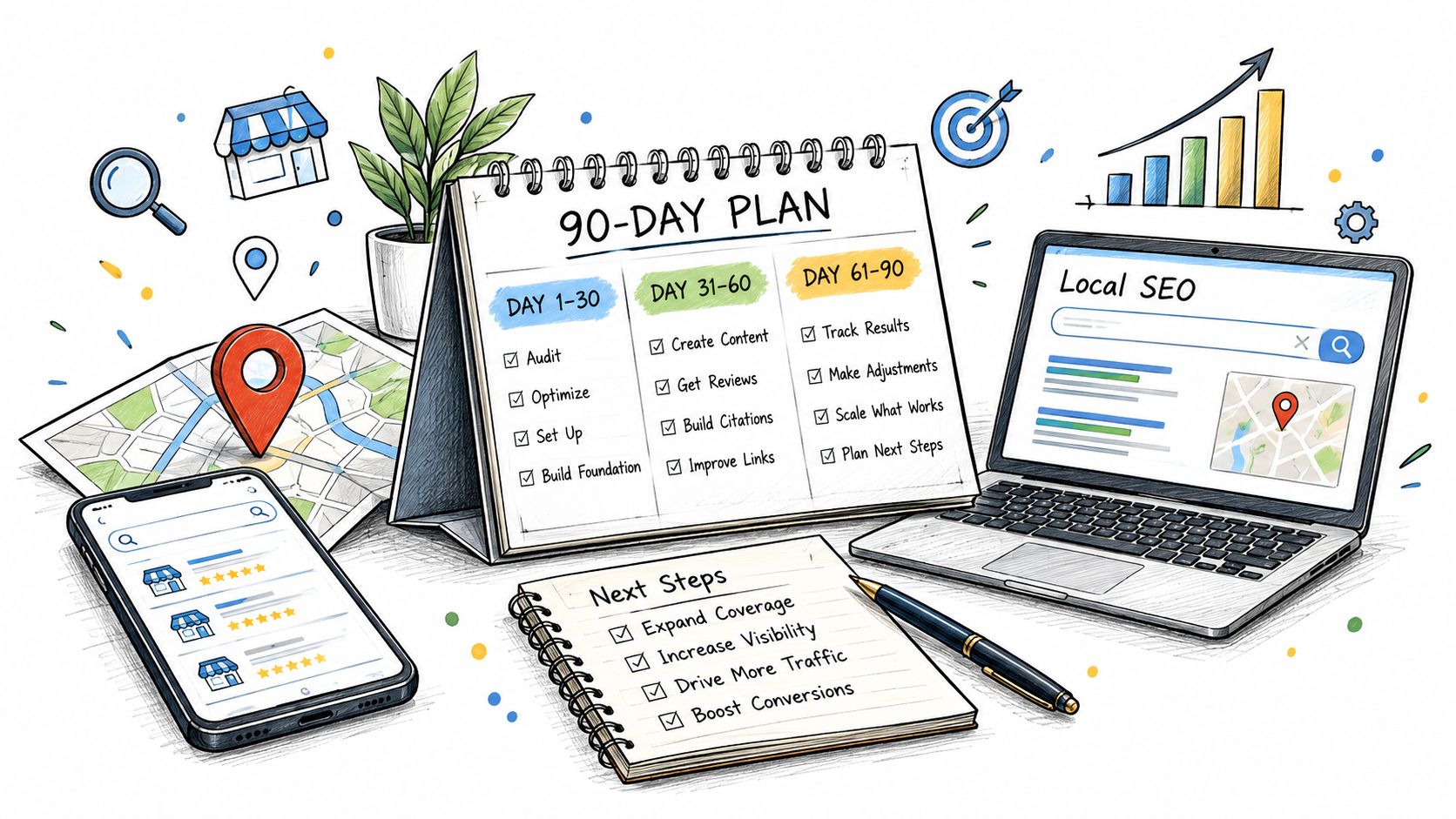
Days 46–75 activate trust and authority
The third phase puts the review workflow into daily operations, launches local link outreach, and publishes Google Posts tied to genuine seasonal offers or service updates. Customer-facing teams need clear prompts and escalation rules so review requests and responses don't depend on one marketer remembering them.
The business should also monitor broader entity consistency. AI Overviews and other AI surfaces can appear before traditional results, so visibility increasingly depends on coherent references across profiles, directories, review language, local publications, and the company's own website. One 2026 study reported AI Overviews in 68% of local searches, compared with 39% for the classic local pack, while a separate source reported 27.2% of U.S. search traffic as zero-click, up from 24.4% in March 2024 (2026 local SEO trend coverage). Those figures are source-reported and future-dated relative to earlier local-search benchmarks, so teams should treat them as directional signals rather than a reason to abandon map-pack fundamentals.
Days 76–90 turn findings into the next quarter
The final phase reviews the query-to-action dashboard, removes or improves underperforming service pages, validates schema, checks profile changes, and defines the next quarter's local content and outreach priorities. The operating question is whether each location is easier to find, easier to trust, and easier to contact.
Nerdify can complement this internal playbook with nearshore digital marketing and SEO services, while the business retains strategic ownership of its positioning, data, and customer experience. With more than nine years of experience, over 100 projects, and work across ten countries, Nerdify also provides web and mobile development, UX/UI design, and nearshore staff augmentation for teams that need execution capacity across digital initiatives.
Nerdify helps growing businesses improve local search foundations through SEO, digital marketing, website development, and UX/UI work that connects discovery to conversion. Its nearshore teams can support profile and entity data projects, service-area website improvements, schema implementation, and ongoing performance measurement. Visit Nerdify to discuss a local SEO optimization project and define the right delivery team.