Mobile App Development for Startups: A Practical Guide
Before you write a single line of code, your app's success or failure has already begun. The real work of building a great mobile app for a startup starts with a solid strategic blueprint. It’s about turning your big idea into a real plan that an investor could get behind. This means getting brutally honest about who your user is, what problems they actually have, and how your app will solve them.
Building Your App's Strategic Blueprint

When you first start, it's so tempting to jump right into designing cool-looking screens and making a long list of all the features you want. I've seen countless startups make this mistake. The ones who succeed pump the brakes. They put their energy into the foundation first—the "why" and "for whom" behind the app.
Getting this planning phase right is the single best way to avoid burning through your cash and time. You're not just trying to build an app; you're trying to fix a real problem for a specific group of people. Building something just because it seems like a cool trend is a fast track to an empty bank account. Your first job is to get out of your own head and prove that your idea solves a genuine pain point in the market.
Who Is This For? Defining Your User and Their Journey
You can't solve a problem if you don't know the person who has it—and I mean really know them. This is where creating detailed user personas is a game-changer. Forget vague demographics. A good persona is a story about a real person.
Let's say you're building a budgeting app. Your user isn't just "millennials." No, your user is "Alex, a 28-year-old freelance designer who can't keep track of his unpredictable income and gets hives just thinking about complicated financial software." See the difference? That level of detail becomes your North Star for every decision, from the user interface to your marketing ads.
With "Alex" in mind, you can map out their entire journey:
- Discovery: Where does Alex hang out online? How will he find out your app exists? A targeted Instagram ad? A review on a design blog?
- Onboarding: What's the fastest, most painless way to get Alex signed up and seeing value? No 12-step processes.
- Core Action: What's the one thing he must do? Maybe it’s connecting his bank account and categorizing his first ten expenses in under two minutes.
- Retention: What brings him back? Is it the weekly spending insights that pop up? Or the feeling of control he gets from the clean dashboard?
Sizing Up the Competition (The Smart Way)
Looking at your competitors isn't about copying their feature list. A smart competitive analysis is about finding their weaknesses and turning them into your strengths. You're not just looking at what they do; you're hunting for what they don't do well.
Here’s a pro tip: go read their one-star reviews in the app stores. They are absolute gold. If you see dozens of people complaining that the leading competitor’s app is confusing or that their customer support is non-existent, you've just found your opening. That's a powerful differentiator you can build your entire brand around.
To give you a clearer picture, here’s a quick checklist to guide your initial planning phase before you even think about code.
Initial App Planning Checklist for Startups
| Planning Stage | Key Action | Question to Answer |
|---|---|---|
| Idea Validation | Conduct user interviews and surveys. | Does my solution solve a real, urgent problem for a specific group? |
| User Persona | Create a detailed profile of the ideal user. | Who am I building this for, and what are their daily challenges? |
| Market Analysis | Research competitors and market size. | What are competitors missing, and is the market big enough? |
| User Journey | Map the user's path from discovery to retention. | What does the ideal experience look like from the user's perspective? |
| Monetization | Define the revenue model (e.g., subscription, freemium). | How will this app make money in a way that feels fair to the user? |
Getting this blueprint right sets you up for everything that comes next.
A critical part of the initial strategy is understanding the broader market dynamics. The mobile app market is not just growing; it's exploding with opportunity for those who plan correctly.
This market momentum is precisely why a strong blueprint is non-negotiable. The mobile app market in the United States alone is projected to hit around $80.92 billion by 2025. That incredible growth means the competition is fierce, and you have to be sharp from day one.
A solid plan is also the bedrock of your product roadmap, helping you make smart choices about what to build first. To get a head start, check out our guide on how to create a product roadmap. And don't forget the small stuff—I’ve seen founders get a lot of clarity by validating your startup's name before the serious development work begins.
Choosing Your Tech Stack and Development Team
With your strategic blueprint in hand, you've reached a critical fork in the road. The technical decisions you make next will have a huge impact on your budget, timeline, and the ultimate quality of your product. This isn't just about picking programming languages; it's about choosing the right tools and, more importantly, the right people to bring your vision to life.
These choices are fundamental to effective mobile app development for startups. A mismatch here can create technical debt that slows you down for years. Let's break down the two biggest decisions you'll face: picking your technology and structuring your team.
Native vs. Cross-Platform Development
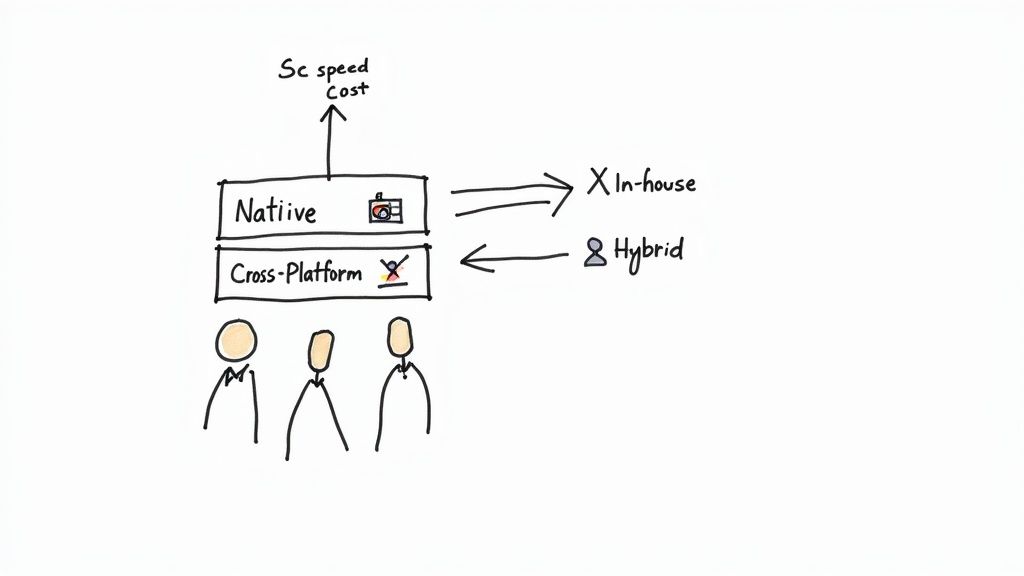
The first big question is how your app will be built. Do you create separate, dedicated apps for iOS and Android (Native), or use a single codebase that works on both (Cross-Platform)? Each path has serious trade-offs, especially for a startup.
I've seen countless founders agonize over this. Here's how I break it down:
Native Development: This means using the platform's "native" language—Swift for iOS and Kotlin for Android. This approach delivers the absolute best performance, seamless access to device features like the camera and GPS, and the most polished user experience. The catch? It's expensive and slow, since you're literally building and maintaining two separate apps.
Cross-Platform Development: Using frameworks like React Native or Flutter, your team can write the code once and deploy it on both platforms. This can slash development time and costs, which is a massive win for startups trying to launch a Minimum Viable Product (MVP) quickly. The trade-off is sometimes a slight dip in performance and occasional headaches when accessing very specific device functions.
For a direct comparison, this table lays out the core differences from a startup's perspective.
Native vs. Cross-Platform: A Startup's View
| Factor | Native Development (iOS/Android) | Cross-Platform (React Native/Flutter) |
|---|---|---|
| Performance | Highest possible. Smooth, fast, and responsive. | Very good, but can lag behind native for graphically intense tasks. |
| Cost | High. You're paying for two separate development teams/efforts. | Lower. One codebase and one team means significant cost savings. |
| Speed to Market | Slower. Building two apps takes nearly double the time. | Much faster. Ideal for getting an MVP to market quickly. |
| User Experience (UX) | Best. Follows OS-specific design guidelines perfectly. | Good. Can mimic native look and feel, but small inconsistencies may exist. |
| Maintenance | Complex. Two codebases to update, bug-fix, and maintain. | Simpler. Fix a bug once, and it's fixed on both platforms. |
Ultimately, this decision hinges on your specific needs.
For a startup, the choice often comes down to balancing speed and budget against raw performance. If your app is a high-performance game or relies heavily on complex device hardware, native might be non-negotiable. For most content-driven or utility apps, cross-platform offers a much faster path to market validation.
For a deeper dive, our guide on how to choose a technology stack provides a complete framework to help you make this critical decision.
Structuring Your Development Team
Once you know how you'll build the app, you need to decide who will build it. As a founder, you have three main paths, each with its own balance of cost, control, and access to talent.
The In-House Team: Hiring full-time developers gives you maximum control. This team lives and breathes your product, which is invaluable for long-term iteration. The major downside is the staggering cost and time sink of recruiting, salaries, benefits, and management overhead.
Full Outsourcing: Handing the project over to a development agency gives you access to a complete team of experts—developers, designers, project managers—from day one. This can be fast and efficient, but it often requires a big upfront investment and can leave you with less direct control over the day-to-day work.
Nearshore Staff Augmentation (The Hybrid Model): This approach offers a powerful middle ground. You maintain a core in-house team (like a CTO or product manager) and supplement them with specialized talent from a nearshore agency. This gives you the flexibility to scale your team up or down, control costs, and access skilled developers in similar time zones without the full overhead of hiring.
This hybrid model is incredibly effective for startups. It lets you keep strategic control in-house while tapping into specialized skills for specific project phases—blending the stability of a core team with the flexibility of outsourcing.
The good news is that the app development field is bustling with talent. Globally, the total number of active mobile developers exceeds 1.2 million. And with the Google Play Store expected to host about 2.06 million apps in 2025 and roughly 65% of its developers being independent or from small studios, startups are the engine of this ecosystem. Understanding these trends helps you tap into a vast talent pool. You can discover more insights about mobile app download statistics on tekrevol.com.
Scoping Your Minimum Viable Product The Smart Way
The term Minimum Viable Product (MVP) gets thrown around so much in startup circles that its real power is often misunderstood. An MVP isn't just a stripped-down version of your app built on a shoestring budget. It's a strategic weapon.
Its entire purpose is to learn as much as you can about your users with the least amount of time and money invested. Think of it as a scientific experiment. Your big idea is the hypothesis, and the MVP is how you prove it in the real world, with actual users, before you go all in. The goal is validation, not perfection.
The single biggest mistake I see founders make is falling in love with their feature list. They get excited and try to cram every "nice-to-have" idea into the first version. What they launch is a bloated, confusing app that doesn't solve one single problem exceptionally well. An MVP forces you to be ruthless with your own ideas.
Prioritizing Features with Purpose
So how do you decide what makes the cut? The secret is to stop asking, "What can we build?" and start asking, "What must we build to prove people want this?"
For this, you need a framework. One of the best and most practical I've ever used is the MoSCoW method. It’s a dead-simple way to categorize every potential feature, forcing you to make the hard calls.
Here’s the breakdown:
- Must-Have: These are the absolute, non-negotiable core features. Without them, your app is broken or useless. If you're building a ride-sharing app, seeing a map and booking a ride are must-haves.
- Should-Have: These are important and add a ton of value, but the app can launch without them. For that ride-sharing app, saved destinations or sharing your ETA would be a should-have.
- Could-Have: Think of these as the "bells and whistles." They're desirable but have a minimal impact on the core function. A custom user profile avatar would be a could-have.
- Won't-Have (This Time): This is the most important category for keeping your project on track. It's a list of features you are explicitly not building for this version. This is your defense against scope creep.
Your final MVP scope should be almost entirely "Must-Haves." Maybe, just maybe, you can sneak in a "Should-Have" if it’s a key differentiator, but that's it. This process forces the honest, tough conversations that save you from building a product nobody needs.
The Single-Problem Focus
A successful MVP doesn’t solve ten different problems. It solves one core problem brilliantly for a very specific type of person. This focus is your superpower as a startup.
Your MVP should feel like a painkiller, not a vitamin. It needs to solve an immediate, acute problem for your target user so effectively that they are willing to overlook its initial imperfections.
When Dropbox first launched, it didn't have fancy collaboration tools or advanced security. It did just one thing, but it did it perfectly: it synced a file from your desktop to the cloud. That was the painkiller. Everything else came later, based on what users actually wanted.
This laser focus doesn't just simplify development; it makes your marketing crystal clear. You become "the app for X," which is far more powerful than being "another app that does a bit of everything."
Planning for Post-Launch Learning
Launching your MVP is the starting line, not the finish. Now the real work starts: gathering feedback, learning, and iterating. Before a single line of code is written, you need a plan for how you're going to collect and analyze user data.
Your feedback loop should be a mix of both hard numbers and real conversations:
- Quantitative Data: Use analytics tools to see what people are actually doing. Are they using your core feature? Where are they getting stuck? High drop-off rates tell you what's wrong.
- Qualitative Feedback: Get on the phone. Send simple surveys. Talk to your earliest users and find out why they do what they do. This direct communication tells you why things are going wrong.
This combination of data and direct insight is pure gold. It takes the guesswork out of your roadmap and ensures the next things you build are features your users are practically begging you for. This is what separates the startups that make it from those that burn out building something for an audience of one.
Bringing Your App to Life: Development, Testing, and Launch
Alright, you’ve carved out your MVP scope. The theoretical part is over, and now the real work begins—turning that focused set of features into a product people can actually use. This is where code gets written, bugs get squashed, and your vision finally starts to feel real.
Managing the actual mobile app development for startups is a balancing act. You need a solid process, but the startup world is too unpredictable for rigid, year-long plans. The most successful teams I've seen are the ones that can build, learn, and pivot quickly, ensuring they never lose sight of what their users actually want.
Move Fast and Don't Break Things (Much): The Agile Way
Forget those old-school "waterfall" plans where everything is mapped out for a year in advance. That model is a death sentence for startups. Instead, you need to live and breathe Agile development. This is all about breaking the project into small, manageable pieces of work, usually called sprints.
A typical sprint is a two-week cycle with a crystal-clear goal, like "build the user login flow" or "integrate the payment gateway." It creates a rhythm of constant progress and gives you regular opportunities to change course if needed.
Here’s what that looks like in practice:
- Daily Stand-ups: A quick, 15-minute huddle every morning. Everyone shares what they did yesterday, what's on their plate today, and—most importantly—what's blocking them. It's the best way to keep the team aligned and solve problems before they snowball.
- Sprint Reviews: At the end of each two-week sprint, the team shows off what they’ve built. This isn't a slide deck; it's a live demo of working software. This is your chance as a founder to see real progress and give immediate, hands-on feedback.
- Retrospectives: After the demo, the team huddles up to talk about what went well and what didn't. This culture of constant, small improvements is the secret sauce to a high-performing team.
This cycle of build-review-improve prevents you from spending six months building in a vacuum, only to find out you've built the wrong thing.
Quality Assurance: Your Startup’s Secret Weapon
I’ve seen so many founders get impatient and try to rush through Quality Assurance (QA). It feels like a bottleneck when you're racing to launch. Trust me on this: it's a catastrophic mistake. A buggy, crash-prone app will get you a flood of one-star reviews you can never recover from.
QA isn't just about finding bugs; it’s about defending the user experience. It's your product's immune system, catching problems before they ever reach a customer.
Think of QA as an investment, not a cost. Every bug you catch before launch saves you from losing a user—and potential revenue—after launch. On day one, a polished, stable product is your single greatest marketing asset.
For a startup, testing needs to hit a few different angles. If you want a deep dive into the whole journey, from planning to launch day, this guide on developing a social media app from idea to launch is a great resource.
At a minimum, make sure your QA process covers these four bases:
- Functional Testing: Does the app actually do what it’s supposed to? Every button, every flow, every feature gets checked against the requirements.
- Usability Testing: Is the app easy and intuitive to use? Get it in front of real people. Watch where they get stuck or confused. You’ll be amazed at what you learn.
- Performance Testing: How does the app handle pressure? Testers check for speed, responsiveness, and how much battery it drains. A slow, resource-hungry app is the first to get deleted.
- Compatibility Testing: Does it work on an old iPhone SE as well as the latest Google Pixel? Your app has to perform consistently across a jungle of different devices, screen sizes, and OS versions.
The Final Mile: Getting into The App Stores
After all that hard work, you're finally ready to submit your app to Apple’s App Store and the Google Play Store. This can be a nail-biting experience because a rejection can throw your whole launch timeline off track.
Both platforms have pages and pages of guidelines, but a few common mistakes trip up most first-time founders. Pay close attention here:
- Nail Your Store Listing: This means your app name, description, keywords, privacy policy, and especially your screenshots. Don't phone it in. Incomplete or sloppy listings are a red flag for reviewers.
- No "Coming Soon" Features: If you have a button that leads to a dead end or a "coming soon" page, Apple will almost certainly reject you. The app you submit must be a complete, working product.
- Provide a Demo Account: This is such a simple thing, but so many people forget it. If your app requires a login, you must provide valid demo credentials for the review team. Forgetting this is an automatic rejection.
The Google Play review is usually pretty quick, often just a few days. Apple's process is much more thorough and can take anywhere from a day to over a week. You absolutely have to bake these potential delays into your marketing and launch plans. That "Approved" email is one of the best feelings for a founder—it’s the official start of your app's journey.
Your Go-To-Market and App Scaling Strategy
Getting your app live in the store is a massive achievement, but let's be clear: that's the starting gun, not the finish line. The moment you launch, you’ve entered a new race—the race for users, engagement, and growth. This is where a smart go-to-market (GTM) strategy makes all the difference.
Great mobile app development for startups doesn't just stop with a successful deployment. It pivots into a growth phase, one that’s fueled by tactical marketing and a backend that can actually handle success. Your GTM plan is your playbook for turning those first hundred downloads into your first thousand loyal fans. It’s all about creating momentum right out of the gate.
Building Your Launchpad for User Acquisition
Forget about a massive, splashy ad campaign. Your initial marketing should be a series of precise, targeted efforts to find your tribe—the early adopters who will become your first evangelists. And this work starts long before you hit the “publish” button.
Get a head start by generating buzz in the niche communities you identified way back in the planning stage. Jump into the conversation on social media, in forums, and on platforms where your ideal users are already hanging out. Offering early access to a beta group not only provides incredible feedback but also makes those first users feel like insiders.
One of the most common mistakes I see is founders waiting until launch day to even think about marketing. Your first users are gold. They validate your entire concept and provide the social proof you need to attract everyone else. Start building that community months ahead of time.
Once your app is live, App Store Optimization (ASO) becomes your best friend. It’s basically SEO, but for the app stores. A well-optimized listing is the single biggest factor in getting your app discovered through search.
Here’s where to focus your ASO efforts:
- App Title & Subtitle: Don't just name it "FinTrack." Make it "FinTrack: Personal Budget Planner." Weave your most important keywords right into the title.
- Keywords: Do your homework. Find out what terms your audience is actually typing into the search bar and use all the available keyword space.
- Screenshots & Video: This is your digital storefront. Make it pop. Your first few screenshots need to scream your core value proposition and look incredibly polished.
- Ratings & Reviews: Gently encourage your early users to leave honest reviews. Good ratings are a powerful signal to both the store's algorithm and potential new users.
The Metrics That Truly Matter Post-Launch
You're about to be flooded with data. It’s tempting to get obsessed with "vanity metrics" like the total download count. It feels good, sure, but it tells you almost nothing about the health of your business. You need to track the numbers that signal a sustainable future.
Make sure your analytics are set up to track these critical KPIs:
- User Retention Rate: What percentage of people are still using your app a day, a week, or a month after downloading it? High retention is the strongest indicator of product-market fit.
- Daily & Monthly Active Users (DAU/MAU): This is the pulse of your app. A healthy, growing DAU/MAU ratio means you've built something sticky that people value.
- Customer Lifetime Value (CLV): On average, how much revenue does a user generate throughout their entire time with your app? Knowing this tells you exactly how much you can afford to spend to acquire a new customer.
- Churn Rate: This is the opposite of retention—the percentage of users who ditch your app over a certain period. Your mission is to keep this number as low as humanly possible.
For a deeper dive, our guide on creating a mobile app marketing strategy can give you a solid framework for building out your campaigns.
Architecting Your Backend for Viral Success
You could have the best marketing on the planet, but if your app crashes the second you get a flood of traffic, it's game over. This is exactly why a scalable backend isn’t an add-on; it’s a non-negotiable requirement. It’s the engine that ensures you can grow without blowing up.
Using cloud services like Amazon Web Services (AWS) or Google Cloud Platform is the standard for a reason. They let your server resources scale up or down automatically based on real-time demand. This means you’re not overpaying for idle servers, but you have the power to instantly handle a traffic spike from a feature on a major tech blog. This elasticity is what will help you survive your first taste of viral success.
The market for these technologies is absolutely exploding. The mobile application development platform market is set to grow from $243.5 billion in 2025 to $480.6 billion by 2030, largely because of the shift to cloud-native tools that help startups scale efficiently.
Answering Your Burning Questions About Startup App Development
Even the best-laid plans come with a healthy dose of uncertainty. When you're building an app, you're constantly juggling technical jargon, tough strategic calls, and the very real pressure of your budget. Let's cut through the noise and get straight to the answers for the most common questions we hear from founders.
Think of this as your personal cheat sheet. We've boiled down the key ideas into quick, practical insights to help you move forward with confidence.
How Much Does It Cost to Build a Startup App?
This is the big one, isn't it? The honest answer is: it depends. There’s no flat rate for innovation. The final price tag is a direct reflection of your app's complexity, the features you decide are essential for your MVP, and the kind of development team you bring on board.
For a focused MVP with its core functionality, you could be looking at a starting range of $40,000 to $80,000, especially when working with a nearshore team. But if your vision includes intricate custom animations, multiple third-party integrations, and a sophisticated back-end, that number can easily climb past $150,000.
The single most effective way to manage your budget is to be absolutely ruthless with your MVP scope. Your goal is to solve one core problem for your user, and solve it brilliantly. Every bell and whistle you add pushes your costs and timeline further out.
How Long Does It Realistically Take to Build an MVP?
Like cost, the timeline can vary. But for a well-defined MVP, you should generally plan for four to six months from the project kickoff to having your app ready for submission to the app stores.
That timeline isn't just one long sprint; it breaks down into a few key phases:
- Discovery & Design (1-2 months): This is where the foundation is laid. We’re talking about locking down the strategy, mapping out user flows, creating wireframes, and then bringing it all to life with a polished UI design.
- Development & QA (2-3 months): The longest stretch. This is heads-down coding, building out the features, and then trying to break everything through rigorous testing.
- Deployment & Launch (2-3 weeks): The home stretch. This involves final prep, submitting to the app stores, and navigating their unique review processes.
Trying to shortcut any of these stages almost always backfires. A rushed design phase leads to a confusing app that nobody wants to use. Skimping on QA guarantees a buggy launch that can tank your reputation from day one.
Should I Build for iOS or Android First?
For most startups, building for both platforms at once is a luxury you can't afford. The right choice comes down to one thing: your target audience. All that user persona research you did earlier? This is where it pays off big time.
- Choose iOS first if: Your ideal customers have more disposable income, are mainly in North America or Western Europe, or if your monetization plan involves in-app purchases or a paid download.
- Choose Android first if: You're aiming for a massive global audience, particularly in fast-growing markets like Latin America or Southeast Asia, and you plan to make money through ads.
There's a great middle ground, too. Using a cross-platform framework like React Native or Flutter lets you build for both iOS and Android from a single codebase. For many startups, this is the smartest move, offering the widest reach for your initial investment in mobile app development for startups.
Frequently Asked Questions
Still have questions? That's completely normal. Here are some quick-fire answers to other common queries we get from founders.
| Question | Answer |
|---|---|
| What's the biggest mistake startups make? | Scope creep. They try to build too many features for their V1 launch instead of focusing on a core, high-value problem. |
| Do I need a technical co-founder? | Not necessarily. A reliable development partner or agency can fill that role, providing the technical expertise you need to build and scale. |
| How much should I budget for marketing? | A common rule of thumb is to budget at least as much for marketing and user acquisition as you do for the initial app development. |
| What happens after the MVP is launched? | The real work begins! You'll be gathering user feedback, analyzing data, fixing bugs, and planning your V2 feature set. |
This is just the start of the conversation. Every startup's journey is unique, but being armed with the right information makes navigating the path a whole lot easier.