Boost Your Business with nearshore software development services

If you've ever struggled to find the right tech talent locally or dealt with the headaches of a 12-hour time difference with an offshore team, you've probably wondered if there's a better way. There is, and it’s called nearshore software development. It offers a powerful middle ground, giving you access to incredible talent in neighboring countries without sacrificing collaboration.
This model is all about finding that sweet spot between cost-efficiency, time zone alignment, and cultural similarity. It's a strategic move that can feel less like outsourcing and more like extending your own team.
What Are Nearshore Software Development Services?

Think of it this way: a company in New York needs a top-notch web development team. Instead of looking overseas, they partner with a firm in Costa Rica or Colombia. The teams are only one or two hours apart, so their workdays almost completely overlap. This small detail changes everything.
This proximity is what makes the nearshore model so effective. When your project manager can hop on a video call for a daily stand-up without anyone having to wake up at midnight, collaboration just works. Problems get solved in real-time, feedback loops are tight, and your project keeps moving forward.
The Strategic Shift to Nearshore
Nearshore development has grown from a simple cost-cutting trick into a core strategy for building strong, agile tech teams. Companies are realizing its value goes way beyond just a lower hourly rate. While the global software outsourcing market is huge—projected to hit around $897.44 billion by 2029—the nearshore slice of that pie is growing at an impressive clip of about 14.5% a year. Businesses are actively choosing it over traditional, far-flung offshore options. You can dive deeper into these trends in this detailed software development outsourcing report.
Nearshore development isn't just about finding cheaper developers; it's about finding the right talent in a collaborative environment that fuels agility and innovation without the logistical headaches of massive time zone gaps.
Key Characteristics of the Nearshore Model
So, what really sets a nearshore partnership apart? It boils down to a few core elements that make it such a practical choice for everyone from startups to large enterprises.
These defining features include:
- Geographic Proximity: Your partner is just a short flight away. This makes occasional in-person meetings for kick-offs or critical planning sessions not just possible, but easy.
- Time Zone Alignment: With 80-100% of your workdays overlapping, your teams can collaborate on the fly, just like they would if they were in the same office.
- Cultural Affinity: Shared work ethics, communication styles, and often language similarities mean fewer misunderstandings and a smoother, more natural working relationship.
- A Wider Talent Pool: You suddenly have access to a massive pool of skilled engineers, designers, and project managers that might be hard to find or afford in your own city.
At the end of the day, nearshore software development services offer a balanced, practical solution. You get the financial perks of outsourcing while keeping the close collaboration and control you'd expect from an in-house team.
The Strategic Advantages of Going Nearshore

Choosing nearshore software development isn't just a logistical decision; it's a strategic one that pays dividends in project speed, team collaboration, and your bottom line. The benefits create a powerful feedback loop that touches on everything from finances to talent.
Picture this: your product manager needs to join a daily stand-up. With a nearshore team, it’s a simple real-time call. Roadblocks get cleared on the spot, decisions are made quickly, and the project keeps moving.
Contrast that with a typical offshore model, where teams often wake up to a long list of questions from the day before. That creates a built-in 24-hour lag, slowing everything down. That real-time connection is the lifeblood of agile development, fostering a genuine sense of a single, unified team.
Unlocking Cost-Efficiency Without Compromise
Let’s be honest: one of the biggest draws to nearshoring is the cost savings. But this isn't about a race to the bottom. It's about finding incredible value—gaining access to senior-level engineering talent for a fraction of what you’d pay in a major US or European tech hub.
The numbers back this up. Some analyses show that nearshore development rates can be around 46% lower than onshore alternatives. That means you can get top-tier developers for almost half the price while still having them work during your business hours. In fact, industry-wide surveys show 59% of companies go nearshore specifically to cut operational costs.
This isn't just about saving money. It's about reallocating that budget toward innovation, marketing, or scaling other parts of your business. The savings become a direct investment in your company's growth.
The Power of Cultural and Time Zone Alignment
While the financial perks are clear, you can't overstate the impact of cultural and time zone alignment. When your external team shares similar communication styles and professional norms, collaboration just clicks. You spend less time navigating misunderstandings and more time building great products.
This alignment directly improves project outcomes:
- Faster Problem-Solving: An urgent bug pops up? You can get the right people on a call immediately instead of waiting a full day.
- Improved Team Cohesion: Shared cultural touchpoints and easy conversation build real trust, making the nearshore team feel like a true extension of your own.
- Streamlined Project Management: Agile rituals like sprint planning and retrospectives are far more productive when everyone is present and engaged at the same time.
For a deeper look at how this stacks up against other models, our guide on nearshore vs offshore outsourcing breaks it down even further.
Accessing a Global Talent Pool
Hiring locally can be a nightmare. It’s competitive, it’s expensive, and you’re limited to whoever happens to live nearby. Nearshore blows those walls down, opening up entire countries filled with highly skilled and experienced tech professionals.
This gives you a huge advantage:
- Find Niche Expertise: Need someone who’s an expert in a rare framework? Your odds of finding them are much, much higher when you broaden your search.
- Scale Your Team Quickly: As your project grows, a nearshore partner can bring in vetted professionals fast, letting you skip the months-long local hiring dance.
- Enhance Diversity of Thought: Bringing in talent from different backgrounds introduces fresh perspectives that can spark innovation and solve problems in new ways.
To really appreciate why nearshore hits the sweet spot, it helps to look at the whole picture by understanding the pros and cons of offshore outsourcing. That context makes it clear why the balance of cost, culture, and collaboration makes nearshore an ideal fit for modern, agile companies.
Exploring the World's Top Nearshore Tech Hubs
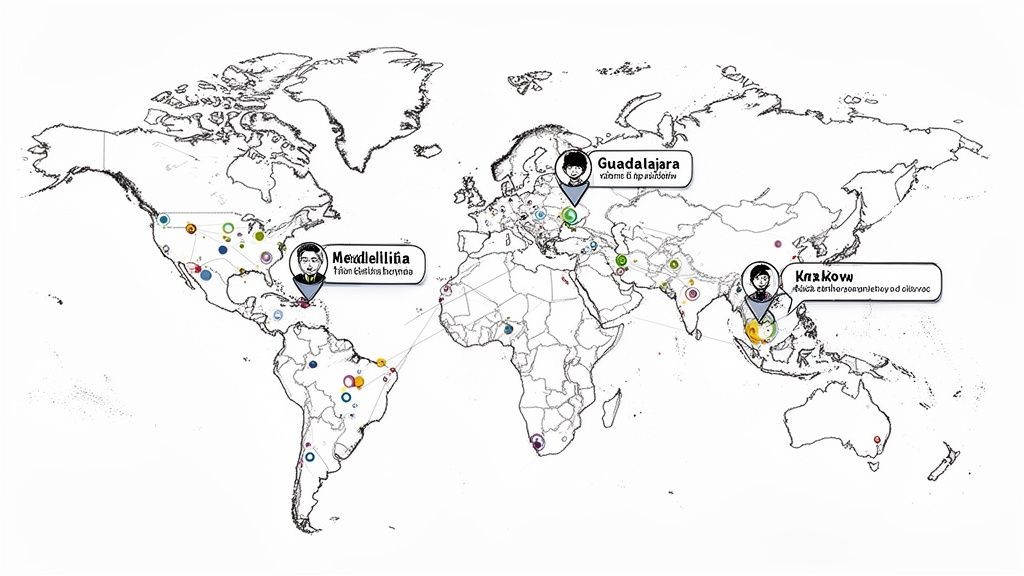
When you start looking for a nearshore partner, you’re doing more than just hiring a team; you’re plugging into a vibrant global tech ecosystem. Certain regions have exploded into nearshoring powerhouses, creating the perfect storm of engineering talent, fresh ideas, and business-friendly policies. Knowing what makes these hubs tick is key to finding the right skills for your project.
It’s easy to just look at a map, but the real story is in the why. What makes a place a tech hub? It's usually a mix of strong government backing for STEM education, active developer communities, and a deep pool of bilingual pros who are ready to jump in and collaborate. This means you're tapping into a stable, mature talent market—not just a temporary trend.
Latin America: The Go-To for North American Companies
For businesses in North America, Latin America has become the undeniable top choice for nearshore talent. The reasons are pretty clear: minimal time zone differences, strong cultural overlap, and a tech workforce that’s growing at an incredible pace. Cities all over the region are buzzing with innovation, fueled by both public and private investment.
This isn't just a hunch; it's a well-established trend, with countries like Mexico and Colombia leading the pack. Mexico alone has around 700,000 technology professionals and nearly 850 IT companies concentrated in hubs like Mexico City, Monterrey, and Guadalajara. For US and Canadian companies, this means direct access to a huge pool of Spanish-English bilingual talent that’s only one to three time zones away. You can find more details about the rise of LATAM tech hubs on teravisiontech.com.
Choosing a nearshore hub isn't just about geography; it's about aligning with an ecosystem that shares your work ethic, communication style, and drive for innovation. The right location feels less like an outsourced vendor and more like your company's second home.
A few standout tech centers in Latin America include:
- Guadalajara, Mexico: Often called Mexico's "Silicon Valley," it's a mature tech scene with a heavy focus on enterprise software and IT services.
- Medellín, Colombia: The city has completely transformed itself into a hub for software development, showing particular strength in mobile apps and creative tech.
- São Paulo, Brazil: As a massive economic engine, São Paulo offers a vast, diverse talent pool with serious expertise in fintech, e-commerce, and complex enterprise systems.
Eastern Europe: A Hub of Deep Engineering Expertise
Over in Europe, Eastern Europe offers an equally powerful nearshoring advantage. The region is legendary for its top-tier technical education, which consistently produces some of the most skilled and detail-oriented software engineers on the planet. You'll often find countries from this region dominating global programming competitions and developer skill rankings.
The emphasis here is squarely on deep technical mastery. You'll find a high concentration of specialists in fields like artificial intelligence, machine learning, blockchain, and complex backend architecture.
Key hubs in this region include:
- Krakow, Poland: A major IT outsourcing destination, Krakow is home to thousands of developers and hosts major R&D centers for global tech giants.
- Kyiv, Ukraine: Despite immense challenges, Ukraine’s tech scene has shown incredible resilience. It remains a powerhouse known for highly skilled engineers and a scrappy startup culture.
- Bucharest, Romania: With a fast-growing IT sector and excellent language skills, Bucharest has become a popular spot for businesses all across Western Europe.
Ultimately, getting to know these tech hubs gives you a much sharper picture of the global talent landscape. Whether you need the agile, collaborative energy of Latin America or the deep engineering discipline of Eastern Europe, your ideal nearshore partner is out there waiting.
How to Choose the Right Nearshore Partner
Picking a nearshore software development partner isn't just another procurement task—it's about finding a team that will function as an extension of your own. Get it wrong, and you're looking at blown deadlines, soaring costs, and a whole lot of frustration. But get it right, and you've found a long-term strategic asset that can genuinely accelerate your growth.
The trick is knowing what to look for.
A great way to cut through the sales noise is to think in terms of "green flags" and "red flags." This simple framework helps you evaluate a company's real-world capabilities and see if they’re a true partner or just another vendor trying to close a deal.
Identifying Green Flags in Potential Partners
Green flags are the good signs. They tell you that a company is professional, transparent, and genuinely invested in helping you succeed. These are indicators of mature processes and a collaborative spirit.
Here are the key green flags to watch for:
- A Portfolio of Similar Projects: A solid partner will be eager to show you case studies from projects that look a lot like yours—whether in industry, scope, or technology. It’s proof they’ve already navigated the kinds of challenges you’re facing.
- Transparent Pricing and Contracts: They should be able to give you a crystal-clear cost breakdown without any fuss. Vague numbers or hidden fees are a huge red flag. You also want to see flexible engagement models, which shows they can actually adapt to your needs.
- A Clearly Defined Communication Protocol: Ask them point-blank how they handle communication. A great partner will have a ready answer, detailing the tools they use (like Slack or Jira), their meeting schedule (daily stand-ups, weekly syncs), and who your main point of contact will be.
- Access to Key Team Members: You should be able to talk directly with project managers or senior developers during the vetting process. If the salespeople are gatekeeping the actual team, it's a warning sign. What are they hiding?
These signals help build the confidence you need to enter a partnership built on trust, not just a contract.
The ultimate green flag? A partner who asks you as many questions as you ask them. When they dig deep into your business goals, user needs, and success metrics, it shows they’re thinking about your long-term success, not just checking boxes on a work order.
Spotting Red Flags Before You Commit
On the flip side, red flags are serious warning signs that should make you hit the brakes. They often point to deeper issues with a company's process, culture, or even its stability. Ignoring them now will almost certainly lead to headaches later.
Tread carefully if you run into any of these:
- Vague Answers About Their Process: Ask them about their development methodology (like Agile or Scrum). If you get a fuzzy, generic answer, they probably don't have a structured process. A seasoned firm can walk you through every step, from discovery to deployment.
- Unwillingness to Provide Client References: Any company that’s proud of its work will have a lineup of happy clients ready to sing their praises. If they hesitate to connect you with references, it’s a good bet their past projects weren't as successful as they claim.
- High Employee Turnover Rates: This one can be tricky to spot, but you can ask about team stability or do a little digging on professional networking sites. High turnover is a recipe for project disruption and often signals internal problems.
Making the right choice also means understanding the different ways you can work together. For example, you need to know if you require staff augmentation or a fully managed project team. Our guide on staff augmentation vs outsourcing models breaks down the differences to help you decide what's best for you.
At the end of the day, finding a nearshore partner is a two-way street. The technical skills are non-negotiable, but it’s just as important to find a team whose culture and values click with your own.
Integrating Your Nearshore Team for Success

So, you’ve signed the contract. That’s a great first step, but the real work is just getting started. The success of this whole venture depends on how you bring your nearshore team into the fold.
Don’t think of them as isolated contractors. The goal is to make them feel like a genuine extension of your in-house crew. This integration process really sets the tone for the entire partnership.
Think of it like merging two high-performing sports teams. Each has its own playbook and star players, but they won't win together until they practice, communicate, and operate as a single unit. Those first 90 days are absolutely critical for building this shared rhythm and establishing a foundation of trust.
This isn't just about sending over login credentials and a project brief. It’s your chance to move from a contractual agreement to a real collaborative partnership. That means having a deliberate onboarding plan that gets everyone aligned on goals, processes, and expectations from day one.
Structuring Your Collaboration Model
Before you get bogged down in workflows, you need to decide how you'll actually work together. The right model is completely dependent on your project's needs, what your internal team can handle, and your long-term goals. Picking the wrong one can create a lot of friction down the line.
For nearshore software development services, two engagement models stand out as the most common and effective: staff augmentation and dedicated teams.
- Staff Augmentation: This is your go-to when you have specific skill gaps on your existing team. You bring in one or more nearshore developers who report directly to your project manager, essentially becoming temporary members of your squad. It’s flexible, it scales easily, and it’s perfect for adding firepower without the commitment of a full-time hire.
- Dedicated Team: With this model, your nearshore partner provides a complete, self-managed team—developers, QA testers, a project manager, the works. This team is 100% focused on your project, acting as its own unit that works toward your strategic goals. It’s the ideal choice for large-scale projects or when you need to build a product from the ground up without distracting your core team.
Figuring this out first helps structure the relationship in a way that truly supports your project’s demands.
Building Your Integration Roadmap
With the engagement model decided, it’s time to map out a tactical integration plan. The main goal here is to eliminate any ambiguity and create a seamless workflow where information flows freely between everyone. Your plan should cover three key areas: communication, tools, and performance metrics.
You can't overstate the importance of communication. It's the glue that holds everything together. Look into the top remote team communication tools to bridge any physical distance. Shared channels in platforms like Slack are essential for solving problems in real-time and just making everyone feel like part of the same team.
Similarly, a shared project management tool like Jira is non-negotiable. It creates a single source of truth for tasks, progress, and priorities. This ensures everyone, no matter their location, is working from the same playbook.
The success of a nearshore partnership is directly proportional to how well it's integrated. Treat your nearshore developers with the same respect, transparency, and inclusion as your local team, and they will become invaluable, long-term contributors to your success.
Finally, define your Key Performance Indicators (KPIs) right from the start. This isn't about micromanagement; it's about making sure everyone is on the same page. Clear metrics ensure the whole team understands what success looks like and can pull in the same direction.
Here are a few essential KPIs to establish:
- Velocity: How much work does the team complete in a sprint? This helps you gauge productivity and makes future planning more predictable.
- Cycle Time: How long does it take for a task to go from "in progress" to "done"? This is great for spotting bottlenecks in your process.
- Code Quality: Keep an eye on metrics like bug counts or feedback from code reviews to maintain high standards.
- On-Time Delivery: A straightforward but crucial metric. Is the team consistently meeting deadlines and commitments?
By setting up these pillars—a clear engagement model, unified tools, and shared metrics—you stop seeing your nearshore talent as just a resource. They become a powerful, fully integrated strategic partner.
Managing Common Risks in Nearshore Development
While nearshore software development offers a ton of benefits, let's be realistic—any partnership has its potential bumps in the road. Acknowledging these hurdles upfront is what separates a good engagement from a great one. Smart risk management isn't about hoping problems don't happen; it's about having a solid game plan for when they do.
Most of the time, anxieties boil down to three main areas: communication breakdowns, intellectual property (IP) security, and quality control. Without a clear strategy, a simple misunderstanding can escalate, your valuable IP might feel vulnerable, and the final product could miss the mark. The good news is that these are known challenges, and an experienced nearshore partner will have built-in safeguards from the very beginning.
Fortifying Communication and Protecting IP
Great communication is the foundation of any successful nearshore project. Even when you're only a few hours apart, things can get lost in translation. The fix? Lock down a disciplined communication protocol right from the start.
This isn't just about sending emails. It means having:
- Daily Stand-ups: These are non-negotiable. Quick, real-time meetings are essential for tracking progress and clearing roadblocks before they become bigger problems.
- A Single Source of Truth: Everyone should live in the same project management tool, whether it's Jira or Asana. It keeps all tasks and progress transparent.
- Dedicated Points of Contact: You need clear project leads on both sides. This simple step cuts through the noise and makes decision-making much faster.
Protecting your intellectual property is just as important. Your code, data, and business logic are core assets. This is where strong legal agreements and secure operational practices come in. Any reputable partner will insist on signing a detailed Non-Disclosure Agreement (NDA) before you share a single sensitive file. This is your legal guarantee that your trade secrets stay secret.
A robust risk management strategy isn't just about legal documents; it's embedded in the daily operations of your nearshore team. It’s the combination of clear communication, secure practices, and a culture of accountability that truly protects your investment.
Upholding Quality and Ensuring Consistency
High-quality code is never negotiable. When you bring in an external team, you have to be confident that the software they build is stable, scalable, and easy to maintain down the line. A structured quality assurance (QA) process is the only way to guarantee that.
An effective QA strategy isn't a single step but a multi-layered approach:
- Peer Code Reviews: Before any code gets merged, another developer—usually a senior one—should review it. This catches errors early and ensures everyone is sticking to best practices.
- Automated Testing: Your team should be writing unit, integration, and end-to-end tests that run automatically. This is your safety net against new features breaking old ones.
- Regular Audits: Periodically, the team should step back and audit the codebase for security vulnerabilities, performance bottlenecks, and overall health.
By building a transparent, structured approach to tackling these common concerns, you can head off most risks before they become real issues. For a deeper dive into building a truly resilient project, check out our complete guide on software project risk management. This proactive mindset is what allows a nearshore partnership to deliver incredible results.
Got Questions About Nearshore? We've Got Answers.
Even after you're sold on the idea of nearshore development, a few practical questions always pop up. It's only natural. Let's tackle some of the most common ones to clear up any lingering doubts you might have.
Think of this as the final once-over before you take the plunge.
Is This Just Like Hiring Remote Freelancers?
Not at all. While both involve talent outside your office walls, the two models are worlds apart in practice.
When you hire a freelancer, you're on your own. You're the one hunting for talent, vetting skills, handling payments, and dealing with all the legal paperwork for individual contractors. It's a very tactical, often disjointed approach that can become a major headache to scale.
Partnering with a nearshore firm is a whole different ballgame. You get a fully managed, cohesive team that’s ready to go. The nearshore company takes care of all the HR, admin, and infrastructure headaches. This gives you stability, better security, and a single point of accountability, letting you focus on building a great product, not managing logistics.
The real difference comes down to structure. A nearshore partner provides a strategic, managed team. Freelancers offer a tactical, individual solution.
What Does the Pricing Actually Look Like?
Most nearshore providers offer a few different ways to engage, so you can pick a model that aligns with your budget and how flexible you need the project to be. Getting your head around these options is key to making a smart financial choice.
Here are the usual suspects:
- Staff Augmentation: You pay a simple, fixed monthly rate for each developer you add to your existing team. This is perfect when you have specific skill gaps to fill but want to keep managing the project directly.
- Dedicated Team: You pay a fixed monthly price for a complete, self-sufficient team—think developers, QA engineers, and a project manager. This is the go-to model for bigger projects where you need a focused group working solely on your product.
- Project-Based: You and the partner agree on a fixed price for the entire project, which has a very clearly defined scope and set deliverables. This gives you the most predictable budget, but it's less wiggle room if your requirements suddenly change.
How Can I Be Sure the Code Quality and Security Are Top-Notch?
Any nearshore firm worth its salt builds quality and security into its process from day one—it's not just a box to check at the end. They know your intellectual property and reputation are on the line.
When it comes to quality assurance, the best partners have a multi-layered approach. They start with a tough vetting process for developers, enforce senior-led peer code reviews, and stick to strict coding standards. They'll also lean heavily on automated testing to squash bugs early and keep the codebase clean.
For security, everything starts with a rock-solid Non-Disclosure Agreement (NDA) to protect your ideas. From there, their teams follow secure coding practices to prevent vulnerabilities and ensure they’re fully compliant with data privacy laws like GDPR. Don't be shy—always ask a potential partner to detail their exact QA and IP protection protocols.