10 Actionable Pieces of Project Management Advice for 2026
In today's fast-paced competitive market, translating a brilliant idea into a successful product requires more than just technical skill; it demands exceptional project management. For startups, SMEs, and technology leaders, the difference between launching a game-changing app and a costly failure often lies in the execution. From defining a rock-solid scope to managing distributed teams and mitigating unforeseen risks, the challenges are significant and require a structured approach.
This guide cuts through the noise, offering 10 pieces of practical, actionable project management advice tailored for the specific challenges of web and mobile development. We will explore proven strategies that high-performing teams use to deliver complex projects on time and within budget. To effectively navigate modern project delivery, it's essential to first grasp the critical distinctions between a Project Manager and a Product Manager, as their roles, while complementary, serve different primary objectives. Understanding this separation of duties is foundational to building an effective leadership structure for any development initiative.
Whether you're a CTO refining your delivery pipeline, a Product Manager leading your next big launch, or an SME looking to scale with nearshore staff augmentation, these insights will provide a clear roadmap. This article covers everything from Agile sprint planning and transparent communication protocols to robust risk management and leveraging nearshore talent effectively. Each point is designed to be immediately applicable, helping you build a framework for predictable success and turn your vision into a tangible, market-ready reality.
1. Define Clear Project Scope and Requirements & Change Management
Establishing a clear and comprehensive project scope is the foundational step in any successful project. It acts as the project’s blueprint, meticulously documenting all deliverables, objectives, constraints, and acceptance criteria before a single line of code is written. This initial investment of time and effort provides a critical baseline for resource allocation, timeline estimation, and stakeholder alignment, preventing the dreaded "scope creep" that can derail even the most promising initiatives.
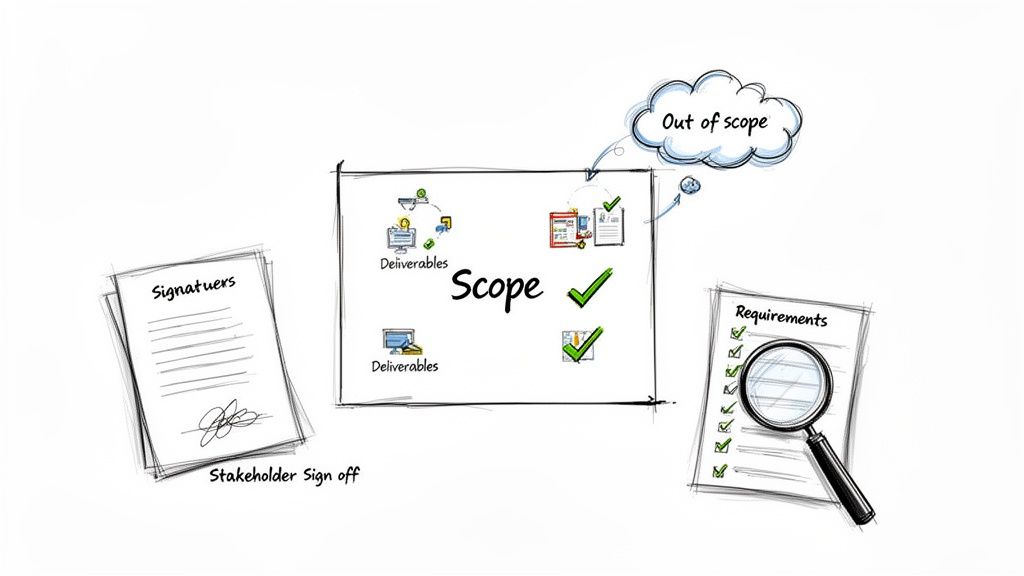
However, even the best-laid plans must accommodate change. A robust change management process is the second half of this equation, providing a structured framework for handling modifications that inevitably arise. This process ensures that when a new feature request or a client-requested adjustment emerges, it is evaluated for its impact on the schedule, budget, and resources before being approved. This disciplined approach maintains project integrity while allowing for necessary agility.
Key Insight: A well-defined scope isn't a rigid cage; it's a stable foundation upon which you can safely manage and evaluate change, ensuring every adjustment adds value without introducing chaos.
Actionable Tips for Implementation
- Host Stakeholder Workshops: Conduct collaborative sessions with all key stakeholders to gather and refine requirements. This ensures a shared understanding and uncovers potential conflicts or unstated assumptions early on.
- Utilize a Single Source of Truth: Use tools like JIRA, Confluence, or Linear to create detailed requirement documentation. This central repository should include everything from user stories and acceptance criteria to technical specifications, preventing miscommunication.
- Establish a Formal Change Request Process: Define a clear procedure for submitting changes. Require a formal request that outlines the proposed change, its business justification, and its perceived impact. This introduces a crucial checkpoint before any deviation from the plan. For more detailed guidance, you can learn more about how to define project scope and requirements.
- Conduct Impact Analysis: Before approving any change, perform a thorough impact analysis. This should quantify the effect on effort, schedule, cost, and potential risks, enabling informed decision-making by designated authorities.
2. Implement Agile Methodology with Regular Sprint Planning
Adopting an Agile methodology is transformative project management advice for teams needing to navigate uncertainty and deliver value quickly. Instead of a monolithic, long-term plan, Agile breaks down large projects into short, manageable cycles called sprints, typically lasting two to four weeks. This iterative approach allows for continuous feedback, adaptation, and incremental delivery, ensuring the final product aligns perfectly with evolving user needs and business goals.
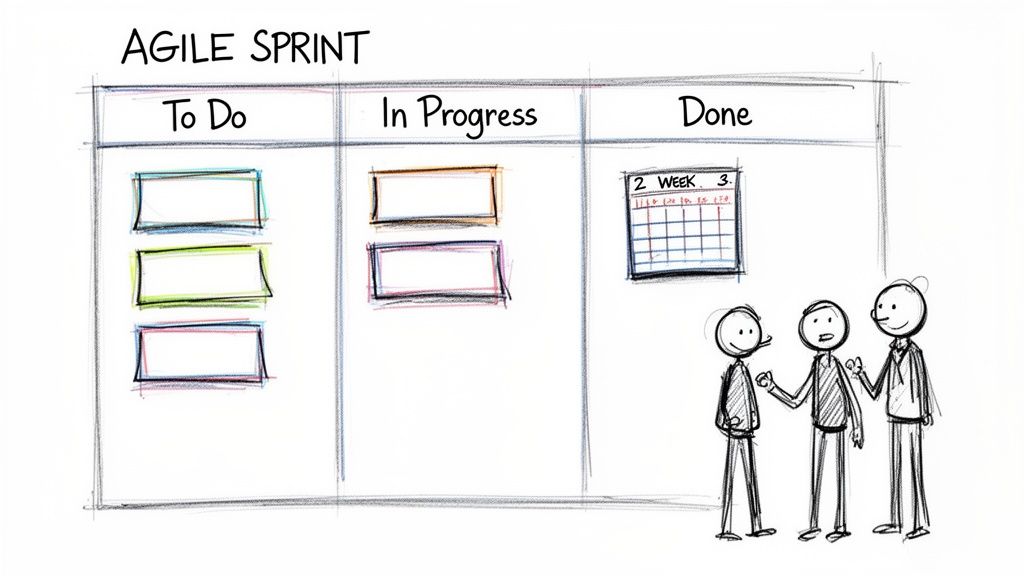
Regular sprint planning sessions are the engine of this methodology. Before each sprint begins, the team collaborates to select a set of high-priority tasks from the product backlog to complete within the cycle. This focus not only boosts momentum but also forces difficult prioritization decisions, ensuring that the most valuable features are built first. For distributed or nearshore teams, Agile ceremonies like daily stand-ups and retrospectives provide a reliable structure for communication, fostering alignment despite geographical separation.
Key Insight: Agile isn't just a process; it's a mindset that prioritizes adaptability and customer value. Regular sprint planning transforms this mindset into a predictable, high-impact delivery cadence.
Actionable Tips for Implementation
- Maintain a Well-Groomed Backlog: A successful sprint planning session depends on a prioritized and clearly defined product backlog. The product owner should continuously refine user stories, ensuring they are ready for the team to work on.
- Optimize Overlap for Stand-ups: For nearshore or distributed teams, schedule daily stand-ups during the critical "overlap window" where all time zones intersect. This maximizes real-time collaboration and unblocks issues faster.
- Utilize Agile Project Management Tools: Employ tools like Jira, Azure DevOps, or Monday.com to visualize sprint progress on a board with "To Do," "In Progress," and "Done" columns. This transparency keeps everyone aligned on status and dependencies. For a deeper dive into one of the most popular Agile frameworks, you can learn more about the Scrum methodology.
- Conduct Honest Retrospectives: At the end of each sprint, hold a blameless retrospective to discuss what went well, what didn't, and what can be improved. This commitment to continuous improvement is a core tenet of Agile that drives team efficiency and morale.
3. Establish Transparent Communication Protocols
Clear, structured communication is the lifeblood of successful project delivery, particularly for distributed teams common in nearshore development. Establishing transparent communication protocols involves creating a formal plan that dictates who needs to know what, when, how, and through which channels. This framework removes ambiguity, ensures all stakeholders remain aligned, and drastically reduces misunderstandings that can lead to costly delays and rework.
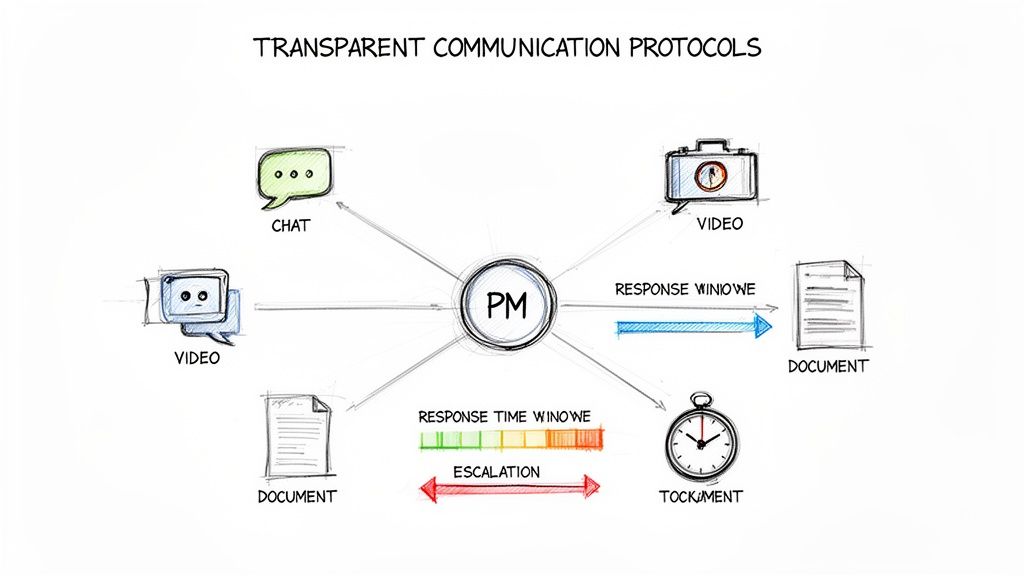
This proactive approach to communication management sets expectations from day one, covering everything from preferred tools and expected response times to meeting cadences and escalation paths. For example, a protocol might specify that urgent issues are handled via a dedicated Slack channel, while architectural decisions are documented in Confluence to create a permanent record. By systemizing information flow, teams can focus their energy on execution rather than chasing updates or clarifying mixed messages.
Key Insight: A communication protocol is not about creating rigid rules; it's about building a reliable system that fosters trust and ensures critical information reaches the right people at the right time, minimizing friction and maximizing efficiency.
Actionable Tips for Implementation
- Develop a Communication Matrix: Create a simple chart that maps out different communication types (e.g., status updates, technical questions, urgent issues) to specific stakeholders, channels, and frequencies. This clarifies responsibilities and prevents information silos.
- Embrace Async-First Communication: For teams across different time zones, prioritize asynchronous channels like detailed documentation, thoughtful comments, and well-structured task descriptions. This respects everyone’s focus time and creates a searchable project history.
- Standardize Reporting and Documentation: Use templates for status reports, meeting agendas, and decision logs. At Nerdify, we use shared dashboards and structured weekly calls with CTOs to ensure everyone consumes information in a consistent, predictable format.
- Schedule High-Value Synchronous Meetings: Maximize time zone overlap for critical, high-context discussions like daily stand-ups, sprint planning, and retrospectives. Record these meetings for team members who cannot attend, ensuring no one is left out of the loop.
- Designate Single Points of Contact (SPOCs): Assign clear owners for different domains, such as a technical lead for architectural questions or a product manager for scope inquiries. This streamlines decision-making and prevents key personnel from becoming bottlenecks.
4. Implement Robust Risk Management and Mitigation Planning
Effective project management advice isn't just about planning for success; it's about preparing for potential failure. Proactive risk management is the practice of systematically identifying, assessing, and mitigating potential threats before they escalate into project-derailing disasters. This process involves looking ahead to pinpoint potential technical, resource, schedule, or budget risks, allowing teams to develop contingency plans and communicate challenges transparently.
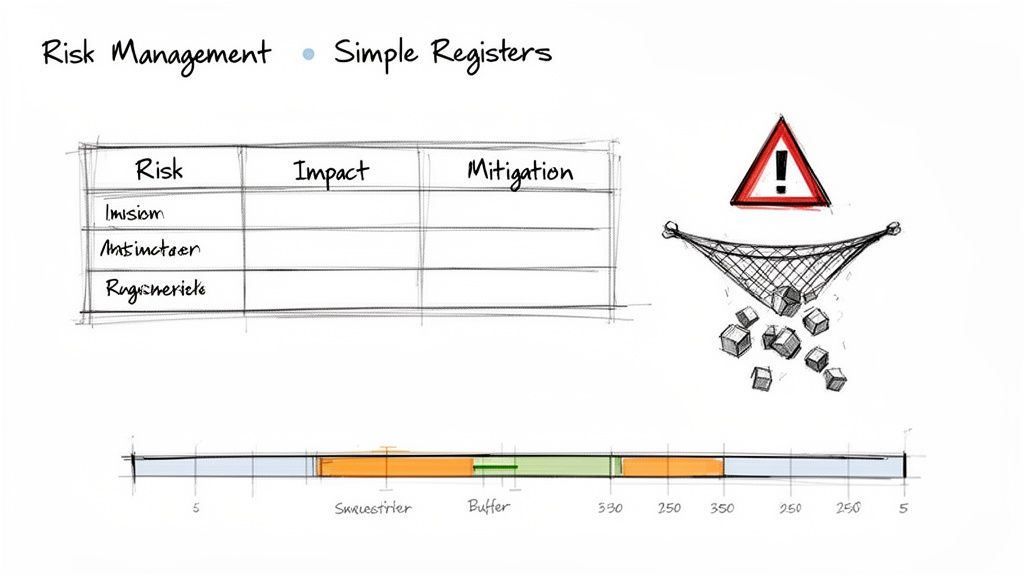
By embedding risk assessment into the project lifecycle, teams move from a reactive, crisis-driven mode to a proactive, controlled state. For example, identifying a critical dependency on a third-party API early on allows for the development of a fallback integration. Similarly, acknowledging a key person dependency in a nearshore staff augmentation model enables cross-training and knowledge documentation, ensuring continuity. This foresight is what separates well-managed projects from chaotic ones.
Key Insight: Risk management transforms uncertainty into a manageable variable. By anticipating what could go wrong, you gain the power to influence outcomes and protect your project's objectives from unexpected turbulence.
Actionable Tips for Implementation
- Conduct Risk Identification Workshops: Early in the project, gather cross-functional team members to brainstorm potential risks. Diverse perspectives are crucial for uncovering a wide range of threats across technical, operational, and external domains.
- Use a Probability × Impact Matrix: Score each identified risk based on its likelihood of occurring and the severity of its potential impact. This simple quadrant helps prioritize which risks demand immediate attention and resources.
- Assign Risk Owners: Designate a specific individual to monitor each significant risk. This owner is responsible for tracking triggers, executing the mitigation plan, and escalating the issue if necessary, ensuring clear accountability.
- Maintain Contingency Buffers: For high-priority risks, allocate a contingency buffer in your schedule and budget, typically 15-20%. This provides the necessary flexibility to absorb the impact of a risk without derailing the entire project. For more details, explore our guide to software project risk management.
- Review Risks Regularly: Make risk review a standing agenda item in sprint reviews and monthly stakeholder meetings. This ensures that the risk register remains a living document and that mitigation strategies adapt to changing project conditions.
5. Establish Key Performance Indicators (KPIs) and Metrics
Defining and tracking the right Key Performance Indicators (KPIs) and metrics is what transforms project management from a subjective art into a data-driven science. Without measurable goals, it’s impossible to gauge progress, identify bottlenecks, or objectively demonstrate success to stakeholders. A well-chosen set of metrics provides a real-time health check on the project, ensuring that every effort remains transparent, accountable, and aligned with overarching business objectives.
This process involves more than just tracking completion dates. It requires a balanced view that encompasses both project delivery metrics (like budget adherence and timeline variance) and product outcome metrics (such as user engagement or ROI). By measuring both how the work is done and the value it creates, teams can make smarter decisions, pivot when necessary, and ensure the final deliverable truly meets its intended purpose.
Key Insight: Metrics are not just for reporting; they are for steering. They provide the critical feedback loop needed to navigate complexities and ensure your project doesn't just get finished, but that it succeeds.
Actionable Tips for Implementation
- Define a Balanced Scorecard: Avoid focusing on a single metric. Instead, create a scorecard with metrics across multiple dimensions: delivery (development velocity, timeline adherence), quality (bug density, test coverage), budget (cost variance), and value (customer satisfaction, user retention).
- Distinguish Project vs. Product Metrics: Clearly separate metrics that measure the efficiency of the project team (e.g., story points per sprint) from those that measure the success of the outcome (e.g., feature adoption rates). Both are essential for a complete picture.
- Focus on 3-5 Critical KPIs: Don’t drown in data. Identify the few vital metrics that offer the most insight into project health and business goals. This focus prevents "analysis paralysis" and keeps the team aligned on what truly matters.
- Automate Data Collection: Utilize tools like JIRA, Asana, or dedicated analytics platforms to automate the collection and visualization of metrics. This reduces manual overhead, minimizes human error, and provides real-time dashboarding for quick insights.
6. Maintain Detailed Project Documentation
Comprehensive documentation serves as the single source of truth and institutional memory for a project. It’s far more than a simple record-keeping exercise; it is a critical asset that enables knowledge transfer, supports compliance, and critically, reduces dependency on individual team members. By meticulously documenting architecture decisions, API specifications, and deployment procedures, you create a resilient framework that allows new team members to onboard quickly and current members to work with clarity and autonomy.
This proactive approach to documentation ensures that valuable insights and rationales are not lost when team members move on or projects evolve. It underpins consistency, especially in complex systems, by providing clear guidance on everything from design patterns to data handling protocols. This level of detail is a cornerstone of sound project management advice, transforming potential chaos into a well-organized, scalable operation.
Key Insight: Documentation is not a task to be completed after the work is done; it's an ongoing discipline that safeguards project knowledge, reduces operational risk, and empowers team independence.
Actionable Tips for Implementation
- Adopt a "Docs-as-Code" Philosophy: Store documentation in your version control system (e.g., Git) alongside the code. This ensures that documentation is updated in lockstep with feature development and that all changes are tracked and reviewable.
- Utilize Architecture Decision Records (ADRs): For every significant architectural choice, create a short, simple document explaining the context, the decision made, and the consequences. This provides invaluable context for future development and maintenance.
- Make Documentation a "Definition of Done": Include documentation updates as a mandatory acceptance criterion for all user stories or tasks. A feature isn't complete until its corresponding documentation, such as API specs or user guides, is also complete.
- Leverage Templates and Automation: Create and enforce the use of templates for common documents like deployment runbooks or post-mortems to ensure consistency. Use tools like Swagger or OpenAPI to automatically generate API documentation directly from your codebase, ensuring it never goes out of date.
7. Implement Effective Resource Planning and Allocation
Strategic resource planning is the discipline of ensuring the right people, with the right skills, are available at the right time. It moves beyond simple task assignment to a forward-looking process that prevents bottlenecks, avoids team burnout, and maximizes efficiency. For development agencies and startups, particularly those utilizing nearshore staff augmentation, this practice is critical for scaling teams flexibly to meet fluctuating project demands and business goals.
Effective allocation involves a deep understanding of your team's capacity, individual skill sets, and project timelines. It allows you to anticipate needs, identify potential skill gaps, and make informed decisions about hiring or training. This proactive approach ensures that high-priority tasks are staffed appropriately, dependencies are managed, and projects remain on track without over-stretching key personnel.
Key Insight: Resource planning isn't just about avoiding scheduling conflicts; it's a strategic tool for optimizing team performance, fostering skill development, and ensuring your most valuable assets-your people-are deployed for maximum impact.
Actionable Tips for Implementation
- Create a Skills Matrix: Develop a comprehensive matrix that maps each team member's skills, expertise levels (e.g., junior, mid, senior), and specializations. This becomes an invaluable tool for quickly identifying the best person for a task.
- Utilize Resource Management Tools: Adopt platforms like Monday.com, Smartsheet, or Forecast to gain a centralized, visual overview of who is working on what. These tools help track utilization rates and forecast future availability, providing data for better planning. To optimize project timelines and resource use, founders can explore effective time management tools.
- Integrate Planning into Scoping: Make resource forecasting a mandatory part of the initial project estimation and scoping phase. By identifying resource needs early, you can secure commitments and prevent last-minute scrambles.
- Build in Buffer Capacity: Avoid scheduling your team at 100% capacity. A buffer of 10-15% allows for unexpected issues, sick days, and crucial professional development time, which prevents burnout and fosters growth.
- Review and Rebalance Regularly: Conduct monthly or bi-weekly reviews of resource utilization. If one team member is consistently overloaded while another is underutilized, rebalance the workload to maintain a sustainable pace and ensure project health.
8. Establish Quality Assurance and Testing Frameworks
Integrating a comprehensive Quality Assurance (QA) and testing framework is not an optional add-on; it's a critical component of successful project delivery. This framework establishes a systematic process for verifying that the final product meets all quality standards, aligns with user expectations, and is free from critical defects. By embedding testing throughout the development lifecycle, teams can identify and fix issues early, significantly reducing the cost and effort required for post-launch corrections.
A mature testing strategy encompasses various dimensions, from granular unit tests that validate individual components to broad end-to-end tests that simulate real user journeys. When automated and integrated into a CI/CD pipeline, this framework empowers teams to deliver features rapidly and reliably. It provides the confidence that new code not only works as intended but also doesn't break existing functionality, forming a crucial safety net for agile development.
Key Insight: Quality isn't achieved by a final inspection; it's built into the product from the start. A robust QA framework transforms testing from a gatekeeper into an enabler of speed and stability.
Actionable Tips for Implementation
- Follow the Testing Pyramid: Structure your testing efforts with a large base of fast, inexpensive unit tests, a smaller layer of integration tests, and a very limited number of comprehensive end-to-end tests. This model optimizes for feedback speed and maintenance cost.
- Integrate Automated Testing into CI/CD: Configure your CI/CD pipeline to automatically run unit, integration, and regression tests on every code commit. This practice provides immediate feedback to developers and prevents faulty code from being merged into the main branch.
- Involve QA from the Beginning: Bring QA specialists into the design and requirements-gathering phases. Their early involvement helps identify potential testability issues, clarify acceptance criteria, and build a quality-first mindset across the entire team.
- Maintain Realistic Test Environments: Create staging and testing environments that closely mirror the production setup, including data, configurations, and infrastructure. This ensures that tests accurately predict how the application will behave in the real world, preventing environment-specific bugs from reaching users.
9. Conduct Regular Stakeholder Engagement and Reviews
Engaging stakeholders consistently is the lifeblood of a successful project, ensuring it remains tethered to business objectives and market realities. This practice moves beyond simple status updates, fostering a collaborative environment where expectations are managed proactively and potential issues are identified and resolved together. Structured forums like sprint reviews, monthly business reviews, and steering committee meetings are essential for demonstrating progress, gathering critical feedback, and making informed course corrections before minor deviations become major problems.
This continuous feedback loop transforms stakeholders from passive observers into active partners. For instance, a weekly sprint review allows the product owner to see a tangible demonstration of new features, providing immediate validation or redirection. Likewise, a quarterly steering committee meeting aligns C-level executives and key clients on high-level strategy, budget, and timelines, securing their buy-in and support. This proactive approach to communication is a cornerstone of effective project management advice, as it builds trust and prevents the kind of misalignment that can quietly sabotage a project's goals.
Key Insight: Consistent stakeholder engagement isn't about reporting; it's about building a shared sense of ownership and steering the project collaboratively toward a unified vision of success.
Actionable Tips for Implementation
- Establish a Predictable Cadence: Schedule review meetings at regular, consistent times (e.g., sprint reviews every two weeks, business reviews on the first Monday of each month). This predictability reduces coordination overhead and makes participation a habit.
- Show, Don't Just Tell: In sprint reviews, always demonstrate working software. A live demo is infinitely more impactful and informative than a slide deck or a verbal update, sparking more meaningful feedback.
- Prepare and Distribute Materials in Advance: Send out clear agendas, relevant data, and pre-reading materials at least 24 hours before a meeting. This allows stakeholders to arrive prepared and ready for a productive discussion.
- Document and Assign Action Items: Every decision and action item must be documented with a clear owner and a deadline. Start each subsequent meeting by reviewing the status of these items to ensure accountability and follow-through.
10. Implement Continuous Learning and Process Improvement
Project management excellence isn't a static destination; it's a dynamic process of evolution. Implementing a culture of continuous learning and process improvement means actively seeking out opportunities to refine workflows, enhance skills, and elevate outcomes. This approach, rooted in methodologies like Lean and Agile, transforms each project into a learning opportunity, ensuring that mistakes become lessons and successes become repeatable blueprints. It builds institutional knowledge that compounds over time, creating a more resilient and efficient organization.
This involves creating formal feedback loops, such as sprint retrospectives or post-project reviews, to systematically analyze what worked and what didn't. Instead of simply moving on to the next task, teams pause to capture insights. This structured reflection prevents the same problems from recurring and ensures that valuable discoveries are shared across the organization, directly impacting future project performance.
Key Insight: The most valuable project deliverable is often the knowledge gained. A commitment to continuous improvement turns this knowledge into a tangible asset that drives future success and operational maturity.
Actionable Tips for Implementation
- Schedule Regular Retrospectives: Make retrospectives a non-negotiable ritual. Hold them at the end of every sprint, project phase, or on a monthly basis. This consistency builds the habit of reflection and ensures feedback is timely.
- Create Psychological Safety: Foster an environment where team members feel safe to share challenges and failures without fear of blame. Frame discussions around processes and systems, not individuals, to encourage honest and constructive feedback.
- Track Actionable Improvements: A retrospective is only effective if it leads to change. Use a tool to assign owners and deadlines to all agreed-upon action items, and review their status at the beginning of the next session.
- Share Lessons Across Teams: Prevent knowledge from becoming siloed. Create a central repository, like a Confluence page or a shared document, for post-project lessons learned. Host "lunch and learn" sessions where teams can share key takeaways from recent projects.
Comparison of 10 Project Management Best Practices
| Item | Implementation Complexity 🔄 | Resource Requirements ⚡ | Expected Outcomes 📊 | Key Advantages ⭐ | Ideal Use Cases 💡 |
|---|---|---|---|---|---|
| Define Clear Project Scope and Requirements & Change Management | High — extensive upfront planning and approvals 🔄 | Moderate — stakeholder time, documentation tools, PM effort ⚡ | Clear baselines, fewer scope changes, accurate estimates 📊 | Better alignment, budget/timeline accuracy, audit trail ⭐ | New projects, complex integrations, regulated environments 💡 |
| Implement Agile Methodology with Regular Sprint Planning | Medium — process setup and cultural change 🔄 | Moderate — ceremonies, product owner involvement, tooling ⚡ | Incremental delivery, faster feedback, adaptive roadmap 📊 | Rapid iteration, transparency, reduced risk ⭐ | MVPs, iterative product development, distributed teams 💡 |
| Establish Transparent Communication Protocols | Low–Medium — define channels, SLAs, escalation paths 🔄 | Low — collaboration tools and discipline ⚡ | Fewer misunderstandings, faster issue resolution, record of decisions 📊 | Improved trust, clarity, traceability ⭐ | Nearshore/distributed teams, stakeholder-heavy projects 💡 |
| Implement Robust Risk Management and Mitigation Planning | Medium–High — workshops, ongoing monitoring, owners 🔄 | Moderate — risk registers, review cycles, contingency buffers ⚡ | Early issue detection, reduced surprises and delays 📊 | Proactive mitigation, cost avoidance, stakeholder confidence ⭐ | Projects with external dependencies or tight schedules 💡 |
| Establish Key Performance Indicators (KPIs) and Metrics | Medium — define, instrument, and report metrics 🔄 | Moderate — dashboards, data pipelines, tooling ⚡ | Measurable project health, data-driven decisions, early warnings 📊 | Objective visibility, alignment to business goals, accountability ⭐ | Executive reporting, delivery tracking, continuous improvement 💡 |
| Maintain Detailed Project Documentation | Medium — continuous authoring and review 🔄 | Moderate — documentation platforms, contributor time ⚡ | Knowledge retention, faster onboarding, compliance support 📊 | Reduced single-point failures, easier troubleshooting, auditability ⭐ | Long-term products, staff augmentation, regulated projects 💡 |
| Implement Effective Resource Planning and Allocation | Medium–High — forecasting, leveling, cross-training 🔄 | High — resource tools, capacity planning, skill development ⚡ | Optimized utilization, fewer bottlenecks, predictable delivery 📊 | Balanced workloads, cost efficiency, scalable staffing ⭐ | Multi-project portfolios, nearshore staffing, peak demand periods 💡 |
| Establish Quality Assurance and Testing Frameworks | High — automation, CI/CD integration, test strategy 🔄 | High — test infra, QA specialists, maintenance effort ⚡ | Lower defect rates, reliable releases, higher user trust 📊 | Improved code quality, faster safe releases, measurable quality metrics ⭐ | Customer-facing apps, safety- or compliance-critical systems 💡 |
| Conduct Regular Stakeholder Engagement and Reviews | Low–Medium — meeting cadence and agenda discipline 🔄 | Moderate — preparation time, reporting, demos ⚡ | Ongoing alignment, timely feedback, course corrections 📊 | Stakeholder buy-in, early issue detection, accountability ⭐ | Executive updates, complex stakeholder landscapes, rollout phases 💡 |
| Implement Continuous Learning and Process Improvement | Medium — retrospectives, training programs, tracking 🔄 | Moderate — time for learning, training budget, facilitation ⚡ | Continuous efficiency gains, fewer repeated mistakes, innovation 📊 | Institutional knowledge, higher team engagement, process optimization ⭐ | Mature teams, long-running engagements, scale-up phases 💡 |
Putting Advice into Action for Lasting Project Success
We've explored ten foundational pillars of effective project management, from defining an ironclad project scope to fostering a culture of continuous improvement. The journey from a project's initial concept to its successful delivery is rarely a straight line. It's a dynamic process filled with challenges, changes, and learning opportunities. The project management advice shared throughout this article is designed not as a rigid set of rules, but as a flexible toolkit you can adapt to your organization's unique context, whether you're a nimble startup or a scaling SME.
The core theme connecting all these strategies is proactive intentionality. Great project outcomes don't happen by accident. They are the result of deliberate planning, transparent communication, and a relentless focus on delivering value. By moving from a reactive "firefighting" mode to a proactive, strategic approach, you empower your team, build stakeholder trust, and consistently hit your targets.
Your Immediate Next Steps: From Insight to Implementation
Absorbing a wealth of project management advice can feel overwhelming. The key is to start small and build momentum. Don't attempt to overhaul your entire process overnight. Instead, use the following steps to translate these concepts into tangible actions:
Conduct a Project Post-Mortem (or Pre-Mortem): Before your next project kicks off, gather your team and key stakeholders. If you just finished a project, analyze what went well and what didn't, mapping your findings back to the ten areas we discussed. If you're starting a new one, conduct a "pre-mortem" to anticipate potential obstacles related to scope, communication, or risk.
Identify Your Biggest Bottleneck: Which of the ten principles represents your most significant pain point right now? Is it scope creep? Poor communication? A lack of clear metrics? Pinpoint the one area where improvement would have the most substantial impact on your project success.
Implement One Targeted Change: Focus your energy on fixing that single bottleneck.
- If scope is the issue, dedicate your next planning session to creating a detailed Statement of Work (SOW) and a formal change request process.
- If communication is lacking, establish a clear protocol: daily stand-ups for the core team, a weekly summary email for stakeholders, and a centralized project hub in a tool like Jira or Asana.
- If you lack metrics, define three to five crucial KPIs for your next project and build a simple dashboard to track them.
By taking a focused, incremental approach, you can create meaningful, lasting change without disrupting your team's workflow.
The True Value of Exceptional Project Management
Mastering these principles is about more than just delivering projects on time and on budget. It's about building a high-performing, resilient organization. When you manage projects effectively, you create an environment where:
- Innovation Thrives: Teams are free to focus on creative problem-solving instead of administrative chaos.
- Team Morale Soars: Clear expectations and transparent processes reduce stress and burnout, leading to a more engaged and motivated workforce.
- Customer Trust Deepens: Consistently delivering on your promises builds a reputation for reliability and excellence.
- Business Goals Are Achieved: Projects become powerful engines for strategic growth, directly contributing to your company's bottom line.
This collection of project management advice serves as your roadmap. Each principle is a step toward building a more efficient, predictable, and successful delivery system. As you apply these strategies, remember that the ultimate goal is not just to manage projects but to lead them with clarity, foresight, and a commitment to excellence. The path to mastery is a continuous journey of application, reflection, and refinement. Start today, and build the foundation for your next great success.