10 High-Impact Project Management Tip Examples for Startups in 2025
In the fast-paced world of startups and engineering, chaos can feel like the default setting. Deadlines shift, resources are tight, and communication breakdowns can derail even the most promising projects. But what if you could trade that chaos for clarity and consistent delivery? The secret isn't a single magic bullet, but a collection of proven strategies. This guide cuts through the noise to deliver 10 essential, actionable project management tips tailored for the unique challenges faced by agile, high-growth teams. From mastering nearshore collaboration to implementing metrics that actually matter, each point is designed to give you a concrete advantage.
We'll explore how simple shifts in process, like defining a rock-solid scope or establishing a proactive risk register, can transform your team’s workflow, boost productivity, and ensure your projects not only launch but succeed. Each project management tip is broken down into a practical, step-by-step format you can implement immediately. Before diving into specific tactics, understanding the 7 core IT project managers responsibilities provides a holistic view of successful project leadership. This foundational knowledge helps contextualize the strategies that follow, ensuring you're not just applying tips, but building a robust management framework. Let's dive into the techniques that will help your team build better, faster, and smarter.
1. Define Clear Project Scope and Objectives
The most crucial project management tip is to establish a rock-solid foundation before a single line of code is written. Defining a clear project scope and setting SMART objectives (Specific, Measurable, Achievable, Relevant, Time-bound) is non-negotiable for success. This foundational step prevents scope creep, aligns stakeholder expectations, and provides a clear roadmap for the entire team, ensuring everyone is working towards the same, well-defined finish line.
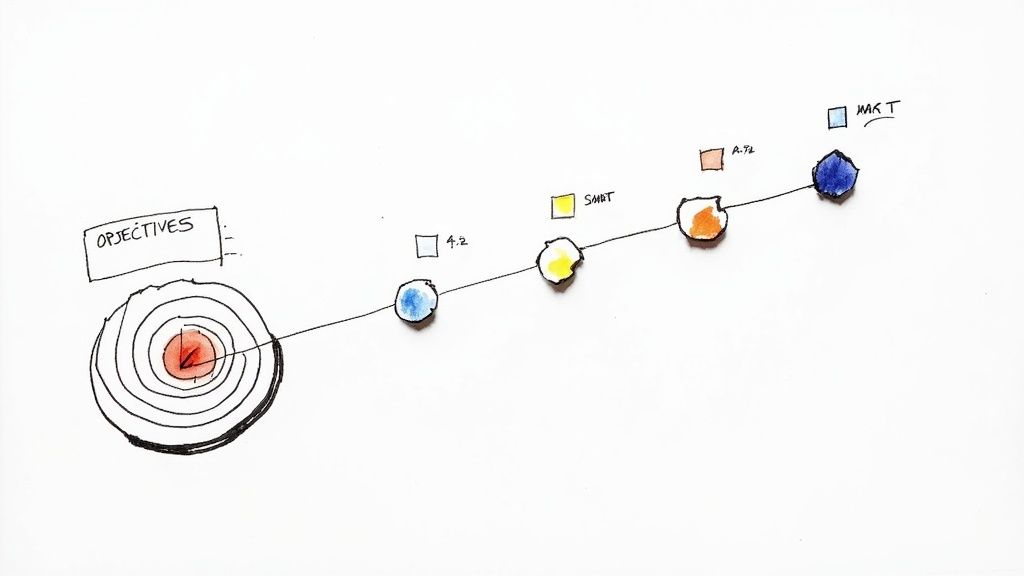
This practice, popularized by the Project Management Institute (PMI) and PRINCE2 methodology, is a core principle for a reason. For example, Agile teams use user stories with explicit acceptance criteria to define what "done" means for each feature, leaving no room for ambiguity. Similarly, Google's project charters meticulously detail specific outcomes and success metrics, creating a single source of truth that guides all subsequent decisions.
How to Implement This Tip
To put this into practice, start by hosting a project kickoff workshop with all key stakeholders to gather input and build consensus. Document all assumptions, constraints, and out-of-scope items explicitly to avoid future misunderstandings.
- Create a Scope Baseline: Formally document the approved scope and get sign-off from all stakeholders.
- Use Measurable Goals: Break down high-level objectives into measurable key results (OKRs).
- Establish Change Control: Implement a formal process for reviewing, approving, and communicating any changes to the scope.
- Review Regularly: Schedule periodic reviews to ensure the project remains aligned with its original objectives and to manage any necessary adjustments proactively.
2. Implement a Work Breakdown Structure (WBS)
Once your scope is defined, the next critical project management tip is to break down the project into smaller, more manageable components. A Work Breakdown Structure (WBS) is a hierarchical decomposition of the total scope of work to be carried out by the project team. It transforms large, high-level deliverables into detailed tasks, making it far easier to estimate costs, assign ownership, and accurately monitor progress from start to finish.
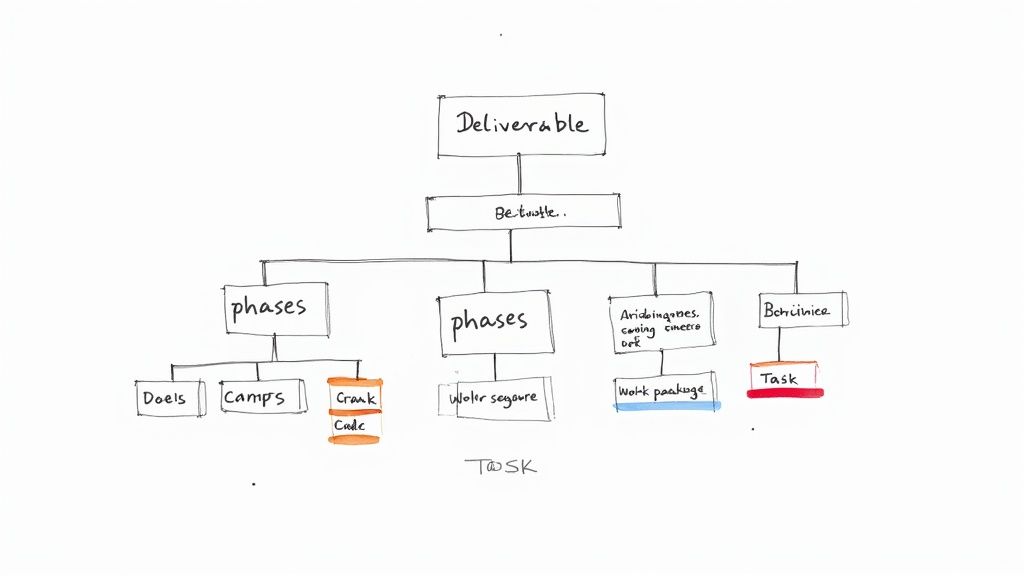
This method, a cornerstone of the Project Management Institute’s (PMI) PMBOK® Guide, ensures nothing gets overlooked. For example, a software development project might be broken down into modules, then into specific features, and finally into individual coding and testing tasks. Likewise, a marketing campaign can be decomposed by channel (e.g., social media, email), then by activity (e.g., content creation, ad setup), and finally into specific deliverables like writing a blog post or designing an email template.
How to Implement This Tip
Begin by identifying the major deliverables of the project and then progressively break them down into smaller work packages. Involve your team in this process to leverage their expertise and ensure greater accuracy and buy-in for the resulting plan.
- Decompose Top-Down: Start with the main project deliverable and break it into major phases or components.
- Aim for Actionable Packages: Decompose until you reach work packages that can be realistically completed by one person or a small team in 1-2 weeks.
- Use a Naming Convention: Apply a consistent numbering or naming system (e.g., 1.1, 1.1.2) to clearly show the hierarchy.
- Document and Review: Formally document the WBS and its accompanying dictionary, which details each work package, and review it with stakeholders.
3. Use Agile Methodology for Flexibility
In today's fast-paced environment, the ability to adapt to change is a significant competitive advantage. Adopting an Agile methodology allows teams to embrace uncertainty and respond quickly to shifting requirements. This iterative approach focuses on delivering value in small, incremental cycles called sprints, enabling frequent feedback loops, continuous improvement, and deep collaboration between teams and stakeholders.

Popularized by frameworks like Scrum and Kanban, Agile is a core project management tip because it prioritizes customer satisfaction and functional software over rigid, upfront planning. Tech giants exemplify its power: Spotify uses its squad-based model to foster autonomy and rapid innovation, while Netflix’s continuous deployment pipeline allows for constant, low-risk feature releases. This methodology is particularly effective for projects where the final outcome is not fully defined from the start.
How to Implement This Tip
To truly harness the power of Agile, familiarize your team with essential Agile development best practices that foster adaptability and continuous delivery. Start small by introducing the framework to a single pilot team before a wider organizational rollout.
- Establish a Prioritized Backlog: Maintain a dynamic list of features and tasks, ordered by business value, to ensure the team is always working on what matters most.
- Define "Done": Create a clear, shared understanding of what it means for a task or user story to be complete to ensure quality and consistency.
- Hold Retrospectives: After each sprint, facilitate a team meeting to discuss what went well, what didn't, and what can be improved in the next cycle.
- Encourage Transparency: Use tools like Kanban boards and daily stand-ups to make progress visible to everyone, fostering accountability and open communication.
4. Establish Effective Communication Plans
A brilliant project can fail solely due to poor communication. The next essential project management tip is to create a structured communication plan that defines how, when, and what information is shared with all stakeholders. A deliberate plan ensures alignment, prevents misunderstandings, and keeps everyone engaged, transforming communication from a potential risk into a strategic asset that maintains project momentum.
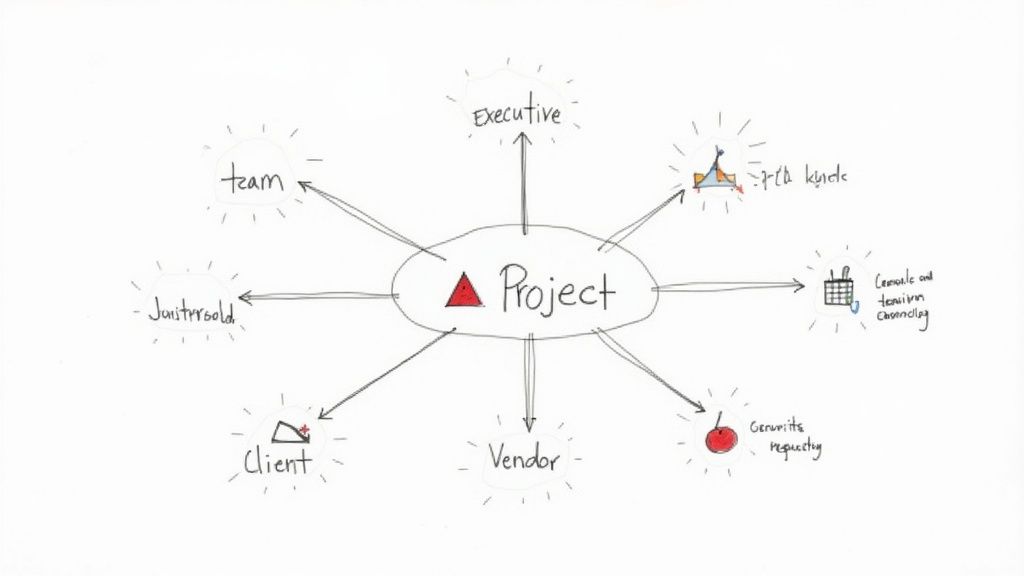
This principle is heavily emphasized in frameworks like the PMBOK guide, which dedicates an entire knowledge area to it. In practice, Agile teams live this through daily standups, which are capped at 15 minutes to keep updates concise and relevant. Similarly, companies like HubSpot use real-time dashboards combined with scheduled reports, tailoring the communication channel and frequency to different stakeholder needs, from the engineering team to the C-suite.
How to Implement This Tip
Begin by identifying all project stakeholders and analyzing their specific information needs. Document this in a shareable communication matrix that outlines the message, audience, channel, frequency, and owner for each type of communication, creating a single source of truth for how the team connects.
- Tailor the Message: Send concise, color-coded weekly status reports to executives, and more detailed technical updates to the development team.
- Establish a Cadence: Set a predictable rhythm with daily standups for the core team and monthly steering committee meetings for high-level governance.
- Centralize Information: Use a project management tool or a shared wiki as the central hub for all documentation, decisions, and updates to prevent version control issues.
- Create Feedback Loops: Actively solicit feedback through surveys or dedicated channels to ensure communication is a two-way street, not a one-way broadcast.
5. Implement Risk Management Processes
A powerful project management tip that separates proactive teams from reactive ones is the systematic implementation of risk management. Instead of waiting for problems to derail a project, this process involves identifying, analyzing, and planning responses to potential threats before they materialize. This foresight minimizes negative impacts, improves contingency planning, and significantly increases the likelihood of delivering on time and within budget by turning uncertainties into manageable variables.
This principle is a cornerstone of established frameworks like the PMI’s standard for risk management and PRINCE2. For example, a software team might proactively identify technical debt and potential third-party integration failures as major risks, creating mitigation plans early on. Similarly, a product launch team can anticipate market adoption hurdles or regulatory changes, developing alternative strategies to ensure a smooth rollout. This approach transforms risk from a project killer into a strategic consideration.
How to Implement This Tip
Begin by conducting a risk identification workshop with a diverse group of team members and stakeholders to brainstorm potential issues. Document everything in a risk register, which will serve as a living document throughout the project lifecycle.
- Prioritize with a Risk Matrix: Assess each risk based on its probability and potential impact to focus efforts on the most significant threats.
- Assign Risk Owners: Designate a specific team member to monitor each identified risk and be responsible for executing its response plan.
- Develop Response Plans: For high-priority risks, create clear, actionable plans to either avoid, mitigate, transfer, or accept the risk.
- Maintain Contingency Reserves: Allocate a portion of your budget and schedule as a buffer to absorb the impact of unforeseen events.
- Review Risks Regularly: Make risk review a standard part of your recurring project meetings to update the register and adapt to new information.
6. Practice Resource Leveling and Optimization
A powerful project management tip that often separates successful projects from struggling ones is the strategic allocation of resources. Resource leveling and optimization involve managing your most valuable assets, people, budget, and equipment, to maximize efficiency. This practice ensures team members aren't overworked, critical skills are available when needed, and project costs remain under control, preventing burnout and maintaining momentum.
This principle is a cornerstone of methodologies promoted by the Project Management Institute (PMI) and is built into tools like Microsoft Project. For instance, large consulting firms use detailed utilization dashboards to ensure their experts aren't double-booked, while construction managers must level equipment allocation to avoid costly downtime. Similarly, engineering teams using Jira with resource management plugins can visualize workloads across sprints, reassigning tasks to prevent individual bottlenecks and keep the development pipeline flowing smoothly.
How to Implement This Tip
To apply this, start by creating a detailed resource plan during the initial project planning phase. Gain a clear understanding of each team member's capacity, skills, and existing commitments before assigning new tasks.
- Create a Resource Plan: Document who is needed, when, and for how long. Get stakeholder agreement early.
- Use Management Tools: Leverage software for real-time visibility into who is working on what, preventing overallocation.
- Monitor Utilization Rates: Check utilization reports weekly to spot and address signs of burnout or underuse proactively.
- Reserve a Buffer: Keep 10-15% of your team's capacity unallocated to handle unexpected issues or urgent tasks without derailing the project.
7. Monitor Progress with Key Performance Indicators (KPIs)
To navigate a project successfully, you need more than just a plan; you need a reliable compass. This vital project management tip involves tracking Key Performance Indicators (KPIs), which are the quantifiable metrics that provide an objective view of project health and progress. KPIs transform abstract goals into tangible data points, enabling early issue detection, data-driven decision-making, and transparent stakeholder reporting, ensuring your project stays on course.
This practice is a cornerstone of methodologies like Earned Value Management (EVM), which uses metrics such as the Schedule Performance Index (SPI) and Cost Performance Index (CPI) to gauge project efficiency. In the Agile world, teams rely on metrics like sprint velocity and burndown charts to forecast delivery timelines and manage workload. By visualizing these metrics in a dashboard, teams can instantly spot bottlenecks or deviations from the plan and react before they escalate into major problems.
How to Implement This Tip
Start by identifying a small, focused set of KPIs that directly align with your project objectives. Avoid "vanity metrics" and concentrate on data that drives action. The goal is clarity, not overwhelming your team with numbers.
- Select Critical KPIs: Choose 5-10 essential KPIs that best reflect project success, such as defect density or cycle time.
- Establish Baselines and Targets: Define what "good" looks like by setting clear baseline and target values for each KPI before the project starts.
- Create Visual Dashboards: Use project management tools to build a centralized, easy-to-read dashboard that visualizes KPI trends for all stakeholders.
- Review on a Cadence: Schedule regular (weekly or bi-weekly) KPI review meetings to discuss progress, analyze trends, and make necessary adjustments.
8. Develop Strong Stakeholder Management
A project doesn't exist in a vacuum; its success is heavily influenced by the people it impacts. This crucial project management tip involves identifying, analyzing, and actively engaging all stakeholders to understand their needs and manage their expectations. Proactive stakeholder management builds vital support, mitigates potential risks from resistance, and ensures everyone from the end-user to the executive sponsor feels heard and valued, creating a collaborative environment primed for success.
This principle is a cornerstone of the PMI's PMBOK® Guide and is central to how management consultancies navigate complex enterprise projects. For instance, an enterprise software implementation requires engaging department heads, IT staff, and daily users with tailored communication plans to ensure smooth adoption. Similarly, a public infrastructure project succeeds by involving government agencies, community leaders, and local businesses early and often to align interests and prevent roadblocks.
How to Implement This Tip
Begin by mapping out every individual, group, or organization that could be affected by your project. From there, you can prioritize your engagement efforts based on their influence and interest to ensure your communication is both efficient and effective.
- Create a Stakeholder Register: Document all stakeholders, their roles, interests, and potential impact on the project.
- Use a Power/Interest Matrix: Categorize stakeholders to determine the appropriate level and frequency of engagement for each group.
- Develop Tailored Communication: Create specific engagement plans for key stakeholders, addressing their unique concerns and communication preferences.
- Communicate Proactively: Establish a regular cadence for updates and one-on-one meetings to manage expectations and gather feedback before issues escalate.
9. Maintain Comprehensive Project Documentation
A powerful, yet often overlooked, project management tip is the disciplined creation and maintenance of comprehensive documentation. This practice establishes a single source of truth for all project activities, decisions, and outcomes. Accurate, organized, and accessible documentation is the backbone of successful project control, enabling seamless knowledge transfer, supporting regulatory compliance, and empowering data-driven decision-making throughout the project lifecycle.
This principle is heavily emphasized by the Project Management Institute (PMI) and codified in ISO standards for good reason. For instance, pharmaceutical projects rely on meticulous documentation to demonstrate FDA compliance, while large-scale construction projects use daily logs and inspection reports to mitigate legal risks. In software development, thorough technical and user documentation on a platform like Confluence ensures new engineers can onboard quickly and reduces long-term maintenance costs.
How to Implement This Tip
To effectively integrate this practice, make documentation a proactive, planned activity rather than an afterthought. Build it directly into your project workflows and assign clear ownership for key artifacts. This ensures information remains current and valuable.
- Establish Documentation Standards: Create and enforce clear templates for common documents like meeting minutes, risk registers, and change requests.
- Use a Centralized Repository: Utilize tools like SharePoint, Confluence, or Notion to store all project documents in one accessible location.
- Assign Ownership: Designate a specific owner responsible for creating, updating, and securing approval for each major document.
- Implement Version Control: Ensure you have a system to track changes and manage different versions of documents to avoid confusion.
- Schedule Regular Audits: Periodically review documentation to confirm it is up-to-date, accurate, and still relevant to the project's current state.
10. Conduct Regular Project Reviews and Retrospectives
A crucial project management tip for continuous improvement is to systematically evaluate performance and capture lessons learned. Conducting regular project reviews and retrospectives transforms every project, successful or not, into a valuable learning opportunity. This practice creates a feedback loop that refines processes, improves team dynamics, and prevents repeating the same mistakes, ensuring future projects are more efficient and effective.
This principle is a cornerstone of the Agile Manifesto and a core process recommended by the Project Management Institute (PMI). Agile teams famously use sprint retrospectives to ask "What went well? What didn't? What can we improve?" after each cycle. Similarly, Google’s Project Aristotle research highlighted that psychological safety, a key component of effective retrospectives, is the most critical factor in building high-performing teams. These sessions build institutional knowledge and foster a culture of growth.
How to Implement This Tip
To make reviews effective, treat them as non-negotiable, scheduled events, not an afterthought. The goal is to create a psychologically safe environment where the team can provide honest feedback without fear of blame.
- Schedule Consistently: Book retrospectives at the end of every sprint, phase, or project. Don't skip them, even when busy.
- Focus on Process: Frame the discussion around processes, tools, and workflows, not individual performance or blame.
- Document and Act: Capture key lessons learned in an accessible, shared document. Most importantly, create concrete action items with assigned owners and due dates to ensure follow-through.
- Celebrate Successes: Explicitly acknowledge and celebrate team achievements and individual contributions to boost morale and reinforce positive behaviors.
Comparison of 10 Project Management Tips
| Practice | Implementation Complexity 🔄 | Resource Requirements ⚡ | Expected Outcomes ⭐📊 | Ideal Use Cases 💡 | Key Advantages ⭐ |
|---|---|---|---|---|---|
| Define Clear Project Scope and Objectives | 🔄🔄🔄 — upfront planning effort | ⚡⚡ — moderate initial investment | ⭐⭐⭐⭐ · 📊 High clarity; less scope creep | New or ambiguous projects needing alignment | ⭐ Aligns stakeholders; measurable success |
| Implement Work Breakdown Structure (WBS) | 🔄🔄🔄🔄 — detailed hierarchical design | ⚡⚡⚡ — time & planning resources | ⭐⭐⭐⭐ · 📊 Improved estimates & tracking | Delivery-focused projects (construction, dev) | ⭐ Task clarity; better cost/time estimates |
| Use Agile Methodology for Flexibility | 🔄🔄🔄 — process shift and coaching | ⚡⚡⚡ — ongoing team & stakeholder effort | ⭐⭐⭐⭐ · 📊 Early/continuous value delivery | Uncertain requirements; software/startups | ⭐ Adaptability; frequent feedback loops |
| Establish Effective Communication Plans | 🔄🔄 — straightforward to design, maintain | ⚡⚡ — steady communication effort | ⭐⭐⭐ · 📊 Improved alignment and issue detection | Stakeholder-heavy or distributed teams | ⭐ Reduces misunderstandings; builds trust |
| Implement Risk Management Processes | 🔄🔄🔄 — systematic identification & analysis | ⚡⚡⚡ — workshops, monitoring, expertise | ⭐⭐⭐⭐ · 📊 Fewer disruptions; better contingency | High-uncertainty or regulated projects | ⭐ Proactive mitigation; increased confidence |
| Practice Resource Leveling and Optimization | 🔄🔄🔄 — requires data and balancing | ⚡⚡⚡ — tools, capacity planning, training | ⭐⭐⭐ · 📊 Better utilization; cost control | Multi-project or resource-constrained orgs | ⭐ Prevents burnout; improves productivity |
| Monitor Progress with Key Performance Indicators (KPIs) | 🔄🔄🔄 — select, baseline, and report KPIs | ⚡⚡⚡ — tracking tools and discipline | ⭐⭐⭐⭐ · 📊 Objective project health visibility | Performance-driven or metric-focused projects | ⭐ Data-driven decisions; trend detection |
| Develop Strong Stakeholder Management | 🔄🔄🔄 — continuous analysis & engagement | ⚡⚡⚡ — time-intensive relationship work | ⭐⭐⭐⭐ · 📊 Higher buy-in and smoother decisions | Organizational change; cross-functional programs | ⭐ Builds support; reduces resistance |
| Maintain Comprehensive Project Documentation | 🔄🔄 — standards and centralized repos | ⚡⚡⚡ — ongoing updates and storage | ⭐⭐⭐ · 📊 Knowledge transfer; compliance support | Regulated, long-term, or handover projects | ⭐ Single source of truth; audit readiness |
| Conduct Regular Project Reviews and Retrospectives | 🔄🔄 — scheduled sessions and follow-up | ⚡⚡ — recurring meeting time & action tracking | ⭐⭐⭐ · 📊 Continuous improvement; lessons learned | Iterative teams and learning-focused orgs | ⭐ Captures improvements; celebrates wins |
Turn These Tips into Your Team's Superpower
We've explored a comprehensive suite of strategies, from defining a crystal-clear project scope with a Work Breakdown Structure to fostering agility and managing stakeholder expectations. Each project management tip shared here is a powerful tool on its own. However, their true potential is unlocked when they are woven together into a cohesive, operational fabric within your team. The goal is to evolve beyond simply managing tasks and deadlines. It's about building a predictable, resilient, and high-performing engine that consistently transforms vision into reality.
This journey from isolated tactics to an integrated system is what separates good teams from great ones. It’s the difference between reacting to problems and proactively preventing them. By mastering concepts like resource leveling, risk management, and KPI monitoring, your team gains the foresight needed to navigate complexity with confidence. For startups and engineering teams where every resource and every hour counts, this proactive stance isn't a luxury; it's a critical competitive advantage.
From Knowledge to Action: Your Next Steps
Reading about a great project management tip is one thing; implementing it is another. To avoid letting this knowledge become shelf-ware, commit to a clear action plan. Don't try to boil the ocean by implementing everything at once.
- Select Your Starting Point: Identify the one or two tips from this list that address your team's most significant pain point right now. Is communication chaotic? Start with an effective communication plan. Are deadlines constantly shifting? Focus on implementing a WBS for better scope definition.
- Create a Pilot Program: Test your chosen tip on a small, contained project. This allows you to refine the process, gather feedback, and demonstrate value without disrupting major initiatives. For example, pilot a new retrospective format with a single sprint team before rolling it out company-wide.
- Document and Standardize: Once you've validated the approach, document the new process. Create a simple template, a checklist, or a "how-to" guide. Make it easy for everyone, including new hires and nearshore partners, to adopt the new standard.
- Measure the Impact: Track the before-and-after. Did implementing a risk register reduce the number of unforeseen issues? Did better documentation speed up onboarding? Use this data to build momentum and justify further process improvements.
Building Your Project Management Flywheel
Ultimately, adopting a single project management tip can fix a problem, but embedding a culture of project management excellence builds a sustainable advantage. It creates a positive feedback loop: clear objectives lead to better planning, which leads to smoother execution, which results in successful outcomes and higher team morale. This success, in turn, fuels the appetite for even greater efficiency and innovation.
This structured approach is the bedrock upon which ambitious startups and scaling SMEs build their futures. By turning these principles into daily habits, you empower your team to not just complete projects, but to deliver exceptional value consistently and predictably, turning your operational process into its own unique superpower.