10 Software Development Life Cycle Best Practices for 2026
The software development life cycle (SDLC) provides a blueprint for creating high-quality software, yet many teams struggle to navigate its complexities effectively. Simply following the established phases of requirements, design, development, testing, deployment, and maintenance is no longer sufficient. The critical difference between a successful project and a failed one often hinges on the specific, intentional practices adopted throughout this process. Generic advice falls short; teams need concrete, actionable strategies that address modern challenges like distributed workforces, rapid release cycles, and persistent security threats.
This guide is designed to cut through the theoretical noise. We have compiled 10 essential software development life cycle best practices that move beyond basic concepts. Each item in this list offers a deep dive into proven methodologies and techniques actively used by high-performing engineering teams, covering everything from agile implementation and comprehensive code reviews to robust security auditing and scalability planning. These are not abstract ideas but a collection of practical, battle-tested approaches to building better software.
Whether you're a startup aiming for rapid market entry, an SME scaling your operations with nearshore talent, or an established enterprise refining your development pipeline, these practices provide a clear framework. We will provide actionable implementation steps, specific tooling examples, and practical insights drawn from real-world scenarios. The goal is to give your product managers, developers, and CTOs a definitive roadmap to elevate your entire development process and consistently deliver reliable, scalable, and secure applications.
1. Agile Methodology Implementation
Agile is an iterative, flexible approach to the software development life cycle that prioritizes collaboration, customer feedback, and rapid, incremental delivery. Instead of a rigid, linear plan like the Waterfall model, Agile organizes projects into short cycles called sprints, which typically last from one to four weeks. At the end of each sprint, the team delivers a working piece of software, allowing for continuous feedback and adaptation.
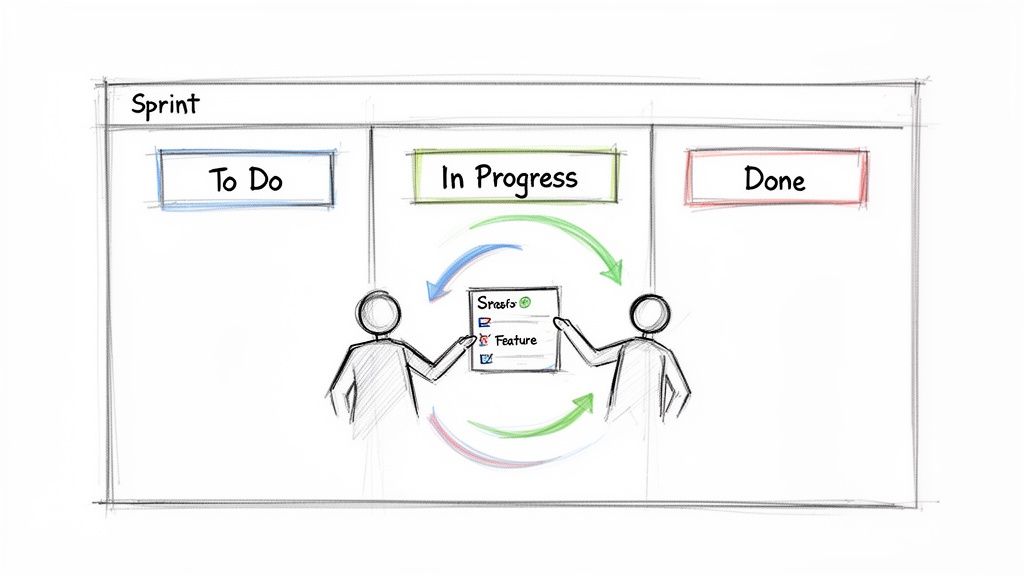
This methodology stands out as one of the most crucial software development life cycle best practices because it directly addresses modern project uncertainty and evolving requirements. Companies like Spotify build their entire organizational structure around Agile "squads" for maximum autonomy and speed, while Google’s rapid innovation is fueled by continuous sprint cycles. For development agencies like Nerdify, Agile is essential for managing diverse client projects where scope may evolve, ensuring nearshore teams remain perfectly aligned across different time zones.
Why It's a Top SDLC Practice
Adopting an Agile framework enables teams to respond swiftly to market changes and user feedback. This adaptability reduces the risk of building a product that no longer meets customer needs by the time it launches. It fosters a culture of transparency and continuous improvement, as teams regularly reflect on their processes in sprint retrospectives and make immediate adjustments.
How to Implement Agile Effectively
To successfully integrate Agile, focus on these actionable steps:
- Establish a "Definition of Done": Clearly define the criteria a task must meet to be considered complete. This ensures quality and consistency.
- Utilize Project Management Tools: Platforms like Jira, Monday.com, or Asana are vital for tracking sprint progress, managing backlogs, and providing project visibility to all stakeholders.
- Prioritize Communication: Maintain clear and constant communication channels between the development team and the client. Daily stand-up meetings and shared repositories for documentation are key.
- Conduct Sprint Retrospectives: After each sprint, hold a meeting to discuss what went well, what didn't, and what can be improved. This fuels continuous process refinement. For a deeper dive into one of the most popular Agile frameworks, you can explore the Scrum methodology in more detail.
2. Comprehensive Code Review Processes
Structured code review involves the systematic examination of source code by team members before it is integrated into the main codebase. This peer-review process is designed to find and fix mistakes overlooked in the initial development phase, improving the overall quality of the software. It serves as a critical checkpoint to enforce coding standards, share knowledge, and prevent bugs from reaching production.
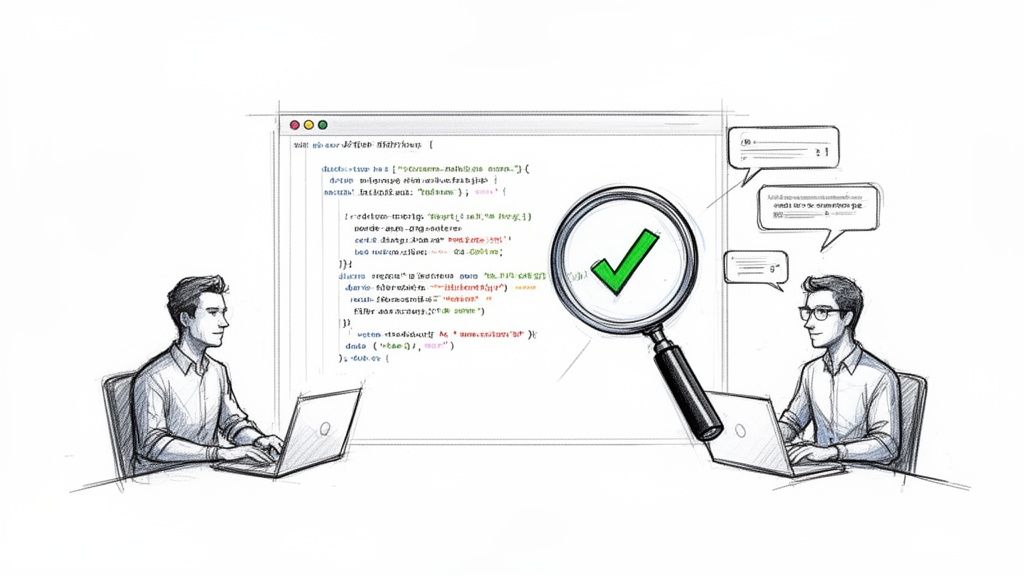
This practice is one of the most impactful software development life cycle best practices for building robust and maintainable systems. Tech giants like Google and Microsoft have made rigorous code reviews a mandatory step for every code change, recognizing their role in maintaining high standards at scale. For organizations like Nerdify that utilize nearshore staff augmentation, code reviews are vital for ensuring that code from distributed team members is consistent, high-quality, and aligned with the project's architecture.
Why It's a Top SDLC Practice
Implementing a formal code review process directly enhances code quality by catching defects, security vulnerabilities, and logic errors early. This early detection dramatically reduces the cost and effort of fixing issues later in the development cycle. Furthermore, it fosters a collaborative environment where developers learn from each other, leading to a collective improvement in team skills and a more consistent codebase.
How to Implement Code Reviews Effectively
To successfully integrate code reviews, focus on these actionable steps:
- Establish a Documented Style Guide: Create and share clear coding standards that define formatting, naming conventions, and best practices. This provides an objective basis for feedback.
- Use Code Review Tools: Platforms like GitHub, GitLab, and Bitbucket offer built-in features for pull requests, inline commenting, and threaded discussions to streamline the review workflow.
- Focus on Constructive Feedback: Frame comments as suggestions rather than criticisms. The goal is to improve the code, not to blame the author.
- Automate What You Can: Use static analysis tools and linters to automatically check for formatting and simple syntax errors, allowing human reviewers to focus on logic, architecture, and security. For a structured approach, you can explore this detailed code review checklist.
3. Continuous Integration and Continuous Deployment (CI/CD)
Continuous Integration (CI) and Continuous Deployment (CD) form an automated pipeline that streamlines how code gets from a developer’s machine to a production environment. CI is the practice of automatically building and testing code every time a developer commits a change to version control. CD extends this by automatically deploying all code changes that pass the testing phase to a production environment, making releases routine and low-risk.
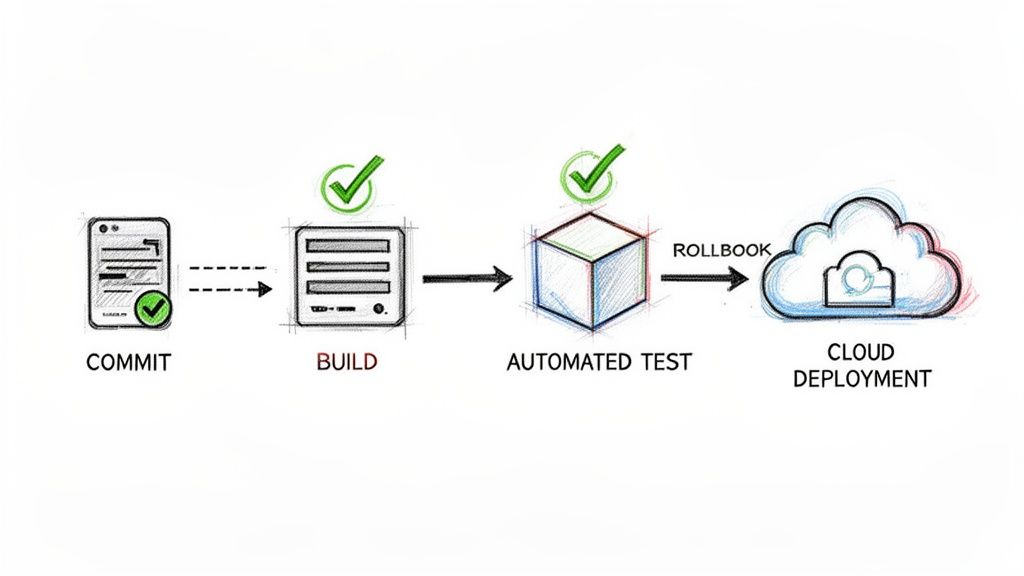
This automation is fundamental to modern software development life cycle best practices, enabling elite performers like Netflix and Amazon to deploy code hundreds or even thousands of times per day. For startups and SMEs, implementing a CI/CD pipeline means faster feedback loops, reduced manual errors, and a significant acceleration in time-to-market. It transforms releases from a stressful, high-stakes event into a predictable, everyday activity, ensuring development teams can deliver value to users continuously.
Why It's a Top SDLC Practice
A robust CI/CD pipeline minimizes integration issues by merging code frequently, catching bugs earlier in the development cycle when they are cheaper and easier to fix. It dramatically increases developer productivity by automating repetitive build, test, and deployment tasks. This practice fosters a culture of ownership and high quality, as the entire team is responsible for maintaining a green build and ensuring the product is always in a releasable state.
How to Implement CI/CD Effectively
To build a successful CI/CD pipeline, focus on these critical steps:
- Start with Continuous Integration: Before aiming for full CD, establish a solid CI process where every code commit triggers an automated build and a comprehensive suite of tests.
- Invest in Automated Testing: Your pipeline's reliability depends on thorough testing. Aim for high test coverage (80%+) across unit, integration, and end-to-end tests to build confidence in automated releases.
- Use Containerization: Tools like Docker ensure consistency between development, testing, and production environments. This eliminates the classic "it works on my machine" problem.
- Implement Safe Deployment Strategies: Use techniques like blue-green or canary deployments to release new features to a small subset of users first. This minimizes the impact of potential issues.
- Monitor and Alert: Set up robust monitoring for your production environment to detect issues immediately after a deployment. Automated alerts ensure your team can respond quickly to any problems.
4. Test-Driven Development (TDD)
Test-Driven Development is a software development process that reverses the traditional coding and testing sequence. Instead of writing code first and tests later, TDD requires developers to write an automated test case before they write the production code necessary to pass that test. The process follows a simple, repetitive cycle: write a failing test (red), write the minimum amount of code to make the test pass (green), and then refactor the code to improve its structure without changing its behavior (refactor).
This disciplined approach is one of the most impactful software development life cycle best practices because it builds quality and maintainability directly into the development workflow. It ensures that every piece of code is covered by a test from its inception. Tech giants like Google often require TDD-inspired testing practices for critical systems to maintain stability, while Etsy attributed significant reductions in bugs and deployment issues to their adoption of TDD, improving overall product quality.
Why It's a Top SDLC Practice
TDD leads to a more robust, bug-resistant codebase and a comprehensive, automated test suite that serves as living documentation. This practice forces developers to think through requirements and design before writing functional code, resulting in simpler and more decoupled designs. It also provides a safety net that allows teams to refactor and add new features with confidence, knowing that the existing functionality is protected by tests.
How to Implement TDD Effectively
To successfully integrate TDD into your development process, focus on these key actions:
- Start with Critical Logic: Don’t try to apply TDD to everything at once. Begin with core business logic and complex algorithms where correctness is paramount.
- Follow Clear Naming Conventions: Name your tests descriptively to explain what behavior is being tested (e.g.,
should_return_error_when_input_is_invalid). This makes the test suite easier to understand. - Keep Tests Small and Focused: Each test should verify a single behavior or outcome. This makes it easier to pinpoint failures when a test breaks.
- Utilize Appropriate Frameworks: Select testing frameworks that are well-suited to your programming language and environment, such as Jest for JavaScript, pytest for Python, or JUnit for Java.
5. Documentation, Knowledge Management, and Team Development
Effective knowledge management combines comprehensive documentation with a culture of continuous learning to build team capability and ensure project resilience. This practice involves creating and maintaining accessible resources like technical docs, API specifications, and architecture diagrams, while simultaneously fostering an environment where team members actively share expertise through mentorship and training sessions. This systematic approach ensures that critical information isn't siloed with individuals.
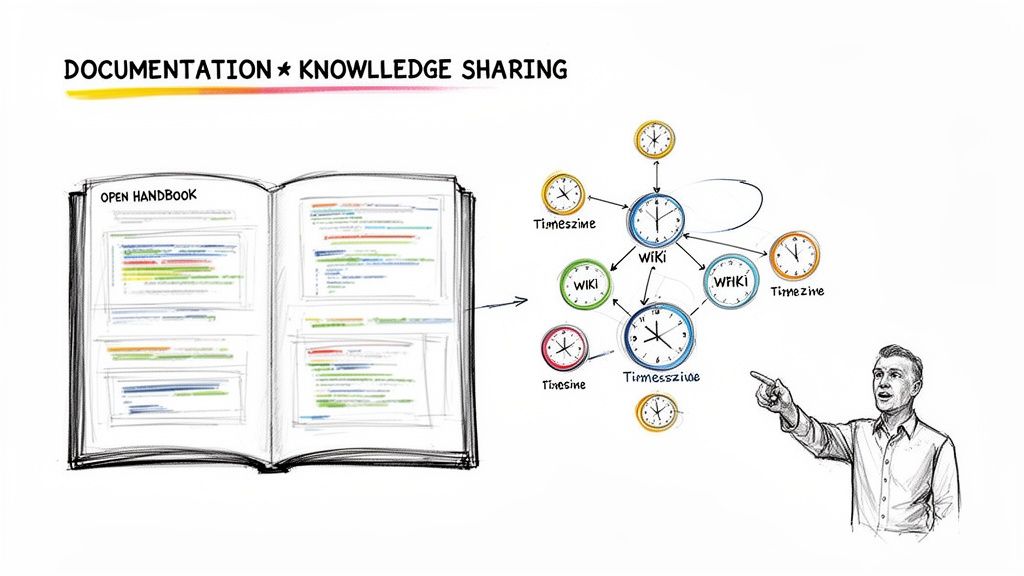
This holistic approach is one of the most vital software development life cycle best practices for scaling teams and maintaining long-term project velocity. Stripe’s public API documentation is a gold standard, making complex financial integrations straightforward for developers globally. Similarly, open-source communities like the Apache Software Foundation thrive on high-quality documentation that enables distributed, asynchronous collaboration. For agencies with nearshore models, robust knowledge management is the glue that aligns teams across different geographies, ensuring consistent quality and smooth handoffs.
Why It's a Top SDLC Practice
A strong focus on documentation and team development directly mitigates key-person risk, where the loss of one team member could derail a project. It streamlines the onboarding process for new hires, allowing them to become productive much faster. Furthermore, investing in continuous learning keeps the team's skills sharp and relevant, enabling them to leverage modern technologies and solve complex problems more efficiently.
How to Implement It Effectively
To build a culture of shared knowledge and growth, implement these strategies:
- Document Decisions as They Happen: Integrate documentation into your workflow. Record architectural decisions, API changes, and process updates in real-time rather than treating it as an afterthought.
- Use a Centralized Knowledge Base: Implement tools like Confluence, Notion, or even a well-organized Git repository wiki. This creates a single source of truth that is easily accessible to everyone.
- Schedule Knowledge Sharing Sessions: Dedicate regular time for "lunch and learns," tech talks, or code reviews where team members can share new findings, demonstrate techniques, or discuss challenges.
- Invest in Professional Growth: Provide a dedicated budget for courses, certifications, and conferences. Create clear career paths that link advancement to skill acquisition and mentorship.
6. Version Control and Git Workflows
Version control is a system that records changes to a file or set of files over time so that you can recall specific versions later. For software development, this is most commonly managed with Git, which allows multiple developers to collaborate on a single project without overwriting each other's work. Structured Git workflows, such as Git Flow or GitHub Flow, provide a framework for managing how code is merged, reviewed, and deployed, ensuring a predictable and organized development process.
This discipline is one of the most foundational software development life cycle best practices because it provides a safety net for development, an audit trail for every change, and the backbone for collaboration. The Linux kernel, one of the largest open-source projects in history, relies on Git to manage contributions from thousands of developers worldwide. For development agencies like Nerdify, a well-defined Git workflow is non-negotiable for maintaining code quality and coordinating efforts across distributed nearshore and offshore teams, ensuring every feature and bug fix is traceable and reversible.
Why It's a Top SDLC Practice
Effective version control minimizes integration conflicts, prevents code loss, and enables parallel development. By using distinct branches for features, bug fixes, and releases, teams can work on different tasks simultaneously without destabilizing the main codebase. It also facilitates code reviews through pull requests, creating a crucial quality gate before new code is merged. This structured approach provides full traceability, allowing teams to pinpoint when a bug was introduced and by which change.
How to Implement Version Control Effectively
To successfully integrate robust Git workflows, focus on these actionable steps:
- Establish a Clear Branching Strategy: Document your chosen workflow (e.g., Git Flow, trunk-based development) and ensure every team member understands it. Consistency is key.
- Use Descriptive Naming Conventions: Name branches and write commit messages clearly. For branches, use prefixes like
feature/orbugfix/. For commits, follow a convention like Conventional Commits to describe the change's intent. - Keep Commits Atomic: Each commit should represent a single, logical change. This makes code reviews easier and simplifies cherry-picking or reverting changes if necessary.
- Protect Key Branches: Configure repository rules to protect your
mainordevelopbranches. Require pull requests and successful status checks before allowing any code to be merged. - Utilize a
.gitignoreFile: Create a.gitignorefile at the root of your repository to prevent committing unnecessary files like dependencies, logs, or system-specific configurations.
7. Regular Security Audits and Vulnerability Management
Regular security audits and vulnerability management are systematic processes for evaluating code, infrastructure, and development practices to uncover security weaknesses before they can be exploited. This proactive approach involves continuous scanning, penetration testing, and threat modeling to build and maintain secure applications, which is a non-negotiable for protecting user data and building trust.
Integrating security throughout the development process is one of the most critical software development life cycle best practices in today's threat landscape. Microsoft’s Security Development Lifecycle (SDL) is a prime example of a company-wide commitment to secure software engineering. Similarly, platforms like GitHub offer integrated security scanning directly within repositories, making vulnerability management a seamless part of the developer workflow. At Nerdify, we implement security audits as a standard procedure to ensure the custom applications we build for clients are resilient against potential attacks.
Why It's a Top SDLC Practice
Making security a continuous concern rather than an afterthought drastically reduces the risk of costly data breaches and reputational damage. It helps teams identify and fix vulnerabilities early in the lifecycle when they are less expensive and easier to resolve. This approach, often called "Shift Left," creates a security-first culture that protects both the end-user and the business, ensuring compliance with regulations like GDPR and HIPAA.
How to Implement Security Audits Effectively
To build a robust security posture, embed these practices into your SDLC:
- Integrate Security Scanning into CI/CD: Use automated tools like SonarQube or Snyk within your continuous integration pipeline to scan code for vulnerabilities on every commit.
- Conduct Threat Modeling: During the design phase, hold sessions to identify potential threats, attack vectors, and security controls for new features.
- Keep Dependencies Updated: Regularly use dependency scanning tools to find and patch known vulnerabilities in third-party libraries and frameworks.
- Enforce Secure Coding Standards: Establish and enforce secure coding guidelines based on OWASP Top 10 principles and use them as a checklist during code reviews. For a deeper look at this proactive approach, you can learn more about Shift Left security.
- Implement the Principle of Least Privilege: Ensure all systems and user accounts have only the minimum permissions necessary to perform their functions.
8. Effective Communication and Stakeholder Management
Effective communication is the glue that holds the software development life cycle together. It involves establishing clear, consistent, and transparent information flows between developers, product managers, clients, and other stakeholders. Instead of ad-hoc conversations, this practice relies on structured protocols, regular updates, and shared documentation to ensure everyone is aligned on goals, progress, and expectations.
This practice is one of the most vital software development life cycle best practices because it directly mitigates the primary cause of project failure: misalignment. Companies known for their distributed workforces, like Automattic and GitLab, have built their success on rigorous communication frameworks. For nearshore models, like those at Nerdify, mastering cross-cultural and time-zone-aware communication is essential to bridging geographical gaps and delivering a unified project vision.
Why It's a Top SDLC Practice
Structured communication prevents scope creep, reduces costly rework, and builds trust among stakeholders. When everyone has access to the same information and understands their role in the decision-making process, teams can identify and resolve blockers faster. This transparency fosters a collaborative environment where feedback is constructive and project momentum is maintained, ensuring the final product accurately reflects the intended business value.
How to Implement Effective Communication
To build a robust communication framework, integrate these actionable steps:
- Establish a Meeting Cadence: Schedule regular, purposeful meetings like daily stand-ups for quick syncs, weekly reviews for progress demos, and bi-weekly retrospectives. Respect time zones by rotating meeting times if necessary.
- Centralize Documentation: Use a single source of truth like Confluence, Notion, or a shared repository to document all key decisions, requirements, and meeting notes. This prevents information silos.
- Define Roles with a RACI Matrix: Create a chart that clearly outlines who is Responsible, Accountable, Consulted, and Informed for each major task or decision. This eliminates confusion about authority.
- Leverage Project Management Tools: Utilize platforms like Jira or Monday.com to provide all stakeholders with real-time visibility into project status, backlogs, and potential roadblocks.
- Balance Synchronous and Asynchronous Communication: Use real-time meetings for complex problem-solving and collaboration, but rely on tools like Slack or email for non-urgent updates to respect deep work time.
9. Performance Monitoring and Observability
Performance monitoring and observability are critical practices for understanding how your software behaves once it's live in a production environment. While monitoring involves collecting predefined metrics (like CPU usage or response times), observability goes deeper, enabling teams to ask new questions about their system's state without needing to ship new code. It combines logs, metrics, and traces to provide a holistic view, making it possible to debug complex and unpredictable issues.
This approach is one of the most vital software development life cycle best practices for maintaining system health and ensuring a positive user experience post-launch. For instance, Netflix relies on sophisticated observability to manage its massive, distributed infrastructure and ensure smooth streaming for millions of users. Similarly, Shopify heavily invests in observability to maintain platform reliability for its merchants, especially during high-traffic events like Black Friday. This proactive insight prevents downtime and protects revenue.
Why It's a Top SDLC Practice
Implementing robust observability allows teams to move from a reactive "what is broken?" mindset to a proactive "why is this happening?" approach. It dramatically reduces Mean Time to Resolution (MTTR) for incidents by providing the context needed to pinpoint root causes quickly in complex microservices architectures. This practice closes the feedback loop in the SDLC, feeding production insights directly back into the development process for continuous improvement and optimization.
How to Implement Performance Monitoring and Observability Effectively
To build a culture of observability, integrate these actionable steps:
- Define Service Level Objectives (SLOs): Establish clear, measurable targets for system performance and reliability that matter to the user (e.g., 99.9% of homepage loads are faster than 500ms).
- Implement Structured Logging: Ensure logs are written in a consistent, machine-readable format (like JSON) and include context, such as a correlation ID, to trace a single user request across multiple services.
- Utilize Observability Platforms: Tools like Datadog, New Relic, or open-source solutions like Prometheus and Grafana are essential for aggregating telemetry data (metrics, logs, traces) and creating insightful dashboards.
- Create Meaningful Alerts: Configure alerts based on user impact and SLO violations, not just arbitrary system-level thresholds. Accompany alerts with runbooks that guide on-call engineers on how to respond.
10. Architecture Review and Scalability Planning
Architecture review and scalability planning involve proactively designing and evaluating a system's foundation to ensure it can handle future growth, maintain performance, and adapt to evolving business needs. Rather than treating architecture as a one-time decision, this practice integrates it as a continuous concern throughout the SDLC. It focuses on making deliberate choices about components, their interactions, and the underlying infrastructure to prevent costly refactoring and technical debt.
This structured approach is a cornerstone among software development life cycle best practices because it directly impacts a product's long-term viability and total cost of ownership. For instance, Netflix's famous transition from a monolith to a microservices architecture was a strategic move to achieve massive scalability and team autonomy. Similarly, Amazon built its empire on a service-oriented architecture that allows independent teams to innovate and deploy rapidly, a model that has since been widely adopted.
Why It's a Top SDLC Practice
A solid, scalable architecture prevents performance bottlenecks that can cripple a growing application. By planning for growth from the outset, teams avoid the "rewrite everything" scenario that plagues many successful startups. It forces developers to think critically about system constraints, resilience, and maintainability, leading to a more robust and reliable end product. This practice ensures the system can evolve without requiring a complete overhaul for every new feature.
How to Implement Architecture Review and Scalability Planning Effectively
To integrate this practice into your workflow, focus on these key actions:
- Document Decisions with ADRs: Use Architecture Decision Records (ADRs) to document significant architectural choices, their context, and their trade-offs. This creates a clear historical record for future teams.
- Design for Horizontal Scaling: Build stateless services whenever possible. This allows you to easily add more instances to handle increased load without complex state management.
- Implement Caching Strategies: Use tools like Redis or Memcached to store frequently accessed data in memory, reducing database load and improving response times for users.
- Plan for Observability: Integrate logging, monitoring, and tracing tools from day one. This gives you the visibility needed to identify and diagnose performance issues before they impact users.
- Conduct Regular Reviews: Don't treat architecture as a static blueprint. Schedule periodic architecture review meetings, especially when introducing new major features, to ensure the design remains aligned with current and future requirements.
10-Point SDLC Best Practices Comparison
| Practice | Implementation Complexity 🔄 | Resource Requirements ⚡ | Expected Outcomes 📊 | Ideal Use Cases 💡 | Key Advantages ⭐ |
|---|---|---|---|---|---|
| Agile Methodology Implementation | 🔄 Moderate — iterative process change, sprint cadence | ⚡ Moderate — cross-functional teams, PM tools, client time | 📊 Faster time-to-market; frequent client feedback | 💡 Projects with evolving requirements and client collaboration | ⭐ Adaptability; continuous delivery; improved team alignment |
| Comprehensive Code Review Processes | 🔄 Low–Moderate — defined review workflows | ⚡ Low–Medium — reviewers, review tools, automation | 📊 Higher code quality; fewer defects; consistent style | 💡 Distributed teams; maintaining large or shared codebases | ⭐ Early bug detection; knowledge transfer; reduced tech debt |
| Continuous Integration & Deployment (CI/CD) | 🔄 High — pipeline design and automation complexity | ⚡ High — CI servers, infra, extensive test suites | 📊 Rapid, reliable deployments; fewer manual errors | 💡 Frequent-release products; scalable delivery pipelines | ⭐ Fast delivery; deployment consistency; rollback safety |
| Test-Driven Development (TDD) | 🔄 Moderate — workflow discipline (red/green/refactor) | ⚡ Medium — testing frameworks, skilled developers | 📊 High test coverage; fewer regressions; clearer specs | 💡 Critical business logic; long-lived codebases | ⭐ Improved design; confident refactoring; lower maintenance cost |
| Documentation, Knowledge Management & Team Development | 🔄 Moderate — cultural practices and maintenance | ⚡ Medium — docs platforms, time for writing/training | 📊 Faster onboarding; reduced key-person risk; better handoffs | 💡 Nearshore/distributed teams; long-term maintenance projects | ⭐ Knowledge retention; improved collaboration; reduced attrition |
| Version Control & Git Workflows | 🔄 Low–Moderate — branching strategy and rules | ⚡ Low — Git hosting, training, CI integration | 📊 Safe parallel development; audit trail; easier rollbacks | 💡 Any software team requiring collaboration | ⭐ Traceability; structured merges; conflict isolation |
| Regular Security Audits & Vulnerability Management | 🔄 High — specialized testing and remediation cycles | ⚡ High — security tools, auditors, ongoing scans | 📊 Lower breach risk; regulatory compliance; client trust | 💡 Client-facing apps; regulated industries (PCI, HIPAA, GDPR) | ⭐ Risk reduction; early vulnerability detection; compliance |
| Effective Communication & Stakeholder Management | 🔄 Low–Moderate — meeting cadences and protocols | ⚡ Low–Medium — PM tools, time for syncs and updates | 📊 Fewer misunderstandings; aligned expectations; faster decisions | 💡 Nearshore engagement; client-heavy projects | ⭐ Transparency; stronger stakeholder trust; clearer priorities |
| Performance Monitoring & Observability | 🔄 High — instrumentation, dashboards, tracing | ⚡ High — APM/logging tools, storage, SRE expertise | 📊 Faster MTTR; proactive detection; improved UX | 💡 Production services; high-traffic or distributed systems | ⭐ Data-driven optimization; proactive alerting; reliability |
| Architecture Review & Scalability Planning | 🔄 High — strategic reviews and design validation | ⚡ High — architects, load testing, design tools | 📊 Scalable, maintainable systems; reduced future rework | 💡 Systems expecting growth; complex or long-lived apps | ⭐ Prevents costly rewrites; ensures performance and resilience |
From Theory to Practice: Integrating SDLC Best Practices Into Your Workflow
Navigating the complexities of modern software development requires more than just technical skill; it demands a structured, strategic approach. Throughout this guide, we've explored ten cornerstone software development life cycle best practices, from implementing Agile methodologies and robust CI/CD pipelines to prioritizing security audits and stakeholder communication. These aren't just theoretical concepts but a practical roadmap to building higher-quality software, faster and more reliably.
The journey from a chaotic, reactive development process to a streamlined, proactive one is transformative. By integrating these principles, you move beyond simply writing code to engineering predictable, scalable, and resilient systems. Each practice we've discussed, whether it's the discipline of Test-Driven Development or the foresight of architecture review, acts as a force multiplier, amplifying your team's efficiency and the long-term value of your product.
Key Takeaways: From Principles to Action
The central theme connecting these practices is a shift towards a culture of continuous improvement and proactive quality assurance. Instead of treating testing, security, and documentation as afterthoughts, they become integral, ongoing activities woven into the fabric of your daily workflow.
- Proactive vs. Reactive: Adopting practices like TDD and regular security audits shifts your team from fixing bugs and vulnerabilities after they appear to preventing them from happening in the first place.
- Automation is Your Ally: Leveraging CI/CD and automated testing frees up your developers from manual, repetitive tasks, allowing them to focus on innovation and complex problem-solving.
- Collaboration is Core: Structured code reviews, effective stakeholder management, and comprehensive documentation are not just about process; they are about building a shared understanding and collective ownership of the project's success.
- Visibility is Vital: Performance monitoring and observability provide the critical feedback loop needed to understand how your application behaves in the real world, enabling data-driven decisions for future development and scaling.
Your Actionable Next Steps
Adopting all ten practices at once can be overwhelming. The most effective approach is iterative and tailored to your team's unique challenges and goals. Here’s a practical plan to get started:
- Assess Your Current State: Conduct an honest audit of your existing SDLC. Where are the biggest bottlenecks? What causes the most friction or leads to the most defects? Use this as your starting point.
- Prioritize for Impact: Select one or two practices that will deliver the most immediate value. If your deployment process is manual and error-prone, start with CI/CD. If code quality is inconsistent, formalize your code review process.
- Start Small and Iterate: Implement the chosen practice on a single project or with a small team. Use this pilot to learn, refine the process, and demonstrate its value. For example, begin with a simple Git workflow like GitFlow before moving to more complex trunk-based development models.
- Measure and Communicate: Define key metrics to track the impact of the new practice. Did it reduce deployment failures? Did it decrease the number of bugs found in production? Share these wins with the wider team and stakeholders to build momentum and buy-in for further adoption.
Ultimately, mastering software development life cycle best practices is an ongoing commitment, not a one-time project. It's about cultivating a mindset where quality, efficiency, and collaboration are everyone's responsibility. By taking these deliberate, incremental steps, you are not just improving a process; you are building a resilient, high-performing engineering culture. This investment will pay dividends in every feature you ship, every product you launch, and every customer you serve, creating a powerful engine for sustainable innovation and business growth.