Staff Augmentation Vs Consulting A Guide to Scaling Your Team
The real question when choosing between staff augmentation and consulting comes down to one thing: are you trying to fill a hole in your team, or are you trying to solve a puzzle for your business? Think of it this way: staff augmentation gives you the tactical specialists who can jump right into your projects and start contributing immediately. On the flip side, consulting provides a strategic partner you hand a problem to, and they come back with a managed solution.
Choosing Your Growth Model: A Quick Guide
Picking the right model is a pivotal decision for any company looking to scale. One path gives you the extra hands you need to get work done, while the other offers the high-level brainpower to figure out what work you should be doing in the first place. Getting clear on this fundamental difference is the only way to make sure your investment pays off.
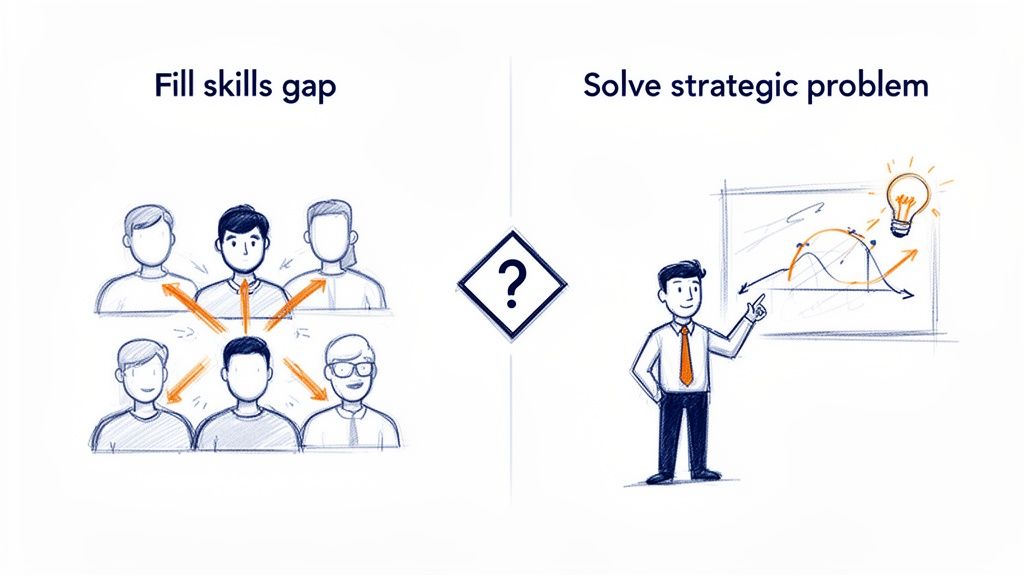
This guide is designed to help you pinpoint your core challenge and choose the model that fits. Whether you need to speed up a software build or map out an entry into a new market, the right choice is crucial. And once you've chosen, success often hinges on optimizing consulting and management operations to get the most value from your external partners.
Key Situational Differences
Staff augmentation shines when your project is already well-defined and you have strong leaders in place, but you just don't have enough people—or the right specialists—to get it over the finish line. You keep total control. The new team members simply slot into your existing structure and report to your managers.
Consulting is the answer when you're staring down a complex business challenge and aren't even sure where to begin. Consultants work on their own to dig into the problem, create a strategic roadmap, and deliver a full-blown plan. They give you the "what" and the "why," while augmented staff helps you with the "how."
The core distinction is simple: Staff augmentation is about doing, while consulting is about advising. You hire augmented staff to build the product you’ve designed; you hire consultants to help you decide what product to build in the first place.
Decision Matrix: Staff Augmentation Vs. Consulting
When you're at a crossroads, a clear framework can make the decision much easier. Use this table to quickly assess which model best fits your immediate business objectives and operational needs.
| Decision Factor | Best for Staff Augmentation | Best for Consulting |
|---|---|---|
| Primary Goal | Executing a known project or task | Defining strategy or solving a complex problem |
| Project Control | Full internal control over talent and tasks | Ceding control over strategy and deliverables |
| Team Integration | Professionals work as part of your team | External team works independently |
| Knowledge Transfer | Skills are embedded directly into your team | Knowledge delivered via reports and presentations |
| Cost Structure | Typically hourly or monthly rates | Often project-based or value-based pricing |
Ultimately, your choice depends on whether you need more hands to execute a vision you already have (staff augmentation) or an expert mind to help you create that vision (consulting).
How Each Engagement Model Actually Works
Knowing the dictionary definitions of staff augmentation and consulting is one thing. Understanding how they feel in practice—day-to-day, in the trenches—is something else entirely. Let's break down how these models really function when it comes to team integration, project control, and what happens to all that valuable knowledge once the engagement is over.
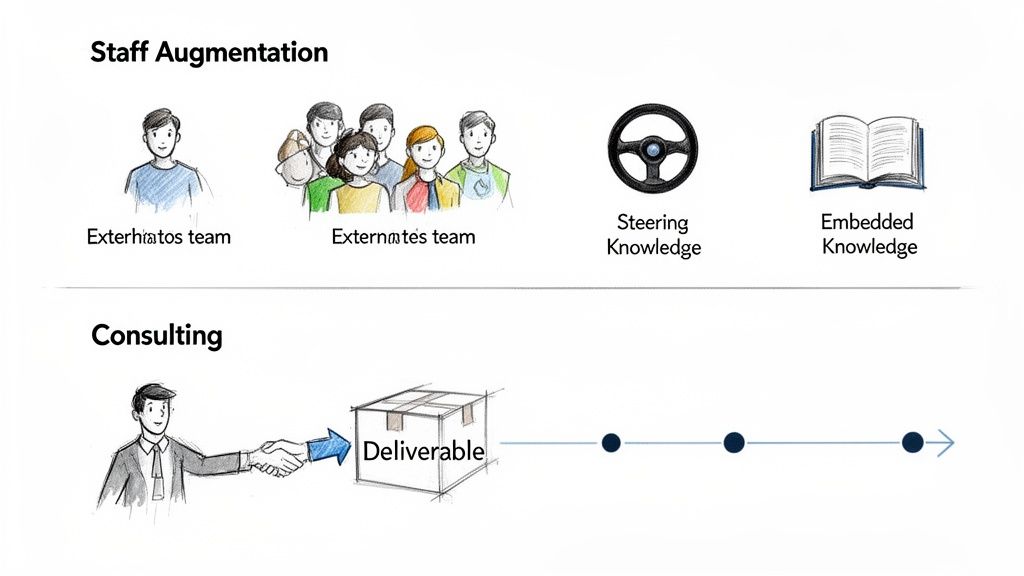
Think of staff augmentation as bringing in a new team member who just happens to be on a flexible contract. They slot directly into your existing team, adopt your culture, use your tools, and report to your managers. It's all about deep integration.
Consulting, on the other hand, is about bringing in external advisors. They work more independently, applying their own proven methods to solve a very specific problem. Their interactions are more structured and less about becoming part of the daily grind.
Integration and Team Dynamics
The level of integration completely changes your team's workflow. An augmented hire becomes, for all practical purposes, one of your own. They’re in your daily stand-ups, committing code to your repositories, and collaborating directly with your permanent staff.
This tight integration creates a single, unified team working toward the same goals using the same processes. The catch? You're on the hook for onboarding them and making sure they mesh with your company culture.
Consultants intentionally keep a bit of distance. Their value lies in their objective, outside perspective, which can get diluted if they get too tangled up in internal politics or day-to-day routines. They operate as a self-contained unit focused squarely on delivering a strategic outcome.
Key Takeaway: Staff augmentation brings talent inside your team to build it out. Consulting brings an expert team to work alongside yours to solve a problem. One enhances your structure; the other provides an independent one.
Project Control and Ownership
This is one of the biggest differentiators. With staff augmentation, you keep 100% control. You call the shots on the project's direction, the daily tasks, and you own the final outcome, for better or worse. Your augmented staff are there to execute your vision, under your leadership.
You set the priorities and manage the backlog. This approach is perfect when you have a solid plan and strong internal leadership but just need more hands or specific skills to get it done.
Consulting flips that script entirely. You're handing off the problem and the ownership of the solution. The consulting firm signs up to deliver a specific result—a market entry strategy, a new tech roadmap, a process overhaul—on an agreed-upon timeline.
Your role shifts from hands-on manager to key stakeholder. You'll give input and review progress, but the consultants drive the project management and are responsible for the deliverables. It’s a model that shares DNA with outsourcing, where you delegate responsibility for a function or outcome. For a more detailed look, our guide on staff augmentation vs outsourcing breaks it down further.
Knowledge Transfer and Long-Term Impact
Think about what happens after the contract ends. With staff augmentation, knowledge transfer is a natural, ongoing process. As augmented pros work shoulder-to-shoulder with your employees, they're constantly sharing skills, shortcuts, and new ways of thinking.
This organically upskills your entire team. Long after the contract is over, you're left with a smarter, more capable team because that new knowledge has been absorbed into your organization's muscle memory.
In a consulting engagement, knowledge transfer is a much more formal, one-time event. It typically happens at the very end of the project and looks something like this:
- Final Reports: Thick documents detailing all the findings and strategic advice.
- Presentations: A formal deck and meeting where the consultants walk your leadership through their solution.
- Training Workshops: Sessions designed to teach your team how to implement the recommended changes.
This is all incredibly valuable, but it’s a single hand-off. It puts the pressure on your team to absorb a ton of information at once. If that hand-off is fumbled, all those brilliant insights can easily end up sitting unread in a folder somewhere.
Analyzing The True Costs and Financial Impact
When you're weighing staff augmentation against consulting, looking at just the hourly rate is a rookie mistake. To really understand the financial picture, you have to dig into the total cost of engagement, the hidden expenses, and what kind of return you can realistically expect from each. One might look cheaper on paper, but the real story is in the details.
Staff augmentation typically comes with a much more straightforward price tag. You pay an agreed-upon rate—whether it's hourly, daily, or monthly—for a specific person's time and skills. This model is all about cost-efficiency. You're effectively sidestepping all the heavy financial baggage that comes with hiring a full-time employee.
Think about it: no recruitment fees, no benefits packages, no payroll taxes, no new hardware. Instead of being locked into a long-term salary, you have a flexible operational expense that you can turn on or off as your project needs change.
How You'll Actually Be Billed
The billing structure for each model is fundamentally different because you’re paying for two different things: time and skills on one hand, strategic outcomes on the other. Getting this right is crucial for matching the engagement to your budget.
Staff Augmentation Pricing: This is almost always a time-and-materials (T&M) game. You pay for the hours your augmented team members work. It’s transparent, it’s flexible, and it’s perfect for projects where requirements are likely to shift. You’re in the driver's seat, controlling the budget by managing the team's workload.
Consulting Pricing: Consultants bill based on the strategic value they deliver. You'll usually see a few common models:
- Fixed-Price: You agree on a single price for a clearly defined project, like a market research report. It offers budget predictability but leaves little room for changes.
- Retainer: A recurring monthly fee gives you ongoing access to a consultant's expertise. This is great for long-term strategic guidance.
- Value-Based: This is where the fee is linked to the results. A consultant might take a percentage of the cost savings or revenue increase their work generates.
The core financial difference is this: are you paying for input or for output? With staff augmentation, you buy the skilled labor (input) to execute your vision. With consulting, you're buying a strategic result (output), and that guarantee always comes at a premium.
Looking Beyond The Sticker Price
The initial quote is just the starting point. The real financial appeal of staff augmentation is how it slashes recruitment overhead. Businesses that lean into this model are seeing hiring cost reductions of 40-60% compared to traditional hiring. You bypass the whole cycle of sourcing, interviewing, and onboarding, plus you avoid long-term salary and benefits commitments. We dive deeper into these benefits of staff augmentation in another article.
Of course, there's no free lunch. You still have to account for the internal management time your team will spend bringing augmented staff up to speed and overseeing their work. That's a real, though indirect, cost. But in most cases, the model is designed for such quick integration that this overhead is minimal.
Consulting, on the other hand, might have a higher upfront cost, but its value is in preventing very expensive mistakes. That hefty price tag includes project management, deep expertise, and, most importantly, accountability for the final outcome. The right consultant can save you millions by steering you away from a bad technology choice or a flawed go-to-market strategy. They are essentially taking on the risk of failure for you, which is a massive, if intangible, financial upside.
Ultimately, your choice comes down to your financial strategy. Staff augmentation is a clean, controllable way to add firepower to your team without adding long-term headcount. Consulting is a strategic investment where the ROI isn't measured in hours worked, but in problems solved and business goals achieved.
When to Use Each Model: Real-World Scenarios
Theory is one thing, but seeing how these models play out in the real world is where the rubber meets the road. The best choice between staff augmentation and consulting becomes much clearer when you map it to a specific business problem. Let's ditch the abstract definitions and look at some concrete examples of where each model really shines.
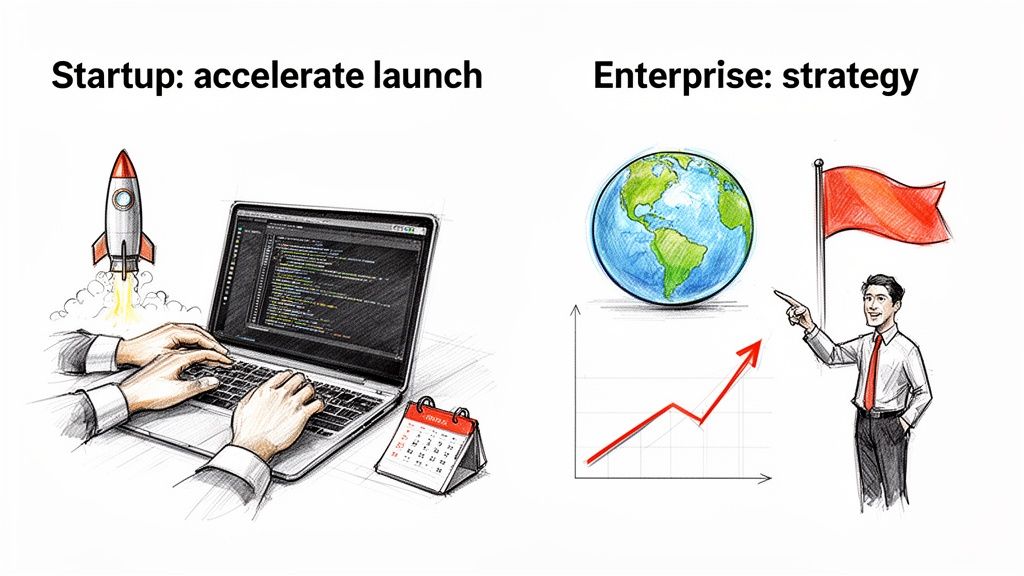
Think about a fast-moving startup with a crystal-clear product roadmap and a non-negotiable launch date. They know exactly what to build but just don’t have the specialized mobile developers to do it in time. This is a classic case for staff augmentation.
By bringing in two senior iOS developers, they can immediately plug that skills gap. The new hires slot right into the existing team, the CTO keeps full control, and the project gets back on track without the weeks or months lost to traditional recruiting.
Ideal Scenarios for Staff Augmentation
Staff augmentation is your best bet when you need tactical execution and already have strong internal leadership. It's about adding skilled hands to a machine that's already running smoothly.
You'll see it work best in situations like these:
- Hitting a Tight Deadline: A software company is just three months away from a major SaaS platform release, but their front-end team is drowning. They bring on three React developers for a four-month stint to burn through the backlog and ensure they hit their go-live date.
- Plugging a Niche Skill Gap: A mid-sized e-commerce company wants to build an AI recommendation engine. Lacking in-house machine learning talent, they contract a data scientist for six months to develop the algorithms, working directly with their core engineering team.
- Covering a Temporary Leave: The lead DevOps engineer is about to go on a three-month parental leave. To keep projects moving, the company augments the team with an experienced DevOps specialist to manage the infrastructure and CI/CD pipelines.
In all these cases, the what and the why are already figured out. The company just needs the who to execute. Staff augmentation delivers that "who" quickly, letting them integrate right into the existing workflow.
Prime Use Cases for Consulting
Now, let’s flip the script. Imagine an established enterprise looking to break into the European market. They have no experience with regional regulations, local consumer behavior, or cross-border logistics. They don't need more coders; they need a strategic blueprint. This is precisely where you call in consultants.
A consulting firm would come in to perform deep market analysis, develop a go-to-market strategy, and map out a phased rollout. Their deliverable isn't code; it's a comprehensive roadmap. They take ownership of the strategic problem itself.
The data backs this up. A significant 72% of companies engage consultants for specific, high-level challenges, while 60% use staff augmentation to fill tactical skill gaps. This highlights how consulting is viewed as the solution for structured growth plans, where outside experts architect long-term strategies for things like market entry or operational overhauls. You can dig deeper into these trends by exploring more on staff augmentation versus consulting.
Consulting is the clear winner in scenarios like these:
- Guiding a Digital Transformation: A legacy manufacturing company wants to completely modernize its software development lifecycle. Consultants are hired to audit the current state, recommend an agile framework, and oversee the adoption of new tools and methodologies.
- Making a Critical Technology Choice: A healthcare provider needs a new Electronic Health Record (EHR) system. A consulting team evaluates the top vendors, navigates complex compliance requirements, and provides an objective, data-driven recommendation.
- Optimizing Inefficient Processes: A financial services firm is bleeding money due to clunky workflows. Consultants are brought in to map every process, pinpoint the bottlenecks, and design a streamlined operational model to boost efficiency and cut costs.
Navigating Potential Risks and How to Succeed
Picking a growth model is just the starting line. The real work begins when you start managing the unique risks that come with both staff augmentation and consulting. Each approach is a powerful tool, but they both have their own set of potential tripwires. Knowing what those are upfront is the key to getting your money's worth and avoiding the common mistakes that can send a project off the rails.
The market is clearly leaning into flexible talent. The staff augmentation market is on track to hit $81.87 billion, and that's just a slice of the much larger $591.2 billion IT outsourcing pie. It's easy to see why—businesses are desperate to skip the long, painful hiring process, where just replacing one tech employee can cost 80-200% of their salary. But speed has its price. A staggering 58% of augmentation projects get delayed because of integration problems, while consulting projects are in a constant battle with scope creep.
Mitigating Risks in Staff Augmentation
With staff augmentation, the biggest headaches are almost always people-related. You're dealing with cultural fit, getting them up to speed effectively, and keeping them productive without being able to look over their shoulder. The secret is to stop thinking of them as temporary help and start treating them like part of the core team from day one.
To get them settled in smoothly and head off these risks, you need a solid integration plan:
- Create a Robust Onboarding Packet: Don't just give them a login. Lay out the project goals, who's who on the team, how you communicate, and links to every important document.
- Assign an Internal Mentor: Give your new team member a go-to person on the inside. Someone they can ask the "stupid" questions to and who can help them figure out your company's unwritten rules.
- Over-Communicate Early On: Set up daily check-ins for the first week. It’s the fastest way to get everyone on the same page, spot problems early, and build a good working relationship.
A common mistake is to treat augmented staff like a task-based service. True success comes from deep integration. The goal isn't just to get code written; it's to get the right code written by someone who understands the business context as well as your full-time employees do.
Managing Challenges in Consulting Engagements
When you bring in consultants, the risks pivot from people problems to project problems. The two biggest dangers are scope creep—where the project's goals just keep growing—and a potential gap between the consultant’s brilliant strategy and your team's ability to actually implement it.
Stopping these issues before they start comes down to meticulous planning and crystal-clear communication. Your Statement of Work (SOW) is your best friend here, and it needs to be bulletproof.
Here’s how you keep the project on track and make sure you get something you can actually use:
- Define Deliverables with Extreme Clarity: Don't just ask for a "market analysis." Specify "a 20-page market analysis report covering competitor positioning, target audience demographics, and pricing strategy for the EU market." The details matter.
- Establish Firm Milestones and Checkpoints: Put regular review sessions on the calendar where the consultants have to show their work against the SOW. This is how you avoid nasty surprises at the finish line.
- Appoint a Single Point of Contact: Pick one person from your team to be the main point of contact. This stops consultants from getting mixed signals and ensures they have a clear line of communication.
Managing your external partners well doesn't stop once you've signed the contract. For a deeper look at how to build strong, productive relationships, it's worth exploring some vendor management best practices. Proactive oversight is what makes these partnerships work. You can also explore our detailed guide on software project risk management for more tactical strategies.
Making the Right Choice: A Final Checklist
Choosing between staff augmentation and consulting really boils down to what your project needs most at this exact moment. Before you sign any contracts, run through this final checklist. Getting honest about your answers here will make the right path forward much clearer.
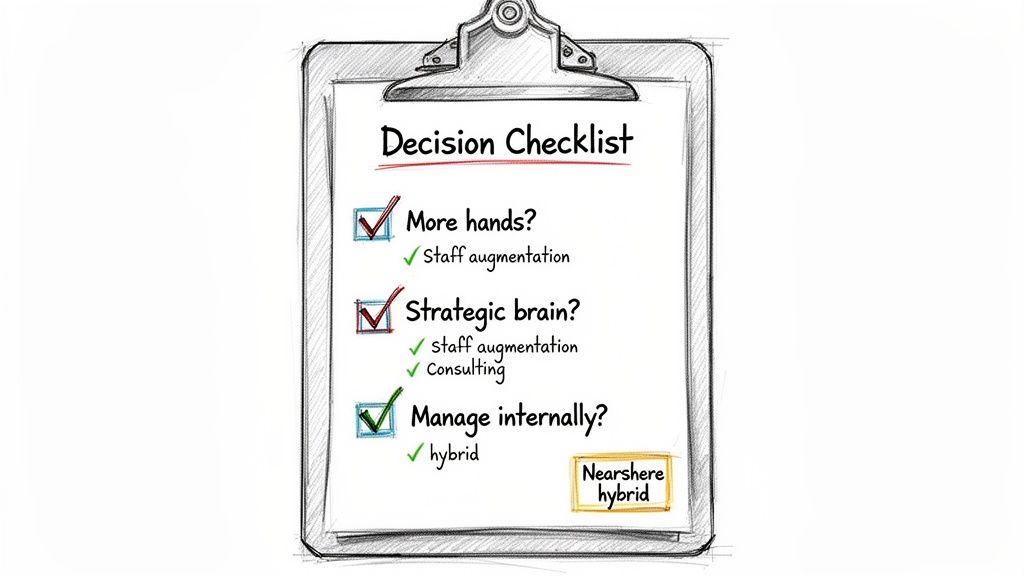
Think of this less as just picking a service and more as defining the kind of partnership that will actually help you win. Your answers will tell you if you need tactical boots on the ground or a strategic mind to draw the map.
Key Decision Questions
Do you need more skilled hands or a new strategic brain? If you have a solid plan and just need the talent to get it done, staff augmentation is your go-to. If you need someone to help you create the plan, that's what consulting is for.
Is your project scope crystal clear or still fuzzy? Staff augmentation works best when you have well-defined tasks and a clear backlog. Consulting, on the other hand, is built for navigating ambiguity and helping you define the scope as a core part of the job.
Can your team realistically manage more people right now? Augmentation means your managers will be directly overseeing the new talent. Consulting is a "set it and forget it" model where the firm manages its own people to deliver a finished product.
The fundamental difference in the staff augmentation vs. consulting debate is control. With staff augmentation, you’re in the driver’s seat. With consulting, you’re handing over the keys for a specific part of the journey.
Finding Your Fit
If you found yourself nodding along to needing hands-on execution for a clearly defined project—and you have the management bandwidth—then staff augmentation is almost certainly your best bet. It’s a flexible, budget-friendly way to scale your team and hit your deadlines faster.
But if you’re staring down a complex problem without a clear path forward, consulting will give you the high-level strategic guidance you’re missing.
For businesses looking for a middle ground, a modern nearshore staff augmentation partner like Nerdify can offer a compelling hybrid. You get scalable, deeply integrated talent without ever giving up strategic control of your project's vision.
Frequently Asked Questions
When you're trying to decide between staff augmentation and consulting, a few key questions always seem to pop up. It’s smart to get these sorted out, as the answers usually point you in the right direction for your project, budget, and overall goals.
We've gathered the most common queries we hear to help you iron out those final details and make a decision you can feel good about.
What’s the Main Difference, in Simple Terms?
The easiest way to think about it is to ask: who owns the work?
With staff augmentation, you’re bringing a specialist onto your team. They work under your direction and follow your processes to get the job done. Think of it as renting an expert pair of hands to help you execute your vision.
With consulting, you’re hiring a firm to solve a problem for you. They manage their own people and are on the hook for delivering a specific outcome, whether that’s a strategic plan or a finished piece of software. You’re buying a result, not just someone’s time.
Here's a simple analogy: Staff augmentation gives you more capacity—more hands to build what you've already designed. Consulting provides new capability—the strategic brain to create the blueprint in the first place.
Which One Is Actually More Cost-Effective?
This is the classic "it depends" scenario, because what’s “cost-effective” is tied directly to your goals. On the surface, staff augmentation almost always looks cheaper. You’re paying a straightforward hourly or monthly rate, which makes budgeting predictable and keeps upfront costs down.
Consulting fees are higher, no question. But you're paying for more than just a person; you're paying for their expertise, project management, and a guaranteed outcome. If a consultant steers you away from a multi-million dollar mistake—like building on the wrong tech stack—that higher fee suddenly looks like a bargain. The real value is in de-risking your project.
Can I Mix and Match Both on the Same Project?
Yes, and you absolutely should if the project is complex enough. Using a hybrid model is a savvy move that plays to the strengths of both approaches. It’s a common strategy for a reason.
Here’s what that typically looks like:
- Phase 1 (Consulting): You bring in a consulting firm to handle the high-level strategy. They’ll do the discovery, map out the project, define the scope, and design the technical architecture.
- Phase 2 (Staff Augmentation): With a solid plan in hand, you switch to staff augmentation. You bring in the developers, QA testers, and other specialists you need to build out the vision under your own project manager.
This gives you the best of both worlds. You get top-tier strategic guidance to ensure you're building the right thing, followed by a more cost-effective and flexible way to actually get it built.