Test Plan vs Test Strategy in Software Testing Explained
The core difference between a test plan and a test strategy boils down to a simple concept: a test strategy is the high-level, long-term philosophy that steers your company's entire approach to quality. On the other hand, a test plan is a detailed, tactical document that maps out exactly how, when, and who will test a specific application or feature.
Think of it this way: the strategy is your "why," while the plan is your "how."
Untangling the Test Plan vs Test Strategy Debate
Getting the distinction between a test plan vs test strategy in software testing right is absolutely critical for any QA team. These documents aren't interchangeable—they operate at different levels of the quality assurance process and serve entirely different functions. When used correctly, they prevent confusion, align the entire team with business goals, and create a testing workflow that’s both structured and efficient.
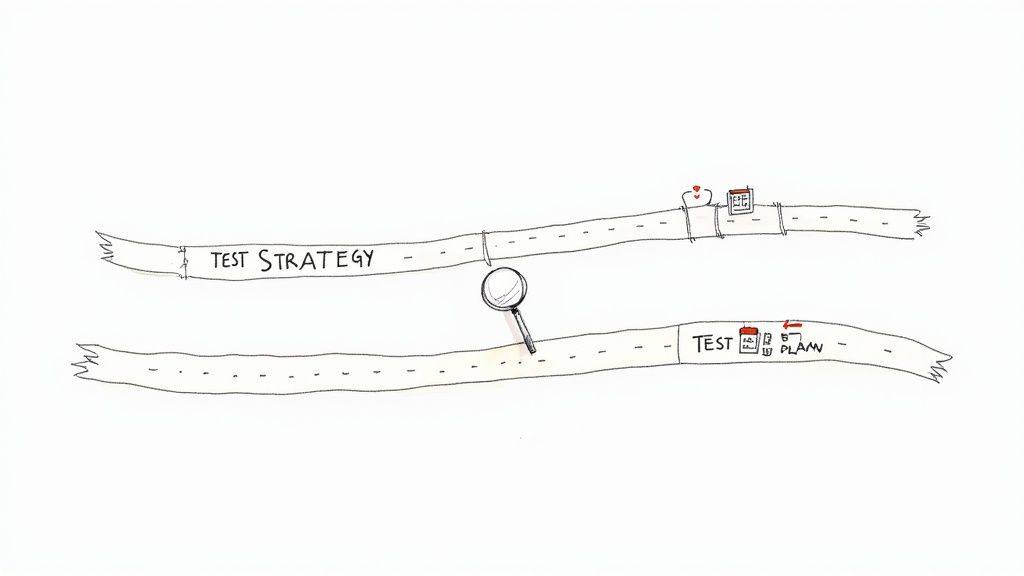
A test strategy acts as the foundational blueprint for quality across your organization. It’s a largely static document that defines your guiding principles, approach to risk, and choices in tooling. It provides consistent answers to the big questions that apply to all projects, ensuring everyone adheres to the same quality standards. For instance, a strategy might declare that all public-facing apps must pass rigorous performance testing before going live.
In contrast, a test plan is purely tactical and dynamic. It takes the high-level goals from the strategy and translates them into a concrete set of actions for a single project. This document gets into the weeds, detailing the scope, schedule, resources, entry and exit criteria, and the specific features under scrutiny. It’s a living roadmap that the project team relies on every single day to guide their work.
A test strategy sets the direction for your entire testing organization. A test plan provides the turn-by-turn directions for a single project's journey. One without the other leads to either inconsistent quality or directionless execution.
To really nail down these roles, let's break down their core differences.
Quick Comparison Test Strategy vs Test Plan
For a quick, at-a-glance reference, this table summarizes the fundamental differences between a test strategy and a test plan. It’s a great way to quickly distinguish their unique functions in the QA process.
| Attribute | Test Strategy (The Guideline) | Test Plan (The Roadmap) |
|---|---|---|
| Scope | Organizational or product-line level, covering all projects. | Project or release-specific, focused on one application. |
| Purpose | Defines guiding principles, objectives, and general approaches. | Details specific testing activities, schedules, and resources. |
| Lifespan | Long-term and relatively static; updated infrequently. | Short-term and dynamic; exists for the project's duration. |
| Ownership | Typically owned by a QA Manager, Director, or Head of QA. | Owned by a Test Lead or Project Manager. |
| Content | Includes testing methodologies, tools, and risk management. | Includes scope, features to test, and specific timelines. |
As you can see, the strategy provides the overarching rules of the road, while the plan is the specific itinerary for a single trip. Both are essential for reaching your destination: a high-quality product.
Defining the Test Strategy: Your Blueprint for Quality
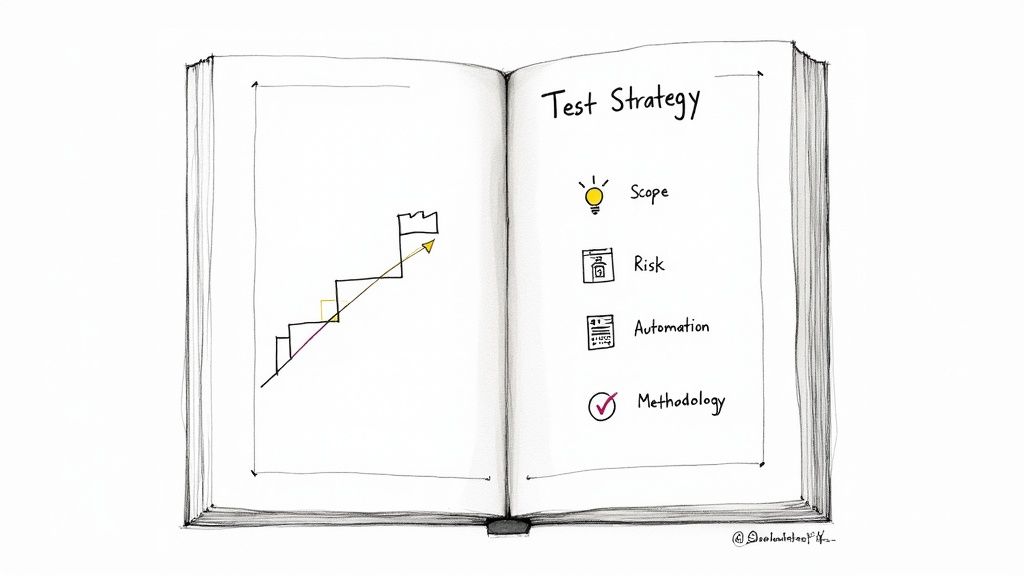
Think of a test strategy as the constitution for your entire quality assurance effort. It's a high-level, foundational document that establishes an organization's guiding principles and objectives for testing. This isn't about a single project; it’s about aligning all your QA work with bigger business goals, like becoming a market leader or nailing regulatory compliance. Because of its broad nature, this document rarely changes, providing a steady framework for every project that comes down the pipeline.
Unlike a test plan, which is tied to a specific project, the test strategy is built for the long haul. It answers the fundamental 'what' and 'why' of your testing initiatives long before anyone even thinks about drafting a project plan. In a rapidly expanding market, this kind of strategic clarity is invaluable. The global software testing services market hit about $45 billion in 2023 and is expected to climb past $70 billion by 2028. Much of that growth is fueled by Agile and DevOps, where clear documentation has been shown to cut failure rates by up to 30%—and a solid test strategy is the bedrock of that clarity.
Key Components of a Robust Test Strategy
A truly effective test strategy acts as the north star for all testing activities. It typically contains several core elements that ensure every team is on the same page, working toward the same quality standards.
- Scope and Objectives: This section sets the high-level quality goals for the whole organization. It tackles big questions like, "What are our non-negotiable quality benchmarks?" and "How does our testing support key business outcomes?"
- Testing Methodologies: Here, you'll define the official approaches to be used—whether that's Agile, Waterfall, or some kind of hybrid. It establishes the "how" for integrating testing into the software development lifecycle.
- Risk Analysis and Management: The strategy outlines a consistent process for identifying, evaluating, and mitigating project risks. It sets the company-wide standard for risk tolerance and contingency planning.
- Test Environment Requirements: This component specifies the standard hardware, software, and data setups required for testing. It’s all about making sure every team has access to consistent and reliable environments to work in.
- Automation Approach: The strategy defines which kinds of tests are prime candidates for automation (like regression or performance) and lays out the criteria for selecting automation tools. This prevents teams from making ad-hoc decisions that lead to inefficiency.
A test strategy isn’t about the nitty-gritty details of a single release. It’s about building a scalable culture of quality. It ensures that whether a team is shipping a minor patch or a massive new product, their approach to quality is consistent, predictable, and in lockstep with the company’s values.
The Strategic Value in Practice
The real magic of a test strategy is its power to connect day-to-day testing tasks with the company's grand vision. For instance, if a company wants to be known as the most reliable platform in its field, the test strategy would mandate rigorous performance and stability testing for all products, no exceptions.
This high-level directive prevents individual project teams from straying from that core mission. Understanding various product strategy frameworks can give QA leaders a huge advantage in crafting a test strategy that truly serves as a blueprint for quality. At the end of the day, it's the document that elevates testing from a simple bug hunt into a strategic engine for business success.
Understanding the Test Plan: Your Tactical Project Roadmap
If the test strategy is the 30,000-foot view, the test plan is the boots-on-the-ground action plan. It takes the broad, guiding principles from your strategy and converts them into a detailed, project-specific document. This is where the abstract goals of your overall QA approach meet the messy, practical realities of a single software release.
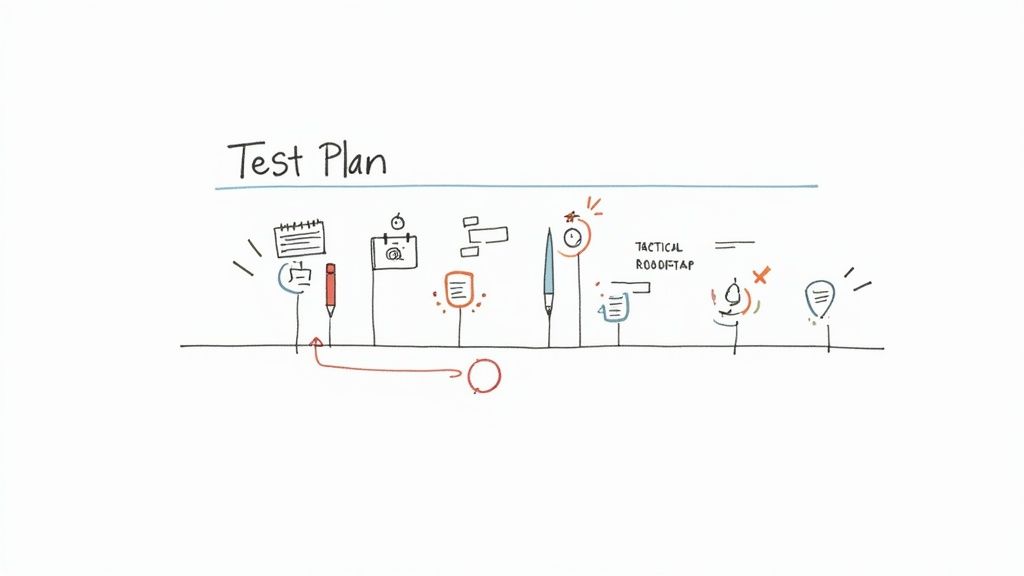
Think of it this way: a strategy answers "why we test," while the test plan gets into the nitty-gritty of "how," "when," and "who" for a specific project. It’s the day-to-day tactical guide for the QA team, making sure everyone is on the same page. And unlike a strategy, which is fairly static, a good test plan is a living document—it has to be flexible enough to be updated as project requirements inevitably change.
Core Components of a Comprehensive Test Plan
A solid test plan is all about clarity. It should leave no room for interpretation and meticulously lay out every single aspect of the project’s testing cycle. While the exact format can vary, most robust test plans (often inspired by standards like IEEE 829) share a few non-negotiable elements.
Together, these components create a complete roadmap for the entire testing process:
- Test Scope: This is where you draw the lines. You’ll define exactly what will be tested—and just as critically, what will not be tested. It should list specific features, user stories, and functions that are in-scope for the release, which is key to preventing scope creep and keeping the team focused.
- Schedule and Milestones: Here, you’ll map out the entire testing timeline. This includes the start and end dates for major activities like test case design, execution, and reporting. It’s also where you establish key milestones to track progress against the broader project deadlines.
- Resource Allocation: This section details who and what you need to get the job done. It assigns responsibilities for specific tasks (like manual testing or automation scripting) and lists all the necessary hardware, software, and test environments.
- Deliverables: This is a simple but crucial list of all the artifacts the testing team will produce. Common examples include the final set of test cases, automation scripts, detailed bug reports, and the final test summary report that goes out to stakeholders.
The test plan is the operational heart of any testing project. It transforms the strategic 'what if' into a tactical 'here's how,' providing the clarity and direction needed to execute flawlessly under project deadlines.
The Role of Entry and Exit Criteria
One of the most vital functions of a test plan is defining the exact conditions for starting and stopping the testing phase. We call these Entry and Exit Criteria.
Entry Criteria are the non-negotiable prerequisites that have to be met before the QA team even touches the build. For instance, the build must be successfully deployed to the correct test environment, and a quick smoke test on core functionality must pass. This simple step prevents the team from wasting hours testing a broken or unstable product.
On the other hand, Exit Criteria are the finish line. They are the measurable goals that tell you when a testing cycle is complete and the software is potentially ready for release. Some common examples include:
- 95% of all planned test cases have been executed.
- No outstanding critical or blocker defects remain open.
- All high-priority bugs have been fixed and successfully re-tested.
By setting these clear, objective goalposts, the test plan eliminates ambiguity from the decision-making process. It ensures that everyone—from the junior tester to the project manager—shares the exact same understanding of what "done" actually means.
A Detailed Comparison of Test Plan and Test Strategy
Sure, a test strategy sets the big picture for quality and a test plan handles the day-to-day, but the real magic is in understanding how they differ in practice. When you dig deeper than just their definitions, you start to see just how distinct their roles are. This isn't just about semantics; it's about how quality assurance actually gets done in a real-world software development team.
Getting these nuances right helps teams sidestep common traps, like writing a plan that's completely disconnected from the company's goals or crafting a strategy that’s so high-level it’s useless for guiding actual work.
Scope and Focus
The clearest distinction between a test plan and a test strategy comes down to their scope. A test strategy is the 30,000-foot view. It operates at an organizational or product-line level, creating a consistent quality framework that applies to many projects at once. Think of it as the quality constitution for your entire department.
A test plan, on the other hand, is zoomed all the way in. It’s laser-focused on a single project or a specific release. It takes the grand ideas from the strategy and translates them into concrete, actionable steps for a particular feature or application.
- Test Strategy Example: Might mandate that all applications handling user data must pass security vulnerability scans and meet a certain performance benchmark before release. This is a non-negotiable rule for every project.
- Test Plan Example: Spells out the exact schedule for running that security scan on the "Q3 new user dashboard" project, assigns the performance tests to a specific engineer, and defines the precise load conditions (like 500 concurrent users).
Purpose and Intent
Their core purposes are just as different. A test strategy is all about defining the guiding principles—it answers the "why" and "what" of testing. It’s where you establish your overall approach, the methodologies you'll follow, and the level of risk the organization is willing to accept.
The test plan is purely about execution specifics. It's a practical roadmap that answers the "how," "when," and "who" for a single project's testing effort. Its job is to ensure the team's tactical work hits the project's immediate targets.
The strategy provides the philosophical foundation for quality, while the plan provides the operational blueprint for achieving it on a project-by-project basis.
Lifespan and Flexibility
The shelf life of these documents tells you a lot about their function. A test strategy is a long-term, relatively static document. It’s built to last and usually only gets a major overhaul when the organization makes a big shift, like adopting a new development methodology or entering a market with new compliance rules.
In contrast, a test plan is short-term and highly dynamic. It lives and dies with its project. You can expect it to be updated frequently as scopes change, timelines shift, or resources get reallocated—that flexibility is crucial for navigating the realities of a software development cycle.
The difference in their nature is stark. A good strategy is typically 70-80% reusable across projects, giving you a stable quality baseline. A plan, being release-specific, might get updated 4-6 times over a single project’s lifecycle. This consistency is a huge asset, but a smart strategy also bakes in about 20-30% flexibility to accommodate new tech like microservices without needing a full rewrite. If you want to dive deeper into this, TestRail's blog offers some great insights on test documentation.
Ownership and Audience
Who writes them and who reads them couldn't be more different. The test strategy typically falls under the ownership of senior leadership—think a QA Director or Head of Quality. Its audience is other leaders: executive stakeholders, development leads, and product managers who need to grasp the company's high-level commitment to quality.
The test plan belongs to the Test Lead or Project Manager. Its audience is the boots on the ground: the testers, developers, and business analysts who need to know the testing schedule, who is responsible for what, and the exact pass/fail criteria for the current release.
Level of Detail and Content
Finally, the contents of each document are tailored to their specific job. The level of detail is a dead giveaway—one is a set of principles, the other is a task list.
In-Depth Breakdown Test Strategy vs Test Plan Attributes
This table really puts the content differences under a microscope, showing how each document tackles similar ideas but from completely different altitudes.
| Comparison Point | Test Strategy | Test Plan |
|---|---|---|
| Testing Approach | Defines high-level methodologies (e.g., Agile, BDD) and standard testing levels (e.g., unit, integration, E2E). | Specifies which features will undergo which types of testing for this release. |
| Tools and Tech | Recommends the standard toolchain for automation, bug tracking, and test management across the organization. | Lists the specific tool versions and environments to be used for this project. |
| Risk Management | Outlines a general framework for identifying and categorizing risks that can be applied to any project. | Identifies specific project risks (e.g., tight deadline, dependency on a new third-party API). |
| Metrics and KPIs | Sets broad organizational quality goals (e.g., target defect density, desired automation coverage percentage). | Defines the explicit exit criteria for the current release (e.g., zero open critical bugs). |
| Deliverables | Describes the types of reports leadership should expect (e.g., quarterly quality summaries, trend analysis). | Lists the specific documents the team will produce (e.g., the final test summary report, bug reports). |
By mastering these five key differences—scope, purpose, lifespan, ownership, and content—teams can make sure both documents serve their intended function. This alignment ensures that the day-to-day tactical work is always pushing toward the long-term strategic vision for quality.
How Strategy and Planning Work Together in Modern QA
When people talk about test plans versus test strategies, it's easy to get tangled up in a debate. But here’s the thing: they aren't competitors. They’re partners. An effective QA process needs both to connect high-level business goals with the actual, on-the-ground work of testing. The strategy sets the quality bar, and the plan details exactly how the team is going to clear it.
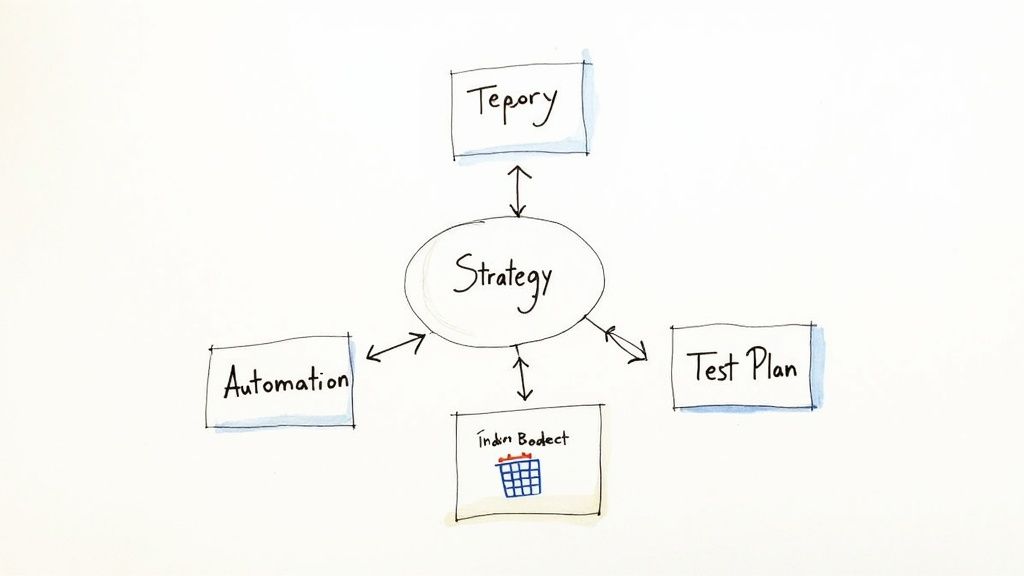
Think of it as a hierarchy. The test strategy is the foundational document, outlining the long-term vision for quality across the entire company or a major product line. From that one core strategy, you can then spin up multiple, project-specific test plans. This ensures every single development effort is pulling in the same direction and adhering to the same quality principles.
The Strategy to Plan Workflow
Let’s say a company’s test strategy is built around protecting brand reputation and user trust. A core principle in that document might be: "All new features must achieve 95% automated regression test coverage before deployment to protect core functionality and prevent customer-facing disruptions."
This high-level rule gives every team a consistent standard to aim for. When a team kicks off a new project, they don't waste time debating that 95% target. They simply take that strategic mandate and build their test plan around it. The plan’s job isn't to ask "why," but to figure out "how."
A test strategy provides the destination and the rules of the road. A test plan is the detailed, turn-by-turn GPS route for a specific trip, ensuring you arrive on time and on budget while following all the rules.
A Practical Example of Integration
Let's walk through how this plays out. Imagine a SaaS company is building a new billing module—a piece of the application where mistakes are not an option. Here's how their strategy and plan would link up:
Test Strategy Mandate: "Achieve 95% regression coverage for all business-critical workflows."
Test Plan Action: The billing module's test plan gets specific. It assigns three QA engineers to the task and budgets a two-week sprint for them to write the necessary automated scripts.
Test Strategy Mandate: "Utilize our standardized test automation framework built on Selenium to ensure consistency and maintainability."
Test Plan Action: The plan specifies the exact version of the Selenium framework to use and confirms the test environment is properly configured.
Test Strategy Mandate: "Define clear exit criteria based on defect severity to manage risk."
Test Plan Action: The plan's exit criteria section will state, "No open P1 or P2 defects in the billing module before release." This directly translates the strategic goal into a concrete, measurable outcome.
This smooth handoff from strategy to plan ensures that the day-to-day work of the QA team is always aligned with the company's bigger picture. This synergy is what separates a good QA organization from a great one. For a deeper dive into how this fits into current development cycles, it’s worth exploring modern software testing best practices. It's all about turning abstract quality goals into high-quality software that ships.
Common Traps in Test Documentation and How to Sidestep Them
Even when you know the difference between a test plan and a test strategy, it's surprisingly easy to fall into a few common traps. These missteps can turn your carefully crafted QA documents into expensive shelf-ware, completely undermining their purpose. Spotting these issues ahead of time is the key to creating documentation that actually helps your team ship better software.
One of the most common mistakes I see is a test strategy that’s set in stone. A strategy is supposed to be a high-level, long-term guide, but "long-term" shouldn't mean "permanent." Tech changes, business goals pivot, and new testing methods pop up all the time. A strategy that can't adapt becomes a relic, forcing teams to find workarounds instead of following a useful framework.
Another huge problem is the test plan with a fantasy timeline. This usually happens when someone creates estimates without talking to the engineers who are actually going to do the work. You end up with a plan that's doomed from the start, leading to rushed testing, missed bugs, and a burned-out team.
Keeping Your Test Strategy from Becoming a Relic
To stop your test strategy from becoming obsolete, you have to treat it like a living document. The goal is stability, not stagnation. It's a real problem; some studies show that rigid documentation affects as many as 15% of agile teams, making it hard to react to new project needs. You can learn more about the impact of documentation on agile teams.
Here’s how to keep your strategy effective and up-to-date:
- Schedule Annual Reviews: Put a recurring meeting on the calendar with key players like the Head of Engineering and Product Leads. This simple habit ensures your strategy stays aligned with where the company is headed.
- Add a "Flexibility Clause": Write it directly into the document: project teams can deviate from the strategy as long as they have a good reason and document it. This empowers leads to make smart decisions on the ground.
- Keep an Eye on Industry Trends: Task a QA lead with monitoring new tools and methodologies. A quick quarterly report can flag things that might require a strategy update.
A great test strategy provides guardrails, not a straitjacket. It should guide teams toward consistent quality while giving them the room to navigate the unique challenges of their specific projects.
Building Test Plans That Actually Work
A test plan is completely useless if its goals are impossible to meet. Unrealistic plans often lead to constant updates, which can eat up 10-15% of a QA budget in agile sprints just on administrative churn. To build a plan your team can follow, you need to focus on collaboration and practicality.
Follow these practices to ground your test plans in the real world:
- Estimate as a Team: Never, ever create timelines in a silo. Hold a planning session where every QA engineer involved gets to weigh in. This not only leads to more accurate forecasts but also gives everyone a sense of ownership over the plan.
- Bake in a Buffer: Any experienced manager will tell you that things always go wrong. Add a 15-20% buffer to your timelines. This will be your lifeline when you hit unexpected technical debt, environment issues, or last-minute requirement changes.
- Be Ruthless with Priorities: Be crystal clear about what you are testing and, just as importantly, what you are not testing. Use a simple priority system (like the MoSCoW method) to make sure that if you start running out of time, you've already covered the most critical features.
By getting ahead of these common pitfalls, you can turn your documentation from a tedious chore into a genuinely useful tool that helps your team build and release great products.
Frequently Asked Questions
Even after you've got the difference between a test plan vs. a test strategy straight, some questions always pop up when you try to put it all into practice. Let's tackle some of the most common ones I hear from teams trying to figure out how these documents work in the real world.
Can a Project Have a Test Plan Without a Test Strategy?
Technically, yes. You can absolutely write a test plan for a project without having a formal test strategy document guiding you. I’ve seen this happen a lot, especially in startups or smaller companies where formal processes are still taking shape.
But let’s be clear: it’s a risky move. Without a strategy setting the high-level quality goals, every test plan gets created in a silo. This is how you end up with wild inconsistencies. One project team might be all-in on performance testing, while another completely ignores it. The result? A product portfolio with a choppy, unpredictable user experience.
A test plan without a guiding strategy is like one ship setting sail without a fleet-wide map. Sure, that single ship might find its way, but an entire fleet operating that way will end up scattered, with no guarantee they'll uphold the same standards or even reach the same continent.
How Often Should a Test Strategy Be Updated?
Think of your test strategy as a long-term vision, not a project-specific document. It shouldn't be changing constantly. That said, it's not meant to be written once and then forgotten on a shared drive somewhere.
A good rule of thumb is to review and refresh it annually.
You should also dust it off anytime there's a major shift in the company. This could be things like:
- Moving from a Waterfall model to Agile development.
- Adopting a major new technology, like shifting to a microservices architecture.
- Expanding into a new region that comes with its own set of compliance rules.
Who Approves Each Document?
The approvers for each document directly reflect its scope and impact.
- Test Strategy Approval: Since this document defines quality for the whole company, it needs buy-in from the top. Approval usually comes from senior leaders like the Chief Technology Officer (CTO), the Head of Engineering, or a Director of QA.
- Test Plan Approval: This is all about a specific project. Approval happens at the project level, typically by the Project Manager or a Test Lead who can confirm it lines up with the project’s immediate scope, timeline, and budget.
Do Agile Teams Need Both a Test Plan and a Test Strategy?
They absolutely do. Agile values working software over comprehensive documentation, but that doesn't mean no documentation. The core principles behind a plan and a strategy are still incredibly valuable. The key is to adapt them.
In an Agile environment, the test strategy is often a lean, living document. It might outline the team’s "Definition of Done," their approach to test automation within the CI/CD pipeline, and the quality principles everyone agrees on.
The test plan gets broken down into much smaller pieces. Instead of one massive document, you might have sprint-level test plans that focus only on the user stories for that two-week iteration. This keeps the planning focused, relevant, and continuously evolving.