testing strategy vs test plan: A Clear Guide to QA
Think of a test strategy as the high-level philosophy that guides why your organization tests software the way it does. It's a foundational document that stays fairly consistent across many projects. In sharp contrast, a test plan is the detailed, project-specific roadmap spelling out the who, what, when, and how for a single release, and it's created fresh for each new initiative.
Distinguishing The Blueprint From The Battle Plan

People often use the terms "test strategy" and "test plan" interchangeably, but they serve two very different, yet complementary, roles in software development. Getting this distinction right is a hallmark of a mature quality assurance in software development process.
The test strategy is like your organization's testing constitution. It’s a long-term document that sets the overarching principles, standards, and goals for all quality-related activities. It tackles the big-picture questions:
- What's our general philosophy on test automation?
- Which testing methodologies (like Agile or BDD) do we adhere to?
- What are the standard tools in our approved testing toolkit?
- How do we approach and classify quality-related risks?
The test plan, however, is the tactical battle plan for a specific project. It’s a hands-on, operational document that takes the broad principles from the strategy and turns them into concrete, actionable steps for a single feature or release. It gets down to the nitty-gritty details so the team can execute flawlessly.
The impact of having both is significant. Teams that formalize both their strategy and their plans consistently see approximately 40-50% fewer critical defects leak into production when compared to those relying on informal, ad-hoc testing.
A Test Strategy defines the why and sets the rules of engagement for quality. A Test Plan executes the how and details the specific actions for a single project's success.
To put it all into perspective, here's a quick table to show the core differences at a glance.
Quick Comparison Test Strategy vs Test Plan
| Attribute | Test Strategy | Test Plan |
|---|---|---|
| Scope | Organization-wide or product-line level | Project or release-specific |
| Level | High-level, guiding principles | Low-level, detailed, and operational |
| Lifecycle | Long-term and relatively static | Short-term and dynamic (per project) |
| Purpose | Defines why and how we approach testing in general | Defines what to test, who will test, and when |
| Owner | QA Manager, Director, or Head of Engineering | Test Lead or Project Manager |
| Core Focus | Testing methodologies, tools, environments, risk approach | Test scope, features, schedule, resources, deliverables |
Ultimately, the strategy provides the guardrails and vision, while the plan maps out the specific journey for each project, ensuring everyone is aligned and moving toward the same quality goals.
Comparing The Core Attributes In Detail
While a quick comparison table is useful, the real-world differences between a test strategy and a test plan only become clear when you dig deeper. These documents aren't just paperwork; their core attributes shape their influence, their lifespan, and what they ultimately achieve for your quality assurance process.
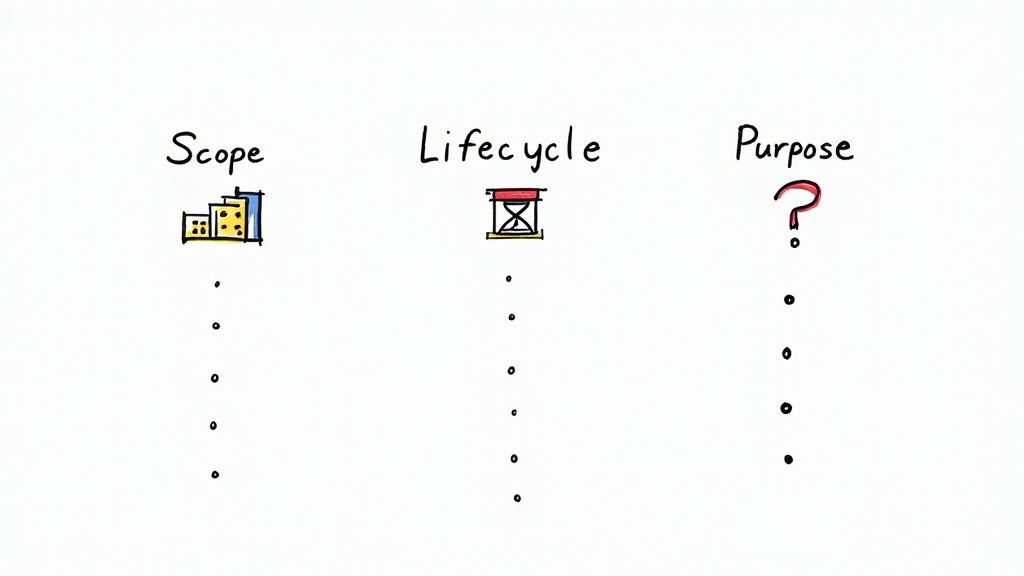
At their heart, they answer fundamentally different questions. One defines your guiding philosophy on quality, while the other lays out the specific, tactical steps for a single project. Let's break down these distinctions across three critical areas: Scope, Lifecycle, and Purpose.
Scope: Organizational Vision vs. Project Focus
The most obvious difference is their scope. A test strategy is a high-level document, offering a bird's-eye view of how the entire organization or a major product line approaches quality. It's meant to be broad and foundational.
On the other hand, a test plan gets its hands dirty with the specifics of one project or release. Its scope is deliberately narrow and laser-focused, containing only the information needed for that particular effort to succeed.
Imagine a company building a new e-commerce platform to see how this plays out:
- Strategy Scope: The test strategy would establish company-wide rules, like, "All applications handling financial data must undergo third-party security penetration testing," or "We will automate regression tests for all critical user paths to support our CI/CD pipeline."
- Plan Scope: For the upcoming "Shopping Cart V2" release, the test plan would get specific: "Penetration testing will be done by XYZ Security from July 15th to July 20th," and "The 'Add to Cart' and 'Checkout' flows will be automated using Playwright and will run against every new build."
The strategy sets the universal standard, and the plan details how to apply it to a specific project. This keeps teams from having to reinvent their approach to quality for every new feature.
Lifecycle: Static Bedrock vs. Dynamic Roadmap
The lifespan of these documents also reveals their different roles. A test strategy is a long-term, fairly static artifact. Think of it as a stable foundation that only needs to change when something big happens—a major shift in technology, business goals, or development methodology.
A test plan, however, is a short-term, living document. It evolves right alongside the project, getting updated sprint by sprint or even daily as new information surfaces, requirements change, or unexpected bugs pop up. Its job is done once the project's testing is complete.
A test strategy is written in ink, reviewed annually. A test plan is written in pencil, reviewed daily.
Here’s another way to look at it:
- Strategy Lifecycle: A company might revisit its test strategy once every year or two. A good trigger would be a decision to move from a monolithic architecture to microservices, which would fundamentally change how testing needs to be done.
- Plan Lifecycle: The test plan for a mobile app's next feature is created at the start of that development cycle. It will be tweaked constantly as developers finish their work, testers find new edge cases, and product managers shift priorities. Once the feature is live, that plan is archived.
This difference ensures your core quality principles stay consistent (the strategy), while your day-to-day execution remains flexible enough to handle project realities (the plan).
Purpose: The "Why" vs. The "How"
Ultimately, each document serves a completely different purpose. The test strategy is all about the "Why" and the high-level "How." It defines the organization's philosophy on quality and establishes the general methods for getting there. It sets the direction and communicates why testing is valuable.
A test plan is purely operational. It’s focused on the nitty-gritty "What, When, Who, and How." It turns the strategic vision into an actionable checklist of tasks, schedules, and responsibilities.
Let's cap this off with one final, practical example:
- Strategic Purpose (The Why): The strategy might declare, "Our goal is to achieve 99.9% uptime and deliver a seamless user experience. We will achieve this by implementing a rigorous performance testing process for all critical, customer-facing systems." This tells everyone the business reason behind the effort.
- Plan Purpose (The How): The test plan for the new "User Profile" feature would then spell out the execution: "Load testing will be conducted with Apache JMeter. The test will simulate 1,000 concurrent users over a 30-minute period. Jane Doe is responsible for execution, and results must be shared by EOD Friday."
This clean separation ensures every detailed task in a test plan can be traced back to a meaningful, high-level quality goal defined in the strategy.
How Strategy Guides The Test Plan

The link between a testing strategy and a test plan isn't about choosing one over the other; it's a clear hierarchy. The strategy sets the "why," and the plan lays out the "how." It’s a direct flow, creating a logical path from high-level company goals right down to the specific tasks a team executes on the ground.
A great way to think about it is building a skyscraper. The test strategy is the architectural blueprint for the entire building. It defines the core principles—the building’s purpose, the high-grade materials needed for structural integrity, and the overarching safety standards everyone must follow.
The test plan, on the other hand, is the detailed construction schedule for a single floor. It takes that grand vision from the architect and breaks it down into concrete actions: who pours the foundation, where the wiring runs, and the exact deadline for installing windows. That schedule would be chaotic and pointless without the blueprint to guide it.
A test plan without a guiding strategy is just a random list of tasks. It leads to inconsistent testing that's completely disconnected from what the business actually wants to achieve.
This top-down relationship is absolutely essential for creating a quality assurance process that makes sense. To see how testing fits into the bigger picture, it's helpful to understand broader software development best practices for remote teams, including robust testing.
From Strategic Directive To Tactical Execution
Let's walk through how this works in the real world. Imagine a company's test strategy contains a simple but powerful directive: "We will adopt a risk-based testing approach to focus our efforts on the most critical areas of the application."
That one sentence completely changes how a project's test plan gets written. The test lead for a new "User Profile Overhaul" project now has a clear mandate. They'll translate this high-level principle into specific, actionable sections in their plan.
Here's how that strategic guidance trickles down:
- Feature Prioritization: The test plan must now include a risk analysis. Features like "Password Reset" and "Payment Method Management" are immediately flagged as high-risk. A less critical feature, like "Profile Avatar Upload," is tagged as low-risk.
- Test Scope Definition: The scope becomes much sharper. It will explicitly state that 100% of test cases for high-risk features must be executed and pass. In contrast, low-risk features might just get some exploratory testing or have a lower pass-rate requirement for minor bugs.
- Resource Allocation: The plan will now assign the most experienced QA engineers to the high-risk password and payment features. Junior testers can cut their teeth on the lower-risk avatar upload, making sure expertise is focused where it matters most.
The Right Sequence For Success
This flow highlights why getting the sequence right is so important. A test strategy must be in place before any project-specific test plans are drafted. While industry data shows that 60-70% of organizations often mix this up, the ones that follow the correct order see huge benefits.
Teams that establish their test strategy first report approximately 50% faster test plan development cycles. Why? Because all the big, foundational decisions have already been made. This logical progression ensures every tactical choice in the plan serves a strategic purpose, making the entire QA process more efficient and ultimately more effective.
Key Components of Each Document
It's one thing to talk about the high-level differences between a test strategy and a test plan, but the real clarity comes when you look at what actually goes inside each document. This is where the rubber meets the road. While they serve different purposes, both rely on a clear set of components to be effective. A strategy without a defined approach is just a wish, and a plan without clear deliverables is just a schedule.
Let's break down the essential building blocks for each. This will show you not just what they are, but what they actually do.
What Goes Into a Test Strategy
Think of the test strategy as your constitution for quality. Its components are broad by design, setting the principles and standards that will guide every testing effort across the company.
Scope and Objectives: This isn't about testing a specific feature. It’s about the big picture—the overall quality goals for the organization. For example, an objective might be, "Achieve 95% code coverage for all new backend services," or "Ensure all customer-facing applications comply with WCAG 2.1 AA accessibility standards."
Test Approach: Here you're outlining the core methodologies and philosophies your organization commits to. It answers the big questions: Do we prioritize risk-based testing? What's our official stance on manual vs. automated testing? A common approach might be, "We will adopt a shift-left model, integrating testing activities as early as possible in the development lifecycle."
Risk Analysis and Mitigation: This section identifies common, high-level risks and establishes a standardized playbook for handling them. For instance, it might define a risk category like "Data Integrity" and a standard mitigation plan, such as, "All database migrations must be validated by a corresponding suite of data verification tests."
Tools and Environments: The strategy specifies the official, approved toolchain and the standards for test environments. It will list the sanctioned tools (like TestRail for management or Playwright for automation) to maintain consistency and prevent teams from going rogue with their own setups.
A solid test strategy provides the guardrails for quality. It makes sure that no matter the project, every team starts with the same definition of excellence and has the right tools to get there.
What Goes Into a Test Plan
A test plan takes those strategic principles and turns them into a concrete action plan for a specific project. Its components are tactical, detailed, and all about execution.
Test Items and Features: This is a specific, itemized list of what you're actually going to test. It could include user stories like, "As a user, I can reset my password," or technical components like "the new payment processing API endpoint."
Pass/Fail Criteria: This defines, without ambiguity, what success looks like. An entry might read, "A test case passes if all functional requirements are met and no blocker or critical defects are found. The feature is shippable with a maximum of 5 known minor bugs."
Schedule and Milestones: This section lays out a detailed timeline. It maps all testing activities to the project schedule, setting hard deadlines for test case creation, execution cycles, and final reporting.
Resource Staffing: The plan names names. It identifies who is involved and what their specific roles are. For example, "Jane Doe (Lead QA) is responsible for test case review and final sign-off. John Smith (QA Engineer) will execute the performance tests."
Test Deliverables: This lists the actual, tangible artifacts the testing process will create. It includes things like the final test summary report, a prioritized list of all outstanding defects, and the updated regression test suites. To make sure nothing gets missed, many teams rely on a comprehensive software testing checklist.
Comparing Components Side-by-Side
To make the distinction completely clear, let's look at the components in a head-to-head comparison. The following table breaks down what belongs where, settling the testing strategy vs test plan debate for good.
Key Components Breakdown Strategy vs Plan
This table provides a quick reference, showing the standard components found in each document and highlighting their different levels of focus.
| Component | Included in Test Strategy? | Included in Test Plan? | Description |
|---|---|---|---|
| Scope Definition | ✔️ (High-Level) | ✔️ (Project-Specific) | Strategy defines organizational quality goals; Plan defines features to be tested in a specific release. |
| Risk Management | ✔️ (Framework) | ✔️ (Specific Risks) | Strategy sets the approach for risk analysis; Plan identifies and lists project-specific risks. |
| Approved Tools | ✔️ | ❌ (Implicitly uses) | Strategy lists the official testing toolset for the entire organization to maintain consistency. |
| Specific Schedules | ❌ | ✔️ | Plan details the exact deadlines and milestones for a single project's testing activities. |
| Resource Names | ❌ | ✔️ | Plan assigns specific team members to tasks and roles for the project's duration. |
| Pass/Fail Criteria | ❌ | ✔️ | Plan defines the precise, measurable conditions that determine if a feature is ready for release. |
By keeping these distinct components in mind, your team can create documentation that is clear, comprehensive, and perfectly suited for its job. The strategy provides the direction, and the plan gives you the detailed map to get there.
Adapting Documentation For Your Team Size

The classic test strategy vs. test plan debate often misses a key piece of the puzzle: your team’s size. A one-size-fits-all documentation approach just doesn't work. You’ll either drown in bureaucracy or stumble through chaos. The right level of formality really comes down to where you are on your growth journey.
For a scrappy startup, agility is the name of the game. A sprawling, formal test strategy would be a massive waste of time. Instead, a lightweight, one-page document works perfectly. It might just outline a few core principles, like "we automate all critical user flows."
In this environment, the test plan often isn't a separate document at all. It could just be the acceptance criteria written directly into a Jira ticket. The whole point is to get everyone on the same page quickly, not to create a paper trail.
Scaling For Growth In SMEs
As a company scales up, however, that informal approach starts to show cracks. A mid-sized business (SME) needs more structure to keep quality consistent as more teams pop up.
This is where a formal test strategy becomes essential. It’s the glue that holds everything together, making sure different product teams follow the same quality standards and use a consistent toolset. This is how you stop each team from reinventing the wheel.
Test plans also get a promotion. They graduate from being ticket notes to distinct documents that lay out the scope, resources, and timelines for a specific feature or release. This detail is absolutely critical for coordination when project managers and stakeholders aren't sitting in on every daily stand-up.
The leap from startup to SME is where documentation evolves from a casual guideline into a vital tool for managing complexity and ensuring everyone is pulling in the same direction.
Thinking about how to manage this transition can be tough. It's worth exploring proven methods for building and scaling quality assurance teams effectively, as this ensures your documentation practices actually help you grow instead of holding you back.
Enterprise-Level Governance
Once you reach the enterprise level, the scale—and the risk—is on a whole different level. Here, a comprehensive test strategy is a non-negotiable governance document. It defines the quality policy for the entire organization, often tying directly into regulatory compliance and high-level business risk.
Project-level test plans become incredibly formal artifacts, typically managed in dedicated platforms like TestRail. They are meticulously detailed, spelling out everything from exact environment configurations to the precise entry and exit criteria for every test cycle. This level of rigor is the only way to coordinate hundreds of engineers across different departments and locations, ensuring every piece of a massive system is validated against a single standard.
The documentation always scales to match the organization's complexity:
- Startup: Strategy and plan are lean, often combined. The focus is on speed.
- SME: Strategy ensures consistency across teams; plans are detailed project roadmaps. The focus is on creating scalable processes.
- Enterprise: Strategy is a core governance tool; plans are formal, auditable records. The focus is on risk mitigation and compliance.
By tailoring your documentation to your team’s reality, you make sure it remains a valuable asset that drives quality, not a bureaucratic hurdle that slows everyone down.
Common Pitfalls To Avoid
Even when you nail the difference between a test strategy and a test plan, it's surprisingly easy to fall into a few classic traps. I’ve seen them derail even the most well-intentioned QA efforts. Knowing what they are is the first step to avoiding them.
One of the biggest mistakes I see is writing a test plan in a strategic vacuum. A test lead gets excited, dives straight into the weeds of schedules and test cases, but completely forgets to look at the high-level test strategy. You end up with a beautifully detailed plan that’s aimed at the wrong target. It's a classic case of busy work that doesn't align with what the business actually cares about.
Creating an Unactionable Strategy
The opposite problem is just as bad: a test strategy that’s too vague to be useful. It’s full of nice-sounding but empty phrases like “ensure high quality” or “leverage automation.” That gives the team zero real direction. A good strategy has to be specific. Does it dictate certain tools? Does it define risk tolerance? Without that, it's just a document full of fluff.
The most effective test strategies are opinionated. They make firm decisions about tools, methodologies, and priorities, providing clear guardrails that empower teams to create focused, effective test plans.
The Static Document Trap
Another critical error is treating the test plan as a "write-once, ignore-forever" document. Projects are messy. Requirements change, surprise bugs pop up, and deadlines shift. A test plan that isn't updated to reflect this new reality becomes useless almost immediately. If you're not looking at it weekly, or sometimes even daily, it's just an outdated artifact.
A great way to avoid this is to build plan updates right into your regular meetings, like sprint reviews. This keeps the plan alive and relevant. It’s also a powerful way to learn how to prevent scope creep because it forces you to constantly ask if you’re still testing the right things for the right reasons.
Here are a few quick fixes to help you steer clear of these problems:
- For a Strategic Vacuum: Add a mandatory "Strategy Alignment" section to the very top of your test plan template. This forces the writer to connect their tactical plan directly to the organization's strategic goals from the start.
- For a Vague Strategy: For every strategic principle, add a "Practical Application" example. So, next to a goal like "Adopt risk-based testing," you could add: "This means high-risk payment features get 100% test case coverage, while low-risk UI tweaks get exploratory testing."
- For a Static Plan: Make "Test Plan Review" a standing five-minute agenda item in your daily stand-ups. It's a simple habit that keeps the document current and top-of-mind for everyone.
Frequently Asked Questions
Even after spelling out the differences between a test strategy and a test plan, a few practical questions always pop up. Let's tackle some of the most common ones to help you put these ideas into practice with your team.
Can a Project Have a Test Plan Without a Test Strategy?
Technically, yes. But it's a huge red flag for any mature quality assurance process.
When a team operates without a strategy, they're forced to reinvent the wheel on every single project. This almost always leads to inconsistent quality, wasted effort, and a testing process that feels completely disconnected from what the business is actually trying to achieve. A test plan without a strategy is just a to-do list, not a tactical execution of a well-defined quality vision.
Who Owns These Documents?
Ownership really breaks down along strategic and tactical lines, which makes perfect sense given the scope of each document.
Test Strategy Owner: This falls to a senior leader—think a QA Director, Head of Quality, or a senior QA Manager. Their job is to define the long-term vision for quality across the entire organization or a major product line.
Test Plan Owner: This is a project-level role. It's usually a Test Lead or a QA Manager assigned to a specific project who takes the reins. They're on the hook for the day-to-day execution and successful delivery of testing for that release.
This split ensures that the high-level governance (the strategy) and the on-the-ground execution (the plan) are managed by the right people at the right levels.
How Often Should a Test Strategy Be Updated?
Your test strategy is a foundational document, so you shouldn't be changing it all the time. It's built for stability.
A test strategy should be treated as a durable guide, not a reactive document. It provides the stable foundation upon which dynamic, project-specific test plans are built.
That said, it isn't set in stone. A review makes sense under a few specific conditions:
- Annually: A yearly check-in is smart just to make sure the strategy still lines up with the company's business goals.
- Major Organizational Shifts: Big changes demand a second look. This could be anything from adopting a new development methodology like moving to CI/CD, overhauling your tech stack, or a major pivot in the business model.
Unless one of these fundamental shifts happens, your strategy should remain a consistent guidepost for your team.