What is nearshore software development? Discover benefits and partner-fit

Nearshore software development is all about a simple, powerful idea: outsourcing your tech projects to a team in a nearby country, not one on the other side of the world. Think of it as the Goldilocks solution—it gives you the cost savings of outsourcing while keeping your team in a similar time zone and cultural orbit. It’s a smart balance between value and seamless collaboration.
Decoding Nearshore Development
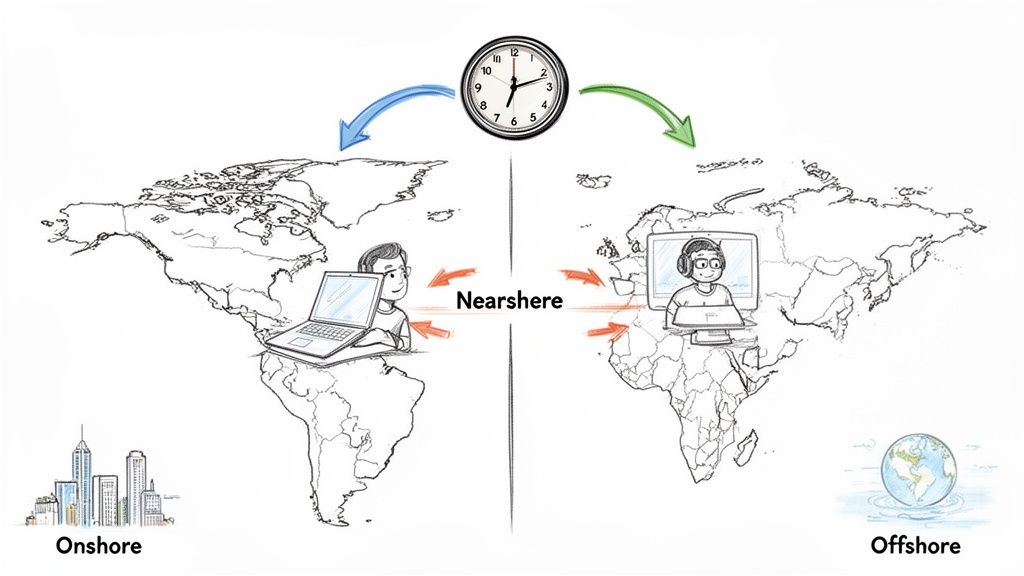
Let's say your company needs to build a new mobile app. Your first thought might be to hire locally—that’s onshore. It’s familiar, but it’s almost always the most expensive route. On the other end of the spectrum is offshore, where you hire a team in a distant country to cut costs. The catch? You’re often wrestling with a massive 12-hour time difference and significant communication hurdles.
Nearshore development offers a third, and often better, path. It’s like hiring experts from the next state over. They work when you work, but at a much more competitive rate. For a US-based company, this means partnering with a top-notch development team in a country like Mexico, Costa Rica, or Colombia.
This model isn't just a niche trend; it’s booming. In fact, 80% of North American businesses are now using or actively exploring nearshore partnerships. This shift has unlocked Latin America’s massive talent pool of over 1.5 million developers, allowing startups and SMEs to scale their projects without the usual friction.
Onshore Vs Nearshore Vs Offshore At a Glance
The main things that set these models apart are geography, cost, and collaboration. It’s a strategic choice that directly shapes your project's budget, timeline, and ultimate success. Getting a handle on these differences is the first step toward building a smarter, more efficient development process.
Here’s a quick breakdown of how the three models stack up:
| Factor | Onshore | Nearshore | Offshore |
|---|---|---|---|
| Location | Same Country | Neighboring Country | Distant Country |
| Time Zone | Identical | Similar (0-3 hours) | Significant Difference (8+ hours) |
| Collaboration | High (In-Person/Real-Time) | High (Real-Time) | Low (Asynchronous) |
| Cost | Highest | Moderate | Lowest |
| Cultural Fit | Strongest | High | Varies Greatly |
As you can see, nearshore hits that sweet spot—offering real-time collaboration and strong cultural alignment without the premium price tag of onshore development. For a deeper dive into the concept, check out this comprehensive guide to nearshore software development services.
The Strategic Sweet Spot of Nearshore Development
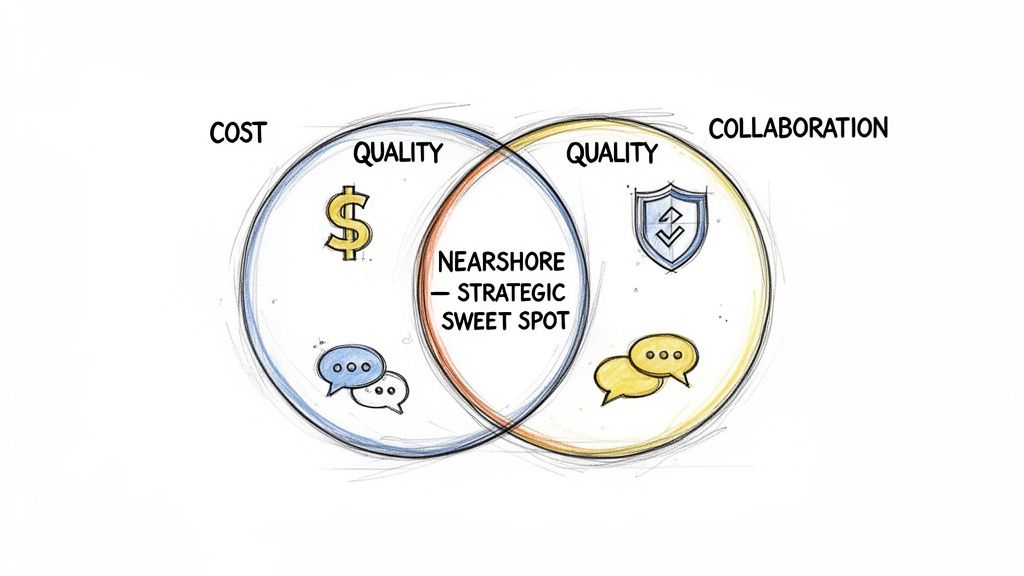
Choosing a development partner often feels like you're being forced to pick just two out of three: budget, collaboration, or talent. This is where nearshore software development comes in. It’s not just another buzzword; it’s a genuinely strategic approach that hits the sweet spot between competing priorities.
Let’s be honest, onshore development is great for seamless, real-time collaboration. The problem? It comes with a massive price tag. For most startups and SMEs, the astronomical costs and fierce competition for local talent can stop a project in its tracks.
On the other end, offshore development dangles the carrot of huge cost savings. But those savings often get eaten up by logistical headaches. Working across massive time zone gaps means sluggish communication, delayed feedback, and a team that never truly feels connected. These aren't just minor annoyances; they're genuine risks to your project's timeline and quality.
Nearshore neatly sidesteps the pitfalls of both. It offers major cost benefits over hiring locally while maintaining the tight-knit, agile collaboration that offshore models simply can't replicate.
The Real-World Impact of Time Zone Alignment
Picture this: it’s 2 PM on a Tuesday, and a critical bug pops up on your platform. You need to get your product manager and lead developer on a call right now to figure it out before more users are affected.
- With an onshore team: No problem. Everyone jumps on a quick video call, and the fix is underway within the hour.
- With an offshore team (10+ hours ahead): Your developer is sound asleep. That critical fix now has to wait until tomorrow, creating a 24-hour delay that could frustrate users and cost you real money.
- With a nearshore team (0-2 hours difference): The experience is virtually identical to having an onshore team. A quick call gets everyone on the same page, the problem is solved together, and a patch is deployed that same afternoon.
This simple scenario shows why being in a similar time zone is so crucial. It’s not about convenience—it’s about keeping your project moving forward without losing a step.
A nearshore model effectively eliminates the "communication tax" that comes with large time zone differences. This allows your team to operate in a single, unified workflow, making agile practices like daily stand-ups and pair programming truly effective instead of a logistical nightmare.
Balancing Cost and Quality
The financial case for nearshore development is just as strong. While building an in-house team can inflate your costs by up to 60%, nearshore hits that perfect middle ground.
North American companies can see cost reductions of 50-65% while dodging the hidden costs of offshore management, which can secretly add 20-30% more time just trying to coordinate everything. You can find more of these nearshore development statistics from HatchWorks.
At the end of the day, the goal is to build a talented, cohesive team that ships great products without breaking the bank. Nearshore gives you access to a deep talent pool in neighboring countries, strong cultural overlap, and the operational sync you need for modern, agile development. For a deeper dive into how it stacks up, check out our guide on nearshore vs. offshore outsourcing.
Key Benefits of Building Your Nearshore Team
Going nearshore is about more than just dodging logistical headaches. It’s a strategic move that delivers real, measurable advantages for your project's success. We're talking about tangible gains in efficiency, team chemistry, and your bottom line. Think of it as building a better, more integrated team that just happens to be in a neighboring country.
The most obvious win? Real-time collaboration. When your entire team works on a similar clock, all the friction of asynchronous communication just melts away. This alignment is the fuel for modern, agile development.
Instead of waiting a full day for an answer, your teams can jump on a call, run daily stand-ups, pair program, and knock out critical issues together, right when they pop up. That seamless workflow keeps the project humming along and stops small delays from turning into major roadblocks.
Seamless Collaboration and Stronger Team Cohesion
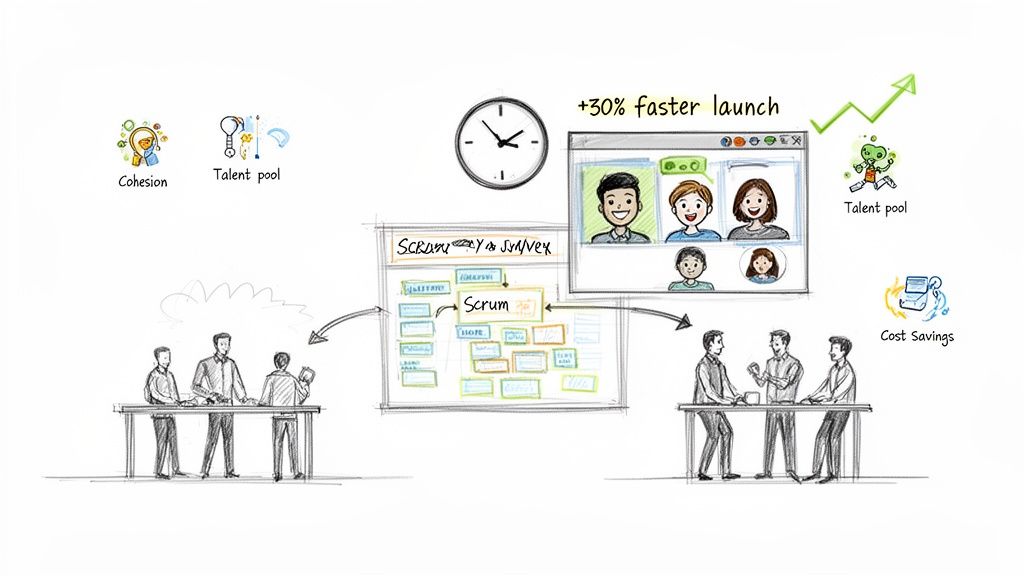
Let's make this real. Imagine a startup scrambling to get its product to market. Their nearshore team is just one time zone away, so they kick off every morning with a quick video stand-up. A developer gets stuck? They can grab a product manager for a quick chat immediately, saving hours of guesswork. This kind of tight feedback loop has been shown to accelerate product launches by an estimated 30%.
But this real-time connection does more than just speed things up—it builds a genuinely unified team. When you partner with teams in regions like Latin America, the cultural and linguistic similarities are a huge plus. Communication just flows better, which builds rapport and creates a shared sense of ownership.
When your nearshore partners share a similar cultural context, it fosters a deeper level of engagement. They're not just executing tasks; they're actively contributing ideas and collaborating as true partners, which is essential for innovation and problem-solving.
Accessing Top Talent Without Breaking the Bank
Nearshore development also unlocks access to a massive and growing talent pool. Tech hubs across Latin America are churning out world-class engineers, designers, and project managers. Suddenly, you have access to specialized skills that might be rare or incredibly expensive to find at home. You can dig deeper into these advantages by exploring the core benefits of nearshore outsourcing in our detailed guide.
This model hits that sweet spot between cost and quality. You get the financial perks of lower operational costs and competitive rates without having to sacrifice the skill or commitment of your team. This isn't about finding the cheapest labor; it's about getting the best possible value for your money.
Here's a quick rundown of the main advantages:
- Real-Time Agile Sprints: Time-zone alignment makes daily stand-ups, instant feedback, and faster problem-solving a reality, keeping your project on schedule.
- Enhanced Team Dynamics: A shared cultural backdrop reduces communication barriers, paving the way for a more tight-knit and collaborative team.
- Vast Talent Pool: Tap into highly skilled developers in booming tech hubs without the fierce competition and high salaries of your local market.
- Cost-Effective Quality: See significant savings compared to hiring onshore, all while maintaining an incredibly high standard of work.
At the end of the day, a nearshore strategy is about building a true extension of your own team. It creates the perfect environment for agile methods to shine, bringing together collaboration, talent, and smart economics to help you build better products, faster.
Choosing Your Nearshore Engagement Model
Once you’re sold on the idea of nearshore software development, the next big question is: how do you actually work with your new partner? This isn't a one-size-fits-all deal. The right setup—what we call an engagement model—really hinges on your specific project goals, your current team structure, and just how hands-on you want to be.
Think of it like building a house. Do you just need a skilled electrician to handle the wiring? Or do you need an entire construction crew to build a new addition from the ground up? Maybe you just want to hand over a full blueprint and a budget, and have a general contractor deliver a finished, move-in-ready home.
Each approach works, but for very different needs. The same goes for building software. Let's walk through the three most common ways to structure a nearshore partnership.
Staff Augmentation: The Flexible Extension
Staff Augmentation is exactly what it sounds like: you’re adding skilled people directly into your existing team. Let's say your in-house crew is firing on all cylinders, but you're missing a senior Python developer for a critical 6-month project. This model is perfect for that. You're not outsourcing the whole project; you're just "renting" an expert.
With this approach, you keep full control. The nearshore developer becomes part of your team, joining your daily stand-ups and reporting directly to your project manager. It’s the ideal way to fill a temporary skill gap or quickly scale up for a big push without the overhead of a full-time hire.
We cover this in much more detail in our guide to nearshore staff augmentation.
Dedicated Team: Your Managed Squad
A Dedicated Team is a complete, self-contained squad that works exclusively for you, but is managed by your nearshore partner. This is the model you choose when you have a complex, long-term product that needs a full team of developers, QA engineers, and maybe a project manager.
Your partner handles all the messy parts—recruiting, HR, payroll, and admin—and gives you a cohesive unit ready to go. They function as a true extension of your company, fully dedicated to your vision and goals. This model gives you a fantastic balance, offering deep expertise and scalability without you having to manage the day-to-day operational headaches.
The Dedicated Team model is the sweet spot for many growing companies. It combines the focus of an in-house team with the scalability and reduced operational burden of outsourcing, creating a powerful engine for long-term product development.
Project-Based: Fixed Scope and Price
The Project-Based model is the most traditional form of outsourcing. You have a project with a very clearly defined scope, a set timeline, and a fixed budget—think building a marketing website or a simple mobile app. You provide the detailed requirements, and your nearshore partner agrees to deliver the final product for a fixed price.
This model is best when there's little to no uncertainty. Its biggest advantage is predictability; you know exactly what you'll get and what you'll pay. The trade-off is a lack of flexibility. Any changes or new ideas mid-project will almost always mean renegotiating the scope and cost. It's a great fit for smaller, well-defined tasks where you can set the specs and let them run with it.
Which Nearshore Engagement Model Is Right for You?
Choosing the right model is a critical first step. This table breaks down which model works best for different scenarios, helping you match your needs to the right partnership structure.
| Engagement Model | Best For | Flexibility | Cost Structure |
|---|---|---|---|
| Staff Augmentation | Filling specific skill gaps, short-term projects, or quickly scaling an existing team. | High | Monthly rate per developer |
| Dedicated Team | Long-term projects, complex product development, or when you need a full, cohesive tech team. | Medium | Monthly fixed cost for the entire team |
| Project-Based | Small, well-defined projects with a clear scope and minimal expected changes. | Low | Fixed price for the entire project |
Ultimately, the best choice depends on where you are as a business. If you need a single expert to plug a hole, Staff Augmentation is your answer. If you're building a product for the long haul, a Dedicated Team is a powerful asset. And if you have a straightforward, one-off task, the Project-Based model keeps things simple and predictable.
How to Find and Vet the Right Nearshore Partner
Choosing a nearshore partner is a make-or-break decision. Get it right, and they’ll feel like a true extension of your team, pushing your product roadmap forward faster than you thought possible. Get it wrong, and you're in for a world of delays, miscommunication, and frustration.
A structured vetting process is what separates a hopeful guess from a confident, strategic decision.
This journey starts with getting your own house in order. Before you even think about looking for a partner, you need to define exactly what success looks like for your project. Document your technical stack, the specific skills you need, the project scope, and your budget. This internal alignment is your compass for everything that comes next.
Once you have your requirements clearly defined, the hunt begins. Your initial search should focus on established tech hubs in regions with excellent time-zone overlap, like Mexico, Colombia, or Costa Rica if you're in the US. The goal here is simple: create a shortlist of potential partners whose expertise and experience seem to line up with your needs.
Evaluating Technical and Cultural Fit
With a shortlist in hand, the real work starts. This is where you dig deeper than a company's glossy homepage to verify their actual skills and, just as importantly, see if they’re a good cultural fit. A partner’s technical chops are critical, but it’s their communication style and project management habits that will determine if the relationship thrives or dies.
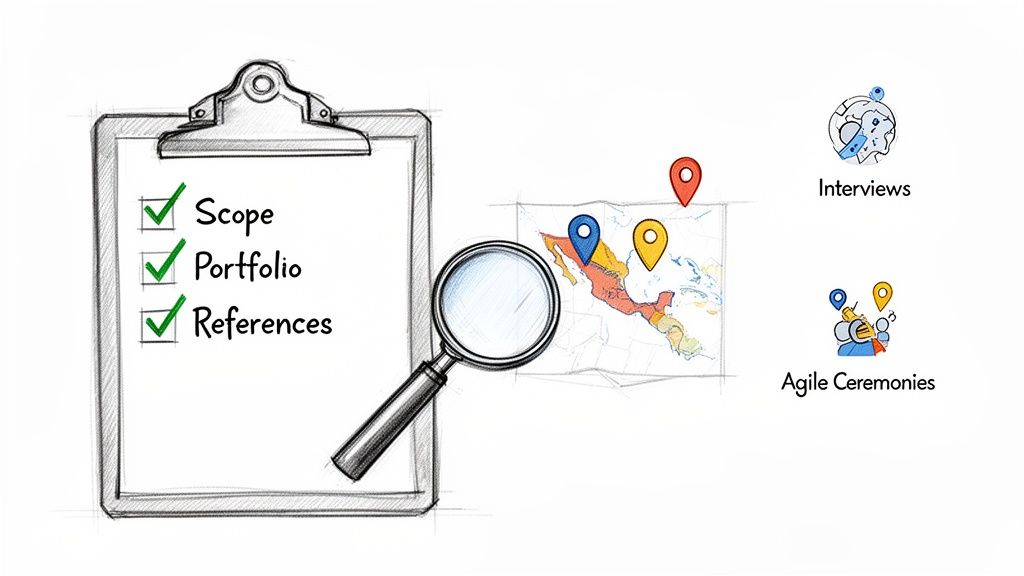
Here’s a practical checklist to guide you through the vetting process:
- Review Their Portfolio and Case Studies: Look for projects that mirror yours in complexity and scope. Do they have a proven history of solving the exact kinds of problems you’re facing? This is your first piece of real-world evidence.
- Assess Their Technical Expertise: Go beyond their list of specializations. For instance, if you're looking for an agency partner, understanding the tools they use—like specific WordPress plugins for agencies—can give you a real glimpse into how they operate.
- Check Client References and Reviews: This is non-negotiable. Talk directly to their past and current clients. Ask tough questions about communication, how they handle problems, and if they consistently meet deadlines. This unfiltered feedback is gold.
Asking the Right Questions
The interview stage is your chance to see how a potential partner really works. Don’t let them get away with generic answers. Come prepared with specific, insightful questions that force them to reveal their processes and their mindset.
The point of vetting isn't just to confirm skills; it's to gauge compatibility. A team of brilliant engineers who can't sync up with your workflow will cause more friction than they're worth. You want partners who are transparent, proactive, and genuinely committed to working together.
Here are a few essential questions to throw at any potential nearshore partner:
- Project Management: "Which agile ceremonies do you use, and what does a typical sprint planning or daily stand-up look like for your team?"
- Scope Management: "How do you handle scope creep when new requirements pop up mid-sprint?"
- Communication: "What tools do you rely on for day-to-day communication and keeping us updated on progress?"
- Problem-Solving: "Tell me about a time a project went off the rails. What happened, and what steps did your team take to get it back on track?"
Their answers will paint a clear picture of their professionalism and how they’ll operate as a part of your team. This methodical approach helps you sidestep the common pitfalls and choose a trustworthy, high-performing partner who will actually help you move the needle.
Your Nearshore Questions, Answered
Even after getting the basics down, you probably still have a few questions rattling around. That's completely normal. Let's tackle some of the most common ones that come up when businesses start seriously considering a nearshore team.
How Is Nearshore Different from Just "Outsourcing"?
It's a fair question. While nearshore is technically a form of outsourcing, the real difference is its strategic focus on proximity.
When people talk about traditional outsourcing, they often mean offshoring—sending work to a team halfway across the world. That model can work, but it frequently comes with major headaches like massive time zone differences and cultural disconnects that bog down projects.
Nearshore is a deliberate choice to partner with teams in neighboring countries. The goal is to get the benefits of real-time collaboration, cultural similarities, and the option for quick, easy travel for those crucial face-to-face meetings. Think of it less as delegation and more as integrated, collaborative partnership.
What Are the Go-To Countries for Nearshore Talent?
For companies in the United States, Latin America has become the undisputed hub for nearshore development. The region is brimming with tech talent, and a few countries consistently rise to the top.
You’ll frequently see these on the shortlist:
- Mexico: It’s a powerhouse, with a massive pool of skilled engineers and a business culture that meshes well with the US.
- Colombia: This country has a fast-growing tech scene and a solid reputation for quality engineering and creative problem-solving.
- Costa Rica: Known for political stability, excellent English skills, and deep expertise in specific tech niches.
- Argentina: A mature market with a long history of producing top-tier developers, especially for complex, architecturally challenging projects.
These countries have poured resources into tech education and infrastructure, making them incredibly reliable and competitive partners.
Choosing a nearshore partner in Latin America means tapping into a region that not only aligns with US time zones but also shares significant cultural affinities, which drastically reduces communication friction and fosters a more cohesive team environment.
Is This Really an Option for Startups, or Just Big Companies?
Absolutely not just for large enterprises. In fact, startups and small-to-medium-sized businesses (SMEs) often get the most out of the nearshore model. It gives them a direct line to world-class developers without the eye-watering salaries and recruitment costs of hiring locally.
For a smaller company, this is a game-changer. It means you can scale your team, build a fantastic product, and compete with the big players, all on a budget that won’t make your investors nervous. Models like staff augmentation are particularly great for growing businesses, offering the flexibility to ramp up or down as your project needs change.
How Do You Actually Manage a Nearshore Team Effectively?
Success with a nearshore team isn't about micromanagement. It’s built on a bedrock of trust, clear communication, and solid agile processes, all powered by the right tools.
Here’s what works in practice:
- Daily Stand-Ups: Non-negotiable. A quick video call each morning keeps everyone on the same page and surfaces roadblocks immediately.
- A Single Source of Truth: Use a project management tool like Jira or Asana so everyone can see project status, tasks, and progress at a glance. No ambiguity.
- Constant, Casual Communication: A dedicated Slack channel is essential for those quick questions and updates that keep work flowing smoothly.
The good news? Any nearshore partner worth their salt will already have these systems dialed in. They should be able to integrate with your existing workflow almost seamlessly from the very first day.