What is nearshore staff augmentation: Scale teams with aligned time zones
Picture this: you have a critical project, but your team is missing a key specialist. Instead of getting bogged down in a long and expensive local hiring process, you bring in an expert from a nearby country. This person works in a similar time zone, gets your cultural nuances, and plugs right into your team.
That's nearshore staff augmentation in a nutshell. It’s a smart way to add skilled professionals to your roster without the headaches and overhead of a traditional hire.
Unpacking The Nearshore Staff Augmentation Model

At its heart, nearshore staff augmentation is a flexible strategy for scaling your team. Think of it less like hiring someone from the other side of the world and more like bringing in a consultant from the office building next door. Your "neighbor" just happens to be in a country close by, usually with a time zone difference of only a few hours, if any.
This approach lets you temporarily expand your in-house crew with external experts who have the exact skills you need. These professionals report directly to your managers and become a genuine part of your daily workflow, participating in everything from stand-ups to brainstorming sessions. You keep complete control over your project while gaining access to a much larger and more accessible talent pool.
The Core Idea Behind Nearshore Augmentation
The main goal here is to fill skill gaps without missing a beat. Instead of enduring the lengthy and costly cycle of recruiting, hiring, and onboarding a new full-time employee, you partner with a specialized vendor who has a bench of pre-vetted talent ready to go. This is a game-changer for projects with tight deadlines or those that demand niche technical skills that are tough to find in your local market.
Nearshore staff augmentation bridges the gap between the high cost of local talent and the logistical challenges of a global workforce. It offers a practical balance of cost-efficiency and close collaboration, making it a powerful tool for modern businesses.
This model is different from other ways of extending your team. While it has some things in common with outsourcing, the real distinction is the level of integration and control. You can dive deeper into these differences in our guide on staff augmentation vs outsourcing to figure out what works best for you. With nearshore, you're adding people to your team, not just offloading tasks to a vendor.
Why Is This Model Gaining So Much Traction?
The numbers speak for themselves. The global staff augmentation services market, valued at USD 6.89 billion, is projected to hit USD 7.35 billion in the next year. That's a compound annual growth rate (CAGR) of 7.11%, signaling a major shift in how companies are thinking about building their teams. Agility and specialized skills are the name of the game now.
What's driving this trend? A few key factors:
- Access to Specialized Skills: Companies can tap into a global reservoir of experts in high-demand fields like AI, cybersecurity, and cloud engineering that might be scarce locally.
- Cost-Effectiveness: Bringing in talent from countries with a lower cost of living can dramatically cut operational expenses without compromising on quality.
- Improved Collaboration: With minimal time zone differences, real-time communication, daily check-ins, and quick problem-solving become the norm, not the exception.
To make it even clearer, here’s a quick look at how the nearshore model can directly benefit your business.
Nearshore Staff Augmentation at a Glance
| Benefit | Impact on Your Business |
|---|---|
| Time Zone Alignment | Enables real-time collaboration, faster decision-making, and smoother project workflows. |
| Cultural Proximity | Reduces communication barriers and fosters a more cohesive and productive team environment. |
| Cost Savings | Provides access to top-tier talent at a more competitive rate than most local markets. |
| Rapid Scalability | Allows you to quickly scale your team up or down based on project demands and deadlines. |
As you can see, the nearshore model delivers a balanced mix of efficiency, collaboration, and financial sense, making it a compelling option for businesses looking to stay competitive.
The Real Difference Between Nearshore, Onshore, and Offshore
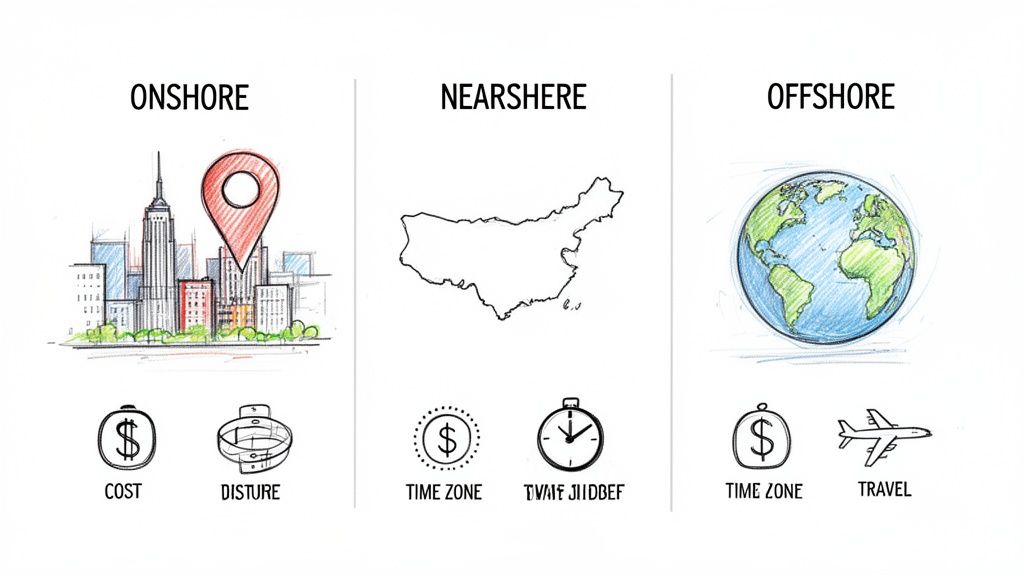
Trying to pick the right talent model can make your head spin. But honestly, it all comes down to one thing: proximity. Think of it like deciding where to set up a new branch of your office. Each option—onshore, offshore, and nearshore—presents a different mix of cost, collaboration, and cultural fit.
Let’s unpack these models to see where nearshore staff augmentation fits in and why it’s become the go-to sweet spot for so many companies looking to scale intelligently.
Onshore: The Familiar but Costly Option
Onshore staff augmentation is straightforward: you hire professionals from right inside your own country. It's like bringing in a consultant from the next state over. The upsides are obvious. You won't face any language barriers, cultural differences are almost nonexistent, and everyone is playing by the same legal and business rules.
Collaboration feels effortless since everyone is in the same time zone, or very close to it. But all that convenience comes with a hefty price tag. Onshore talent, especially for in-demand tech roles, is the most expensive of the three, which can put a serious dent in your budget.
Offshore: The Cost-Effective but Distant Choice
At the complete opposite end is offshore staff augmentation. This model means you’re partnering with talent in far-flung countries, often halfway across the globe in places like Asia or Eastern Europe. The main draw here is the massive cost savings—hourly rates can be up to 70% lower than what you’d pay at home.
The catch? You’re dealing with a huge time zone difference, often 8 to 12 hours or more. That gap can throw a wrench in real-time collaboration, leading to delayed responses, middle-of-the-night meetings, and a workflow that feels disconnected. Cultural and language differences can also add friction, sometimes derailing project alignment.
Nearshore: The Balanced and Strategic Middle Ground
This is exactly where nearshore staff augmentation shines. It carves out a strategic middle ground, giving you the best of both the onshore and offshore worlds. By working with talent in neighboring countries, you get significant cost savings without sacrificing close operational alignment.
With a time zone difference of only 0 to 3 hours, your nearshore team members can sync up with your core team in real time. Daily stand-ups, quick feedback, and spontaneous brainstorming sessions happen naturally, just as they would with a local hire. Cultural similarities also smooth over communication, creating a much more integrated and cohesive team. To truly grasp the benefits, it's worth exploring the nuances between Nearshore vs Offshore models.
One of the biggest wins here is speed. A good nearshore partner can have vetted, qualified candidates in front of you in a week or two. That means you can have a new developer fully onboarded and contributing to your projects in less than four weeks. This kind of agility gives smaller startups the power to access specialized skills in cybersecurity, AI, and cloud computing, letting them punch well above their weight.
For a deeper dive into these dynamics, take a look at our detailed comparison of nearshore vs offshore outsourcing.
Nearshore vs. Onshore vs. Offshore: A Head-to-Head Comparison
To make the differences crystal clear and help you decide which model aligns with your business goals, here's a side-by-side comparison of the most important factors.
| Factor | Nearshore | Onshore | Offshore |
|---|---|---|---|
| Cost Efficiency | High (Significant savings over onshore) | Low (Highest market rates) | Very High (Lowest market rates) |
| Time Zone Overlap | Excellent (0-3 hour difference) | Perfect (Same time zone) | Poor (8-12+ hour difference) |
| Cultural Alignment | High (Shared business practices) | Excellent (Same culture) | Moderate (Potential for mismatch) |
| Real-Time Collaboration | Seamless and highly effective | Seamless and highly effective | Challenging and often delayed |
| Travel Convenience | Easy (Short, affordable flights) | Very Easy (Domestic travel) | Difficult (Long, expensive flights) |
| Access to Talent | Excellent (Large, skilled talent pools) | Good (Limited by local market) | Excellent (Vast global talent pools) |
In the end, your choice hinges on what you value most. If budget isn’t a concern and you need perfect cultural sync, onshore is your best bet. If slashing costs is your number one priority, offshore is a viable option. But for most businesses that want a smart balance of cost, quality, and seamless collaboration, the answer is clear: nearshore staff augmentation delivers the most strategic and sustainable value.
When Does the Nearshore Model Make Sense for Your Business?
Knowing what nearshore staff augmentation is is one thing. Recognizing the perfect moment to pull the trigger is another entirely. Certain business challenges act as tell-tale signs that it’s time to look just beyond your borders for talent. These signals almost always boil down to a need for speed, specialized skills, or smarter spending.
Think of it as a business diagnostic. When your company shows specific symptoms, the nearshore model can be the most effective prescription. This isn't just another way to hire; it’s a strategic move to overcome hurdles that would otherwise stall your growth and kill innovation.
You Needed to Scale Your Team Yesterday
One of the loudest alarm bells is the urgent need to grow, and fast. Maybe a massive new project just got the green light with a brutal deadline. Or perhaps your flagship product needs a major feature overhaul to fend off a new competitor. In these high-stakes moments, the traditional hiring process—which can easily drag on for months—is dead on arrival. You simply don't have time for job postings, candidate screening, and endless interview rounds.
This is where nearshore staff augmentation becomes your lifeline. A solid partner can introduce you to pre-vetted, highly skilled developers in as little as a week or two. That means you can have new team members onboarded and contributing in under a month. This kind of agility completely changes your ability to jump on market opportunities and deliver value while it still matters.
For companies aiming for rapid expansion, the nearshore model is a proven way to achieve business scalability through optimized HR outsourcing. It gives you the exact workforce you need, right when you need it, without the long-term overhead of permanent hires.
The Local Hunt for Niche Talent Is Coming Up Empty
Your local market has talent, sure, but it’s not a bottomless well. What do you do when your project demands a developer with deep expertise in a niche technology like AI, machine learning, cybersecurity, or a very specific cloud platform? These specialists are rare, in high demand everywhere, and consequently, incredibly difficult and expensive to hire locally.
This is where the nearshore model really shines. It blows the doors wide open on your talent search, giving you direct access to massive tech hubs in neighboring countries. Suddenly, you're no longer fighting tooth and nail with every other company in your city for the same two experts. You’re now tapping into a rich, diverse ecosystem of specialized professionals.
- AI and Machine Learning: Find engineers who have hands-on experience building and deploying complex algorithms.
- Cybersecurity: Bring in security specialists who can defend your digital assets against the latest threats.
- Cloud Engineering: Onboard certified experts in AWS, Azure, or Google Cloud to build and optimize your infrastructure.
This targeted approach ensures you get the precise skills your technical roadmap demands, without having to make compromises.
Nearshore isn't just about finding more developers; it's about finding the right developers. When the local talent pool can't deliver the specific technical firepower you need, a nearshore strategy is your direct line to world-class specialists.
Your Budget Is Tight, but Your Standards Aren't
Let’s be honest: money matters. A crucial trigger for looking nearshore is the need to manage costs without sacrificing an ounce of quality. Onshore development talent commands a premium price, a tough pill to swallow for startups and SMEs trying to make every dollar count. And while offshore models promise lower costs, the headaches from huge time zone gaps and communication barriers often lead to project delays and quality dips.
Nearshore staff augmentation hits that financial sweet spot. You get access to top-tier developers at a significantly lower cost than you’d find in the US or Western Europe. For a closer look, you can explore the various benefits of nearshore outsourcing that directly boost your bottom line.
This isn’t about cutting corners; it’s about smart resource allocation. The money you save can be reinvested directly into your product, marketing, or other growth drivers, giving you a powerful competitive edge.
A Practical Roadmap for Implementing Nearshore Staff Augmentation
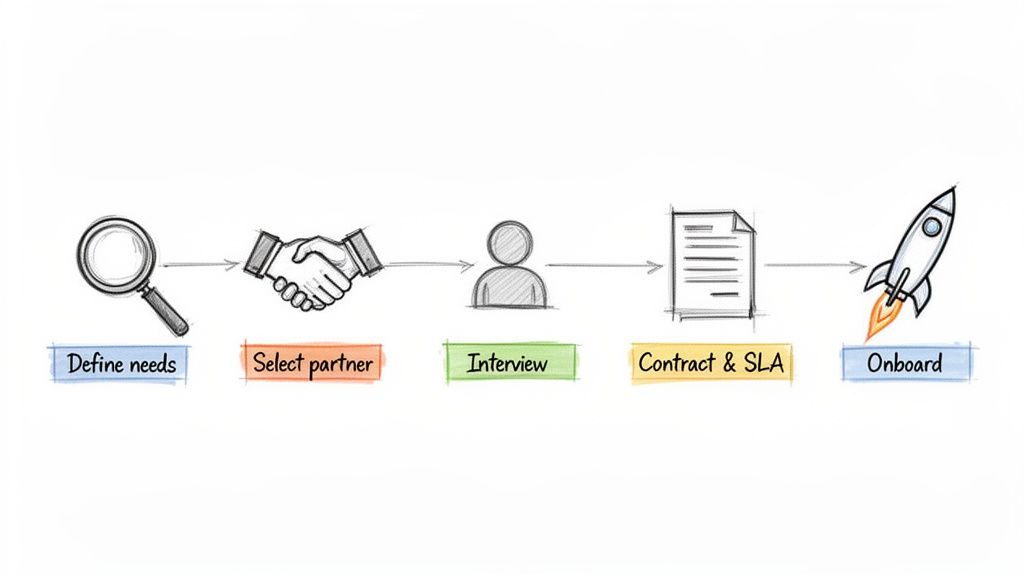
Jumping into a nearshore staff augmentation model isn’t a leap of faith; it’s a structured process. With the right plan, you can smoothly integrate top-tier talent into your team, fast-track your projects, and finally fill those critical skill gaps.
Think of it like building an extension on your house. You wouldn’t just start knocking down walls. You need a blueprint first—one that details your goals, helps you find the right builders, and shows exactly how the new part will connect to your existing structure. This roadmap breaks down that journey into five manageable steps, turning the idea of a nearshore partnership into a concrete, actionable strategy.
Step 1: Define Your Needs and Skill Gaps
Before you even start looking for partners, you need to look inward. A successful nearshore engagement starts with a crystal-clear understanding of what you’re trying to achieve. It’s time to get specific about the roles you need and the exact expertise required to move your projects forward.
Start by asking these critical questions:
- What specific technical skills are we missing? (e.g., A senior React Native developer who’s also fluent in GraphQL).
- How long will we need this person? (e.g., Is this for a six-month project or a long-term, ongoing role?).
- What are our absolute must-hit goals and deadlines? (e.g., We need to launch the new mobile app feature by Q4).
An honest assessment here acts as your north star. It ensures you’re searching for people who don’t just fill a seat but directly contribute to your business goals from day one. This clarity is your best defense against scope creep and misalignment down the road.
Step 2: Find and Vet Potential Nearshore Partners
Once your requirements are locked in, it’s time to find a vendor. This is about more than just finding talent; it’s about finding a strategic partner who gets your industry, your company culture, and your tech stack. A great partner essentially becomes your recruiting and HR arm in that nearshore location.
When you’re evaluating potential partners, dig into these areas:
- Proven Experience: Do they have case studies or testimonials from companies that look like yours?
- Vetting Process: How, exactly, do they screen candidates for technical chops, soft skills, and English proficiency? Get the details.
- Cultural Fit: Do they actually care about finding professionals who will gel with your team's communication style and work ethic?
This vetting process is crucial. A partner with a rigorous, transparent screening methodology will save you countless hours by only sending you highly qualified candidates who are ready to make a real impact.
Step 3: Conduct Interviews and Technical Assessments
After your partner sends over a shortlist of candidates, the ball is in your court. The interview should be a two-way street, giving you a chance to assess their technical prowess while they get a feel for your company and the project.
The goal of the interview isn't just to validate a resume; it's to confirm a genuine team fit. Treat nearshore candidates exactly as you would any potential in-house hire, focusing on both their hard skills and their ability to collaborate effectively.
Your interview process has to include a technical assessment that mirrors the real-world challenges they'll face on your projects. This could be a live coding session, a take-home assignment, or a system design discussion. This step is non-negotiable—it ensures there are no surprises about their capabilities once they join the team.
Step 4: Establish Clear Contracts and SLAs
You've found your ideal candidate. Now it's time to make it official. Work with your nearshore provider to draft a clear, comprehensive contract that leaves no room for ambiguity and protects everyone involved.
Your contract must explicitly detail:
- Roles and Responsibilities: A precise description of the work the augmented staff will be doing.
- Service Level Agreements (SLAs): Key performance indicators (KPIs), expected deliverables, and firm timelines.
- Communication Protocols: Agreed-upon channels, meeting schedules, and reporting frequency.
- Confidentiality and IP: Strong non-disclosure agreements (NDAs) to protect your intellectual property.
A well-defined contract is the foundation of any healthy, long-term partnership. Don't rush it.
Step 5: Onboard and Integrate Your New Team Members
This final step is arguably the most important: welcoming your new talent into the fold. A structured onboarding process is what makes them feel like a true part of the team from their very first day. Assign them a buddy or mentor from your in-house team to help them navigate company workflows, tools, and unwritten rules.
Make sure you provide them with thorough documentation on your codebase, project goals, and communication practices. Schedule introductory meetings with key stakeholders and, critically, integrate them into all relevant team ceremonies, like daily stand-ups and sprint planning. Seamless integration is what unlocks the full power of your nearshore staff augmentation strategy.
Here's the rewritten section, designed to sound like it's coming from an experienced human expert.
Steering Clear of Common Nearshore Pitfalls
Let's be real: no business partnership is a walk in the park. While bringing on nearshore talent can be a game-changer for scaling your team, it’s not without its potential bumps in the road. Being upfront about these challenges isn't a red flag; it’s what separates an experienced partner from a rookie. A great partner knows that building a solid, long-term relationship means facing potential issues head-on.
Getting this right is all about anticipating and managing risks before they turn into project-derailing problems. So, let’s break down the most common hurdles I’ve seen and talk about practical, proven ways to clear them.
Mind the (Subtle) Gaps in Culture
Even when you're working with teams in culturally similar countries, you'll still run into small but significant differences. Things like communication styles, attitudes toward deadlines, and even national holidays can throw a wrench in the works if you’re not prepared. For example, a direct "no" might be standard in your office, but your nearshore colleagues might prefer a softer, more indirect way of flagging a problem.
These aren't deal-breakers, but they can cause friction. The fix is to build a culture of open dialogue from day one.
- Create a Team Playbook: Don't leave communication to chance. A simple document that outlines how you use Slack, when to send an email, and what the ground rules are for meetings can work wonders.
- Make Time for Banter: Seriously. Virtual coffee chats or online team-building events aren't just fluff; they build the human connections you need to get through the tough stuff.
- Assume Good Intent: Encourage everyone to ask questions instead of making assumptions. A little empathy goes a long way in smoothing over minor cultural misunderstandings before they escalate.
Locking Down Your Data and IP
Anytime you bring someone new into your digital workspace, especially from outside the company, security has to be top of mind. You're giving them access to your codebase, customer information, and internal systems. It's a huge amount of trust, and a single mistake can have massive consequences.
This is where you can't afford to compromise.
Your digital assets are your crown jewels. Your nearshore partner can't just be a bystander—they need to be an active guard at the gate, contractually and culturally committed to your security standards.
Here’s how you build a fortress around your valuable data:
- Ironclad Agreements: Your NDAs and contracts must be crystal clear about confidentiality and who owns the intellectual property. Get this sorted before anyone writes a single line of code.
- Secure Workflows: Make secure coding practices, peer code reviews, and regular vulnerability checks a non-negotiable part of the process.
- Need-to-Know Access: Follow the principle of least privilege. Team members should only have access to the specific systems and data they absolutely need to do their job. Always use VPNs and other secure network protocols.
Keeping the Quality Bar High
One of the biggest anxieties leaders have with distributed teams is whether the work will meet their internal standards. Without someone looking over a developer’s shoulder, how do you ensure the code is clean, the features work, and the final product is something you're proud of?
The answer is structure and communication. You need clear, documented processes and tight feedback loops. Set up a system for regular code reviews, lean heavily on automated testing, and have a rock-solid "definition of done" for every task. This eliminates guesswork.
And don't forget the human element. Regularly scheduled one-on-ones are crucial. They're your chance to give direct, constructive feedback and make sure everyone is aligned. This is how you ensure your nearshore talent isn't just filling a seat but actively pushing your projects forward.
Your Checklist for Choosing the Right Nearshore Partner
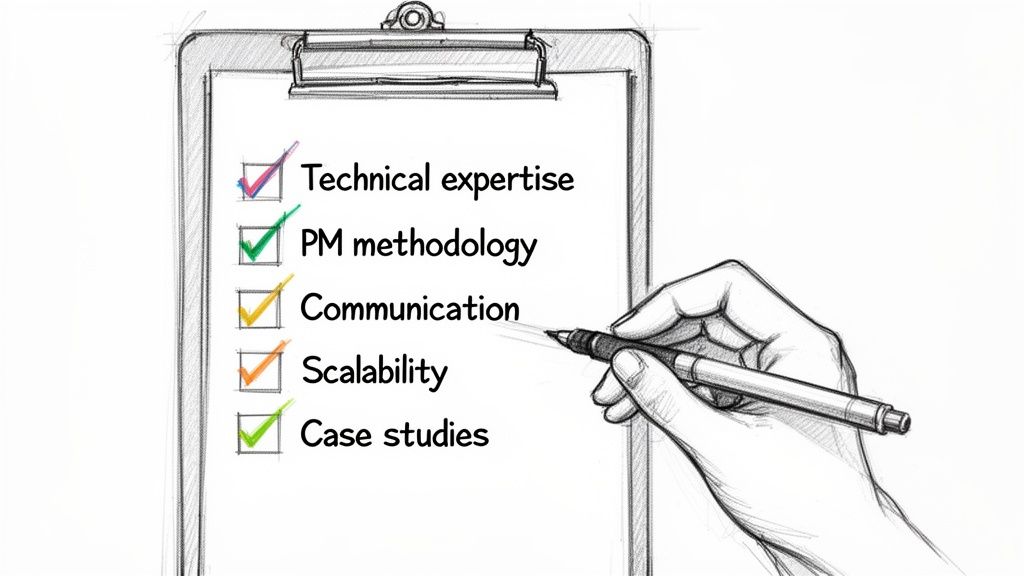
Picking a nearshore partner is the single most critical decision you'll make. Get it right, and your projects take off with a team that feels like your own. Get it wrong, and you're stuck with constant friction and stalled progress. You need a reliable way to vet potential vendors and make a choice you can stand behind.
This checklist is designed for tech leaders who need to cut through the sales noise and focus on what actually matters. Use these core areas to evaluate partners and find the one that truly fits your technical needs, work style, and business goals.
Technical Expertise and Industry Experience
It all starts with technical skill. You need a partner who not only gets your tech stack but also has a proven history of success in your specific industry.
Start by digging in with pointed questions:
- Tech Stack Alignment: How deep is their bench for your core technologies? Whether it’s specific JavaScript frameworks, cloud platforms, or mobile languages, you need to know they have the talent ready.
- Industry Knowledge: Ask for case studies or client references from companies that look like yours. Real-world proof is everything.
- Vetting Process: What is their exact process for screening candidates? Don’t be afraid to ask to see sample coding challenges or technical assessments.
A partner with relevant domain experience will understand your project's context right away. This dramatically cuts down on onboarding time and ensures their developers can add real value from day one.
Project Management and Communication Protocols
Smooth integration lives and dies by communication and compatible workflows. If your processes don't line up, you’re setting yourself up for misunderstandings and delays, which kills the whole point of bringing on nearshore talent.
A great partner doesn’t just provide developers; they provide a framework for successful collaboration. Their communication strategy should be as robust as their technical screening.
To gauge their operational fit, you’ll want to confirm a few things:
- Methodology Fit: Do they operate within your team’s project management framework, like Agile, Scrum, or Kanban?
- Tooling: Are they comfortable using your team's standard tools? Think Jira, Slack, and GitHub.
- Reporting Cadence: How do they handle progress updates? What’s their standard for check-ins and performance reports?
Scalability and Contract Flexibility
Your needs are going to change. A project might suddenly expand, or you may need to ramp down after a big launch. Being locked into a rigid, long-term contract can quickly become a major headache.
Look for a partner who offers genuine flexibility:
- Team Scaling: How fast can they add more people to your team if needed? What about scaling down? Get a clear answer on their typical turnaround time.
- Contract Terms: Do they offer flexible models, like month-to-month options or project-based terms? Avoid getting stuck in a 12-month commitment unless it truly makes sense for you.
This kind of agility keeps the partnership cost-effective and responsive as your business evolves. A partner who builds for scalability is a partner who is ready for a long-term relationship.
Your Top Nearshore Staff Augmentation Questions, Answered
Even when you've done your homework, a few questions are bound to pop up. That’s a good thing—it means you’re thinking critically about what nearshore staff augmentation really means for your business. Let's tackle some of the most common ones I hear from leaders just like you.
How Is This Different From Project Outsourcing?
This is a big one, and the difference really comes down to control and integration.
Think of staff augmentation as bringing a specialist onto your home team for a specific mission. You’re hand-picking an expert who slots right into your existing crew, reports to your managers, and collaborates daily with your people. They're on your Slack, in your stand-ups, and working under your direction.
Project outsourcing is completely different. It's more like hiring a general contractor to build an extension on your house. You hand them the blueprints, agree on a price and timeline, and then they manage their own team to get the job done. You’re delegating the entire outcome, not just adding a skilled person to your team.
What Pricing Models Are Most Common?
Knowing how you'll be billed is obviously critical for budgeting. While every partner has their own flavor, most nearshore agreements boil down to two main structures.
- Monthly Retainer: This is straightforward. You pay a set monthly fee for each person you bring on board. It’s perfect for long-term projects where you need someone's full attention, as it provides predictable costs and guarantees their dedication.
- Time and Materials (T&M): Just like it sounds, you pay an hourly rate for the work done. This model gives you incredible flexibility, making it a great fit for projects with a fuzzy scope or when you expect the workload to ramp up and down.
The monthly retainer offers stability and peace of mind. T&M, on the other hand, gives you the agility to adapt to changing project needs.
Choosing the right pricing model aligns your budget with your project's reality. A fixed monthly fee provides cost certainty for ongoing work, while an hourly rate offers the flexibility needed for more unpredictable project cycles.
How Do You Ensure Cultural Alignment?
Getting the team chemistry right is non-negotiable. A skilled nearshore partner knows this and builds cultural vetting directly into their hiring process—it's not an afterthought. They look beyond a resume to gauge soft skills, communication habits, and professional values to find someone who won't just do the work, but will actually click with your team.
But it’s a two-way street. Here are a few things you can do on your end to build a strong, unified culture from day one:
- Write Down Your "Rules of the Road": Create a simple document that explains how your team communicates, what you value, and your day-to-day workflow.
- Make Room for Human Connection: Schedule virtual coffee breaks, online game sessions, or even just casual "water cooler" channels. It's these informal moments that build real bonds.
- Prioritize Regular Check-Ins: Consistent one-on-ones are gold. They create a space to build trust, solve small problems before they become big ones, and make sure everyone feels seen and heard.