Discover what is technical architecture: A Clear Guide to System Design

Ever wondered what makes an app like Spotify stream music flawlessly to millions of users at once, or how Amazon handles the chaos of Prime Day without crashing? The answer isn't just clever coding; it's a rock-solid technical architecture.
Think of it as the master blueprint for any digital product. It’s not about the color of the buttons or the font you choose. It's about the deep-down engineering—the steel beams, the plumbing, and the electrical grid that make everything work together. This blueprint dictates the specific technologies, systems, and processes required to build something that's reliable, scalable, and secure.
The Blueprint for Digital Success
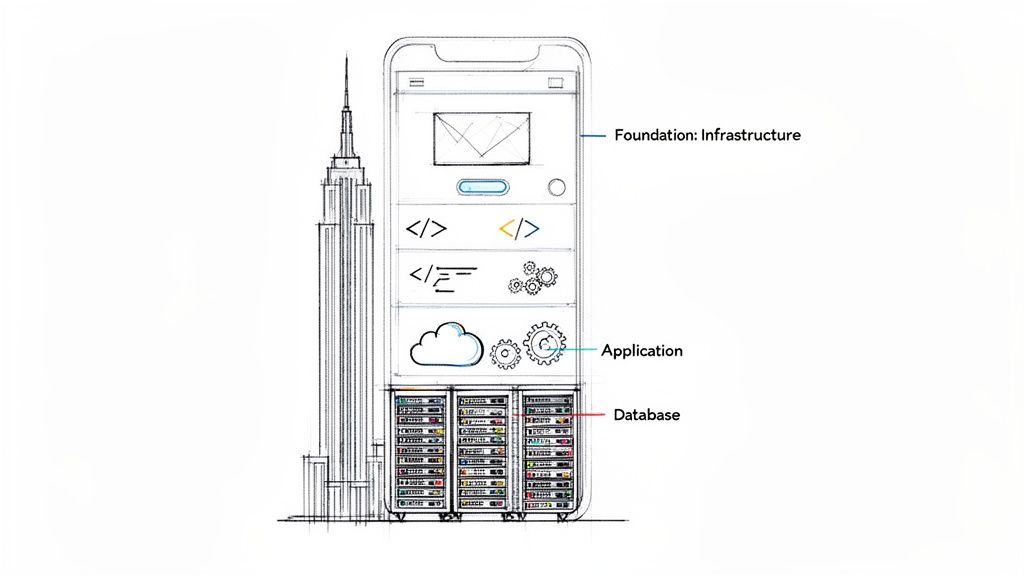
You wouldn't build a skyscraper without a detailed structural plan, right? You might get a few floors up, but you'd soon run into massive problems. Can the foundation actually support 50 stories? How will the electrical system handle the load when every office is lit up?
A technical architecture answers these exact same kinds of questions, but for software. It ensures your digital product won't buckle under pressure when your user base explodes or when you need to add a major new feature. It's about planning how all the essential components connect and communicate, creating a resilient and efficient system from the ground up.
Getting this right from the very beginning is a game-changer. It prevents those gut-wrenching, expensive rebuilds down the line and makes sure your product actually delivers on its promises.
Why Architecture Matters More Than Ever
In today's world, user patience is razor-thin. A slow-loading page, a crash during checkout, or a security breach can send customers running to a competitor. A strong technical architecture is the invisible force that prevents these disasters. It's what delivers that smooth, snappy user experience everyone expects.
The value of good design isn't just a tech-world concept. The global Architecture & Urban Planning Market was valued at USD 668.63 billion in 2026 and is on track to hit USD 1 trillion by 2032. This shows just how much value is placed on well-thought-out structure—a principle that's just as vital for software as it is for cities.
A great technical architecture isn’t just about making something work today. It’s about ensuring it can evolve, scale, and remain secure for years to come, adapting to new challenges without requiring a complete teardown.
Core Goals of Technical Architecture
When you get down to it, every decision an architect makes is a balancing act between a few key goals. These are the north stars that guide the entire development process and determine if a product will survive in the long run.
- Scalability: Can your system handle a massive, unexpected spike in traffic—like a viral marketing campaign or a Black Friday sale—without breaking a sweat?
- Performance: Is the application quick and responsive? A few milliseconds of lag can be the difference between a happy user and a lost customer.
- Security: Is sensitive user data and critical business logic locked down tight against cyber threats and unauthorized access?
- Maintainability: When it's time to fix a bug or add a new feature, can developers jump in and make changes easily without causing a domino effect of new problems?
Achieving these goals often starts with the fundamentals, like a well-designed network infrastructure. This is the bedrock upon which everything else is built, and planning it carefully is the first step toward creating a product that's not just functional but truly future-proof.
Exploring the 5 Core Layers of Technical Architecture
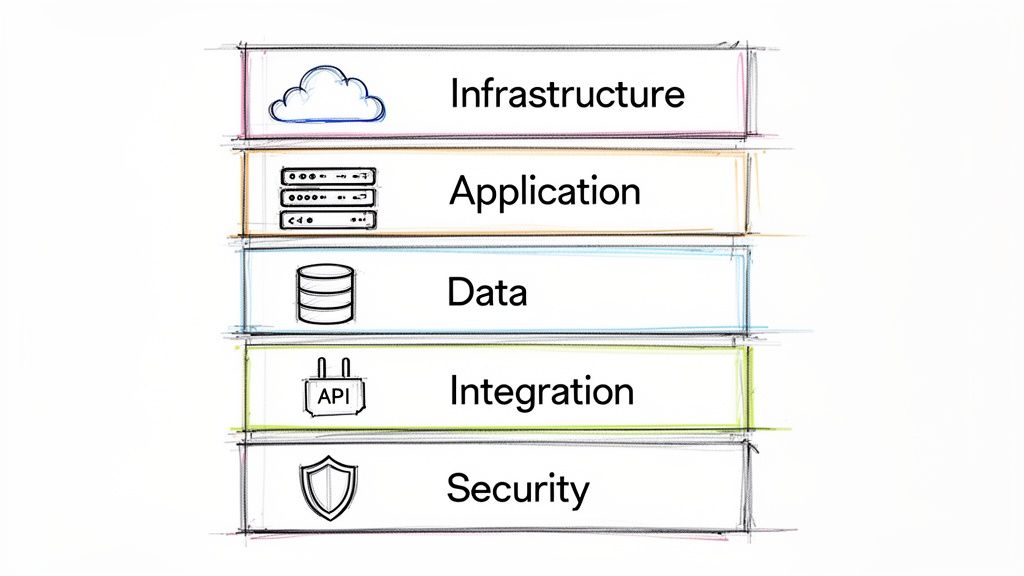
To really get a handle on technical architecture, you have to peel it back layer by layer. Think of it like a skyscraper. A massive building isn't just one giant piece; it's a collection of distinct but interconnected systems—the foundation, the steel frame, the plumbing, the electrical grid. A digital product is built the same way, on a stack of five core layers.
Each layer has a specific job, but they all have to work together to create a cohesive, functional whole. Breaking down the complexity this way helps you see how a single technology choice can ripple through the entire structure. Let's start from the ground up.
The Infrastructure Layer: The Foundation
The Infrastructure Layer is the absolute bedrock of your technical architecture. In our skyscraper analogy, this is the poured concrete foundation and the heavy steel frame. This layer is all about the hardware, both physical and virtual, that your application needs to run.
Without a solid foundation, even the most beautifully designed building will crumble. It's the same in tech. Without reliable infrastructure, even the most elegant code is going to fail. This is where you make the big calls on servers, cloud computing resources, networking, and storage.
Key components here include:
- Servers: These could be physical machines humming away in a data center or, more commonly these days, virtual servers rented from a cloud provider.
- Cloud Services: Platforms like Amazon Web Services (AWS), Microsoft Azure, or Google Cloud Platform provide the raw compute power, storage, and networking you need, right when you need it.
- Networking: This covers everything from load balancers that intelligently distribute traffic to firewalls that act as the first line of defense.
A startup might kick things off with a simple setup on a single virtual server. But as it scales, that infrastructure might evolve into a complex web of multiple servers spread across different geographic regions—a strategy global services like Netflix use to make sure you can stream your favorite show without a hitch, no matter where you are.
The Application Layer: The Functional Floors
Once the foundation is set, you can start building the floors where people actually live and work. The Application Layer is where your business logic lives. It’s the code that performs the core functions of your product—it’s what the user sees, touches, and experiences.
This is where your product’s features come to life, whether it's processing a payment or displaying a user's profile. The programming languages (like Python or Java), frameworks (like React or Django), and the overall structure of the code all belong here.
A poorly designed application layer is a recipe for disaster. It leads to slow performance, frustrating bugs, and a constant headache when you try to add new capabilities down the road.
The tools used to plan this layer are big business. The Architecture Design Software Market was valued at USD 3.9 billion in 2023 and is expected to grow by over 12% CAGR through 2032. This surge shows just how critical sophisticated design tools have become, especially as cloud-based solutions are projected to top USD 5 billion by 2032.
The Data Layer: The Secure Archive
Every modern application runs on data. The Data Layer is in charge of storing, retrieving, and managing all of it. In our skyscraper, this is the secure, climate-controlled archive, holding everything from customer records and product inventory to user photos and comments.
The architecture of this layer dictates how efficiently your application can get the information it needs. A slow database can bring the entire system to a grinding halt, no matter how fast your application code is.
Common components include:
- Databases: Systems like PostgreSQL (relational), MongoDB (NoSQL), or Amazon DynamoDB are used to store all kinds of data.
- Data Warehouses: These are used for storing huge amounts of historical data for analytics and business intelligence.
- Caching Systems: Tools like Redis keep frequently accessed data in memory for lightning-fast retrieval, giving your app a serious performance boost.
Picking the right database is one of the most critical decisions an architect makes. A social media app might go with a NoSQL database to handle a firehose of unstructured posts, while a bank would rely on a traditional relational database for its bulletproof consistency and transactional integrity.
The Integration Layer: The Elevators and Wiring
A skyscraper needs elevators, plumbing, and wiring to connect all the floors and make them useful. In technical architecture, the Integration Layer does the same thing. It allows different parts of your application to talk to each other and to connect with external services.
This layer is the glue that holds your system together, powered by Application Programming Interfaces (APIs) that act as a universal translator between different software components.
When you use a "Log in with Google" button on a website, that's the integration layer at work, using Google's API to securely verify who you are. An e-commerce site uses an API to talk to a payment processor like Stripe, letting you use their trusted service instead of building a complex payment system from scratch. You can learn more by exploring common software architecture design patterns that make these connections possible.
The Security Layer: The Locks and Surveillance
Finally, you wouldn't build a skyscraper without locks, surveillance cameras, and security guards. The Security Layer isn't a separate floor; it's a concern that cuts across every single other layer, protecting the entire structure.
This layer involves implementing measures to protect data, stop unauthorized access, and handle threats. Security can't be an afterthought bolted on at the end—it has to be designed into the system from the very beginning.
Key practices here include:
- Authentication & Authorization: Figuring out who users are and what they’re allowed to do.
- Data Encryption: Scrambling data to protect it both when it's stored (at rest) and when it's being sent over a network (in transit).
- Threat Monitoring: Actively watching for and responding to any suspicious activity.
From locking down the physical servers in the infrastructure layer to preventing code injection attacks in the application layer, this final piece ensures the entire system is safe and trustworthy for everyone.
Technical vs Software vs Enterprise Architecture
It's incredibly easy to get tangled up in the jargon of system design. You'll hear people throw around terms like enterprise, software, and technical architecture, often as if they mean the same thing. They don't. Each one represents a different altitude of planning, and knowing the difference is vital for making sure the right people are having the right conversations.
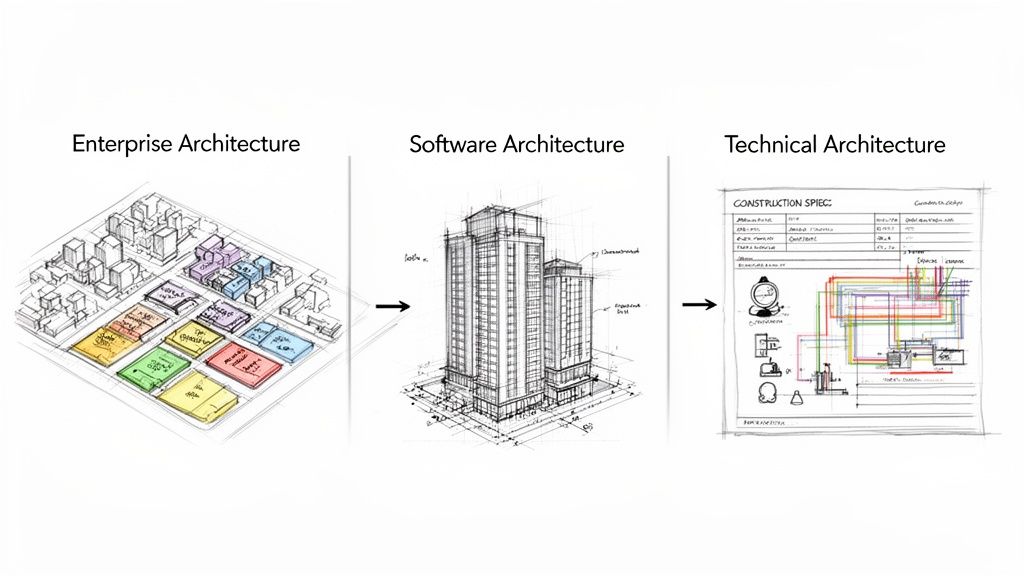
To really nail this down, let’s think about building a new city district from scratch. You wouldn’t use the same plans to lay out the highways as you would to design the plumbing in a single skyscraper, right? The same logic applies here.
Enterprise Architecture: The City Plan
Enterprise Architecture (EA) is the 30,000-foot view. In our analogy, this is the master city plan. The enterprise architect isn't worried about the brand of windows in a particular building; they’re focused on the big picture.
Their job is to answer the huge, strategic questions that shape the entire organization’s technology landscape.
- Zoning: They decide where the residential, commercial, and industrial zones go. In business terms, this means defining which departments own which business capabilities—sales, finance, logistics, etc.
- Infrastructure: They map out the major highways, power grids, and transit systems. For a company, this means setting overarching IT policies, data governance rules, and standards for how different parts of the business connect and communicate.
Ultimately, EA ties the company's long-term strategic goals to its technology roadmap, ensuring every project—from a new CRM to a mobile app—moves the entire organization in the right direction. You can dive deeper into how these big-picture plans take shape with these common enterprise application architecture patterns.
Software Architecture: The Building Blueprint
Now, let's zoom in. If EA is the city plan, then Software Architecture is the detailed blueprint for a single building within that city—let's say, a new office tower in the commercial district.
The software architect is laser-focused on the structure of one specific application. They’re making the critical calls on how it will be built to do its job effectively.
The city plan says, "We need an office building here." The software architect designs its layout: how many floors it has, where the elevators and stairwells go, and how the different office suites are connected.
Key decisions at this stage include choosing a design pattern like microservices, defining the main software components and how they'll talk to each other, and mapping out the flow of data through the application.
Technical Architecture: The Construction Specs
Finally, we get to the ground level with Technical Architecture. If software architecture is the blueprint, what is technical architecture? It’s the nitty-gritty construction and engineering spec sheet for that office tower. This is where the abstract plan gets real.
A technical architect picks the exact materials and technologies needed to bring the blueprint to life. They are obsessed with the non-functional requirements—the things that make the system fast, secure, and reliable.
Their checklist includes:
- Materials: What specific grade of concrete (PostgreSQL 14) and steel (Java 17) will we use?
- Systems: Which brand of HVAC (AWS) and electrical wiring (RabbitMQ) is the right fit for this building's needs?
- Logistics: How will the servers be configured? What firewall rules are required? Which security protocols must be implemented?
Technical architecture creates the tangible, real-world instructions that developers use to build, deploy, and maintain the software. It’s the critical bridge between the logical software design and the physical (or virtual) hardware it runs on. It ensures the final product isn't just a clever design, but a robust, scalable, and secure system that actually works.
To make these distinctions even clearer, let's look at them side-by-side.
Comparing Technical vs Software vs Enterprise Architecture
| Aspect | Technical Architecture | Software Architecture | Enterprise Architecture |
|---|---|---|---|
| Scope | Single application or system | Single application | Entire organization or business unit |
| Focus | How it's built and runs (The "How") | Logical structure & components (The "What") | Business strategy & capability (The "Why") |
| Key Questions | Which database? Which cloud? How to scale? | Monolith or microservices? What are the APIs? | How does this tech support our goals? |
| Analogy | Construction & Engineering Specs | Building Blueprint | City Master Plan |
| Primary Concerns | Non-functional requirements (performance, security, scalability) | Functional requirements, system behavior, maintainability | Business-IT alignment, governance, standardization |
| Deliverables | Infrastructure diagrams, tech stack specs, deployment plans | Component diagrams, data flow diagrams, API contracts | Business capability maps, technology roadmaps |
This breakdown shows how each architectural layer builds on the last, moving from high-level strategic goals all the way down to the specific technologies that make it all happen.
How Technical Architecture Works in the Real World
So, we've talked about the blueprints and the "what-ifs." Now, let's get down to brass tacks. Technical architecture is the invisible engine that powers the digital products you rely on every day. Its design isn't arbitrary; the choices an architect makes are always driven by the specific goals of the business.
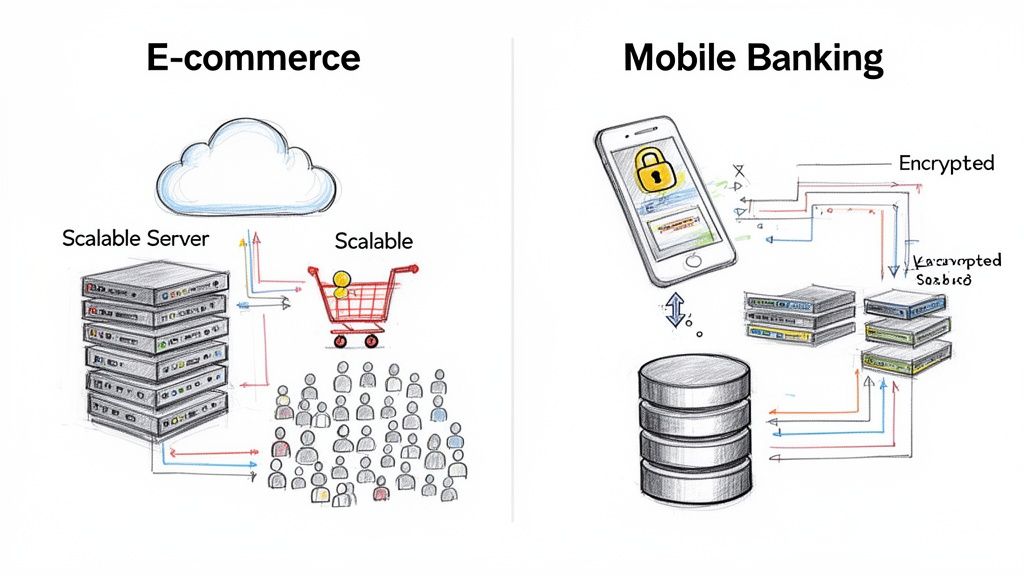
A system built for millions of shoppers hitting a "buy now" button all at once has a completely different DNA than one designed to safeguard your financial data. Let’s look at two common scenarios to see how this plays out in the wild.
Example 1: The Scalable E-commerce Site
Picture a huge online retailer gearing up for a Black Friday sale. Their number one concern? Scalability. The system has to withstand a massive, sudden flood of traffic without buckling. Even a few minutes of downtime could mean millions in lost sales.
The technical architecture here is all about elasticity—the ability to expand resources when needed and shrink them back down to save money when the rush is over.
Here’s a peek under the hood:
- Infrastructure Layer: It's almost certainly built on a cloud platform like Amazon Web Services (AWS). They’d use auto-scaling groups to spin up more servers automatically as traffic climbs. A Content Delivery Network (CDN) would also be essential to cache images and product info closer to users around the world, making pages load in a snap.
- Application Layer: You'll often find a microservices pattern. Instead of one giant, monolithic application, it’s broken into smaller, independent services—one for the product catalog, one for the shopping cart, another for payments. If the payment service gets slammed, it can be scaled up on its own without slowing down the rest of the site.
- Data Layer: A mix-and-match approach to databases is typical. A speedy NoSQL database might handle transient data like shopping carts, while a rock-solid relational database manages permanent orders and customer profiles. Caching tools like Redis would be used heavily to keep popular product data in memory, taking pressure off the main databases.
This setup allows the site to run smoothly for a handful of shoppers on a quiet Tuesday and for millions during a holiday frenzy. To dive deeper, check out our guide on e-commerce microservices architecture.
Example 2: The Secure Mobile Banking App
Now, let's switch gears to a mobile banking app. Performance is still important, but the undisputed king is security. The architecture here is less of a flexible machine and more of a digital fortress. Every single decision is made to protect sensitive financial information and block unauthorized access.
For financial applications, the architecture isn't just about functionality; it's about building trust. Every layer must be hardened to protect against a constant barrage of potential threats, ensuring user data remains confidential and transactions are secure.
The blueprint for a banking app looks radically different from our e-commerce site.
The focus shifts to these key areas:
- Security Layer: This is non-negotiable. Multi-factor authentication (MFA) is a must. All data, whether it’s sitting on the phone or flying over the network, is locked down with powerful encryption. The system is also bristling with intrusion detection and real-time activity monitoring to flag anything suspicious.
- Integration Layer: The app communicates with the bank’s core systems only through tightly controlled APIs. These digital doorways are guarded by multiple layers of authentication and authorization, making sure only the legitimate app can get anywhere near account data.
- Infrastructure Layer: While it might still use the cloud, the infrastructure would live inside a Virtual Private Cloud (VPC) with extremely strict firewall rules. Redundancy is also critical. A key part of the architecture is designing for resilience, often using strategies like multi-provider failover reliability to ensure the service is always available.
These two examples drive home a fundamental truth: technical architecture is not one-size-fits-all. It's a series of careful trade-offs made to achieve a specific business goal, whether that's surviving a viral traffic spike or protecting a user's life savings.
What to Expect: Key Deliverables and Best Practices
A good technical architecture isn't just an abstract idea—it’s a practical blueprint that leads to real, tangible outputs. For founders and managers, knowing what these outputs are is crucial. It gives you a concrete checklist to ensure you're getting what you paid for and making smart trade-offs between speed, cost, and long-term health.
So, when you hire an architect or partner with a development team, what should they actually hand you? The whole process should result in a clear, actionable set of documents that become the single source of truth for your entire team. No more guessing games; everyone builds from the same plans.
The Essential Architectural Deliverables
At the very least, a solid technical architecture process should give you three core documents. Think of these as the bridge between your big-picture business goals and the specific instructions your engineers need.
- Architectural Diagrams: You have to see it to understand it. These visuals, often created using frameworks like the C4 model, map out your system at different levels of detail. You'll get everything from a 10,000-foot view of how your system interacts with the outside world down to the nitty-gritty schematics of its internal components.
- Technology Stack Recommendations: This is more than just a shopping list of technologies. It's a detailed breakdown of the chosen languages, frameworks, databases, and cloud services, complete with the why behind each decision. A good architect justifies every choice, connecting it directly back to your project’s unique needs.
- Non-Functional Requirements (NFRs): This is where we define what "good" looks like. The NFRs document sets clear, measurable targets for how the system must behave. For example, it will specify things like "page load time under 2 seconds," "compliance with GDPR," or "ability to handle 10,000 concurrent users."
These deliverables leave no room for ambiguity. They spell out exactly how the system should be built and how it needs to perform once it's out in the wild.
Building a Foundation That Lasts: Proven Best Practices
The documents are only half the story. The philosophy guiding the architecture is what separates a system that merely works today from one that thrives for years. Following a few battle-tested principles is what ensures your product remains stable, secure, and easy to adapt as your business grows.
This isn't a niche concern; it's a massive industry. The global Architectural Services Market was valued at USD 376.08 billion in 2023 and is on track to hit USD 523.20 billion by 2030. A huge slice of that pie is digital. In the U.S. alone, the data center construction market is set to grow at a 10.2% CAGR through 2030, which tells you just how much is being invested in strong digital foundations. You can find more details in this market analysis from Grand View Research.
This explosive growth makes getting the principles right more important than ever.
A well-designed technical architecture acts as a force multiplier for a development team. It provides the clarity and structure needed to build features faster, with fewer bugs, and with confidence that the system won't break under pressure.
To get there, make sure your architecture is built on these core ideas:
- Design for Scalability and Resilience: Plan for success from the start. This means choosing technologies that can grow with you, like cloud-native services that automatically scale up or down. It also means designing for failure by eliminating single points of weakness, so one hiccup doesn’t bring the whole system down.
- Embed Security from Day One: Security should never be a last-minute patch. A modern "shift-left" approach bakes security into the very first design discussions. Things like data encryption, strict access controls, and threat modeling are treated as fundamental requirements, not optional extras.
- Prioritize Maintainability and Evolvability: Your system will change—that’s a guarantee. The goal is to make those future changes as painless as possible. By using clean code, a modular design, and clear documentation, you ensure that new developers can jump in, fix bugs, and add features without creating a tangled mess.
Got Questions About Technical Architecture? Let's Talk.
Even after you’ve got a handle on the theory, a lot of questions pop up when you start applying technical architecture to an actual project. It’s one thing to know the layers, but another thing entirely to make the right calls in the real world. Turning a great blueprint into a successful product often comes down to navigating these common forks in the road.
Think of this section as a quick chat with an expert, where we tackle the questions we hear most often. We want to clear up the confusion so you can focus on building your business, whether you’re a scrappy startup or an established company looking to grow.
For a Startup, What’s the Most Critical Part of Technical Architecture?
If you’re a startup, your world revolves around two things: speed and flexibility. The most critical job of your architecture is to support that. You need to be able to iterate quickly, test ideas, and pivot without being handcuffed by your own technology.
Building a massive, rigid, "perfect" architecture from day one is a classic startup killer. It burns through your most valuable resources—time and money. The goal is to make smart, pragmatic choices that let you move fast now without creating a total mess you’ll have to clean up later.
Here's where to focus:
- Go with a Simple, Scalable Cloud Setup: Don't try to reinvent the wheel. Pick a major cloud provider like AWS or Google Cloud and lean heavily on their managed services. Using things like serverless functions or managed databases means they handle the grunt work of keeping things running. Your small team can focus on building your product, not managing servers.
- Stick to Common Programming Frameworks: Now is not the time to be a maverick. Choosing a popular, well-supported framework like React for your frontend or Python with Django for your backend is a strategic move. It gives you access to a huge talent pool and tons of pre-built libraries, which speeds up development and makes hiring much, much easier down the road.
The best startup architecture isn't the most complex one; it's the one that gets a working product into your users' hands fast. It just needs to be solid enough to build on top of once you've found your footing. It’s about being practical, not perfect.
How Does Good Architecture Actually Reduce Long-Term Costs?
A well-planned technical architecture is one of the best long-term cost-saving tools you have. The savings don't always show up on next month's P&L, but over a year or two, the difference is massive.
Imagine the difference between a tidy, organized workshop versus a cluttered garage where you can't find anything. In the workshop, building something new or fixing a problem is quick and efficient. The garage? You’ll spend hours just trying to find the right screwdriver. Your tech stack is no different.
Here’s how a solid architecture directly lowers your costs over time:
- Fewer Wasted Developer Hours: When your system is logically structured and well-documented, developers don't have to spend half their day trying to untangle spaghetti code. They can build new features and fix bugs faster, which translates directly to lower payroll and less wasted time.
- Lower Maintenance Drama: A stable, resilient system doesn't break in the middle of the night. You'll spend far less on emergency bug fixes, late-night calls, and all-hands-on-deck "firefighting" that kills both morale and your budget.
- Pay-for-What-You-Use Scalability: Good architecture lets you scale resources up and down intelligently. Instead of paying for huge, expensive servers to handle peak traffic that only happens 5% of the time, a well-designed system can add or remove resources automatically. You only pay for the computing power you actually need, which can easily save a growing company hundreds of thousands of dollars a year.
So, When Is the Right Time to Define the Technical Architecture?
The short answer is as early as you possibly can. You have to draw the blueprint before you pour the foundation.
Defining your technical architecture needs to be a key part of your initial discovery and planning phase, long before a single line of production code gets written. Trying to slap an "architecture" onto a project that's already halfway built is a recipe for chaos, technical debt, and painful rewrites.
This is the stage where you ask the big questions. How will it perform? How will we keep it secure? How will it scale when we succeed? Getting these right from the start saves you from incredibly expensive fixes later on. Trying to fix a bad foundation after the 20-story skyscraper is already built is a nightmare.
This doesn't mean you need a rigid, 100-page document that never changes. Your initial architecture should be a strong but flexible framework designed to evolve. But the core decisions—your cloud provider, your main database, your overall system design—have to be made upfront. They provide the North Star that guides the entire development team.