Enterprise: enterprise software development companies - how to choose a partner
Picking the right partner from the massive pool of enterprise software development companies is one of the most critical calls a business leader will ever make. Get it right, and you fast-track innovation for years to come. Get it wrong, and you're saddled with costly technical debt and frustrating, missed opportunities.
This guide is a practical, field-tested roadmap to help you make that choice with confidence.
Why Choosing the Right Partner Is Your Most Critical Decision
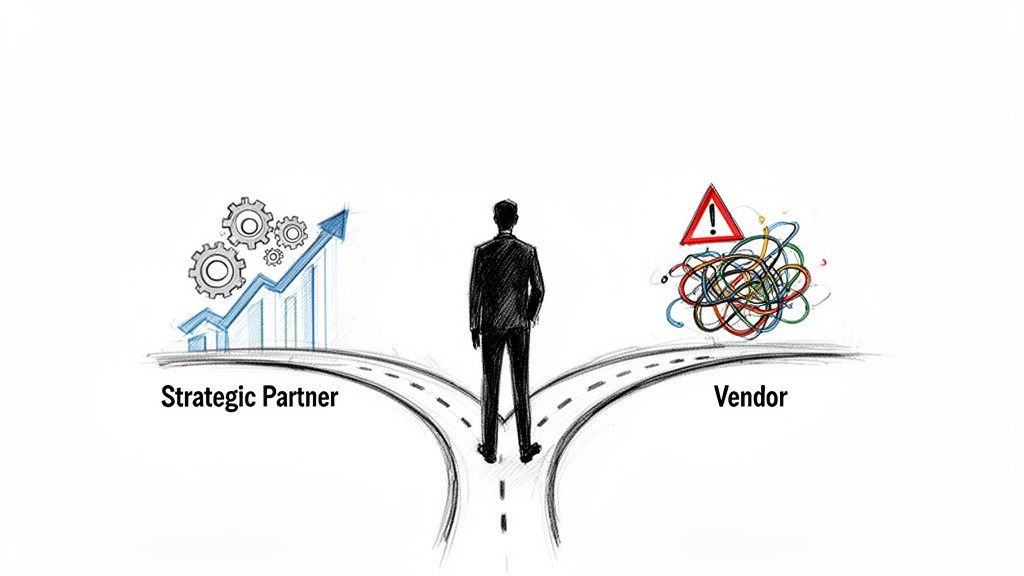
Let's be clear: selecting a software development partner isn't just another procurement task. It's a strategic move that will directly shape your company's future. The best partners aren't just vendors executing a statement of work; they become an extension of your own team, bringing fresh ideas, deep technical expertise, and a genuine commitment to your business goals.
The stakes are higher than ever, especially when you look at the market's scale. The global enterprise software market is on track to hit $403.90 billion by 2030. That's a massive number, and it highlights just how much businesses rely on sophisticated digital tools to function and compete. This segment now makes up 41% of the entire software market, showing how central these solutions have become.
Moving Beyond Generic Advice
Most articles on this topic will give you the same old advice: "check their portfolio" or "ask for references." Those are table stakes, but they barely scratch the surface of what really matters. The true test of a partner is their ability to handle the messy, complex realities of a large organization.
Think about what actually keeps you up at night:
- Long-Term Scalability: Can they build something that will grow with your business for the next five years, or will you be forced into a costly, painful overhaul in just two or three?
- Security and Compliance: Do they have battle-tested experience with the tough security protocols your industry demands, like SOC 2 or ISO 27001? For enterprise work, these are absolutely non-negotiable.
- Cultural Alignment: Will their team actually mesh with yours? A clash in communication styles or work cadence can poison even the most technically sound project.
The goal isn't just to find a firm that builds what you ask for. It's to find a partner who challenges your assumptions, pushes back when necessary, and actively contributes to a better final product. They should feel like a co-owner of the outcome.
A Framework for Success
This guide is designed to help you validate those core concerns. We’ll dig into the tangible benefits of outsourcing software development and provide a clear, actionable framework for evaluating potential partners. It’s built for product leaders and procurement teams who know that the right development firm does far more than just write code—it becomes an engine for sustainable growth.
Defining Your Project and Core Evaluation Criteria
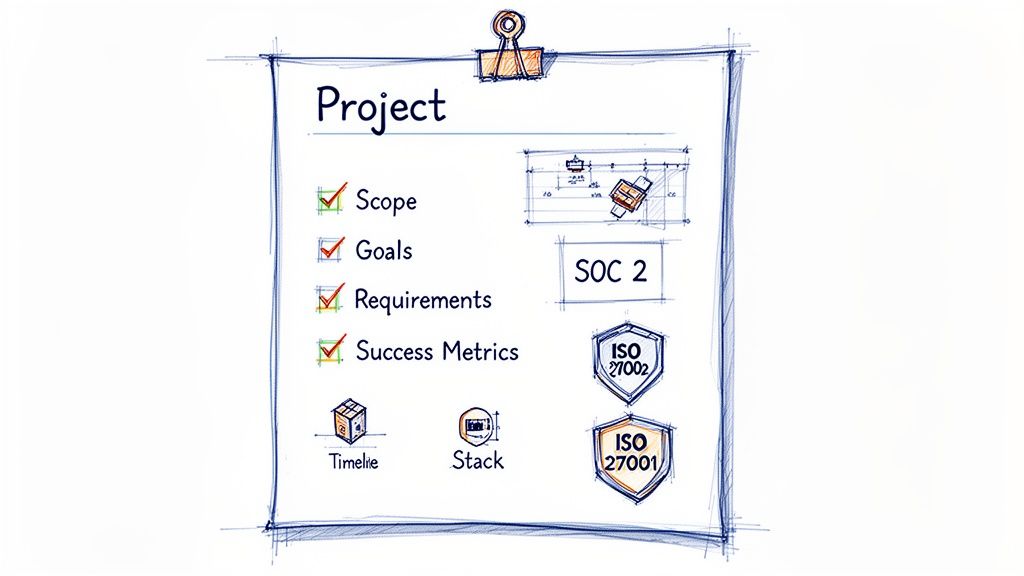
Before you start Googling a single development firm, the most critical work happens internally. You have to create a detailed blueprint of what you actually need.
Jumping into the market with a vague idea like "we need a new CRM" is a direct path to scope creep, blown budgets, and a project that disappoints everyone. The strongest partnerships I've ever seen started with the client having a crystal-clear vision of their own needs first.
This is all about translating broad business ambitions into a concrete set of requirements that a potential partner can sink their teeth into. Without this groundwork, you're just guessing.
From Business Goals to Functional Requirements
First, nail down the "why." What specific business pain are you trying to eliminate? Are you looking to cut operational costs by 15%? Boost customer retention by 10%? Maybe you want to slash manual data entry by 500 hours a month. These are the Key Performance Indicators (KPIs) that will tell you if the project was a success.
With those business objectives locked in, you can start breaking them down into functional requirements—the specific things the software absolutely must do.
Let's say a logistics company wants a real-time tracking platform. Their high-level goal is better delivery efficiency and happier customers. Here’s how that breaks down:
- Business Goal: Decrease customer support calls about package locations by 40%.
- Functional Requirement: The system must have a customer portal showing a package's live location on a map.
- Functional Requirement: The platform needs to send automatic SMS and email alerts at key delivery stages, like "Out for Delivery" and "Delivered."
Getting this level of detail is non-negotiable. If you need a more structured approach, checking out a sample software requirements document can give you a solid template for how these pieces fit together.
Your project documentation should be so clear that a development firm can read it and immediately grasp not just what you want to build, but why it matters to your business. This context is what separates a good partner from a great one.
Establishing Non-Negotiable Evaluation Criteria
Once your project is defined, you can build a scorecard for evaluating potential partners. Think of these criteria as your deal-breakers—the must-haves that separate the contenders from the pretenders.
1. Proven Technical Proficiency
A firm's claimed expertise has to line up perfectly with your tech stack. If you need to integrate with specific enterprise platforms or legacy systems, you need a vendor with a paper trail proving they’ve done it before. For instance, if your ecosystem relies on platforms like Microsoft Dynamics 365, finding a partner with that specific experience is essential.
Don't be shy about asking for case studies using the exact frameworks you need (e.g., .NET Core, Java Spring, React). A flashy portfolio of unrelated projects is a major red flag.
2. Verifiable Industry Experience
There's a world of difference between building software for a bank and building it for a hospital. Every industry comes with its own baggage of regulations, compliance headaches, and unique user expectations.
Your ideal partner has already walked this path. They'll get the nuances of your business without a six-month crash course, which saves time, reduces risk, and ultimately leads to a better product.
3. Robust Security and Compliance Protocols
For any enterprise project, security isn't just a feature; it's the foundation. A single breach can cause catastrophic financial and reputational harm. You need to dig deep into a company's security posture.
Look for hard proof of their commitment:
- ISO 27001: This certification shows they have a systematic, internationally recognized approach to managing sensitive information.
- SOC 2 Compliance: This is a must-have for anyone handling customer data. It ensures they have the right controls for security, availability, and confidentiality.
- Secure Coding Practices: Ask them how they adhere to standards like the OWASP Top 10 to protect against common cyber threats.
These three pillars—technical chops, industry experience, and security—form the bedrock of your evaluation. By defining them upfront, you turn the overwhelming task of finding a partner into a structured, data-driven decision.
Choosing the Right Engagement Model for Your Business
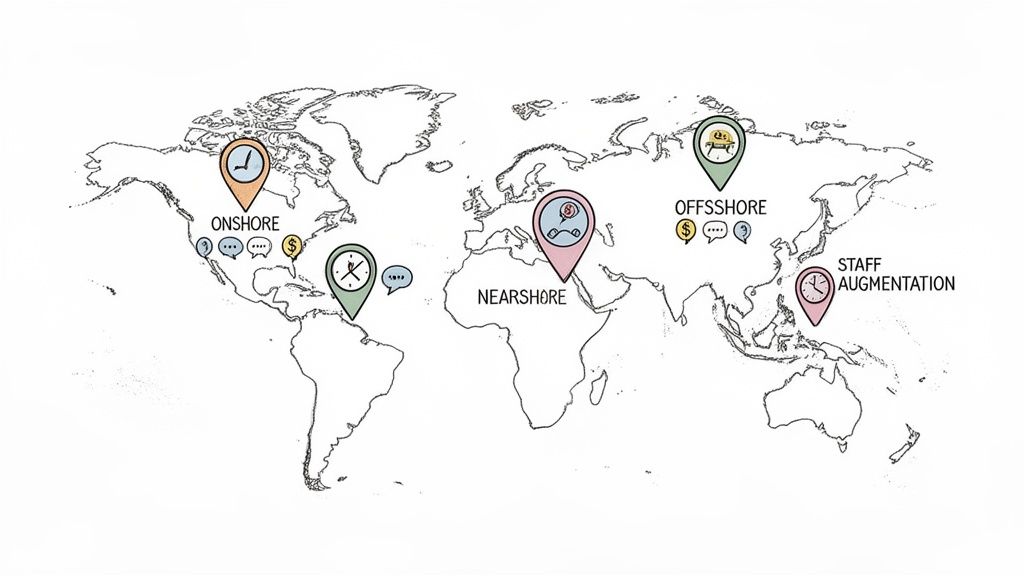
Finding the right development partner is a huge step, but it's only half the story. The way you work with them—the engagement model—is what truly sets the tone for the entire project. This isn't just a detail buried in a contract; it's the operational heartbeat of your collaboration.
Your choice here will come down to a few critical factors: your project's complexity, your budget, and how much hands-on involvement your internal team needs to have. Get this decision wrong, and you could be setting yourself up for friction and missed deadlines, even if you’ve hired the most talented developers in the world.
Onshore for High-Touch Collaboration
Onshore development is straightforward: you partner with a company right in your own country. The biggest win here is the effortless collaboration. You won't be wrestling with time-zone gymnastics or navigating cultural misunderstandings, which makes it a perfect fit for complex projects that demand daily, high-touch strategy sessions.
Of course, that convenience comes with a price tag. Onshore partners command the highest rates because their labor and operational costs are higher. This model makes the most sense when your need for intense, real-time teamwork outweighs budget concerns.
The U.S. enterprise software market is a juggernaut, generating $88.07 billion in 2024 and projected to climb to a staggering $162.74 billion by 2030. This massive domestic demand is what fuels the premium onshore market. You can dig into the numbers by exploring the latest research on the enterprise software market in the United States.
Offshore for Cost Optimization
Going offshore means you're working with a team in a distant country, often on the other side of the world. The primary motivation here is almost always cost. The savings on development rates can be massive.
This approach works best for projects that are buttoned up from the start—think crystal-clear scope, exhaustive documentation, and a minimal need for daily back-and-forth. The time difference forces an asynchronous communication style, so success hinges on meticulous project management to keep everyone aligned.
Don't just chase the lowest price. An offshore model is a strategic play for well-defined, non-iterative work where you can trade real-time access for major budget efficiencies.
Nearshore: The Balanced Approach
Nearshore development is that "just right" sweet spot for many companies. You partner with a team in a neighboring country, like a U.S. firm collaborating with a team in Latin America. You get a powerful mix of benefits without major trade-offs.
- Cost Savings: Rates are much more attractive than onshore, though not rock-bottom like some offshore options.
- Time-Zone Alignment: Your workdays overlap, making real-time chats, daily stand-ups, and agile ceremonies a breeze.
- Cultural Affinity: Shared cultural context can smooth out communication, leading to a more natural and intuitive collaboration.
Nearshore is a fantastic choice if you want the collaborative energy of an onshore team without the eye-watering cost. It’s practically built for Agile development, where quick feedback loops are essential.
Staff Augmentation for Targeted Expertise
This model is a different beast altogether. Instead of outsourcing a whole project, staff augmentation is about bringing individual experts from an enterprise software development company directly into your team. They work under your management, just like any other team member.
It’s the perfect solution when your in-house team is strong but has a specific skill gap. Maybe you need a senior DevOps engineer for six months or a couple of iOS specialists to hit a tight deadline. It gives you incredible flexibility to scale your capacity up or down without the overhead and commitment of full-time hires. We explore this in more detail in our guide to staff augmentation vs. outsourcing.
To help you visualize the trade-offs, here’s a quick comparison of the models.
Comparing Software Development Engagement Models
| Model | Cost | Time Zone Alignment | Cultural Proximity | Best For |
|---|---|---|---|---|
| Onshore | Highest | Excellent | Excellent | Complex, iterative projects requiring intense, daily collaboration. |
| Offshore | Lowest | Poor | Low | Well-defined projects with minimal need for real-time interaction. |
| Nearshore | Moderate | Good | Good | Agile projects needing a balance of cost-efficiency and collaboration. |
| Staff Augmentation | Varies | Excellent | Excellent | Filling specific skill gaps and scaling an existing internal team. |
Ultimately, the best engagement model is the one that aligns with your project goals, team dynamics, and budget. A clear-eyed assessment of these factors will help you build a partnership that feels less like a transaction and more like a true extension of your team.
Crafting a Powerful RFP and Asking the Right Questions
If you send out a generic Request for Proposal (RFP), you're going to get generic partners. It’s that simple. To find a top-tier enterprise software development company, you need to write an RFP that serves as both a detailed blueprint and a sophisticated filter. A truly effective RFP doesn’t just list your wants; it tells the story of your business challenge, forcing potential partners to show their problem-solving chops instead of just ticking boxes.
Think of this document as your first real test of a potential partner. A well-crafted RFP signals that you're a serious client looking for a strategic relationship. It saves you countless hours by weeding out mismatched vendors from the get-go and attracting firms genuinely excited by your project's complexity.
The Anatomy of a Winning RFP
Your RFP needs to strike a delicate balance—comprehensive enough to paint a clear picture, yet concise enough to not be overwhelming. It's a briefing document, equipping potential partners to give you a thoughtful, relevant, and accurate proposal. Sloppy, vague RFPs almost always lead to vague proposals and, down the line, project headaches.
Here's what you absolutely must include:
- Company Background: Who are you? What's your place in the market? Give them the context they need to understand your world.
- Project Vision and Business Goals: What specific problem are you trying to solve? More importantly, what does success actually look like? Use concrete metrics, like "reduce manual data entry by 30%" or "boost user engagement by 20%."
- Detailed Scope of Work: This is the core. Outline the key features and functionality you need. Get as specific as you can with user stories, technical must-haves, and any critical integrations.
- Technical Constraints and Environment: Be upfront about your existing tech stack, any mandatory technologies, and compliance standards you live by, such as SOC 2 or HIPAA.
- Timeline and Key Milestones: Provide a realistic schedule for vendor selection, project kickoff, and major delivery dates.
- Evaluation Criteria and Submission Guidelines: Don't make them guess. Clearly state how you'll score proposals and the exact format they need to follow.
For a great starting point, exploring a tool like an AI-powered Request for Proposal (RFP) submission form template-submission-form-template) can give you a solid framework for structuring your requirements.
Moving Beyond Surface-Level Questions
The real magic happens in the questions you ask. Generic questions get you practiced, generic answers. Instead of asking, "Do you use Agile?" (the answer is always "yes"), you need to dig deeper. Situational and behavioral questions force vendors to draw on their actual, lived experience.
The goal is to move from "what" they do to "how" and "why" they do it. This is where you uncover their true expertise, problem-solving style, and cultural fit. You’re not just buying code; you’re buying a team’s collective wisdom.
Here are a few examples of questions that separate the true partners from the vendors just trying to make a sale:
- On Technical Acumen: "Describe your process for code reviews. What tools do you rely on, and what are the most common issues your team looks for?"
- On Project Management: "Walk us through a time an Agile sprint was derailed by unexpected scope creep. How did your team handle it, what was the outcome, and what did you learn?"
- On Collaboration and Handover: "How do you ensure an effective knowledge transfer to our internal team so we can confidently maintain and build upon the software post-launch?"
- On Problem-Solving: "Looking at our project goals, what’s the single biggest technical risk you foresee, and how would you propose we mitigate it?"
These kinds of questions demand specific, thoughtful answers rooted in real-world scenarios. They reveal how a team thinks on its feet, communicates under pressure, and navigates the inevitable challenges of complex software development.
The Generative AI Litmus Test
You also have to probe a vendor's grasp of current technology. Generative AI has become the fastest-growing area in enterprise software, with spending expected to jump from $11.5 billion in 2024 to $37 billion in 2025.
It’s no longer a "nice to have." With 72% of organizations now using generative AI and coding applications representing the biggest slice of that spend at $4.0 billion, a potential partner's AI strategy is critical.
Ask them directly how they are using AI to improve efficiency, code quality, and testing in their development lifecycle. Their answer will tell you everything you need to know about whether they're at the forefront of the industry or just playing catch-up.
Evaluating Proposals and Navigating Contracts Like a Pro
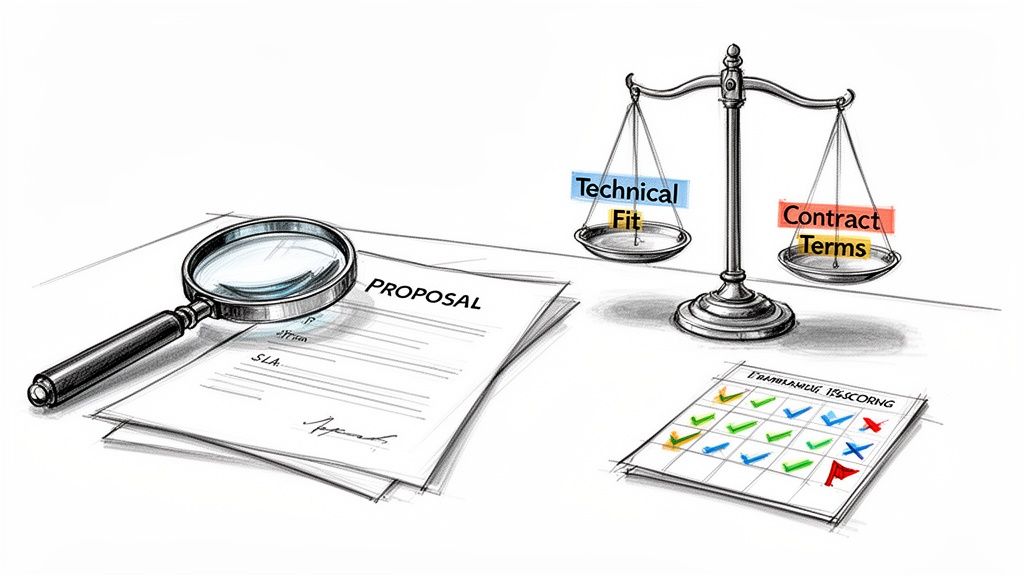
The proposals have landed. This is where the real work begins—sifting through the polished sales pitches to find a true development partner. Your first instinct might be to flip to the last page and compare price tags, but I can tell you from experience, that's a mistake. The lowest bid is rarely the best value.
Instead, let's get methodical. The best way to cut through the noise is with a simple scoring matrix. It’s an essential tool that helps you move from a gut feeling to a data-backed decision, which makes explaining your choice to stakeholders a whole lot easier.
Creating a Practical Scoring Matrix
The key is to weight each category based on what’s most critical for your project. If you're building a complex platform from scratch, technical prowess is everything. You might give that a weight of 40%. But if you need a team that can seamlessly embed with your own engineers, cultural fit could be worth a solid 25%.
Here's a sample framework you can adapt:
- Technical Expertise & Approach (Weight: 40%): Does their tech stack make sense? More importantly, do their case studies prove they’ve actually solved problems like yours before?
- Project Management & Communication (Weight: 25%): Do they just say they're "Agile," or do they clearly explain how they'll run sprints, manage backlogs, and keep you in the loop?
- Cultural Fit & Team Caliber (Weight: 20%): Did their team ask smart, probing questions during the Q&A? Do the bios of the proposed team members inspire confidence?
- Cost & Overall Value (Weight: 15%): Is the pricing model transparent? Does the cost feel aligned with the level of expertise and the quality of the proposal?
This structured approach forces a deeper look at what really drives a successful partnership, long after the ink on the contract is dry.
Decoding the Contract and Key Clauses
Once you have your shortlist, it's time to put on your legal hat. The contract isn't just a formality; it's the rulebook for your relationship. Getting lost in the legalese now can lead to massive headaches down the road. You don't need to be a lawyer, but you do need to zero in on a few critical clauses.
A good contract anticipates the best and worst-case scenarios. It should clearly outline who's responsible for what, protect your assets, and give both sides a clear path forward if things don't go as planned.
Make sure you're crystal clear on these four areas:
- Intellectual Property (IP) Ownership: This one is non-negotiable. The contract must state, without any ambiguity, that you own 100% of the custom code and all IP created for your project. Period.
- Service-Level Agreements (SLAs): What happens after launch? A solid SLA will define guaranteed response times for critical bugs vs. minor tweaks, specify uptime guarantees, and outline penalties if those guarantees aren't met.
- Payment Models: Whether you agree on a Fixed-Price or Time and Materials (T&M) model, the terms need to be spelled out. For T&M, insist on the right to audit timesheets and get a firm rate card for every role.
- Termination Clause: How do you part ways if the partnership sours? A fair clause allows either party to exit with reasonable notice (like 30 days) and details the process for final payments and a complete handover of all code and project assets.
Spotting Critical Red Flags in Proposals
As you review, keep your radar up for warning signs. The best firms put real thought into their proposals, and it shows.
Be wary of these tell-tale red flags:
- Vague, Generic Language: If a proposal reads like it could have been sent to any company, it’s a bad sign. It means they haven't invested the time to understand your unique challenges.
- The "Too Good to Be True" Bid: An estimate that dramatically undercuts everyone else isn't a bargain. It's often a sign of inexperience, a fundamental misunderstanding of the scope, or a plan to claw back profits through endless change orders.
- A Lack of Questions: A great partner will always have clarifying questions after reading your RFP. If a vendor just sends back a proposal without a single query, it suggests they've made assumptions, and assumptions in software development are dangerous.
By blending a methodical scoring system with a sharp eye for contractual details and a healthy dose of skepticism, you’ll be in a much stronger position to choose a partner who’s truly set up to help you win.
Got Questions? Here Are Some Straight Answers
Even with the most buttoned-up evaluation process, a few nagging questions always seem to pop up right before you sign on the dotted line. These aren't just hypotheticals; they're the real-world concerns that keep product leaders and procurement teams up at night. Let's get them answered.
How Do I Know the Code Will Be Secure and High-Quality?
This is a big one, and the answer starts way before a single line of code is written. It starts with your due diligence.
You need to get granular with potential partners about their quality assurance (QA) and security practices. Don't just accept "we do testing." Ask them to walk you through their entire process. What’s their mix of automated versus manual testing? What does their code review workflow look like? Who is responsible for what?
On the security front, get specific.
- Do they build to standards like the OWASP Top 10?
- Are they using tools for static and dynamic application security testing (SAST/DAST)?
- Do they have any relevant certifications, like ISO 27001?
These aren't just checkboxes; they show a serious commitment to protecting your data and reputation. Once the project kicks off, this rigor needs to continue. Your contract must have crystal-clear acceptance criteria for both quality and security. For truly critical applications, I always recommend bringing in a third-party firm for penetration testing before you go live. It’s an independent gut check that’s worth its weight in gold.
What's the Right Pricing Model for My Project?
There's no single "best" pricing model. The right choice—usually between fixed-price and time and materials (T&M)—comes down to how well-defined your project is.
A fixed-price contract is your best bet when you have a rock-solid, well-documented scope that isn't likely to change. Think of it as building from a precise blueprint. It gives you budget predictability, which is great for smaller, straightforward projects. The downside? It’s rigid. If you need to pivot, it can get complicated and expensive.
On the other hand, the time and materials (T&M) model is built for the unknown. It’s perfect for complex, long-term initiatives where you expect requirements to evolve as you go. This is the natural fit for any Agile project. It gives you the flexibility to adapt to user feedback or market shifts, which almost always results in a better final product.
Pro Tip: Consider a hybrid approach. I've seen this work incredibly well. Use a fixed-price model for an initial discovery or design phase to nail down the core requirements and architecture. Then, switch to T&M for the actual development sprints where you need that agility.
How Do We Actually Manage a Remote Team Effectively?
Managing a remote team, whether they’re nearshore or offshore, boils down to being incredibly intentional. You simply can't "wing it." Success is all about creating a deliberate structure for communication and governance from day one.
First, standardize your toolset. Everyone needs to be on the same page. A typical stack looks something like this:
- Communication: Slack or Microsoft Teams for the day-to-day chatter.
- Project Management: Jira or Asana to keep tasks and progress transparent.
- Documentation: Confluence or Notion to serve as your single source of truth.
Next, establish a non-negotiable meeting rhythm. Daily stand-ups, weekly reviews, and monthly steering committee meetings are the heartbeat of a healthy remote partnership. The single most important factor here is having a dedicated project manager on your side and on the partner's side. These two people become the central nervous system for the entire project.
If you’re working with a nearshore team, lean into the time zone overlap for real-time collaboration. For offshore teams, define a daily "golden hour" where both teams are online for critical sync-ups. And for heaven's sake, document every important decision. It’s the best way to prevent misinterpretations down the road.
What Are the Biggest Red Flags I Should Watch For?
When you’re vetting enterprise software development companies, your gut feeling is important, but you should also be on the lookout for a few classic warning signs.
A price that seems too good to be true almost always is. A bid that dramatically undercuts everyone else is a massive red flag. It often means they're using junior developers, they've misunderstood the scope, or they plan to hit you with a mountain of change-order fees later.
Pay close attention to the questions they ask you. A great partner will grill you. They'll want to dig deep into your business goals, your users, and your technical constraints. If they aren’t asking smart, probing questions, it suggests they aren't truly invested in your success.
Also, beware of the generic, copy-paste proposal. A firm that’s serious about winning your business will tailor its proposal to your specific challenges. Finally, if they get cagey about providing recent client references or can't show you a case study that’s truly comparable to your project, walk away. It probably means they don't have the experience they claim.