How to Increase App Downloads and Achieve Sustainable Growth
If you're trying to get more people to download your app, you need a plan that goes beyond just having a great product. The real secret is blending that product with smart, consistent marketing. It’s not about finding one secret trick; it's about building a solid growth system around four core areas: App Store Optimization (ASO), smart paid advertising, user retention, and constant testing.
Your Playbook For Increasing App Downloads
Does getting noticed in the app stores feel like screaming into the void? If your download numbers have stalled or never really took off, you’re not alone. The key to breaking through isn't about chasing temporary hacks but building a sustainable system for growth.
The sheer scale of the market is mind-boggling. Projections show users will download nearly 300 billion apps a year by 2025, and you're competing against almost 5 million others. Even more sobering, the average person only uses about 10 apps a day, making the battle for a spot on their home screen incredibly intense.
This guide isn't about generic advice. It's a practical playbook that walks you through the four essential pillars that drive consistent, long-term installs.
The Four Pillars Of App Growth
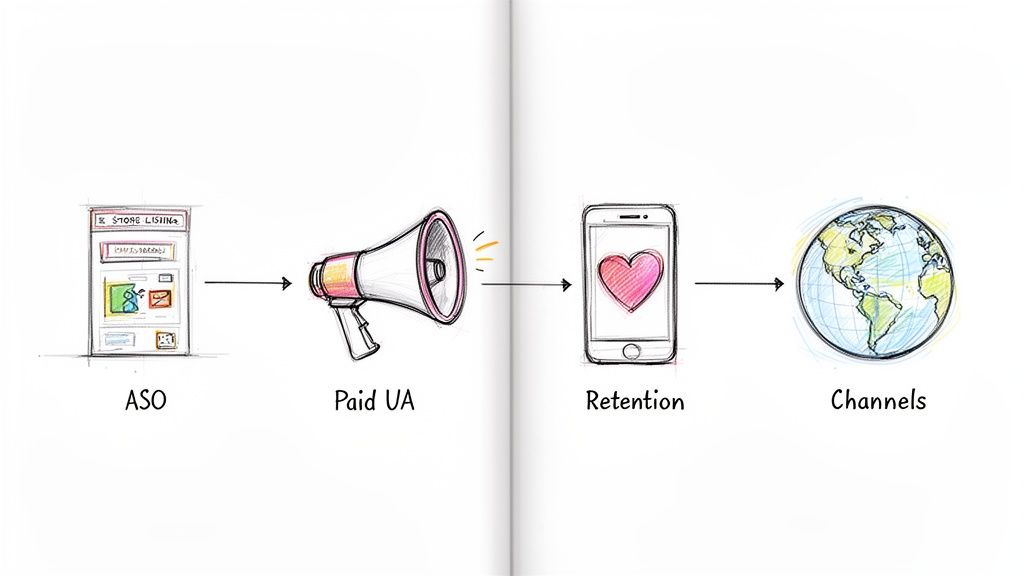
To build a strategy that actually works, you have to focus your energy on four key areas. Each one plays a critical role in the user's journey, from how they first discover your app to becoming a loyal fan. If you neglect one, the others suffer. But when you get them all working together, you create a powerful growth flywheel.
Let's break down these four pillars into a simple framework. Think of each one as a leg on a stool—if one is weak, the whole thing becomes unstable.
Core Pillars of App Download Growth
| Growth Pillar | Primary Goal | Key Activities |
|---|---|---|
| App Store Optimization (ASO) | Increase organic visibility and conversion in the app stores. | Keyword research, title/subtitle optimization, compelling screenshots, A/B testing creative assets. |
| Paid User Acquisition | Drive targeted, high-intent installs quickly to accelerate growth. | Running Apple Search Ads, Facebook/Instagram Ads, TikTok campaigns, and influencer marketing. |
| Retention & Referrals | Keep users coming back and encourage them to invite others. | Smooth onboarding, push notifications, in-app rewards, implementing referral programs. |
| Analysis & Iteration | Make data-driven decisions to continuously improve performance. | Tracking KPIs (LTV, CPI, ROAS), running experiments, analyzing user behavior, and refining your strategy. |
Mastering these pillars transforms your efforts from a collection of random tactics into a cohesive and sustainable engine for growth.
You're not just looking for downloads; you're building a system where satisfied users become your best marketing channel. For a deeper dive into building this kind of momentum, it's worth exploring various effective SaaS growth strategies that can be adapted for the mobile app world.
Getting the Fundamentals of App Store Optimization Right
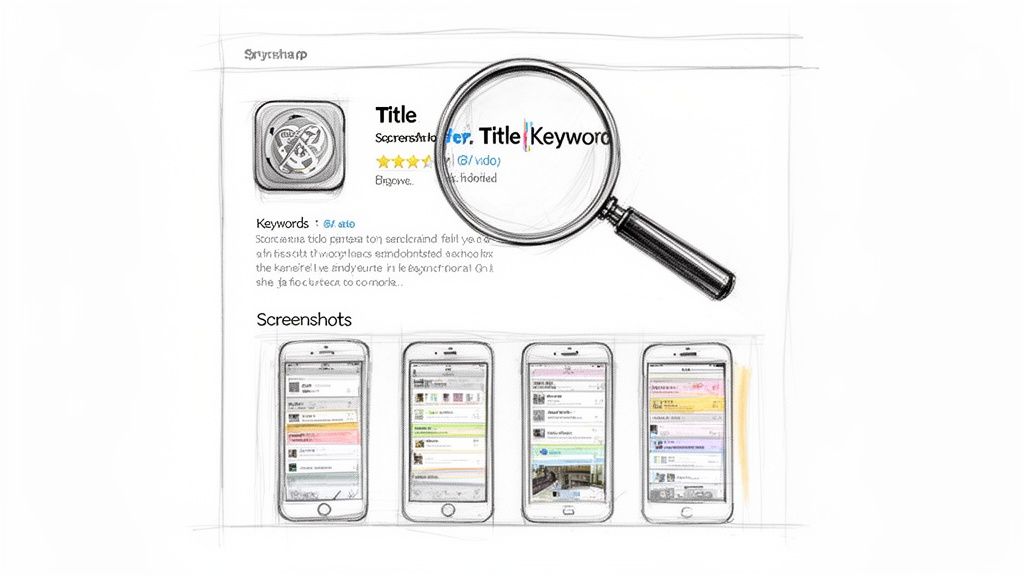
Before you spend a dime on ads, you have to nail App Store Optimization (ASO). Think of it as the foundation for all your growth. ASO is how you make your app's store page so discoverable and convincing that people who find it actually tap "Install."
This isn't just about stuffing keywords into a description. It's about crafting the perfect digital storefront. If your page is confusing or unappealing, people will bounce, no matter how great your app is. Good ASO gets the right people to your page and gives them every reason to download.
Uncover Keywords That Actually Drive Installs
Keyword research is the heart of ASO, but most people approach it wrong. They chase broad, high-volume terms like "fitness" or "photos," which is a surefire way to get lost in the crowd.
The real gold is in long-tail keywords. These are longer, more specific phrases that show someone knows exactly what they want. A user searching for "HIIT workout timer for small spaces" is ready to download. Someone just typing "fitness" is probably just browsing.
To find these high-intent keywords, think like your user:
- What problem are they solving? Instead of "productivity," think "how to stop procrastinating."
- What features are they looking for? People search for things like "meal planner with grocery list" or "photo editor with vintage filters."
- Who are they trying to replace? Searches like "[competitor name] alternative" are from users actively looking to switch.
Once you have a solid list, you can start weaving these terms into your app's metadata. For a much deeper dive, our guide on App Store Optimization strategies covers advanced research tactics.
Craft Titles and Descriptions That Convert
Your app's name, subtitle, and description are your sales pitch. They need to instantly communicate what your app does and why it's worth someone's time, both for the store's algorithm and for human eyes.
A strong title should blend your brand with your most important keyword. For instance, a meditation app called "Calm Space" could use "Calm Space - Meditation & Sleep" to immediately clarify its purpose. The subtitle then offers a chance to add more context, like "Guided breathing and focus exercises."
Your app store description needs to be a persuasive pitch, not a feature list. Hook them with a strong opening sentence, use bullet points to make benefits easy to scan, and close with a clear call to download.
Optimize Your Visuals to Make People Click
Text gets you found, but visuals get you downloaded. Your icon, screenshots, and preview video do the real work of conversion. Users make snap judgments based on what they see.
Your app icon is the first impression. It has to be clean, memorable, and hint at your app's function without needing any words. Avoid tiny details or text that become a blur on a small screen.
Screenshots are your chance to tell a visual story. Don't just show random parts of your UI. Guide the user through the best parts of your app.
- Create a narrative: Use the first 2-3 screenshots to walk through the main user journey.
- Add benefit-focused captions: Overlay short, punchy text on each image, like "Track your progress in seconds."
- Keep it consistent: A cohesive color scheme and style make your app look far more professional and trustworthy.
The apps at the very top of the charts are masters of this. In 2025, giants like Instagram and ChatGPT consistently pulled in 52 million and 45 million monthly installs. Their success isn't an accident. It's built on a crystal-clear value proposition, massive social proof through ratings, and visual storytelling that shows users exactly what they’re getting. When a leader adds that many users a month, you can see how even a small lift in your own conversion rate could mean thousands of new downloads.
Ultimately, great ASO is never "done." It’s a constant cycle of testing, learning, and tweaking to turn more store visitors into active users.
Driving Smart Paid User Acquisition Campaigns
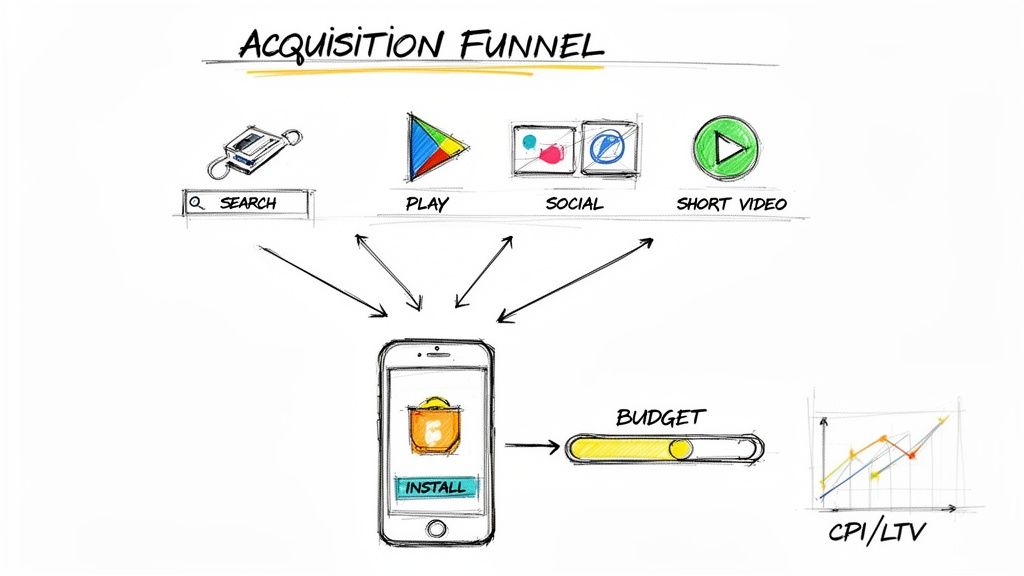
While App Store Optimization sets a solid organic foundation, paid user acquisition (UA) is the jet fuel for rapid growth. It’s how you get your app directly in front of your ideal audience, fast. But smart UA isn't about blindly buying installs; it’s about strategically acquiring users who will actually stick around.
The old goal was chasing a low Cost Per Install (CPI). That's a trap. A cheap install from someone who opens your app once and immediately churns is just wasted money. The real win is acquiring users whose Lifetime Value (LTV) crushes what you paid to get them. It’s all about quality, not just quantity.
Choosing Your Paid Channels Wisely
Not all ad platforms are created equal, and your strategy needs to meet your audience where they already are. A common rookie mistake is spreading a small budget too thin across every channel imaginable. Instead, get really good at one or two platforms that make the most sense for your app.
Apple Search Ads (ASA): For iOS apps, this is almost always the best place to start. The user intent is incredibly high—they're literally in the App Store searching for what you offer. You can target specific keywords, go after competitor app names, or aim for broader categories.
Google App Campaigns (UAC): This is Google's powerhouse for Android apps. It runs across their entire ecosystem, including Search, Google Play, YouTube, and the Display Network. You feed it the assets (text, images, video), and Google's machine learning does the heavy lifting to find users who are likely to install and engage.
Social Media Platforms (Meta, TikTok): These channels are masters of discovery. They let you pinpoint hyper-specific demographics and interests. TikTok is a beast for visual-first apps targeting a younger crowd, while Meta (Facebook and Instagram) offers insanely detailed targeting options for pretty much any user profile you can dream up.
Defining Your Audience And Crafting Your Creative
Before you spend a single dollar, you need a razor-sharp picture of who you're targeting. And I mean really know them. Go way beyond basic demographics. What are their biggest frustrations? What other apps are on their home screen? What kind of content makes them stop scrolling?
This detailed user persona is the blueprint for your ad creative. The polished, static image that might work on Instagram will almost certainly bomb on TikTok, where authentic, user-generated style content reigns supreme. Your ad copy, visuals, and overall vibe have to feel native to the platform where your user sees it.
As your paid user acquisition strategy matures, knowing how to scale Facebook Ads effectively becomes crucial for expanding your reach and maximizing your return.
The single biggest mistake I see in paid UA is measuring success by the install alone. Always track post-install events like completing onboarding, making a first purchase, or hitting a key level. It's the only way to know if you're actually acquiring valuable users.
Launching and Optimizing Your First Campaign
Getting started doesn't have to be overwhelming. A simple, disciplined approach will help you launch, learn quickly, and put your budget to work where it matters most.
First up, set a clear goal and a small budget. Your initial objective isn't to get thousands of downloads overnight; it's to gather data. A modest daily budget is more than enough to start learning what resonates with your audience and what doesn't.
Next, track what happens after the install. This is non-negotiable. Use a mobile measurement partner (MMP) to see what users do once they're in your app. The metric you should obsess over is Return on Ad Spend (ROAS). Are the users from a specific campaign actually generating more revenue than they cost to acquire?
Finally, test and iterate relentlessly. Launch campaigns with a few different ad creatives, headlines, and audience segments. Let them run for a few days, then dive into the data. Which ad had the highest click-through rate? Which audience delivered the best LTV?
Pause what's not working and double down on your winners. Paid acquisition is a constant loop of testing, learning, and optimizing. When you shift your focus from cheap installs to high-quality users, your ad spend stops being an expense and becomes a powerful investment that fuels real, sustainable growth.
Designing for Retention and Viral Growth
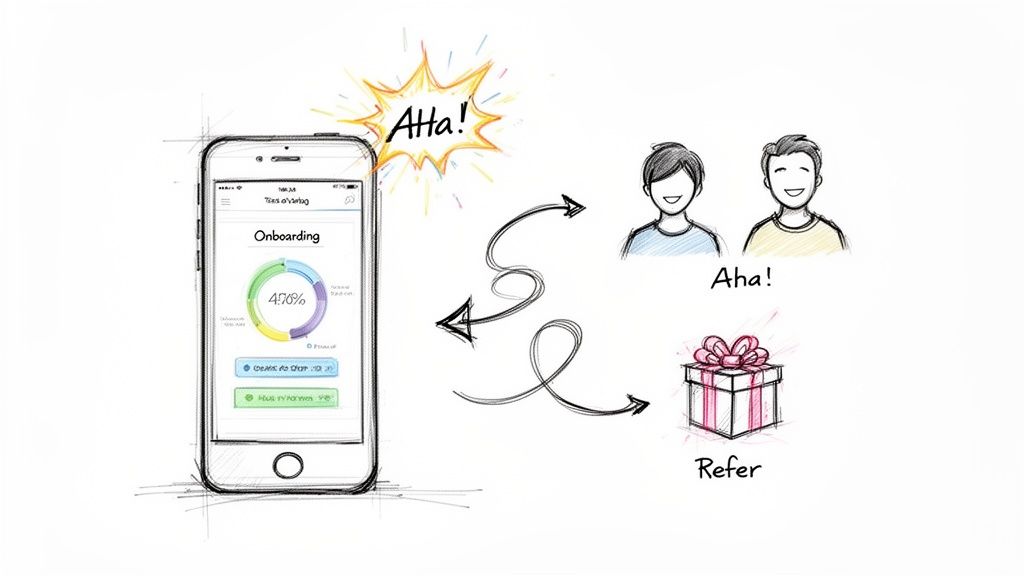
A high download count looks great on a dashboard, but it’s a total vanity metric if those users vanish after the first day. Real, sustainable growth comes from a product people genuinely love using and can’t wait to share. This means we have to shift our focus from just acquiring users to creating an experience that naturally drives both retention and referrals.
When you get this right, you build a powerful flywheel. Happy users stick around, boosting their lifetime value, and they also become your most authentic and effective marketing channel. This is the secret to how you increase app downloads without constantly pouring more money into ads.
Master the First Five Minutes
A user’s first interaction with your app is a make-or-break moment. I’ve seen countless apps lose users right away because of a confusing or long-winded onboarding process—it’s the single biggest cause of day-one churn. Your job is to get new users to their first “Aha!” moment as quickly and painlessly as possible.
That "Aha!" moment is when they get it—when they feel the core value of your app. For a photo editor, it's seeing that perfect filter transform their picture. For a budgeting app, it’s linking a bank account and watching their spending get categorized automatically.
Your onboarding isn’t a user manual for every feature; it's a guided tour straight to that moment of delight.
To nail this critical phase, here’s what I recommend:
- Show, Don’t Just Tell: Use interactive tooltips or short, skippable walkthroughs. Static instruction screens are a snooze-fest.
- Ask for Permissions in Context: Never bombard someone with permission requests—notifications, location, etc.—the second they open the app. Wait until they try to use a feature that actually needs it.
- Celebrate Small Wins: When a user completes a key step, like creating their first to-do list, give them a little nod of encouragement. It makes a huge difference.
The real goal of onboarding is to make the user feel smart and successful within minutes. When they get that quick win, they're far more likely to stick around and explore what else you have to offer.
Building Viral Loops into Your Product
Okay, so you’ve got an engaged user. Now what? The next step is to make it incredibly easy and rewarding for them to bring their friends into the fold. This is the core of a viral loop: a system where every new user is incentivized to bring in more new users, creating a growth cycle that feeds itself.
This goes way beyond just sticking a "Share" button somewhere. It's about engineering moments where sharing feels like the natural and obvious next step.
Think about Dropbox's classic referral program. They didn't just toss out a reward; they gave users more of the core product (storage space). This brilliant move meant their most active users were also the most motivated to refer others. That’s a perfect alignment of incentives.
Another great example is Spotify's "Wrapped" campaign. It creates a personalized, highly shareable piece of content that users are genuinely proud to post, turning their individual music taste into a massive, organic ad for the platform.
A Practical Checklist for Viral Features
Auditing your own app for viral potential can unlock some serious growth. It’s not about tacking on features, but weaving them into the user's journey. And if you want to dive deeper into keeping users happy, our guide on how to increase user retention has a ton of complementary strategies.
Here’s a quick checklist to get you started:
Is the Incentive Compelling?
- Double-Sided Rewards: Give something to the referrer and the new user. "Give $10, Get $10" is a classic because it reframes a selfish act as a generous one.
- Product-Led Rewards: Can you offer access to more features, in-app currency, or a premium subscription? This is often cheaper than cash and attracts users who truly value your app.
Is Sharing Effortless?
- Frictionless Flow: A user should be able to send an invite in two taps, max. Make sure you’re using the native sharing options on iOS and Android.
- Pre-Populated Messages: Write a compelling, editable message that clearly explains the benefit to the recipient. Don't make your user write your ad copy for you.
Is the Timing Right?
- Post-Delight Prompts: The absolute best time to ask for a referral is right after a user has a great experience—they’ve just completed a level, achieved a goal, or made a successful purchase.
When you focus on keeping users and turning them into advocates, you stop renting attention and start earning it. This approach transforms your user base into a powerful engine that can sustainably increase app downloads for years to come.
Drive Traffic from Outside the App Store
Relying on people to just stumble upon your app in the store is a recipe for disappointment. It's like opening a shop on a quiet side street and hoping for the best. To really increase app downloads, you have to go where your users are and bring them to you. Promoting your app on channels outside the app stores creates a wave of interest that sends motivated people straight to your download page.
This isn't about randomly shouting about your app online. It's about strategically building a presence that grabs attention, explains your value, and convinces potential users they need your app before they even open the App Store or Google Play. These efforts build your brand and warm people up, so by the time they see that "Install" button, they're ready to click.
Create Content That Actually Helps People
One of the best ways to get on your target audience's radar is to create content that solves a real problem for them. Stop thinking about it as "promoting your app" and start thinking about it as "solving the problem your app was built for." A solid blog or a few genuinely useful social media posts can quickly make you look like the expert.
For instance, if you have a budgeting app, don't just list its features. Write articles people would actually search for, like:
- "5 Dumb Budgeting Mistakes I Made (And How to Fix Them)"
- "The 50/30/20 Budgeting Rule for People Who Hate Math"
- "How I Saved for a Down Payment While Barely Making Rent"
Once you've provided real value, you can seamlessly introduce your app as the perfect tool to make it all happen. This builds trust and makes your app feel like a helpful solution, not just another ad. This kind of content marketing is a huge part of any successful mobile app marketing strategy.
Work with Influencers and Get Active in Niche Communities
Why build an audience from scratch when you can tap into one that already exists? Influencer marketing gives you a direct line to people who are already primed to listen. The trick is finding partners whose followers are a dead ringer for your ideal user.
And I'm not talking about A-list celebrities. Micro-influencers—creators with smaller, super-engaged audiences—often give you way more bang for your buck. A recommendation from them feels less like a paid ad and more like a tip from a trusted friend.
At the same time, become a regular in the online spots where your people hang out.
- Reddit: Find subreddits where your audience is complaining about the exact problems your app solves. Jump into the conversation, offer real advice, and only mention your app when it makes sense.
- Discord/Slack: Join (or even create) a community. This gives users a place to connect with you and each other, turning them into your biggest fans and advocates.
- Facebook Groups: Get involved in groups related to your app's niche. Share your expertise, answer questions, and build a reputation as a helpful resource.
The real goal here isn't to just blast your message out. It's to build a tribe. A passionate community becomes a powerful engine for feedback, support, and—most importantly—word-of-mouth referrals that drive a steady stream of app downloads.
Build a Landing Page Before You Launch
Even if your app is still being coded, you can start marketing it right now. A simple pre-launch landing page is an incredibly effective way to capture early interest. All it needs is a clear explanation of what your app does and one big, obvious call-to-action: "Enter your email to get early access."
This helps you build an email list of people who are genuinely excited about your app. On launch day, you won't be starting from zero. You'll have a ready-made audience to announce to, which can create that crucial initial spike in downloads and help you climb the app store rankings.
Think about this: people spend an absolutely staggering 4.2 trillion hours a year using mobile apps, and a massive portion of that is on social media. With 63.9% of the world’s population on social networks, it's one of the most powerful places to get in front of potential users. This makes social-driven promotion—from community building to influencer posts—a non-negotiable part of your plan to increase app downloads. You can dig into more revealing app statistics to see just how big the opportunity is.
Building Your Sustainable App Growth Engine
Forget about one-off campaigns or a single magic bullet for getting more app downloads. Real, sustainable growth comes from building a system—an engine—where every single part of your strategy works together. We’re talking about connecting everything from how a user first discovers your app to why they’re still using it six months later.
Think of it like a flywheel. When you nail your App Store Optimization (ASO), you start getting a consistent flow of high-intent organic traffic. Then, you can layer on smart paid campaigns to act as a booster, pushing qualified users to a store page you already know converts well. This gives you that initial momentum, along with a ton of valuable data from your first batch of users.
Weaving Product and Promotion Together
But getting someone to install your app is only the starting line. The product itself has to be built to keep people around and encourage them to spread the word. A killer onboarding experience is crucial; it needs to guide new users straight to that “aha!” moment where they truly get the value of your app. Get that right, and you’ll see churn plummet.
When users genuinely love the experience, they're far more likely to leave a positive review or share the app with a friend. They become your best, most authentic marketing channel. This creates a powerful feedback loop:
- More happy users lead to better store ratings.
- Better ratings boost your ASO rankings.
- Higher rankings drive even more organic downloads.
The apps that truly win don't just acquire users; they build a system where happy users naturally create more happy users. This simple shift in thinking changes your goal from just chasing installs to actually cultivating a thriving community.
The Cycle of Optimization
The fuel for this entire engine? Data. You have to be constantly testing your assumptions. Run A/B tests on your App Store screenshots, play with different ad creatives on social media, and meticulously track which channels bring in the most valuable users—not just the ones with the lowest cost-per-install.
By consistently learning from your metrics and fine-tuning every step of the user journey, you'll stop relying on temporary traffic spikes. Instead, you'll have built a resilient, self-perpetuating system that drives downloads and grows a loyal user base for the long haul.
Got Questions About App Growth? We've Got Answers.
Jumping into app growth always kicks up a few questions. I've been there. To help you get your bearings and set some realistic goals, I've answered some of the most common things that come up when you're trying to get more people to hit that "install" button.
How Long Until My ASO Efforts Actually Pay Off?
This is probably the number one question I get, and the honest answer is: it depends. App Store Optimization (ASO) isn't a magic wand you wave for instant results.
If you're just making small changes, like swapping out screenshots or tweaking your promo text, you might see a little bump in your conversion rate in a couple of weeks. That's the easy part with a fast feedback loop.
But if you're trying to rank for competitive keywords, you need to play the long game. We're talking two to three months of consistent work—that means digging into research, shipping updates, and poring over the data. Think of it less like a sprint and more like building up a snowball of organic visibility that grows over time.
What's a "Good" Cost Per Install Anyway?
There’s no universal answer for what a good Cost Per Install (CPI) looks like. It’s all over the map depending on your app's niche, the country you're advertising in, and which ad network you're using. A casual mobile game might get away with a CPI under $2, but a fintech app in a crowded market? That could easily run you over $10 per install.
The real question isn't "what's a cheap CPI?" but "is my Lifetime Value (LTV) higher than my CPI?" A successful ad campaign isn't about getting the cheapest downloads; it's about acquiring users who stick around and become valuable. As a rule of thumb, I always aim for an LTV that's at least 3x my CPI. That’s where you find sustainable, profitable growth.
Should I Pour Money into Paid Ads or Focus on Organic First?
For almost every new app out there, my advice is to build a solid organic foundation before you open your wallet for ads. Get your ASO in order first. Nail down your onboarding flow so new users don't just open the app once and disappear.
Why? Because it makes your paid ads so much more effective. When you finally do start running paid campaigns, you’ll be sending that expensive traffic to a store page that converts well and an app experience that actually retains them. Once your organic engine is humming, then you use paid channels to pour fuel on the fire.
How Much Do App Ratings and Reviews Really Matter?
They matter. A lot. App ratings and reviews are huge for two main reasons.
First, they're pure social proof. It's human nature. If you see two apps and one has a 4.7-star rating with glowing reviews and the other is sitting at a 3.2-star rating, which one are you going to download? It’s a massive driver for your conversion rate.
Second, both Apple and Google's algorithms look at your ratings and review volume as a key signal for ranking. An app with consistent, positive feedback is seen as a quality product worth showing to more people. Don't be shy about asking for reviews. Prompting a happy user right after they've achieved something in your app is one of the smartest, most effective growth tactics you can use.