App Store Optimization Strategies: 10 Pro Tips
Welcome to your comprehensive guide on mastering the App Store. In 2025, simply building a great app isn't enough; visibility is the currency of success. App Store Optimization (ASO) is the crucial, ongoing process of improving an app's visibility in the app stores to increase organic downloads. It's the difference between languishing in obscurity and topping the charts.
Think of it as SEO, but specifically for the Apple App Store and Google Play Store. A well-executed ASO plan directly impacts impressions, product page views, and ultimately, your install rate. This article breaks down the 10 most critical and actionable app store optimization strategies that product managers, marketers, and app owners need to implement today.
We will move beyond generic advice, providing you with a prioritized, data-driven roadmap. You'll learn how to dissect keyword performance, craft compelling visual narratives, manage user sentiment, and leverage data to make informed decisions. While this guide covers a comprehensive range of tactics, you can also deepen your knowledge with other focused resources. For instance, to further your understanding and discover additional insights, explore these 7 actionable App Store Optimization strategies that can significantly boost your app's growth.
Each strategy in our list is designed not just to be understood, but to be implemented, complete with tactical tips, real-world examples, and key metrics to track your success. Let's transform your app from a hidden gem into a market leader.
1. Master the First Impression: Title & Subtitle Optimization
Your app's title and subtitle are the most crucial pieces of metadata for visibility and conversion. This is the first text a potential user reads, and it carries immense weight with both the Apple App Store and Google Play search algorithms. This foundational ASO strategy involves embedding high-impact keywords directly into these fields to enhance discoverability while simultaneously communicating your app's core value proposition to capture user interest.
This isn't just about keyword stuffing; it's a strategic blend of brand identity and search relevance. An effective title and subtitle combination satisfies the algorithm to rank for valuable search terms and persuades users to tap for more information. Getting this balance right is one of the most effective app store optimization strategies because it directly influences your click-through rate (CTR) from search results, setting the foundation for every subsequent conversion action.

Why It Works & When to Use It
This strategy is paramount during an app launch and should be revisited quarterly or whenever performance metrics stagnate. By placing your most important keywords front and center, you signal their relevance to the app stores, leading to higher rankings for those terms. For example, the meditation app Headspace shifted its title to "Headspace: Meditation & Sleep," immediately targeting two high-volume search categories. Similarly, Slack uses "Slack: Work simplified" to pair its strong brand name with a clear, benefit-driven keyword phrase.
Actionable Implementation Tips
To effectively optimize your title and subtitle, follow these structured steps:
- Keyword Research: Use ASO tools like Sensor Tower or Mobile Action to identify keywords with high search volume and moderate competition. Analyze the titles and subtitles of top-ranking competitors to understand their keyword strategy.
- Strategic Placement: Place your most critical keyword phrase at the very beginning of the title, following your brand name. For instance,
[Brand Name]: [Primary Keyword] & [Secondary Keyword]. - Character Limits: Adhere to the character limits for each store: 30 characters for the iOS title and subtitle, and 30 characters for the Google Play title with 80 for the short description. Use every character wisely.
- Monitor and Iterate: After implementing changes, monitor your keyword rankings and conversion rates weekly. Allow at least 2-4 weeks for the algorithm to process the update before A/B testing new variations to find the optimal combination.
2. Keyword Research and Strategy
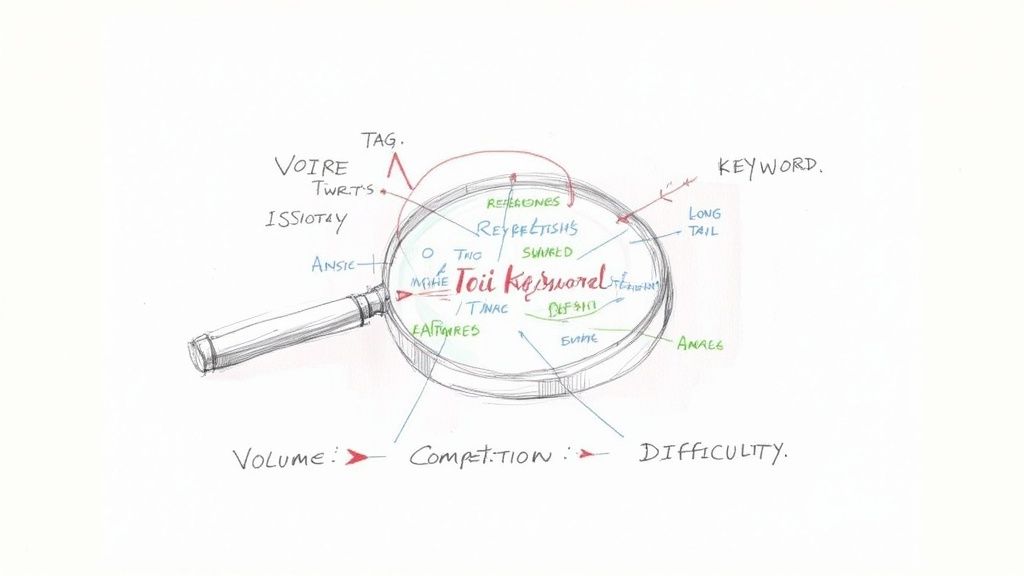
Effective keyword research is the engine of app store visibility. It's a systematic process of identifying, analyzing, and selecting the specific terms and phrases users type into the App Store or Google Play to find apps like yours. This strategy involves evaluating search volume, competitive density, and user intent to build a targeted keyword list that drives relevant traffic.
This is more than just guessing what users search for; it's a data-driven approach that balances high-volume, competitive terms with niche, long-tail phrases. A strong keyword strategy ensures your app appears in front of a high-intent audience, making it one of the most fundamental app store optimization strategies for organic growth. Mastering this allows you to capture existing demand rather than trying to create it from scratch.
Why It Works & When to Use It
This strategy is foundational and should be executed before any metadata is written, especially at launch. It requires regular updates, ideally quarterly or in response to market shifts. It works by aligning your app’s metadata with actual user search behavior, which directly tells the store algorithms what your app is about. For example, a photo editing app might find "photo editor" too saturated but discover "AI photo enhancement" is an emerging, high-intent keyword with lower competition. Similarly, a weather app can rank for both "weather app" and "storm tracker" to capture different user needs.
Actionable Implementation Tips
To build a powerful and effective keyword strategy, follow these structured steps:
- Tool-Assisted Research: Use dedicated ASO tools like App Radar or data.ai to gather data on search volume, difficulty, and relevance. To aid in this crucial step, exploring various free keyword research tools can provide valuable insights into search trends and user language, which can then be adapted for app store keyword strategies.
- Competitor Analysis: Analyze the top 20 apps in your category to identify the keywords they are ranking for. Look for high-potential "keyword gaps" that your competitors are neglecting but are relevant to your app.
- Prioritize and Tier: Create a focused list of 15-25 core keywords. Divide them into primary (high volume, high relevance) and secondary (niche, long-tail) tiers to guide their placement in your metadata.
- Track and Adapt: Once implemented, track your keyword ranking positions weekly. Be prepared to adjust your strategy based on performance data, and plan for seasonal keywords at least 2-3 months before their peak demand to capitalize on trends.
3. Visual Assets and Screenshots Optimization
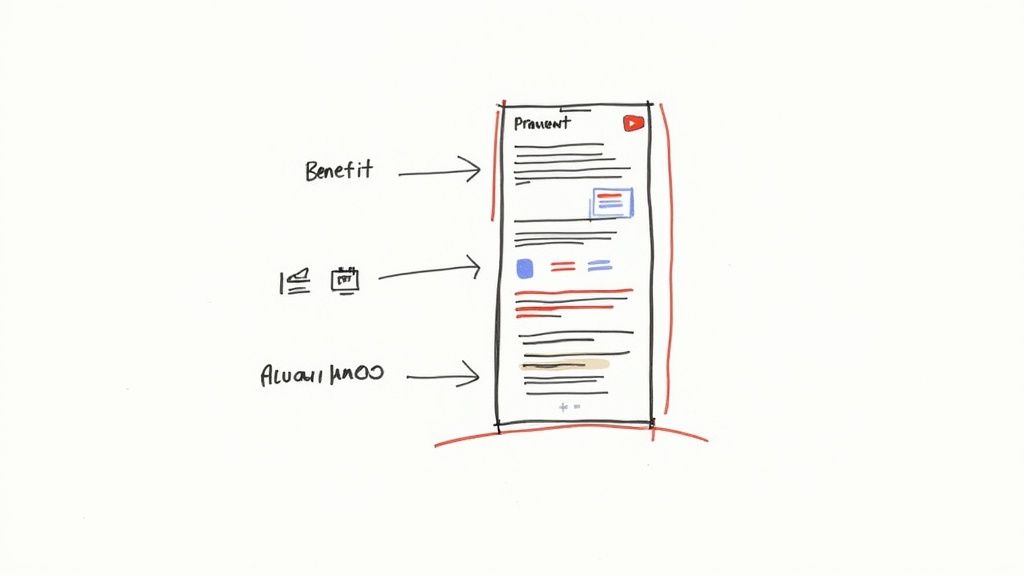
Beyond keywords and text, your visual assets are your most powerful conversion tool in the app stores. An engaging app icon, compelling screenshots, and a dynamic preview video tell a story that text alone cannot. This is where potential users get their first real glimpse of your app's user experience and core functionality. A well-executed visual strategy communicates value instantly, turning casual browsers into committed installers.
This approach is about more than just showing your app's interface; it's about crafting a narrative that highlights benefits and solves a user's problem. Effective visual optimization can dramatically increase your conversion rate from the product page, making it one of the most impactful app store optimization strategies for driving downloads. It bridges the gap between discovery and installation by answering the user's ultimate question: "What will this app do for me?"
Why It Works & When to Use It
This strategy is crucial for every app but becomes even more critical in competitive categories where differentiation is key. Users make snap judgments, and professional, benefit-driven visuals build immediate trust and perceived value. For example, Duolingo uses vibrant, character-driven screenshots to showcase language progression in a fun way, while Calm employs serene imagery that sells the feeling of tranquility. These visuals align perfectly with their brand and user expectations, directly boosting conversions. You should review and refresh your creative assets before major marketing campaigns, after significant UI updates, or when conversion rates start to decline.
Actionable Implementation Tips
To create high-converting visual assets, follow these structured steps:
- Lead with Value: Your first two screenshots are the most important. Use them to highlight your app's primary benefit or unique selling proposition with bold, concise text overlays.
- Tell a Story: Arrange your screenshots in a logical sequence that guides the user through a key workflow or feature set. Show the app in action rather than presenting static UI screens.
- A/B Test Creatives: Continuously test different screenshot styles, benefit callouts, and color schemes using tools like Google Play Experiments or Apple's Product Page Optimization. Aim to test two to three variations monthly.
- Localize for Key Markets: Translate text overlays and adapt imagery to be culturally relevant for your top five international markets. This simple step can significantly lift conversion rates in those regions.
- Follow UI Best Practices: Ensure your screenshots reflect a clean, intuitive interface. You can learn more about crafting an effective user experience with these best practices for user interface design on getnerdify.com.
4. App Store Listing Copy Optimization
While the title and subtitle capture attention, the app description is where you close the deal. This is your chance to expand on your app's value proposition, detail key features, and address potential user questions. This strategy involves crafting persuasive, benefit-focused copy that transforms a curious visitor into a committed user by telling a compelling story about how your app solves their problem or enhances their life.
This is more than a simple feature list; it’s a sales pitch that leverages copywriting principles and psychological triggers. An effective description builds trust, creates desire, and provides a clear call to action, making it a critical component of your overall app store optimization strategies. It directly impacts conversion rates by answering the user’s core question: “Why should I download this app over all the others?”
Why It Works & When to Use It
This strategy is essential for all apps, but it becomes particularly powerful after a major feature launch, a rebranding, or when conversion rates are low despite high traffic. Persuasive copy connects emotionally with users. For example, Evernote’s copy focuses on the emotional benefit of “Remember everything,” tapping into the user’s desire for organization and peace of mind. Similarly, Notion's "One workspace. Every tool you need" clearly communicates its all-in-one value in a single, powerful line. This approach works because it shifts the focus from what the app does to what the user can achieve with it.
Actionable Implementation Tips
To write compelling app store copy that converts, follow these steps:
- Lead with the Hook: Start your description with a powerful one-liner that summarizes your app's core benefit or solves a major pain point. Grab the user's attention immediately.
- Focus on Benefits, Not Just Features: Use short, readable paragraphs (2-3 sentences) and bullet points to highlight 3-4 key benefits. Instead of saying "GPS tracking," say "Never lose your way with real-time route guidance."
- Incorporate Social Proof: Add credibility by mentioning quantifiable achievements like "Trusted by over 10 million users" or by quoting positive press mentions and user testimonials.
- Update Regularly: Keep your description fresh by updating it with every major feature release. This signals to users and app stores that your app is actively maintained and improving.
- A/B Test Your Messaging: Use Google Play Experiments or third-party tools like SplitMetrics to test different copy angles. Test a productivity-focused description against one that highlights cost savings to see what resonates most with your audience.
5. User Ratings and Reviews Management
User ratings and reviews are a powerful form of social proof that directly impacts conversion rates and app store rankings. This strategy involves proactively encouraging positive feedback, professionally managing negative comments, and maintaining a high overall rating. It acknowledges that a high star rating is a top-three factor influencing a user's decision to download an app, making it a critical component of any ASO plan.
This is more than just a customer service function; it’s a core growth lever. Both Apple and Google’s algorithms favor apps with high, recent, and voluminous ratings, viewing them as indicators of quality and user satisfaction. A well-executed review management plan is one of the most effective app store optimization strategies because it builds trust with potential users and provides a direct feedback loop for product improvement, signaling a healthy and well-maintained app to the stores.
Why It Works & When to Use It
This is a continuous, long-term strategy that should be active from day one. High ratings create a virtuous cycle: better ratings lead to higher visibility and more downloads, which in turn generate more ratings. It’s especially critical when launching new features or after major updates to gauge user sentiment. For example, Lyft consistently responds to negative reviews in the app stores, often directing users to support channels. This public display of commitment shows potential users that the company is responsive and values feedback.
Actionable Implementation Tips
To effectively manage your app’s reputation and ratings, follow these structured steps:
- Strategic Prompting: Implement in-app rating prompts that trigger after a user has a positive experience, such as completing a level, making a purchase, or successfully using a key feature. Avoid asking for a review immediately upon app launch.
- Respond to All Feedback: Make it a policy to respond to all negative reviews within 48 hours, acknowledging the user's issue and outlining a path to resolution. Also, thank users for positive feedback to foster community.
- Analyze Review Content: Regularly use tools like AppFollow or Firebase to analyze review sentiment and content. Look for recurring bug reports, feature requests, or points of confusion that can inform your product roadmap.
- Communicate Improvements: In your app update notes ("What's New"), reference specific user feedback you've addressed. For example, "Thanks to feedback from [User], we've fixed the bug affecting login." This shows you are listening and encourages future engagement.
6. Localization and International Optimization
Adapting your app store listing for different languages and cultures is one of the most powerful app store optimization strategies for global growth. This goes far beyond simple translation; it involves adapting your metadata, visuals, and messaging to align with local nuances, keywords, and user expectations. True localization ensures your app feels native to each market, building trust and significantly boosting discoverability and download rates.
This strategy acknowledges that a one-size-fits-all approach fails on a global scale. By customizing your presence, you tap into vast, non-English-speaking user bases that would otherwise be inaccessible. It signals to both users and store algorithms that your app is relevant to a specific region, unlocking new avenues for user acquisition and creating a competitive advantage in crowded international markets.
Why It Works & When to Use It
This strategy is crucial for apps looking to scale beyond their primary market or for those already seeing organic traffic from international regions. It works because it directly addresses user search behavior and cultural preferences, which vary dramatically worldwide. For example, TikTok adapts its UI, content algorithms, and even trending music for each country, creating a highly relevant local experience. Similarly, the ride-hailing app Grab is completely localized for Southeast Asian markets, offering region-specific features that Uber could not match.
Actionable Implementation Tips
To effectively localize your app store presence, follow these structured steps:
- Prioritize Markets: Analyze your current user data or use market research tools to identify countries with high smartphone penetration and revenue potential. Focus your efforts on 2-3 high-opportunity markets first.
- Cultural & Keyword Research: Use native speakers, not just automated tools, for translation. Research local keywords and search terms, as direct translations often miss user intent. Study top local competitors to understand their messaging and visual approach.
- Adapt Creative Assets: Customize screenshots, app previews, and icons. Ensure the people, colors, and imagery used in your visuals resonate with the local culture and avoid potential misinterpretations.
- Test and Localize Messaging: Test different value propositions for each region. For instance, a feature emphasizing efficiency might perform best in Germany, while a message focused on community might resonate more in Brazil. Maintain local review management to address user feedback appropriately.
7. Download Velocity and Launch Strategy
A powerful launch strategy hinges on maximizing download velocity, which is the rate at which your app is downloaded over a short period. App store algorithms interpret a high concentration of initial downloads as a strong signal of quality and relevance, often rewarding the app with a significant boost in category rankings and search visibility. This foundational ASO strategy involves coordinating pre-launch hype with a concentrated marketing push on launch day to create a surge in initial user acquisition.
This isn't just about getting downloads; it's about getting them all at once. By creating a groundswell of interest that peaks during the first few days of release, you can trigger a positive feedback loop. Higher visibility leads to more organic downloads, which in turn reinforces your app's high ranking. Mastering this is one of the most impactful app store optimization strategies because it can catapult a new app past established competitors and establish crucial early market momentum.
Why It Works & When to Use It
This strategy is most critical during an app's initial launch but is also highly effective for major version updates or re-launches. The algorithms are designed to spot trending apps, and a sudden spike in downloads is the clearest indicator of a breakout hit. For example, BeReal achieved explosive growth by building viral momentum, while the exclusive, invite-only rollout of Clubhouse created immense FOMO that translated into sustained, high-velocity demand once it opened up.
Actionable Implementation Tips
To effectively orchestrate a high-velocity launch, follow these structured steps:
- Build Pre-Launch Momentum: Start building a waitlist using a landing page 30-60 days before launch. Engage this audience with updates to ensure they are ready to download on day one.
- Coordinate Marketing Efforts: Time major press releases and influencer marketing campaigns to go live simultaneously on launch day. Concentrate your paid ad spend heavily within the first 1-7 days to amplify the initial surge.
- Strategic Timing: Launch on a weekday, typically Tuesday through Thursday, to maximize media coverage and user activity. Avoid launching during the same week as a major competitor or a highly anticipated industry event.
- Prepare for Success: Ensure your customer support team is staffed and prepared for a surge in user inquiries. A smooth onboarding experience is crucial for converting those initial downloads into active, engaged users. For a deeper dive, explore this comprehensive guide to mobile app marketing strategy on getnerdify.com.
8. A/B Testing and Experimentation
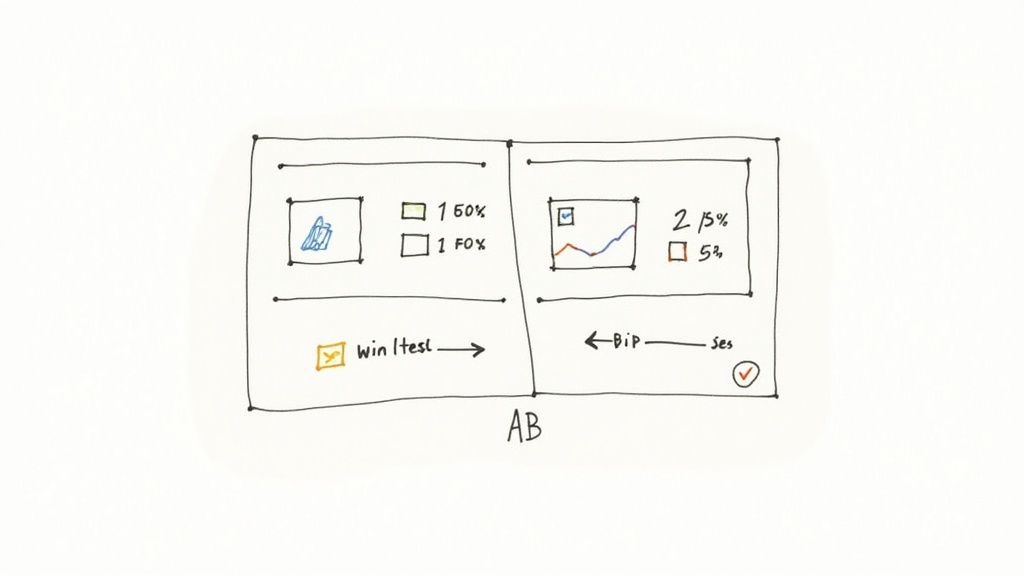
Guesswork is the enemy of growth. A/B testing, or split testing, is a systematic approach to optimizing your app store presence by comparing two or more versions of a single element to see which one performs better. This data-driven methodology allows you to test variations of your icon, screenshots, video previews, and even your title to identify the creative assets and copy that drive the highest conversion rates from impressions to installs.
This process eliminates subjective decision-making and replaces it with statistical evidence, ensuring that every change you make is a calculated step toward improving performance. Implementing a consistent testing framework is one of the most powerful app store optimization strategies because it creates a continuous feedback loop. It directly reveals what resonates with your target audience, enabling you to refine your messaging and visuals for maximum impact and a higher return on your user acquisition efforts.
Why It Works & When to Use It
This strategy is indispensable when you have established a baseline of traffic but are looking to improve your page conversion rate. By testing one variable at a time, you can isolate its impact and understand user behavior with precision. For example, a gaming app might test two different icons: one featuring the main character and another showing an action scene. The data, not intuition, will reveal which image compels more users to download. This method should be used cyclically to constantly challenge and improve upon your current "winning" assets.
Actionable Implementation Tips
To run effective A/B tests and achieve statistically significant results, follow this structured process:
- Isolate a Single Variable: Form a clear hypothesis and test only one element at a time, such as your icon, your first screenshot, or your short description. Testing multiple changes at once makes it impossible to attribute a performance lift to a specific element.
- Ensure Statistical Validity: Aim for a minimum of 10,000 impressions per variation to ensure your results are not due to random chance. Most testing platforms will calculate this for you, but it's a critical benchmark for making confident decisions.
- Prioritize with Impact: Start by testing elements with the highest potential impact on your conversion rate, such as the app icon or the first two screenshots, as these are the most prominent visual assets users see.
- Document and Iterate: Meticulously document every test, including the hypothesis, variations, results, and learnings. Use winning variations as the new control group for subsequent tests to build on your successes. For a comprehensive guide, review this mobile app testing checklist on getnerdify.com to structure your experiments.
9. Competitive Analysis and Benchmarking
Operating in a vacuum is a recipe for stagnation. Competitive analysis and benchmarking involve systematically monitoring competitor app store listings, keyword rankings, and promotional strategies to identify opportunities, gaps, and best practices. This intelligence-gathering approach ensures your app remains competitive by helping you understand market positioning and capitalize on emerging trends before they become saturated.
This is not about blindly copying rivals; it’s about strategic deconstruction. By analyzing what works for them and, just as importantly, where they fall short, you can refine your own approach. Understanding a competitor's metadata updates, creative changes, or review sentiment provides a roadmap for differentiation. This is one of the most proactive app store optimization strategies because it transforms the competitive landscape from a threat into a valuable source of actionable data.
Why It Works & When to Use It
This strategy is a continuous process, essential from pre-launch planning through the entire app lifecycle. It is especially critical when entering a crowded market or when your app's growth begins to plateau. By benchmarking against top performers, you can set realistic performance targets and uncover weaknesses in their strategy to exploit. For instance, DoorDash continually analyzes Uber Eats' market positioning and feature rollouts to inform its own service offerings and promotional campaigns, ensuring it maintains its competitive edge. Similarly, Discord benchmarked its features against both Slack and TeamSpeak to carve out its unique position in the communication market.
Actionable Implementation Tips
To effectively implement competitive analysis and benchmarking, follow these structured steps:
- Identify & Track Competitors: Use tools like Data.ai (formerly App Annie) to identify your top 5-10 direct and indirect competitors. Set up a system to continuously monitor their keyword rankings, metadata updates, and user review sentiment.
- Analyze Keyword Gaps: Track 15-20 of your top competitors' most important keywords over time. Identify keyword gaps where they rank highly but you don't, or vice-versa, to discover untapped opportunities for your app.
- Deconstruct Creative Assets: Take monthly screenshots of competitor product pages. Analyze their icons, screenshots, and preview videos to identify design trends, messaging angles, and A/B tests they might be running.
- Mine User Reviews: Systematically analyze competitor reviews to find common complaints, bug reports, and highly requested features. This user feedback is a goldmine for informing your own product roadmap and marketing messages.
10. Seasonal and Trend-Based Optimization
Adapting your app store presence to align with seasons, holidays, cultural events, and emerging trends is a dynamic strategy to capture spikes in user demand. This involves temporarily updating your metadata, creatives, and messaging to reflect what is currently top-of-mind for your target audience. By tapping into these timely moments, you make your app feel more relevant and can attract a surge of highly motivated users.
This approach goes beyond static optimization by treating your app store listing as a living marketing asset. A well-executed seasonal campaign can significantly boost visibility and conversions by capitalizing on temporary keyword volume and user behavior. This is one of the more agile app store optimization strategies, allowing you to connect with users by participating in their current conversations and needs, from holiday shopping to New Year's resolutions.
Why It Works & When to Use It
This strategy is highly effective for apps with natural seasonal cycles and should be planned at least 3-6 months in advance. It works because it aligns your app's value proposition with a user's immediate needs and intent, which are often heightened during specific times of the year. For example, a fitness app can pivot its messaging to "New Year, New You" in January to attract resolution-makers. Similarly, financial apps can highlight tax preparation features in Q1, directly addressing a timely user pain point.
Actionable Implementation Tips
To effectively implement seasonal and trend-based ASO, follow these structured steps:
- Build a Seasonal Calendar: Map out relevant holidays, cultural events, and industry-specific seasons for the next 12 months. Identify your app's peak seasons to focus your primary efforts.
- Plan Creative Updates: Design and prepare new screenshots, icons, and preview videos 4-6 weeks before a major holiday or event. Ensure they visually communicate the seasonal theme and benefits.
- Monitor Trending Keywords: Use tools like Google Trends and ASO platforms to identify emerging keywords related to an upcoming event. Start integrating these into your metadata ahead of the traffic spike.
- Test and Align: A/B test a few variations of your seasonal messaging before the peak period begins. Align your paid user acquisition campaigns and social media marketing to create a cohesive, omnichannel push that reinforces your ASO efforts.
Top 10 ASO Strategies Compared
| Strategy | 🔄 Implementation complexity | ⚡ Resource requirements & speed | 📊 Expected outcomes | 💡 Ideal use cases | ⭐ Key advantages |
|---|---|---|---|---|---|
| App Title and Subtitle Optimization | Low–Medium; constrained by strict char limits and app update cycles | Low cost; minimal tools; quick concept-to-implementation but subject to app review lag | Improved search rankings and CTR; modest traffic lift | New or live apps needing immediate discoverability | Cost-effective visibility boost; clear value conveyed quickly |
| Keyword Research and Strategy | Medium–High; ongoing analysis and monitoring | Requires subscription tools and analyst time; moderate cadence | More targeted discoverability and higher organic installs | Competitive categories and growth-oriented apps | Data-driven targeting; uncovers high-opportunity keywords |
| Visual Assets and Screenshots Optimization | Medium; requires design skill and localization for formats | Design budget or agency; iterative updates are fast but require assets per device | Significant conversion rate uplift; lower uninstall rates | Consumer apps, retail, games, media — high visual categories | Strong visual storytelling → large CR improvements |
| App Store Listing Copy Optimization | Medium; needs skilled copywriting and platform tailoring | Low–Medium cost; quick edits possible but A/B testing takes time | Higher conversions, clearer expectations, fewer support issues | Feature-rich apps and major updates/releases | Communicates USP effectively; flexible and updatable |
| User Ratings and Reviews Management | Medium; ongoing moderation and response workflows | Requires support team and tooling; steady continuous effort | Improved average rating and trust → higher downloads | Mature apps with active user base and support teams | Builds credibility; provides product feedback loop |
| Localization and International Optimization | High; many languages and cultural adaptations needed | High cost (translations, local experts); slow, resource-heavy rollout | Large global download increases; better regional rankings | Apps targeting multiple countries or rapid global scale | Expands addressable market; increases local relevance |
| Download Velocity and Launch Strategy | High; cross-team coordination and precise timing | High marketing spend and PR coordination; fast short-term impact | Strong initial ranking boosts; higher chance of featuring | New launches, rebrands, or feature reveals | Can create powerful momentum and visibility spikes |
| A/B Testing and Experimentation | Medium–High; statistical design and disciplined iteration | Requires testing tools and sufficient traffic; tests take 2–4 weeks | Empirical conversion gains; removes subjective decisions | Apps with adequate traffic wanting iterative improvement | Data-backed optimizations; compounding performance gains |
| Competitive Analysis and Benchmarking | Medium; continuous monitoring and synthesis | Tool subscriptions plus analyst time; ongoing cadence | Identifies gaps and tactical opportunities; informs roadmap | Market-entry planning and competitive categories | Informs prioritization; early detection of rivals’ moves |
| Seasonal and Trend-Based Optimization | Medium; planning plus rapid execution for peaks | Moderate resources; time-sensitive asset updates | Captures temporary demand spikes; improves seasonal conversions | Apps with clear seasonality (fitness, finance, dating) | Aligns app with current demand → timely performance lifts |
From Strategy to Success: Your ASO Implementation Blueprint
Navigating the crowded digital marketplaces of Apple's App Store and Google Play requires more than just a great app; it demands a strategic, multi-faceted approach to visibility and conversion. We've journeyed through ten critical app store optimization strategies, from the foundational pillars of keyword research and metadata optimization to the dynamic levers of A/B testing and seasonal campaigns. Each strategy represents a vital component in a larger, interconnected system designed to drive sustainable growth.
The core takeaway is this: ASO is not a set-it-and-forget-it task. It is a continuous, iterative discipline that blends creative marketing with data-driven analytics. Success is found in the relentless cycle of research, implementation, measurement, and refinement. Your app title is not just a name; it’s a high-impact keyword placement. Your screenshots are not just product images; they are a visual narrative designed to convert undecided users. Your user reviews are not just feedback; they are a powerful source of social proof that directly influences algorithm rankings.
Your Actionable Roadmap to ASO Mastery
To translate these concepts into tangible results, you need an implementation plan. Avoid the common pitfall of trying to overhaul everything at once. Instead, adopt a prioritized and methodical approach that builds momentum over time.
Here are your immediate next steps:
- Conduct a Comprehensive ASO Audit: Start by benchmarking your current app listing against the ten strategies discussed. Where are the most significant gaps? Is your keyword strategy outdated? Are your visual assets compelling and aligned with your latest UI? A thorough audit provides the baseline data you need to make informed decisions.
- Prioritize the Highest-Impact Opportunities: Based on your audit, identify the "low-hanging fruit." For many, this begins with optimizing the app title, subtitle, and primary keywords, as these changes can yield the quickest visibility gains. If your conversion rate is low despite good traffic, focus shifts to creative asset optimization and A/B testing your screenshots and video.
- Establish a Testing Cadence: Commit to a regular schedule of experimentation. Whether it's testing a new app icon every quarter, updating screenshots after a major feature release, or refreshing keywords to align with new market trends, a consistent testing cadence ensures your strategy remains effective and relevant. Use the platform’s native tools like Google Play Experiments or Apple's Product Page Optimization to validate every hypothesis with real-world user data.
The Bigger Picture: ASO as a Growth Engine
Mastering these app store optimization strategies does more than just boost your download numbers. It fundamentally strengthens your entire mobile business. An effective ASO program lowers user acquisition costs by maximizing organic installs, provides invaluable insights into user behavior and market demands, and builds a stronger brand presence within the app stores. It ensures that the hard work your development team puts into building a fantastic product is seen by the right audience.
Ultimately, your journey to the top of the app store charts is a marathon, not a sprint. It requires patience, persistence, and a deep commitment to understanding your users and the ever-changing algorithms. By embracing this holistic and data-driven mindset, you transform your app store listing from a simple digital storefront into a powerful, optimized engine for discovery, conversion, and long-term success. The blueprint is in your hands; it’s time to start building.