SEO Content Marketing Strategy That Actually Compounds

Traffic is up. Rankings look healthy. The dashboard says content is working.
Then leadership asks a harder question: why isn't pipeline moving with it?
That's the moment when a lot of teams discover they don't really have an SEO strategy and a content strategy. They have two separate workstreams that occasionally touch the same page. One team is chasing rankings. Another is publishing assets. Sales is asking for bottom-funnel content. Product wants launch coverage. Nobody is managing the portfolio as a system.
For founders, CTOs, product managers, and marketing leaders, that gap matters because content doesn't just compete for clicks anymore. It competes for attention across Google results, AI-generated answers, comparison workflows, and buying committees that self-educate before they talk to sales. A workable SEO content marketing strategy has to decide what deserves investment, what needs maintenance, and what should leave the index.
Table of Contents
- Why SEO and Content Marketing Belong in One System
- Researching Topics That Earn Rankings and Pipeline
- Building Topic Clusters That Compound Authority
- Planning an Editorial Calendar That Ships
- On-Page Optimization as a Repeatable Checklist
- Measuring Success With Intent-Specific KPIs
- Auditing and Pruning Content for 2026 Search
- Scaling Execution With the Right Team Model
Why SEO and Content Marketing Belong in One System
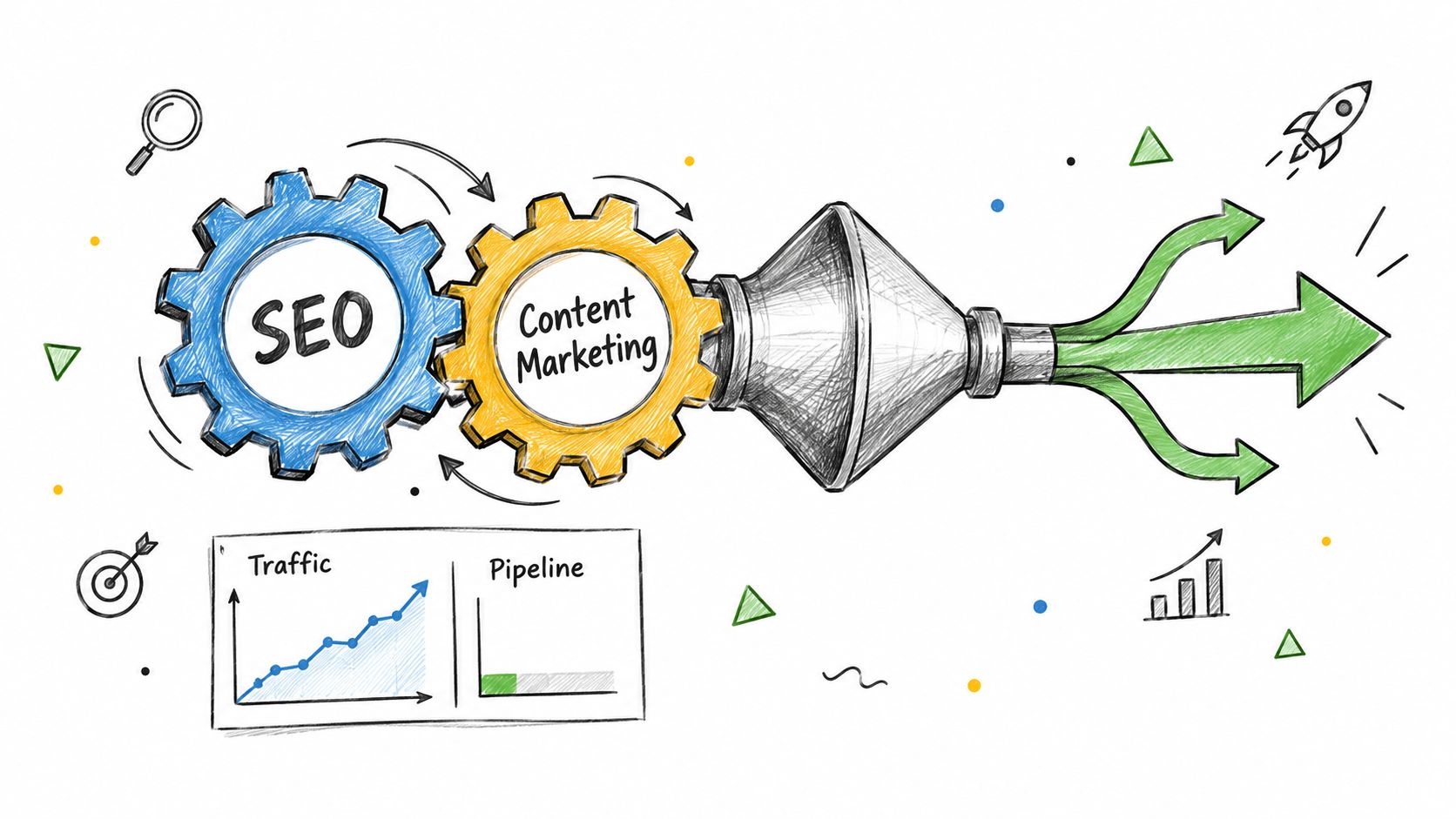
SEO and content marketing only compound when they run as one operating system.
Organic search still drives about 53.3% of all website traffic across major channels, and SEO-generated leads are estimated to close at 14.6% versus 1.7% for outbound leads such as direct mail or print advertising, according to industry statistics summarized by SEO.com. That's why separating “SEO pages” from “content pieces” usually creates waste. The search opportunity and the business outcome live on the same page.
Teams that need examples outside SaaS can also study how content marketing for ecommerce brands gets structured around category demand, product discovery, and conversion paths instead of treating publishing as a brand exercise alone.
The four parts that have to work together
A real system has four connected parts:
- Research determines what buyers ask, what the SERP rewards, and where demand overlaps with revenue.
- Architecture turns scattered topics into clusters, internal links, and page relationships that search engines can interpret.
- Production creates or refreshes assets in the formats the query needs.
- Measurement decides whether a page earned rankings, influenced pipeline, or should be reworked.
When one part breaks, the whole machine underperforms. Strong writing without architecture creates isolated pages. Clean technical SEO without relevant content creates empty templates. Publishing volume without measurement just inflates the archive.
The portfolio lens is what changes execution
Every indexed page should sit in one of four buckets: keep, refresh, consolidate, or cut.
That sounds blunt, but it reflects the market now. Search Engine Land's guide to content strategy in 2026 argues that the bigger strategic gap is deciding what to keep, enhance, consolidate, or remove across both Google and AI answer surfaces. That's a better leadership lens than “how many posts can ship this month.”
Practical rule: If a team can't explain why a page still deserves indexation, that page is already on the chopping block.
This is also where execution usually stalls. Research takes time. Refresh cycles get deprioritized. Pruning is unpopular. Internal teams often have enough capacity for publishing or optimization, but not both at the same time. That's where a structured delivery model, including nearshore augmentation, starts to matter.
Researching Topics That Earn Rankings and Pipeline
Keyword volume is useful. On its own, it's a trap.
A practical SEO content marketing strategy starts by asking a tougher question: if this page ranks, does it create qualified demand or just more sessions? Many teams answer that too late, after the content is already live.
A four-move workflow that holds up
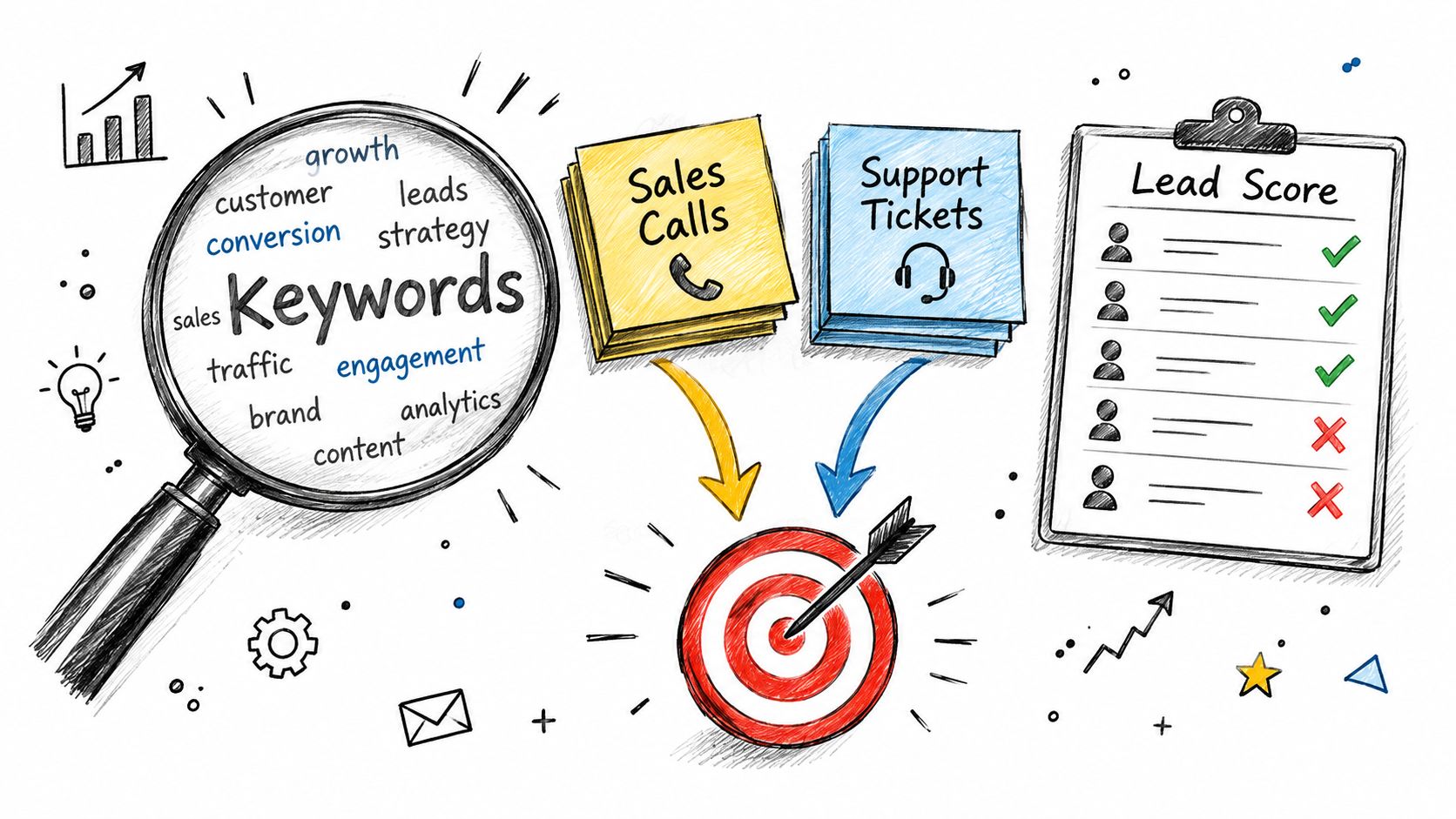
The research process works best when it pulls from both search data and internal signals.
Pull search demand and question patterns
Use tools like Ahrefs, Semrush, Google Search Console, and AlsoAsked to gather keyword variants, related questions, and existing visibility gaps.Layer in first-party signals
Sales calls, support tickets, onboarding objections, implementation questions, and RFP language usually reveal the phrasing buyers use. That language often produces better content angles than keyword tools alone.Score for business fit
Every topic should be judged on two axes: search demand strength and revenue relevance. A topic with strong traffic potential but weak commercial relevance belongs lower in the queue than a smaller topic tied directly to product evaluation or buying friction.Pressure-test SERP intent before assigning a brief
If the results page is dominated by glossaries, a product-led landing page probably won't rank. If the page is filled with comparison content, a generic educational article won't satisfy intent.
Intent tiers make prioritization clearer
Not all keywords should be judged the same way.
- Informational intent supports education, category entry, and early problem framing.
- Comparative intent captures buyers weighing options, alternatives, methods, or trade-offs.
- Transactional intent supports action around demos, services, implementation, pricing, or direct engagement.
Page types convert differently. Benchmarketing's benchmark report shows median lead rates vary by format, from 0.8% for educational articles to 2.6% for comparison pages, 3.4% for gated guides, and 5.1% for interactive tools. Top-quartile performance is also different across those formats. One average KPI won't tell the truth.
A topic should only make the roadmap if search intent, business fit, and page format point in the same direction.
Research outputs that should exist before planning
Before editorial planning starts, the team should already have:
- A topic map grouped by intent tier and product relevance
- A SERP review noting dominant formats and content gaps
- A prioritization score using demand strength and revenue relevance
- A brief-ready angle for each approved topic
- A CTA recommendation aligned to the likely buying stage
Without those artifacts, the calendar turns into a wish list.
Building Topic Clusters That Compound Authority
Topical authority doesn't come from isolated blog posts. It comes from a structure that teaches search engines and buyers how the subject is organized.
That's one reason long-form depth still matters. A large content study found that articles over 3,000 words earn 77.2% more backlinks than pieces under 1,000 words, according to Backlinko's content study. The point isn't that every page needs to be long. The point is that shallow coverage rarely becomes the page others cite, link to, or return to.
What a cluster actually looks like
A cluster has one pillar page that defines the main topic and several supporting pages that handle narrower subtopics in depth.
Take a B2B SaaS example like revenue operations. The pillar might target the broad category and explain systems, stakeholders, tooling, reporting, and implementation patterns. Supporting pages would then handle subtopics such as RevOps org design, CRM governance, forecast accuracy, sales and marketing alignment, and revenue attribution models.
The cluster works when each page has a clear job. The pillar orients. The supporting pages go deep. The links tell search engines how those pages relate.
Internal linking rules that make clusters compound
Most clusters underperform because teams publish the pages but never finish the linking model.
Use these rules:
- Link every supporting page to the pillar with descriptive anchor text that reflects the parent topic.
- Link laterally between sibling pages when the reader would naturally need the next concept.
- Avoid raw URL anchors and vague phrasing like “click here.”
- Refresh older pages to include links to newer cluster assets instead of waiting for new content to carry the architecture.
A thin pillar breaks the model. A five-hundred-word overview can't anchor a serious cluster because it doesn't concentrate enough authority, satisfy enough intent, or give writers enough surface area for meaningful internal linking.
The pillar should be the page that can credibly earn the bookmark, the backlink, and the sales-team share.
When to merge or retire cluster pages
Not every cluster deserves indefinite maintenance.
Retire or consolidate pages when:
- Three weak articles target the same query and split authority.
- A support page repeats the pillar without adding a distinct angle.
- The topic no longer maps to product direction or current services.
- The page attracts the wrong audience and never progresses toward qualified engagement.
In those cases, merging weak siblings into a stronger URL usually beats leaving near-duplicates indexed. Orphan pages rarely help authority. They usually just increase maintenance burden.
Planning an Editorial Calendar That Ships
Editorial calendars fail when they're treated like publishing wish lists.
A useful calendar is a quarterly production plan with ownership, constraints, and trade-offs visible before work starts. That changes the conversation from “what should be written” to “what can be researched, drafted, reviewed, designed, and published without breaking the team.”

Build the quarter around three intent tiers
The most reliable content plans split work into three buckets.
- Foundation pieces target durable topics and category education. These are usually long-form guides, core service pages, glossaries, and evergreen explainers.
- Comparison assets target in-market demand. These include alternatives pages, versus pages, service comparisons, and implementation decision content.
- Thought leadership supports link earning, brand positioning, and sales enablement. This can include opinion pieces, expert commentary, webinars, and original research.
A team that needs a practical framework for structure and deadlines can adapt this guide to creating a content calendar to define owners, dependencies, and publish timing.
Put operations in the calendar, not just titles
Each planned asset should have an assigned owner for:
- Research
- Drafting
- SEO review
- Design
- Upload and publish
- Post-publish QA
That sounds obvious, but many content backlogs are really staffing backlogs in disguise. The title gets approved before anyone decides who will collect SME input, who will handle screenshots, or who will update internal links on related pages.
Add capacity and reserve room for interruption
The calendar should also include columns that make trade-offs visible:
| Planning Field | Why it matters |
|---|---|
| Estimated traffic value | Helps compare search upside across assets |
| Pipeline influence | Forces a conversation about business fit |
| Required production hours | Exposes true capacity limits |
| Dependencies | Flags design, legal, or SME blockers |
| Refresh priority | Prevents the archive from being ignored |
Reserve two weekly slots for reactive content. Customer objections, urgent product questions, and market changes won't wait for the next planning cycle. If the calendar has no room for interruptions, the plan will break by week two.
On-Page Optimization as a Repeatable Checklist
On-page SEO should never depend on memory.
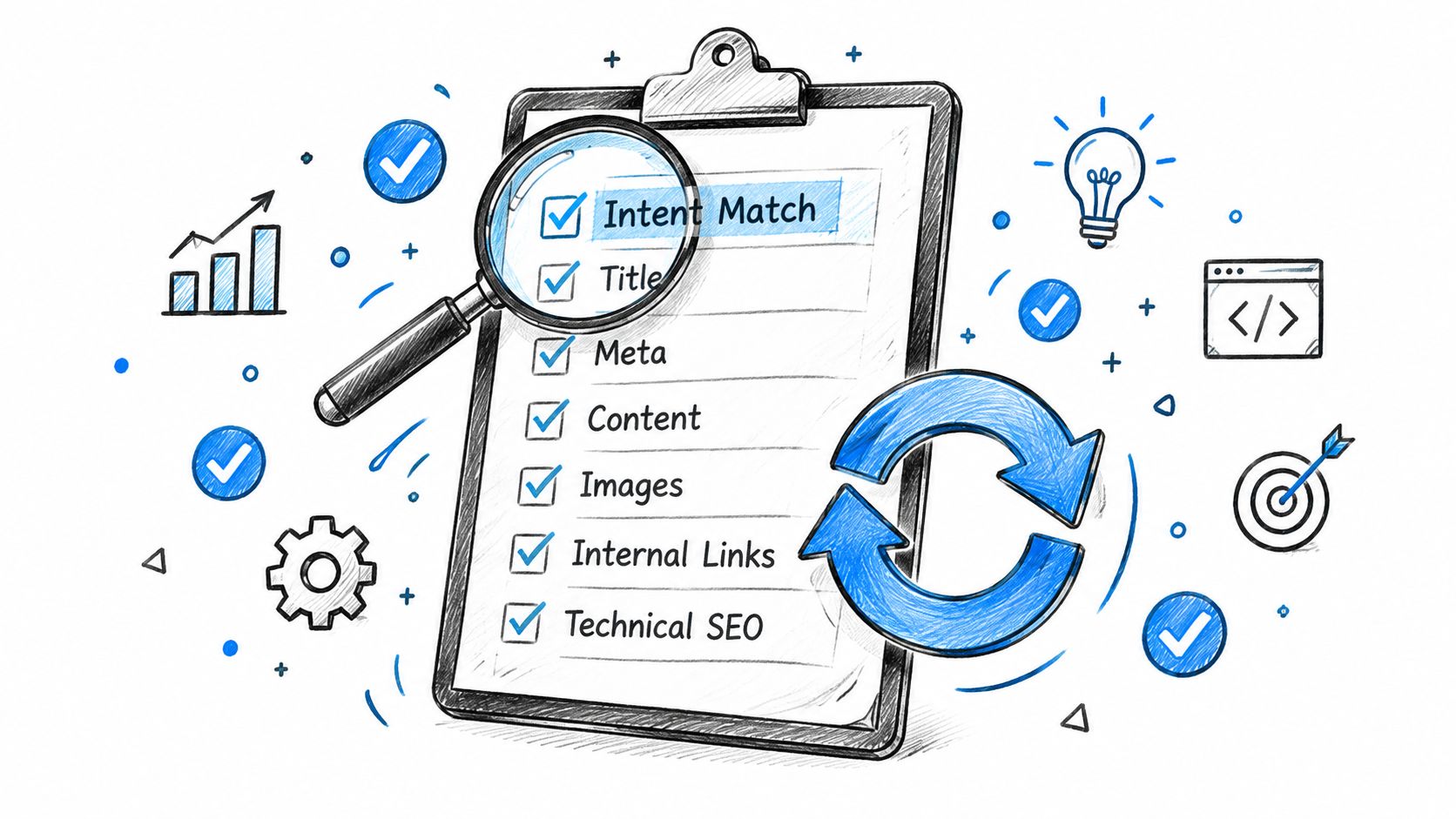
It works better as a pre-publish and refresh checklist that editors, SEOs, and content managers can run the same way every time. That consistency is important because Google's guidance on helpful, reliable, people-first content is clear that content shouldn't copy or rewrite other sources. It needs original value and should be created for people, not just search engines.
Start with intent match
Before reviewing metadata, confirm the page satisfies the task behind the query.
If the SERP favors comparisons, don't publish a broad educational essay. If the query implies a step-by-step answer, the page should let the reader complete that task without hunting through a sales pitch. Format fit comes first.
A strong workflow also includes a metadata standard. Teams that need a cleaner process for click-focused snippets can use this meta description writing guide as part of editorial QA.
Use the same checklist on every page
A practical checklist looks like this:
- Primary keyword placement: Confirm the target phrase appears naturally in the URL slug, title tag, H1, and opening paragraph.
- Heading structure: Use descriptive H2s and H3s that mirror related subtopics and follow the query's likely follow-up questions.
- Body coverage: Answer the core question fully before moving into secondary angles, examples, or CTA copy.
- Meta description: Write a unique summary that earns the click and reflects the actual page.
- Images: Compress files, use descriptive filenames, and add alt text that matches the image context.
- Schema markup: Apply the structured data that fits the content type when appropriate.
- Internal linking: Add links from at least two relevant existing pages with varied, descriptive anchors.
- Outbound citation: Include one credible external reference where it improves trust or clarity.
Don't skip the final QA pass
The page isn't ready just because the copy is approved.
Editorial checkpoint: The publish decision should include mobile performance, layout review, broken-link testing, and confirmation that the page is worth adding to the index at all.
The plan may call for a strict mobile speed threshold, and that's a sensible operational standard. The deeper point is that on-page optimization is only repeatable when it's documented and enforced, not left to whoever uploads the page that day.
Measuring Success With Intent-Specific KPIs
One average content KPI usually hides the truth.
The metrics that matter for a glossary page are different from the metrics that matter for an alternatives page or an original research asset. Leadership needs reporting that reflects that asymmetry, or budget gets pulled toward the wrong work.
What teams actually use to judge SEO content
In a survey with more than 140 respondents, 74.79% of practitioners said increased website traffic was the best indicator of SEO content success, 71.43% cited higher rankings, 63.03% cited lead generation, and 61.34% cited improved search CTR, according to Databox's state of content marketing and SEO survey. Those signals are useful, but they need to be applied by page type.
Content KPIs by Intent Tier
A reporting framework like this keeps expectations realistic.
| Content Tier | Primary KPIs | Secondary KPIs | Example Benchmark |
|---|---|---|---|
| Foundation | Non-brand impressions, ranking coverage, assisted pipeline influence | Engagement quality, internal click paths, refresh retention | Educational articles show a 0.8% median lead rate and 1.7% top-quartile lead rate in Benchmarketing's content benchmarks |
| Comparison | Search CTR, demo requests, sales-qualified leads | Bounce quality, CTA conversion, influenced opportunities | Comparison pages show a 2.6% median lead rate and 4.9% top-quartile lead rate in the same benchmark |
| Thought leadership | Referring domain growth, branded search lift, named-account engagement | Sales enablement usage, newsletter signups, assisted opportunities | Long-form assets can support backlink acquisition, especially when they contribute original depth |
A team that wants to connect content output to business reporting can also use a practical marketing ROI measurement framework to compare content investment against paid channels and other acquisition efforts.
Add a cost lens or the report stays incomplete
Good reporting pairs performance metrics with resource costs.
Track production hours, refresh effort, design time, and cost per assisted opportunity. A comparison page may justify more production effort than a top-of-funnel explainer because it serves a different buying stage. Without that context, teams end up overvaluing cheap traffic and undervaluing pages that move deals forward.
Auditing and Pruning Content for 2026 Search
Most underperforming content programs don't have a publishing problem. They have a refusal-to-prune problem.
That matters more in a search environment where AI-generated answer experiences absorb a growing share of informational clicks. Independent 2026 reporting says 73% of B2C organizations report having a content strategy, but only 37% have a documented one, and only 29% rate their efforts as extremely or very effective, according to Angarum Media's 2026 content marketing and SEO report. The same report cites an Ahrefs study indicating Google AI Overviews reduced click-through rates by 58% by February 2026, up from 34.5% in April 2025. If clicks are harder to win, every indexed page has to justify itself.
Run a four-way classification
A disciplined audit starts with a complete inventory of indexed URLs and a classification decision for each one:
- Keep when the page still ranks, supports conversions, or plays a critical cluster role.
- Refresh when rankings have softened, information is stale, or the page still has strategic fit.
- Consolidate when multiple URLs compete for the same intent and none is strong enough alone.
- Delete when the page no longer serves the business, duplicates a better asset, or attracts irrelevant traffic.
Search Engine Land's earlier-cited guidance is useful here because it frames audit decisions across both Google and LLM visibility, not just classic ranking reports.
Look for cannibalization and citation readiness
Cannibalization usually shows up as three mediocre posts chasing one query. None ranks decisively. Internal links are split. The buyer lands on the weakest answer.
The fix is usually one stronger page with clearer structure, stronger evidence, cleaner internal linking, and a redirect plan for merged URLs. That same restructuring also helps AI retrieval surfaces, because citation-friendly content tends to be explicit, well-organized, and easier to extract.
Pages built for vague “awareness” often become the first pages worth pruning, because nobody can defend their role once clicks decline.
Make pruning a quarterly habit
Quarterly audits work better than annual cleanup projects. They reduce archive sprawl, catch decaying assets earlier, and keep clusters aligned with product and service priorities.
This is especially important for service businesses balancing web and mobile development, UX/UI design, digital marketing, and partner-led growth. As offers evolve, old pages can compete with new messaging for months before anyone notices.
Scaling Execution With the Right Team Model
Strategy failure often gets blamed on ideas. Capacity is usually the underlying issue.
A team may know exactly which pages to refresh, which clusters to build, and which URLs to consolidate. But research, SME coordination, writing, editing, SEO review, design, upload, and reporting all compete for the same internal hours. That makes team design a strategic decision, not just an HR one.
Content Team Models Compared
| Model | Cost | Scalability | Control |
|---|---|---|---|
| In-house only | Fixed overhead and slower expansion | Harder to flex quarter by quarter | High day-to-day control |
| Fully outsourced agency | Variable, but often tied to scope packages | Easier to add output, harder to embed deeply | Lower operational control inside internal workflows |
| Nearshore staff augmentation | More predictable than constant rehiring, with dedicated capacity aligned to demand | Easier to scale up for builds and down for audit phases | Strong control when briefs, SOPs, and dashboards are shared |
Nearshore augmentation tends to work well for content operations because timezone overlap supports editorial reviews, quick approvals, and collaboration with product or sales stakeholders. For leadership teams that already run distributed product or engineering workflows, the model is familiar.
Quality control comes from process, not geography
The usual objection is quality control. That's a process problem, not a location problem.
When briefs are documented, internal linking rules are standardized, and dashboards are shared, external contributors can work inside the same system as the internal team. Tools such as Notion, ClickUp, Airtable, Figma, and Google Search Console help, and visual planning tools that capture and arrange tasks visually can make content workflows easier to review across roles.
Nerdify fits this model as a Nicaragua-based nearshore development partner with 9+ years of experience and 100+ projects across 10 countries, offering web and mobile development, UX/UI design, digital marketing, SEO support, and staff augmentation for teams that need execution capacity without rebuilding their org chart.
The key is to assign dedicated roles to the bottleneck, not to outsource the entire strategy by default. Some teams need research help. Others need writers who can work from product briefs. Others need SEO specialists who can handle audits, internal linking, and refresh operations while internal leaders keep strategy ownership.
Nerdify helps teams turn a scattered publishing effort into an operating model that covers SEO implementation, content production, UX-aware web experiences, and nearshore staff augmentation. For companies that need more output without losing control of strategy, Nerdify can help scope the right content and execution pod around existing priorities.