Choosing Software Development Pricing Models
Picking a software development pricing model is one of those decisions that can make or break your project. It directly shapes your budget, timeline, and even the quality of the final product. You've basically got three main flavors: Fixed Price, which is great for projects with a crystal-clear scope; Time & Materials, the go-to for agile projects that need to evolve; and the Dedicated Team model, built for long-term, ongoing development. Getting this choice right from the start lays the groundwork for a solid partnership.
Why Your Pricing Model Choice Matters

Choosing a pricing model isn't just about the money; it’s a strategic move that defines how you and your development partner will work together. The wrong model can quickly turn a project sour, leading to friction, endless scope creep, and a blown budget. But the right one? It aligns everyone's incentives and fosters a truly collaborative environment where you're all pulling in the same direction.
For your chosen model to really pay off, it needs to fit into your bigger picture of effective business financial planning. This ensures your development spend isn't just an expense, but a strategic investment that pushes your entire company forward.
These models didn't just appear out of nowhere. Early on, software pricing was often just bundled with hardware. Today, things are far more sophisticated. In fact, the average software company now juggles more than seven different pricing models to cater to all sorts of client needs. It's a reflection of how much the industry has grown up.
Understanding the Trade-Offs
Each model strikes a different balance between risk, flexibility, and predictability. Getting a handle on these trade-offs is the first step to making a smart decision that protects your investment and gives your project the best shot at success.
| Dimension | Fixed Price Model | Time & Materials Model | Dedicated Team Model |
|---|---|---|---|
| Budget Predictability | High | Low | Medium |
| Scope Flexibility | Low | High | High |
| Client Involvement | Low (Upfront) | High (Ongoing) | High (Integrated) |
| Risk Distribution | Primarily on Vendor | Primarily on Client | Shared |
The fundamental difference lies in who assumes the risk of uncertainty. A Fixed Price model places risk on the development agency, while a Time & Materials model shifts it to you, the client, in exchange for greater control and adaptability.
In this guide, we'll break down these core software development pricing models side-by-side. The goal is to give you a clear roadmap for picking the structure that truly fits your business goals and your appetite for risk.
The Three Core Software Pricing Models
When you're looking to hire a software development partner, how you pay them is just as important as who you pick. It shapes the entire relationship, from day-to-day communication to who carries the risk if things go sideways. The pricing model isn't just a line item; it's the foundation of your collaboration.
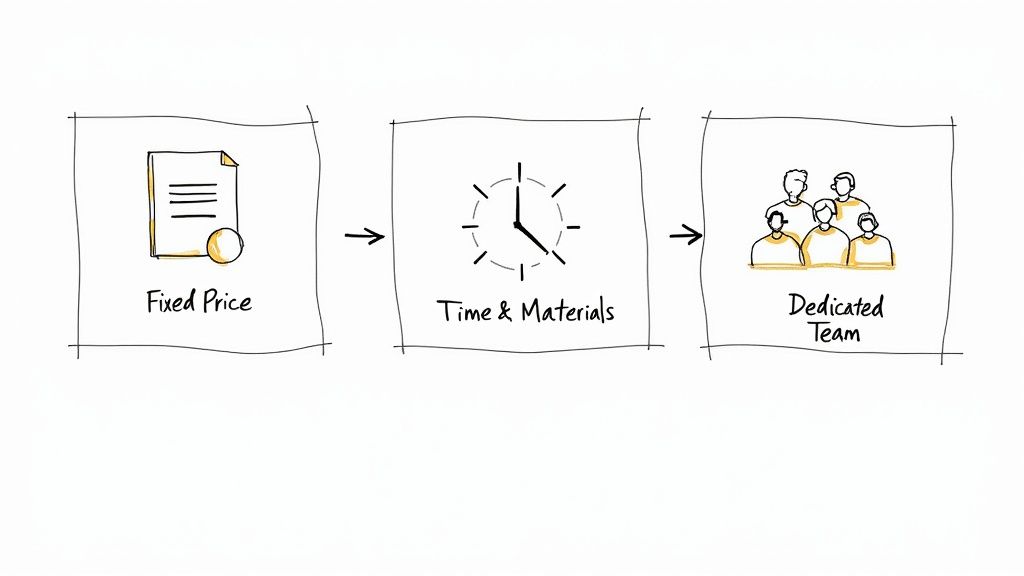
Most partnerships fall into one of three buckets: Fixed Price, Time & Materials, or a Dedicated Team. Each has its place, and choosing the right one hinges on your project's clarity, complexity, and how much flexibility you need. Let’s break down what each one really means for you and your budget.
The Fixed Price Model: Predictability and Risk
The Fixed Price model is straightforward: you agree on a single, all-in price for a very specific scope of work. It’s the go-to choice for smaller, well-defined projects like an MVP or a simple application where every feature can be mapped out from the very beginning.
But that upfront certainty comes at a cost. Agencies have to protect themselves from unexpected issues, so they’ll often bake a risk buffer of 10-30% into the total price. Think of it as insurance against the unknown. This model gives you a predictable budget, but it locks you into the initial plan. Any changes, even minor ones, will likely require a change order and a new price negotiation.
Payments are usually tied to hitting specific milestones. For instance, a common structure is 25% to kick things off, another 25% once the UI/UX designs are approved, and the remaining 50% when the final product is delivered and signed off.
The Time and Materials Model: Flexibility and Control
On the other end of the spectrum is Time & Materials (T&M). This model is all about flexibility and is a natural fit for complex, long-term projects, especially those using an Agile approach. Instead of a fixed cost, you pay an agreed-upon hourly or daily rate for the actual time the team spends working on your project.
This pay-as-you-go approach means you can change your mind, pivot based on user feedback, or re-prioritize features on the fly without having to scrap the entire contract. If you discover a better path forward mid-project, the team can simply adjust and start building.
With T&M, the client gets incredible flexibility, but you also take on more of the financial risk. The final cost isn't set in stone, which requires a deep well of trust and constant, transparent communication with your development partner to keep the budget from spiraling.
Your involvement here is continuous and crucial. You'll be in the trenches with the team, participating in sprint planning, reviewing progress, and helping shape the backlog to ensure they’re always focused on what matters most.
The Dedicated Team Model: Integration and Partnership
The Dedicated Team model isn't so much a pricing model as it is a strategic partnership. You're essentially hiring a full-time, ring-fenced team of developers, QA engineers, and project managers who work exclusively for you. They become a true extension of your own in-house staff, adopting your culture and aligning with your long-term vision.
This approach is perfect for companies with a constant stream of development work who need to scale their team without the headaches of direct recruitment and HR overhead. You pay a simple monthly fee that covers team salaries and the agency's management fee. While this is a common external model, it's also worth seeing how internal performance-based compensation models can shape how you budget for and motivate your own teams.
The real payoff here is the deep domain knowledge the team builds over time. The longer they work on your product, the more efficient and innovative they become. You get complete control over their priorities and integrate them directly into your daily workflow, just like any other employee.
Comparing Pricing Models Side By Side
Choosing a software development pricing model isn't just a financial decision—it’s a strategic one. You're navigating a series of critical trade-offs that will shape your project from day one. Each model behaves differently under pressure, impacting everything from your budget and timeline to your ability to innovate on the fly.
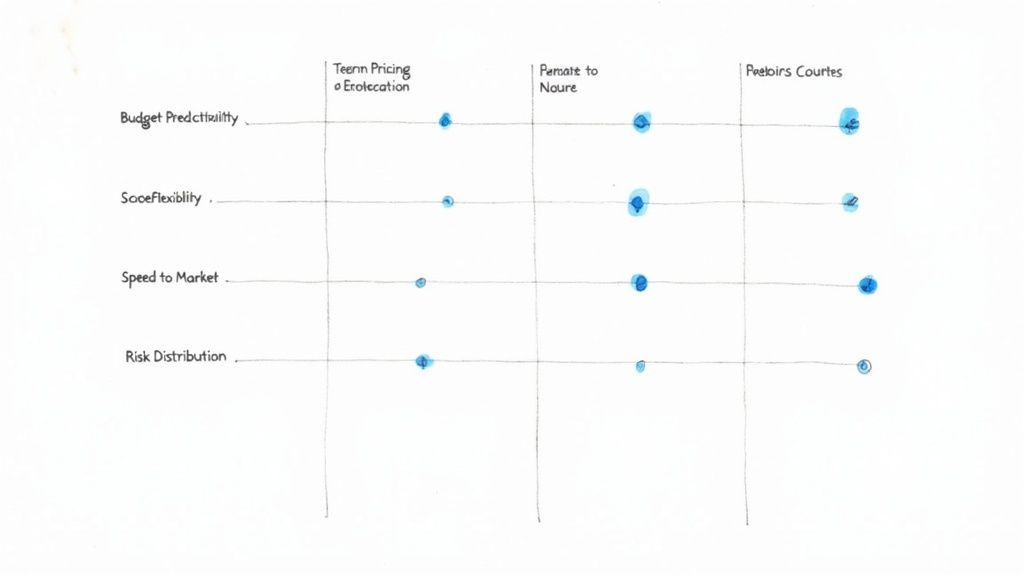
To make the right call, we have to look past the simple definitions. Let's dig into how each of these models stacks up against the four criteria that really matter in the real world: Budget Predictability, Scope Flexibility, Speed to Market, and Risk Distribution. Understanding these nuances is the key to aligning a model with your project’s actual needs.
Budget Predictability: How Certain Is Your Final Cost?
For many organizations, knowing the final bill before you start is non-negotiable. This is where the Fixed Price model shines. It gives you a single, upfront cost that’s set in stone, provided the scope never changes. That level of certainty is perfect for companies with rigid procurement rules or a startup building an MVP on a tight, fixed budget.
The Time & Materials (T&M) model sits at the opposite end of the spectrum. Predictability is low because your final cost is a direct result of the hours logged. This might sound nerve-wracking, but it’s the necessary trade-off for projects where you're figuring things out as you go.
The Dedicated Team model offers a middle ground. You get a predictable monthly cost based on the team's salaries, which is fantastic for operational planning. The total project cost, however, is still variable, since it all depends on how long you need that team to reach your goals.
Scope Flexibility: Can You Adapt to Change?
Software development is rarely a straight line. Market needs shift, user feedback rolls in, and great ideas pop up mid-project. The Fixed Price model is inherently rigid here. Its entire foundation is a meticulously defined, unchanging scope. Even a small tweak requires a formal change request, which can stall momentum and drive up costs.
This is exactly where the T&M model comes into its own. It's built for change. Need to pivot after a sprint, add a killer feature, or scrap one that's not landing with users? You just do it. There are no contractual hoops to jump through, making it a natural fit for Agile development.
The core trade-off is simple: Fixed Price buys you budget certainty at the cost of flexibility, while T&M offers ultimate flexibility at the cost of budget certainty. One prioritizes the plan, the other prioritizes adaptability.
A Dedicated Team also provides incredible flexibility. Because the team is essentially an extension of your own, you have complete control over their backlog. You can shift priorities weekly or even daily, making this model ideal for long-term product evolution where the scope is expected to be in constant flux.
Speed to Market: How Fast Can You Launch?
When getting your product to users is a race against the clock, the right model can give you a serious head start. A Fixed Price project can be quick, but only if the requirements were defined with near-perfect foresight. Any ambiguity or oversight in that initial spec will inevitably lead to delays while you negotiate change orders.
The T&M model often allows for a much faster start. You don't need a massive, exhaustive requirements document to get the ball rolling. The team can start building core features right away while the details of later-stage functionality are still being worked out. This is ideal for getting an MVP out the door to start gathering real feedback.
A Dedicated Team can also move with incredible velocity. Once they're ramped up, they have deep product knowledge and streamlined communication, cutting out the friction that often slows down disconnected project teams. Their singular focus on your product makes them a highly efficient engine for iterative delivery.
Risk Distribution: Who Is on the Hook?
Knowing where the risk lies is fundamental to a healthy client-vendor relationship. With a Fixed Price contract, the development agency carries most of the financial risk. If their initial software development cost estimation was off and the project takes longer, that’s their problem—they absorb the loss. It's also why they usually bake a risk premium into their quotes.
Conversely, the T&M model shifts most of that risk onto you, the client. If the scope grows or the team hits unexpected roadblocks, your costs will rise. This model absolutely requires a high level of trust and transparent communication with your development partner to keep things on track. You can get better at financial forecasting by checking out our guide on software development cost estimation.
A Dedicated Team fosters a shared-risk environment. The vendor is responsible for keeping the team productive and staffed with top talent, while you’re responsible for providing a clear vision and prioritizing the work. It’s a true partnership where both sides are deeply invested in the long-term success of the product.
Software Development Pricing Model Comparison Matrix
To bring it all together, this matrix provides a clear, at-a-glance comparison of how the three models perform across these key project dimensions.
| Dimension | Fixed Price Model | Time & Materials Model | Dedicated Team Model |
|---|---|---|---|
| Budget Predictability | High. A single, agreed-upon cost. | Low. Final cost depends on actual time. | Medium. Predictable monthly rate, variable total. |
| Scope Flexibility | Low. Changes require contract renegotiation. | High. Easily adapt to new requirements. | High. Full control over the team's backlog. |
| Speed to Market | Medium. Fast if scope is perfect, slow if not. | High. Can start quickly and iterate fast. | High. Efficient and focused on one product. |
| Risk Distribution | Vendor Risk. Agency covers cost overruns. | Client Risk. Client covers scope expansion. | Shared Risk. Both parties are mutually invested. |
Use this table as a quick reference, but remember the real decision comes from weighing these factors against your specific project goals, your company's culture, and your tolerance for uncertainty.
Matching the Right Model to Your Project
Knowing the theory behind software development pricing models is one thing. Actually picking the right one for your project? That's where things get tricky. A model that works wonders for a Fortune 500 company could easily sink a lean startup.
This is where you have to connect the dots between your project's goals, your budget realities, and how much risk you're willing to take on. Let's walk through a few real-world scenarios to see how these models actually play out.
Scenario 1: The Startup Building an MVP
Imagine a seed-stage startup with a fresh round of funding. They need to get a Minimum Viable Product (MVP) out the door—fast. Their two biggest constraints are a non-negotiable budget and a hard deadline to prove their concept to investors and early users. The scope is tight, focused only on the absolute core features.
For this situation, the Fixed Price model is almost always the answer.
- Why it works: It offers total cost certainty, which is a lifeline when you're counting every penny. The startup knows the exact bill before a single line of code is written, which protects their precious runway from unexpected costs.
- Implementation tip: The secret to making this work is an ironclad requirements document. The startup must put in the upfront work to detail every feature, user flow, and screen. Any grey area is an open invitation for a change request, which completely undermines the model's benefit.
The very nature of an MVP—a clear, contained scope—is a perfect match for the structured, predictable world of a Fixed Price contract. It forces discipline and prevents the kind of "feature creep" that can be lethal to an early-stage company.
Scenario 2: The Enterprise Modernizing a Legacy System
Now picture a large corporation trying to overhaul a clunky but critical internal system. The project is a beast, tangled with dependencies and lurking technical debt. Everyone knows what the end goal is, but getting there will be a journey of discovery, requiring constant iteration and feedback from different departments.
This is a job for the Time & Materials (T&M) model.
Trying to slap a Fixed Price model on a project riddled with unknowns is a recipe for disaster. The vendor would have to bake in such a massive risk buffer that you’d overpay, or you’d both be stuck in an endless, painful cycle of change-order negotiations.
T&M provides the agility you need to navigate that kind of complexity. The team can pivot as they uncover issues, re-prioritize based on what stakeholders are saying, and adopt better solutions without getting boxed in by an outdated scope document. It encourages a true partnership focused on solving the real problem, not just checking boxes on a contract.
Scenario 3: The SME Needing Continuous Innovation
Consider a growing small-to-medium-sized business (SME) with a successful software product. To stay competitive, they need constant development—new features, bug fixes, and performance tweaks. But they don't want the headache and overhead of hiring and managing a full-time, in-house dev team.
The Dedicated Team model was practically invented for this.
This model gives the SME a stable, long-term crew that becomes deeply embedded in the product over time. You get all the perks of an in-house team—consistency, speed, and institutional knowledge—without the administrative drag. The predictable monthly cost makes budgeting for ongoing product growth a breeze. It’s an incredibly efficient way to scale your development power.
For more on this, our guide on staff augmentation vs outsourcing breaks down the nuances of scaling your team.
Considering Hybrid Software Development Pricing Models
Remember, you're not locked into just one model. Smart teams are increasingly using hybrid approaches, blending models to fit different phases of a project. This lets you get cost certainty where it counts and flexibility where you need it most.
One of the most effective hybrid strategies is a two-phase approach:
- Phase 1: Discovery (T&M): You kick things off with a short Time & Materials engagement. The goal here is simple: eliminate ambiguity. The team dives into technical research, nails down the UX/UI design, and builds out a detailed project backlog. It’s a collaborative deep-dive.
- Phase 2: Development (Fixed Price): Armed with the crystal-clear specification from Phase 1, the scope is no longer a mystery. Now, you can confidently switch to a Fixed Price model for the core development work, locking in the budget and timeline with very little risk for anyone involved.
This hybrid model truly offers the best of both worlds. You get the flexibility of T&M during the fuzzy, uncertain planning stages and the predictability of Fixed Price once the path is clear. It’s a savvy way to de-risk a complex project right from the start.
Understanding Key Cost Drivers and Global Rates

Choosing a pricing model is a crucial first step, but it’s only one piece of the puzzle. The final bill for your software project is shaped by a handful of critical factors that you need to get your head around for any realistic budgeting. It's never just about the hours logged; it’s a reflection of complexity, team makeup, and where in the world your talent is located.
Think of these cost drivers as interconnected gears. A decision in one area creates a ripple effect. For example, if your project is highly complex, you'll naturally need a more senior team, which commands higher rates. Let's break down the three biggest factors that will shape your final investment.
Technical Complexity and Project Scope
The single biggest cost driver, hands down, is the inherent complexity of the software you're trying to build. A simple marketing website with a few static pages is a completely different beast than a sophisticated fintech platform requiring secure payment processing, real-time data analytics, and tight regulatory compliance.
The scope of your project dictates the effort required. Keep an eye on these common elements that can quickly inflate your costs:
- Third-Party Integrations: Every time you connect to an external service via an API—think payment gateways like Stripe, mapping services, or social media platforms—you add layers of development and testing.
- Custom Design vs. Templates: A bespoke UI/UX design delivers a unique user experience but demands significantly more design and front-end development hours compared to a pre-built template.
- Advanced Technologies: Building with tech like artificial intelligence, machine learning, or blockchain requires highly specialized—and therefore expensive—expertise.
The more unique features and complex logic your application needs, the higher the cost. A detailed scope document is your best defense against surprises, which is exactly why a proper discovery phase is so valuable.
For a closer look at how these factors play out in a real project, our article on the average cost to develop an app offers some detailed breakdowns.
Team Composition and Experience Levels
The structure and seniority of your development team are direct inputs into your budget, especially when you're working with Time & Materials or a Dedicated Team model. The good news is you don't always need an army of senior architects. A well-balanced team is often more efficient and cost-effective.
A typical project team is a mix of roles, and each one comes with a different price tag:
- Project Manager: The person who oversees the entire project, manages communication, and keeps the train on the tracks.
- UI/UX Designer: Responsible for creating the user interface and ensuring the user experience is intuitive and smooth.
- Developers (Junior, Mid, Senior): The people writing the code. Senior developers cost more per hour, but they solve tough problems faster and produce higher-quality work.
- QA Engineer: Their job is to test the software relentlessly to find and report bugs before they ever reach your users.
A team stacked with senior talent will have a higher burn rate, but they'll deliver complex features with more speed and quality. On the flip side, a team with more junior developers is cheaper but will likely need more hands-on management and may take longer to get to the finish line.
The Impact of Global Talent Rates
Where your development partner is based is a massive variable in the cost equation. Software development pricing varies dramatically across the globe, driven by local economies and cost of living. This difference is precisely why nearshoring and offshoring have become such powerful strategies for businesses trying to manage their budgets without compromising on quality.
For instance, the hourly rate for a senior engineer in North America ($75-$125) can easily be double that of an equally skilled developer in Latin America ($45-$65) or Eastern Europe ($40-$80). This gap is a primary reason the global software development services market is on track to hit nearly USD 1.29 trillion by 2032. By tapping into these global talent pools, you can access top-tier expertise at a much more sustainable price.
Got Questions About Software Pricing Models? We've Got Answers.
Even after you get the rundown on the main software development pricing models, some practical questions always pop up. It's totally normal. Working through these common sticking points is the key to kicking off a great partnership and keeping your project from going off the rails.
Think of this section as a direct line to an expert. We’re going to tackle the questions we hear most often, clearing up any confusion so you can move forward, make a smart choice, and manage your project with confidence.
How Do You Actually Control Costs in a Time and Materials Model?
Let's be clear: managing a Time & Materials (T&M) budget isn't a "set it and forget it" deal. It’s an active, collaborative process. The flexibility of T&M is its biggest strength, but that means you have to be involved to keep spending in check.
The trick is to establish some smart guardrails right from the start. This isn’t about micromanaging your dev team; it’s about building a framework for accountability that keeps everyone aligned with your budget without killing the creative freedom that makes T&M work so well.
Here are the most effective ways I've seen to keep a T&M project on budget:
- Set Sprint-Based Budget Caps: This is a big one. Agree on a maximum spend for each two-week sprint. This creates a natural rhythm for checking in, forces everyone to prioritize ruthlessly, and breaks a potentially huge budget into smaller, more manageable chunks.
- Require Detailed Timesheets: Don't be shy about asking for weekly or bi-weekly timesheets that detail hours spent per task. This isn’t about being a taskmaster; it’s about getting a clear view of where the effort is going so you can spot potential slowdowns or inefficiencies early.
- Own Your Product Backlog: As the client, your most critical job is to constantly groom the product backlog. You need to make sure the team is always—always—working on the features that deliver the most value. This is your number one defense against scope creep and wasted money.
- Create a Simple Change Request Process: T&M is flexible, but that doesn't mean it should be a free-for-all. Have a lightweight process for introducing big new ideas. This forces a conscious decision about whether a new feature is worth its impact on the timeline and budget.
In a T&M engagement, your most important role is that of an engaged product owner. Your ability to provide clear, decisive direction is the single most powerful tool you have for controlling costs.
At the end of the day, the best way to control costs is to work with a partner you trust—one who isn't afraid to have honest conversations about the budget. Regular progress reviews and open communication are non-negotiable. They’re what prevent those nasty end-of-month surprises.
Can You Switch Pricing Models Mid-Project?
Absolutely. Not only is it possible, but it can also be a really smart strategic move. The key is to handle it with a clear-eyed negotiation and get it all down in a formal contract amendment so there are no misunderstandings later.
The most common and effective way to do this is by starting with T&M and then transitioning to a Fixed Price. This hybrid approach lets you use the best of both models when it makes the most sense.
Here’s what that usually looks like in practice:
- Discovery Phase (T&M): You kick things off with a short, focused T&M engagement. The entire goal here is discovery and planning—defining the full scope, hammering out detailed wireframes, and creating a rock-solid technical specification.
- The Transition Point: Once that discovery work is done, the fog of uncertainty has lifted. You now have a crystal-clear roadmap and know exactly what needs to be built.
- Development Phase (Fixed Price): With the scope locked down and the major risks identified, you and your development partner can now confidently agree on a Fixed Price for the main build.
This strategy gives you the best of both worlds. You get the flexibility to properly explore and define the project upfront, followed by the cost predictability you need for the heavy lifting of development. A pro tip is to outline the possibility of this switch in the initial contract to make the transition as smooth as possible.
What Are the "Hidden" Costs I Should Watch Out For?
Beyond the hourly rates or the single fixed fee, there are always other costs that can sneak up on you. Knowing what they are ahead of time is crucial for building an accurate budget and avoiding any painful financial surprises.
These costs aren't typically part of the core coding work, but they're absolutely necessary to get your product launched and keep it running. Always ask a potential partner to provide a complete cost breakdown and clarify which of these items are—and are not—included in their proposal.
Be on the lookout for these common "extras":
- Project Management Fees: Some agencies bill for project management separately from development. This is often calculated as a percentage of the total development cost, usually in the 10-15% range.
- Third-Party Services and APIs: Your app will almost certainly need to plug into other services for things like payment gateways (Stripe), maps (Google Maps Platform), or analytics. Most of these have their own subscription fees.
- Infrastructure and Hosting: Don't forget the recurring costs for cloud hosting on platforms like AWS or Azure, plus database costs and domain name registration.
- Post-Launch Support and Maintenance: Once the project is "done," it's not really done. You'll need an ongoing support retainer for bug fixes, security updates, and small tweaks. This is almost always a separate agreement.
And for Fixed Price projects, remember that the significant effort required to create the initial detailed spec is often billed as a separate, paid discovery phase. A good, transparent partner will lay all of these potential costs out on the table from your very first conversation.