8 Unmissable Sprint Planning Best Practices for Flawless Agile Delivery in 2025
Sprint planning is more than a routine meeting; it's the bedrock of a successful Agile sprint. Get it right, and your team operates with clarity, focus, and a sustainable pace. Get it wrong, and you're left with missed deadlines, team burnout, and stakeholder frustration. Too often, teams treat planning as a perfunctory checklist exercise, leading to overcommitment, vague goals, and last-minute chaos. This guide breaks that cycle.
We are moving beyond the textbook definitions to provide a comprehensive roundup of the top sprint planning best practices that high-performing teams use to transform their sprints from unpredictable scrambles into well-oiled machines of value delivery. This article is your blueprint for turning chaotic planning sessions into strategic launchpads for success.
Each practice is designed to be immediately actionable, addressing the full spectrum of activities that ensure a successful sprint. We will cover critical topics such as:
- Establishing crystal-clear sprint goals.
- Mastering product backlog refinement before the planning meeting.
- Accurately estimating work and planning for real team capacity.
- Defining what "Ready" and "Done" truly mean for your team.
Whether you are a seasoned Scrum Master refining your process or a Product Manager new to Agile, these insights will equip you to run sprint planning sessions that set your team up for repeated, predictable success. We will provide specific implementation details, practical examples, and actionable advice to help you implement these sprint planning best practices and achieve a consistent, high-quality delivery cadence. Let's dive into the strategies that separate struggling teams from thriving ones.
1. Define Clear Sprint Goals
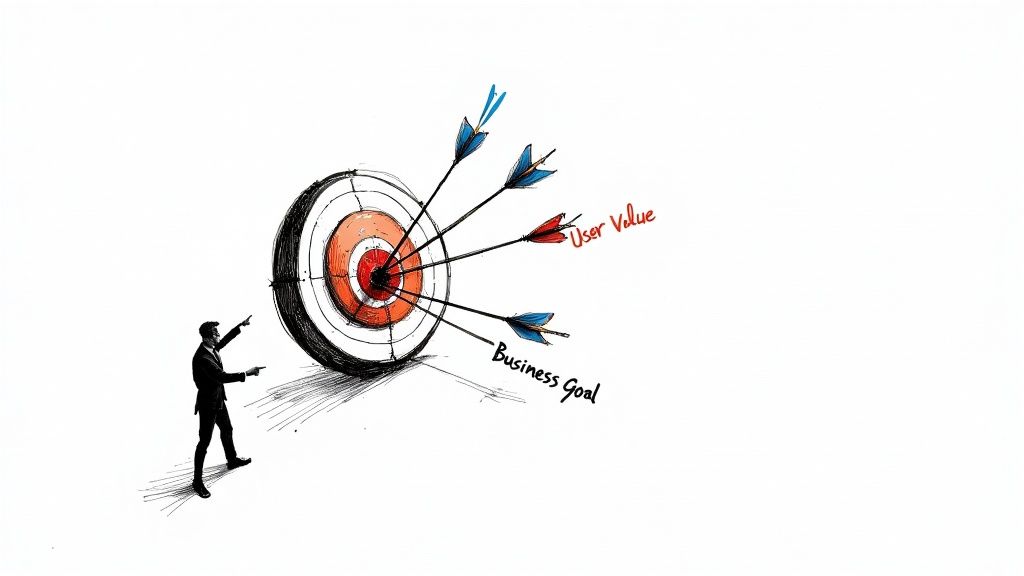
A successful sprint is more than just a collection of completed tickets; it's a focused effort that delivers a cohesive, valuable increment of work. One of the most critical sprint planning best practices is to establish a clear, compelling Sprint Goal. This goal acts as a north star, providing the development team with a shared objective and a clear understanding of what they are trying to achieve together.
The Sprint Goal answers the "why" behind the work. Instead of simply pulling a list of high-priority items from the backlog, the team collaborates to create a single, concise statement that frames the sprint's purpose. This transforms the sprint from a feature factory into a value-delivery engine, ensuring every team member understands how their individual contributions align with the bigger picture.
Why It's a Top Practice
Defining a Sprint Goal provides immense focus and flexibility. It empowers the development team to make smart decisions and trade-offs throughout the sprint. If unforeseen challenges arise, the team can re-negotiate the scope of work needed to meet the goal, rather than getting stuck on a rigid list of tasks. This practice, popularized by Scrum creators like Jeff Sutherland, fosters collaboration and a sense of shared ownership.
For example, a team at Spotify might set a goal like: "Improve the user's playlist creation experience by enabling drag-and-drop reordering on mobile." This is much more inspiring and directive than a list of isolated tasks. It clarifies the intended user value and gives the team a clear definition of success.
How to Implement Sprint Goals
To make this practice effective, integrate goal-setting directly into your sprint planning meeting. After discussing high-priority backlog items, the Product Owner should propose a potential goal. The entire team then collaborates to refine it into something specific, measurable, and achievable within the sprint.
Here are some actionable tips:
- Keep it Singular: Aim for one primary goal per sprint. If necessary, you can have a secondary one, but a single focus is more powerful.
- Use Business Language: The goal should be understandable to stakeholders, not just developers. Focus on the value delivered, not the technical implementation.
- Make it Visible: Display the Sprint Goal prominently in your team's workspace, whether physical or digital. Reference it during daily stand-ups to keep the team aligned.
- Connect to the Product Vision: Ensure the Sprint Goal is a logical step toward achieving your broader product objectives. This directly ties into the discipline of defining project scope, which is essential for long-term success. You can learn more about how to define project scope effectively.
2. Proper Product Backlog Refinement
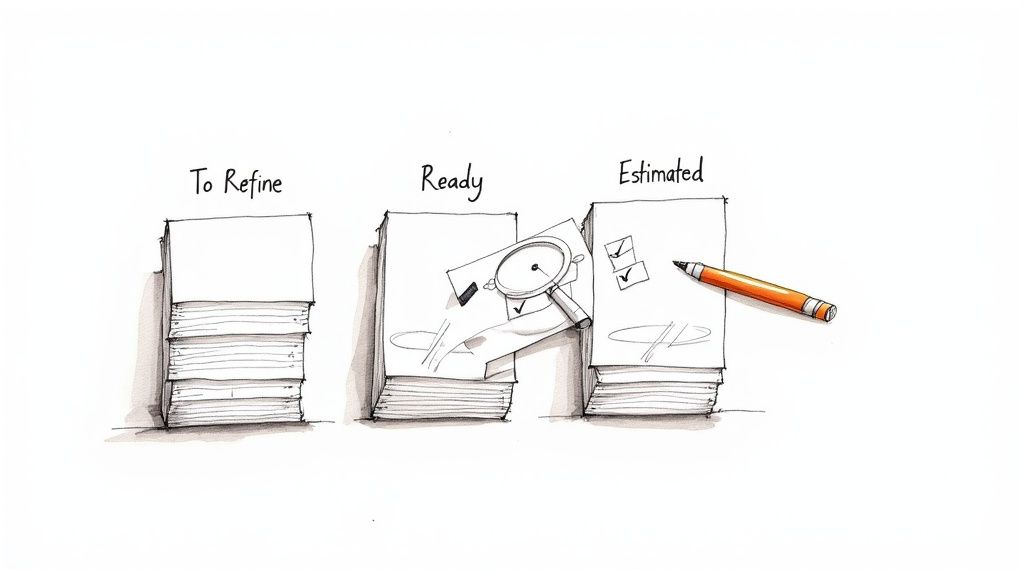
A successful sprint planning meeting doesn’t start when the meeting begins; it starts with the work done beforehand. Proper product backlog refinement, often called backlog grooming, is the continuous process of reviewing, discussing, and clarifying backlog items to ensure they are well-understood, estimated, and ready for development. This ongoing activity transforms sprint planning from a chaotic scramble into a smooth, efficient decision-making session.
This practice is about preparing work before it's committed to a sprint. By refining user stories in advance, the team eliminates ambiguity and surfaces potential dependencies early. This proactive approach, a cornerstone of effective agile development, ensures that when the team sits down for sprint planning, they are looking at a set of clear, actionable items, not a list of vague ideas.
Why It's a Top Practice
Backlog refinement is one of the most impactful sprint planning best practices because it directly prevents scope creep and surprises during the sprint. When work is well-defined, teams can create more accurate forecasts and commit to a sprint with higher confidence. This practice, advocated by agile thought leaders like Mike Cohn and Roman Pichler, establishes a steady, predictable flow of ready work for the development team.
For instance, teams at Amazon are known for their rigorous pre-planning preparation. Before a sprint planning cycle, their backlog items have already been through multiple rounds of refinement, ensuring that every user story has clear acceptance criteria and a shared understanding across product, design, and engineering. This preparation allows their planning meetings to focus on strategic goal-setting rather than last-minute clarification.
How to Implement Backlog Refinement
Integrate backlog refinement as a recurring event in your sprint cadence, separate from the main sprint planning meeting. The Product Owner typically facilitates these sessions, but it's a collaborative effort involving key members of the development team to get technical input.
Here are some actionable tips:
- Schedule It Regularly: Dedicate 1-2 hours per week or per sprint for refinement. This consistency prevents a last-minute rush before planning.
- Look Ahead: Focus on refining items for future sprints (typically 1-2 sprints ahead), not the current one. This builds a healthy buffer of "ready" work.
- Define "Ready": Establish a clear "Definition of Ready" (DoR) for backlog items. This checklist might include criteria like "User story is clear," "Acceptance criteria are defined," and "Initial estimate is complete."
- Involve the Right People: While the whole team isn't always required, ensure the Product Owner, a tech lead, and relevant developers are present to provide business and technical perspectives. This cross-functional input is vital for robust refinement.
3. Right-Sizing Stories and Tasks
One of the most common pitfalls in sprint planning is attempting to tackle work that is either too large and ambiguous or too small and fragmented. Right-sizing stories and tasks is a foundational practice that involves breaking down work into manageable, well-defined units that can be realistically completed within a single sprint. This ensures a smooth workflow, improves predictability, and reduces the risk of carrying unfinished work from one sprint to the next.
This approach transforms vague epics into concrete, deliverable pieces of value. Instead of a single massive ticket like "Build user authentication," a well-sized story would be "Allow a user to sign up with an email and password." This granularity, a key component of effective sprint planning best practices, allows the team to make tangible progress and receive feedback more frequently.
Why It's a Top Practice
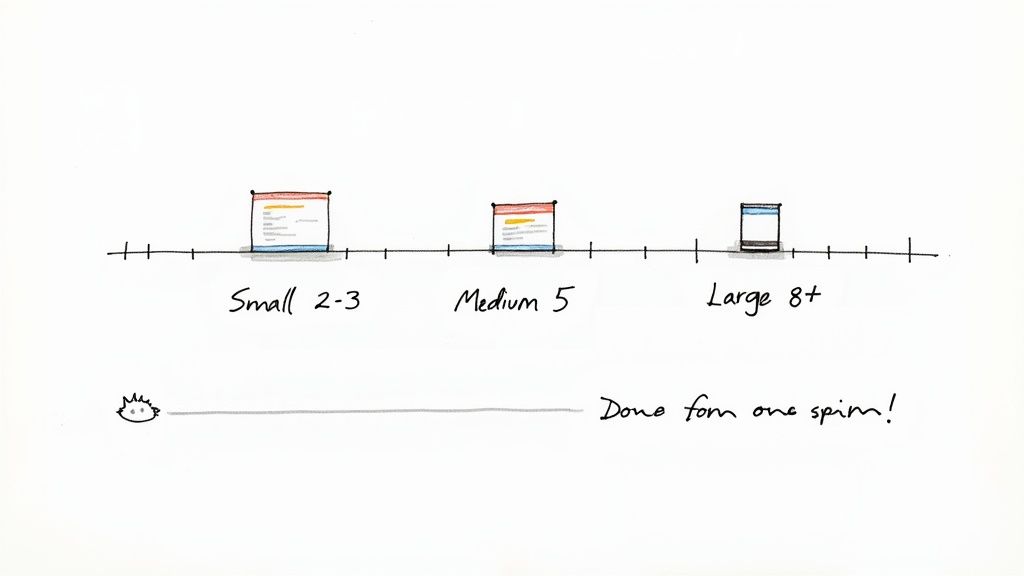
Properly sized stories are the bedrock of accurate forecasting and reliable velocity tracking. When work is broken down effectively, the team can estimate with greater confidence and deliver a consistent amount of value each sprint. This principle, often called the "Goldilocks" rule of sizing (not too big, not too small), was championed by Agile pioneers like Mike Cohn and Ron Jeffries.
For example, teams at Basecamp are known for focusing on small, meaningful batches of work that can be completed in a few days. This prevents developer burnout and keeps momentum high. Similarly, IBM's Agile teams use vertical story slicing to ensure each small story delivers a complete piece of end-to-end user value, rather than just a technical component.
How to Implement Right-Sizing
Integrating story sizing into your backlog refinement and sprint planning meetings is essential. The goal is to ensure that any story considered for a sprint has been discussed, understood, and estimated by the entire team to be completable within the sprint's timeframe.
Here are some actionable tips:
- Use Estimation Techniques: Employ methods like Planning Poker to facilitate a team-wide consensus on story size. This leverages the collective knowledge of the team to arrive at a more accurate estimate.
- Create a Sizing Reference: Establish a clear definition for what each story point value (e.g., 1, 2, 3, 5, 8) represents. This reference guide helps maintain consistency across the team and over time.
- Break Down Hierarchically: Decompose large initiatives (Epics) into major features, and then break those features down into sprint-sized user stories.
- Spike Uncertain Work: If a story involves significant technical uncertainty, create a separate time-boxed "spike" task to research the problem. This allows you to size the actual implementation work more accurately later.
4. Realistic Capacity Planning
One of the most common pitfalls in sprint planning is overcommitment. Teams that consistently pull more work into a sprint than they can realistically complete set themselves up for burnout, missed deadlines, and declining morale. Realistic capacity planning is a foundational practice that ensures the sprint backlog is both ambitious and achievable, building trust and predictability into the development process.
This practice involves looking beyond a simple story point total or a gut-feeling assessment. It requires a data-informed calculation of the team's actual availability, accounting for all the activities that consume time outside of direct feature development. By grounding the sprint commitment in a clear understanding of available effort, teams can establish a sustainable pace, a core principle of Agile championed by pioneers like Kent Beck.
Why It's a Top Practice
Realistic capacity planning prevents the cycle of over-promising and under-delivering. It creates a more reliable forecast, which is crucial for stakeholder management and product roadmap planning. When a team knows its true capacity, it can confidently commit to a scope of work, fostering a sense of accomplishment and psychological safety. This practice directly counters the pressure to "just get more done," replacing it with a strategic approach to sustainable productivity.
For example, a team at ThoughtWorks might use their historical velocity as a baseline but adjust it downwards for a sprint where a key developer is on vacation for a week. Similarly, a team at Intercom would factor in their on-call rotation schedule, recognizing that a portion of their time will be dedicated to reactive support work rather than planned development. This honesty is central to effective sprint planning.
How to Implement Realistic Capacity Planning
Start each sprint planning session by calculating your team's available capacity before discussing backlog items. This simple step sets a realistic boundary for the conversation and helps the team select an appropriate amount of work.
Here are some actionable tips:
- Calculate Available Hours: Start with a baseline: (Team size × Hours per day × Working days in sprint). Then, subtract all planned time off, holidays, and company-wide meetings.
- Account for Overhead: Dedicate a percentage of capacity (typically 20-30%) to recurring meetings like retrospectives, daily stand-ups, and backlog refinement, as well as unplanned support.
- Use Historical Velocity: Track your team's average velocity (completed story points) over the last 3-5 sprints. This provides a data-driven baseline for what your team can typically achieve.
- Build in a Buffer: New teams or those facing significant uncertainty should consider leaving a small buffer (10-15%) for unexpected issues or complexities.
- Adjust and Refine: Capacity is not a one-time calculation. Review and adjust it at the beginning of every sprint planning meeting based on current realities. This is a key aspect of dynamic resource management. To dive deeper into this topic, you can learn more about effective project manager resource allocation.
5. Cross-Functional Team Participation
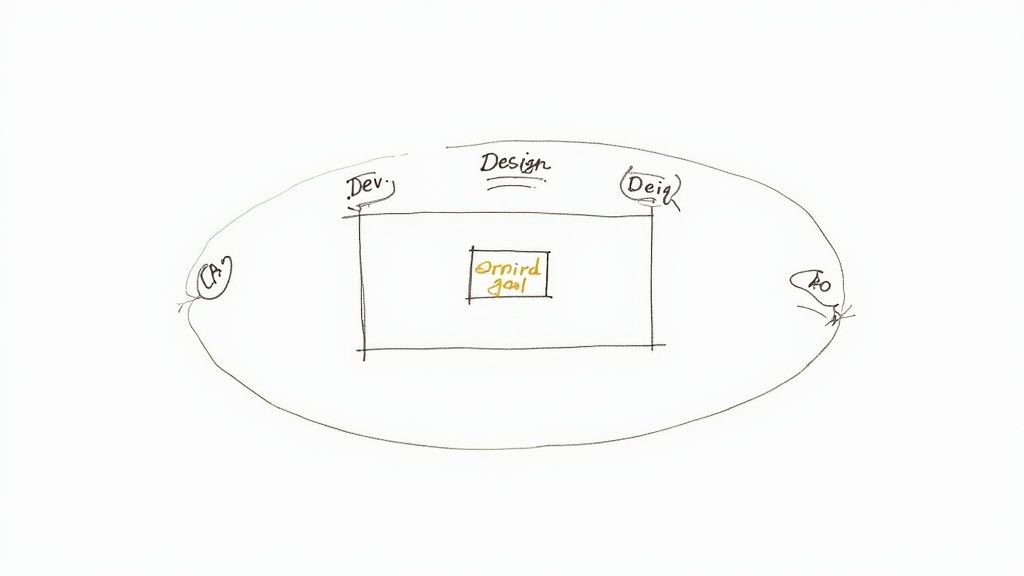
Sprint planning is a team sport, not just a developer activity. A common pitfall is to have only engineers and a product owner in the room, which often leads to missed requirements, inaccurate estimates, and downstream bottlenecks. Truly effective sprint planning involves the active participation of every discipline required to deliver a complete, production-ready increment of work, including developers, QA analysts, UI/UX designers, and even infrastructure specialists.
This holistic approach ensures that diverse perspectives are considered from the outset. A designer can provide crucial feedback on the feasibility of a user flow, while a QA analyst can identify potential testing complexities before a single line of code is written. This collaborative planning creates a strong sense of shared ownership and collective responsibility for the sprint's success.
Why It's a Top Practice
Including all functions in planning prevents knowledge silos and reduces the risk of late-stage surprises. When QA, design, and operations are involved early, potential roadblocks are identified and addressed proactively, not discovered halfway through the sprint when they are more costly to fix. This practice, central to models like the Spotify "squad" framework, fosters a deep, shared understanding of the work and strengthens the team's commitment to the Sprint Goal.
For instance, Stripe often integrates infrastructure and security teams into planning sessions for features involving sensitive data or significant scaling needs. This ensures that non-functional requirements are baked into the plan from day one, not treated as an afterthought. The result is a more robust and realistic sprint forecast and a smoother path to delivery.
How to Implement Cross-Functional Participation
The key is to treat sprint planning as a whole-team event where every voice is essential. The goal isn't just to assign tasks but to collectively understand the "what" and "why" and collaborate on the "how." This comprehensive dialogue is a cornerstone of sprint planning best practices.
Here are some actionable tips:
- Mandate Attendance: Make sprint planning a mandatory meeting for core roles like development, QA, and design. Frame it as the single most important meeting for sprint alignment.
- Involve QA Early: Ask your QA analysts to review user stories for testability and acceptance criteria clarity during the planning meeting. This helps refine requirements and catch ambiguities.
- Give Design a Voice: Designers should confirm that the technical plan aligns with the intended user experience and can flag potential UI/UX challenges before development begins.
- Define Roles Clearly: Clarify who facilitates the meeting, who has the final say on priority (the Product Owner), and who provides technical or domain expertise. This keeps the conversation focused and productive.
6. Clear Definition of Ready and Done
For a sprint to flow smoothly and predictably, there must be a shared understanding of when work is ready to start and when it is truly finished. This is where the concepts of a Definition of Ready (DoR) and a Definition of Done (DoD) become indispensable. These two sets of criteria act as gatekeepers, ensuring quality and transparency at both the entry and exit points of the sprint backlog.
The Definition of Ready outlines the prerequisites a user story must meet before the team can accept it into a sprint. The Definition of Done, conversely, is a comprehensive checklist that confirms a story is 100% complete. These explicit agreements remove ambiguity and prevent half-finished work from moving forward, which is a cornerstone of effective sprint planning best practices.
Why It's a Top Practice
Establishing a clear DoR and DoD prevents common sprint failures, such as starting work on poorly defined stories or discovering at the last minute that "done" means different things to different people. This practice, championed by thought leaders like Mike Cohn and organizations such as Scrum.org, creates a stable and predictable workflow. It reduces mid-sprint churn and ensures that what the team delivers is of high quality and actually shippable.
For example, a team at Atlassian might have a DoD that includes "code peer-reviewed, all automated tests passing, and user documentation updated." This non-negotiable standard ensures consistency and quality. Without it, one developer might consider a feature "done" after coding, while another includes testing, leading to chaos and technical debt.
How to Implement DoR and DoD
The entire team, including the Product Owner and developers, should collaboratively create and agree upon these definitions. They are not meant to be imposed by management but should be a living agreement that reflects the team's commitment to quality.
Here are some actionable tips:
- Define Your "Ready" Criteria: A typical DoR includes: user story is clear and understood, acceptance criteria are defined, dependencies are identified, and the story is estimated by the team.
- Define Your "Done" Criteria: A robust DoD often includes: code is written and peer-reviewed, unit and integration tests are passing, it meets acceptance criteria, and it is ready to be demonstrated.
- Make Them Visible: Post your DoR and DoD in your team's shared digital or physical workspace. Refer to them during backlog refinement and sprint planning to ensure adherence.
- Review and Adapt: These definitions are not set in stone. Use sprint retrospectives as an opportunity to review and refine them based on what the team is learning. This continuous improvement is key to agile success. You can learn more about refining agile processes from resources provided by entities like the Agile Alliance.
7. Iterative Planning and Commitment
Effective sprint planning is a dynamic conversation, not a one-way directive where work is assigned. A core best practice is to adopt an iterative planning and commitment process, where the development team progressively pulls work into the sprint based on their capacity. This method respects the team's expertise and ownership, ensuring the sprint backlog is a realistic commitment, not an aspirational wishlist.
This approach transforms the planning meeting from a session of receiving orders into a collaborative negotiation. The Product Owner presents prioritized user stories, but the development team decides what they can confidently commit to delivering. This dialogue-driven model prevents over-commitment, fosters psychological safety, and ensures that the team truly owns the sprint plan they create.
Why It's a Top Practice
This iterative, pull-based method directly addresses one of the most common sprint failures: over-commitment. When teams are pressured to take on too much work, quality suffers, morale drops, and predictability is lost. By empowering the team to pull in stories one by one until their capacity is met, the commitment becomes grounded in reality.
This practice is a foundational element of the Scrum framework, emphasizing the team's autonomy and self-organization. Companies like Shopify and Automattic rely on such collaborative planning to build sustainable development paces. The final sprint plan is a forecast created by the team, for the team, which dramatically increases the likelihood of success and reinforces accountability.
How to Implement Iterative Commitment
Turn your sprint planning into a structured, team-driven commitment ceremony. The Product Owner sets the direction with priorities, but the team steers the ship by determining the final scope based on their professional judgment and historical data.
Here are some actionable tips:
- Start with Capacity: Begin the meeting by having the team discuss their available capacity for the upcoming sprint, considering holidays, appointments, and other commitments.
- Let the Team Pull, Not the PO Push: The Product Owner presents the highest-priority items from the product backlog. The development team then discusses and pulls these items into the sprint backlog one at a time until they agree their capacity is full.
- Make Trade-offs Explicit: If a high-priority item is too large, the team should openly discuss it with the Product Owner. This leads to healthy negotiations, like splitting the story or swapping it for smaller, valuable items.
- Discuss Dependencies Openly: As the team pulls in each item, they should immediately discuss any technical concerns, dependencies, or potential risks. This proactive problem-solving is a hallmark of mature sprint planning. If you want to dive deeper into this framework, you can learn more about what the Scrum methodology is.
8. Regular Retrospectives and Planning Improvements
Effective sprint planning isn't a static process; it's a dynamic skill that teams must continuously refine. One of the most impactful sprint planning best practices is to treat the planning process itself as an item for improvement. By dedicating time in sprint retrospectives to analyze what worked and what didn't in your planning sessions, you can create a powerful feedback loop that drives efficiency and accuracy over time.
This meta-level reflection ensures your team doesn't just get better at building the product, but also gets better at planning how to build the product. It transforms the retrospective from a simple review of the last sprint's work into a strategic session for honing your entire agile methodology. This commitment to continuous improvement prevents teams from repeating the same planning mistakes and unlocks new levels of productivity.
Why It's a Top Practice
Systematically reviewing the planning process is crucial for long-term agility and team health. It fosters a culture of ownership and accountability where the team is empowered to fix its own processes. This practice, championed by agile pioneers like Norm Kerth, prevents process stagnation and ensures that your planning activities evolve with the team's maturity, project complexity, and changing business needs.
For example, a team at Amazon might use its "bar-raising" mechanism to scrutinize planning accuracy, asking how they can improve estimation and capacity planning in the next sprint. Similarly, Etsy is known for using metrics-driven retrospectives to analyze goal completion rates, directly linking the quality of their planning to tangible outcomes and making data-informed adjustments.
How to Implement Planning Improvements
Integrate a specific segment for "planning review" into every sprint retrospective. This doesn't need to be long; even 15-20 minutes can yield significant insights. The goal is to identify concrete, actionable experiments to try in the next sprint planning meeting.
Here are some actionable tips:
- Dedicate Specific Time: Formally allocate 15-30 minutes of every retrospective to discuss the sprint planning process itself. Use a "what went well / what didn't / what to improve" format.
- Track Planning Metrics: Monitor key indicators like story point commitment vs. completion, sprint goal success rate, and estimation accuracy. Leverage periodic reviews to analyze these trends and inform your improvement efforts.
- Create Actionable Experiments: Don't just identify problems; create small, testable hypotheses for the next sprint. For example, "Next sprint, we will try timeboxing backlog refinement to 45 minutes to see if it improves focus."
- Celebrate Successes: Acknowledge when a new planning technique works well. Celebrating these small wins reinforces the value of continuous improvement and encourages further participation.
8-Point Sprint Planning Comparison
| Practice | Implementation Complexity 🔄 | Resource Requirements ⚡ | Expected Outcomes 📊 | Ideal Use Cases 💡 | Key Advantages ⭐ |
|---|---|---|---|---|---|
| Define Clear Sprint Goals | Medium — requires alignment and upfront planning 🔄 | Low–Medium — PO + team time for goal setting | Improved focus, reduced scope creep, stakeholder alignment 📊 | New features, cross-team alignment, goal-driven releases 💡 | Clarifies priorities and decisions; increases motivation ⭐⚡ |
| Proper Product Backlog Refinement | Medium–High — ongoing discipline to maintain quality 🔄 | Medium — regular grooming sessions (PO, tech lead, devs) ⚡ | Smoother planning, better estimates, fewer mid-sprint surprises 📊 | Active products with frequent changes or complex dependencies 💡 | Improves estimate accuracy and readiness; reduces surprises ⭐⚡ |
| Right-Sizing Stories and Tasks | Medium — requires breaking down epics and calibration 🔄 | Medium — estimation sessions and experienced team members ⚡ | Predictable velocity, fewer spillovers, clearer progress tracking 📊 | Large epics, teams stabilizing velocity, feature slicing work 💡 | Enhances predictability and risk reduction; easier distribution ⭐⚡ |
| Realistic Capacity Planning | Medium — needs historical data and regular adjustments 🔄 | Low–Medium — velocity data, time calculations, PO/SM effort ⚡ | Sustainable pace, realistic commitments, fewer missed targets 📊 | Teams with variable availability or high support/meetings load 💡 | Prevents burnout and sets stakeholder expectations; improves forecasting ⭐⚡ |
| Cross-Functional Team Participation | High — coordination and scheduling complexity 🔄 | High — multiple disciplines must attend planning (Dev, QA, Design, PO) ⚡ | Fewer dependencies, better estimates, stronger ownership 📊 | Integrated features, UX-critical work, end-to-end deliveries 💡 | Identifies blockers early and reduces rework; boosts shared ownership ⭐⚡ |
| Clear Definition of Ready and Done | Medium — requires consensus and documentation 🔄 | Low — time to define, post and review checklists ⚡ | Consistent quality, fewer incomplete stories, clearer handoffs 📊 | Teams experiencing ambiguous completion or quality issues 💡 | Reduces ambiguity and rework; raises quality standards ⭐⚡ |
| Iterative Planning and Commitment | Medium–High — needs facilitation and cultural buy-in 🔄 | Medium — skilled facilitation and collaborative PO/team sessions ⚡ | Increased team ownership, reduced over-commitment, explicit trade-offs 📊 | Autonomous or distributed teams, complex scope with negotiation needs 💡 | Promotes autonomy and realistic commitments; improves negotiations ⭐⚡ |
| Regular Retrospectives and Planning Improvements | Low–Medium — discipline to review and act on outcomes 🔄 | Low — recurring retro time, basic metrics tracking ⚡ | Continuous improvement in planning accuracy and process health 📊 | Teams aiming for steady process gains and higher predictability 💡 | Drives incremental improvement and uncovers root causes; sustains gains ⭐⚡ |
Putting It All Together: Your Blueprint for Actionable Sprint Planning
We've explored a comprehensive set of sprint planning best practices, from establishing clear sprint goals to refining your process through retrospectives. It's easy to see these as a checklist of isolated tasks, but their true power emerges when they are woven together into a cohesive, living process. This isn't about achieving a single, perfect sprint planning meeting; it's about building a sustainable system for predictable delivery, team empowerment, and continuous improvement.
Mastering these concepts transforms sprint planning from a simple scheduling exercise into a strategic dialogue. It becomes the engine that drives your team's focus, alignment, and momentum. When you consistently apply these principles, you move beyond just "getting work done" and start creating a high-performance environment where your team can truly thrive.
From Theory to Tangible Results: Your Next Steps
The journey to exceptional sprint planning is iterative, just like the sprints themselves. Don't try to implement everything at once. Instead, focus on taking small, deliberate steps that will build momentum over time. Here’s a blueprint to get you started:
Conduct a Self-Audit: Use the practices outlined in this article as a scorecard. Where does your current process excel? Where are the most significant gaps? Maybe your backlog refinement is strong, but your capacity planning is based on guesswork. Identifying your biggest opportunity for improvement is the crucial first step.
Pick One Practice to Master: Choose a single area to focus on for your next one or two sprints. For example, you could decide to rigorously enforce your 'Definition of Ready' before any story is considered for the sprint. This small change alone can drastically reduce in-sprint uncertainty and delays.
Make It a Team Initiative: Introduce the chosen practice during your next retrospective. Frame it as an experiment to improve your collective process. Ask the team for their input on how to best implement it. This fosters shared ownership and turns the change from a top-down mandate into a collaborative effort.
Measure and Discuss: At the end of the next sprint, dedicate time in the retrospective to discuss the impact of the new practice. Did it help? Did it create unforeseen problems? Use this feedback to decide whether to adopt it permanently, adjust it, or try a different approach.
The Lasting Impact of Effective Planning
Adopting these sprint planning best practices is an investment in your team’s long-term health and productivity. The benefits extend far beyond a single sprint, creating a ripple effect across the entire organization. You’ll see improved morale as teams gain autonomy and predictability, increased stakeholder trust as you consistently meet your commitments, and a higher quality product built on a foundation of clear goals and well-defined work.
Key Takeaway: The goal isn't just to have a better meeting. The goal is to create a predictable and empowered development culture, and effective sprint planning is the cornerstone of that culture.
To facilitate this structured approach, especially with remote or distributed teams, tooling becomes critical. Coordinating these discussions, tracking action items, and ensuring everyone is aligned requires a centralized platform. To effectively manage the complexities of sprint planning, exploring the best meeting management software can be highly beneficial. The right tool can automate administrative tasks, provide a clear structure for your agenda, and serve as a single source of truth for planning decisions.
Ultimately, great sprints are not a matter of chance; they are the direct and repeatable result of intentional, collaborative, and well-executed planning. Start your journey today, one practice at a time, and watch as your team transforms its potential into consistent, high-impact results.