7 Top UX Design Agencies to Watch in 2026
In a competitive market, a seamless user experience (UX) isn't just a feature; it's the foundation of a successful digital product. A strong UX design drives engagement, boosts conversion rates, and builds lasting customer loyalty. Yet, finding the right partner to design and execute this vision is a significant challenge. The process often involves sifting through countless portfolios, trying to decipher agency jargon, and hoping you’ve found a team that truly understands your business goals.
This guide simplifies that search. We've compiled a definitive list of the top UX design agencies and platforms where you can find them, cutting through the noise to bring you actionable insights. Whether you're a startup needing an end-to-end product build, a product manager looking to augment your team, or an enterprise seeking a high-performance application, this roundup is for you. We provide a clear, structured overview of each option, complete with screenshots and direct links to help you evaluate your choices efficiently.
Our focus is on providing a practical resource to connect you with the ideal creative and technical partner. When evaluating a potential UX partner, delve into examples of their work and assess their proficiency in fundamental principles such as mastering visual hierarchy in web design to guide user attention effectively. This article will equip you with the information needed to make a confident, informed decision, ensuring your investment in UX design delivers measurable results and a product your users will love.
1. Nerdify
Best for: Companies seeking a unified, nearshore partner for integrated product design, development, and growth.
Nerdify stands out among top UX design agencies by positioning itself not just as a design firm, but as a comprehensive product development partner. They specialize in transforming initial ideas into fully operational, production-grade web and mobile applications. Their end-to-end service model, covering everything from UX/UI design to full-stack development and digital marketing, makes them a compelling choice for businesses looking to streamline their vendor relationships and accelerate time-to-market.
The agency’s nearshore model is a significant advantage for clients in North America and Europe. This approach provides crucial time-zone alignment, facilitating real-time collaboration that is often challenging with traditional offshore teams. With a foundation of 9+ years in the industry and a portfolio of over 100 projects, Nerdify has cultivated a reputation for reliability and measurable success. Client testimonials frequently praise their responsiveness, deep technical expertise, and a consistent record of on-time delivery. One notable client story highlights how Nerdify's work directly contributed to doubling their end-user base year-over-year, showcasing a clear focus on driving tangible business outcomes.
Core Strengths and Service Offerings
Nerdify’s value proposition is built on a foundation of integrated services and transparent processes designed for modern, agile teams.
- Integrated Product Teams: Instead of just delivering wireframes or mockups, Nerdify provides a full-stack team. This includes UX/UI designers, developers, and digital marketers working in unison. This holistic approach ensures that design decisions are technically feasible, user-centric, and aligned with business growth objectives from day one.
- Nearshore Staff Augmentation: For companies with existing in-house teams, Nerdify offers a flexible staff augmentation model. Their developers and designers integrate directly into your existing workflows, acting as a genuine extension of your team. This model benefits from close cultural and language affinity, minimizing friction and maximizing productivity.
- Transparent and Collaborative Workflow: Nerdify prioritizes clear and constant communication. Clients are given direct access to the team via dedicated Slack channels for real-time updates and discussions. Project progress is managed transparently using tools like GitHub, which provides complete visibility into development activities and milestones. If you want to dive deeper into their methodology, you can read about Nerdify's approach to the UX design process steps on their blog.
Why It Makes the List
Nerdify earns its spot as a featured choice because it addresses a critical pain point for many growing businesses: the inefficiency of managing multiple agencies. By consolidating strategy, design, development, and marketing under one roof, they offer a streamlined path from concept to launch and beyond. Their proven track record across more than 10 countries demonstrates a capacity to deliver complex, market-first solutions that drive user acquisition and engagement. For startups, SMEs, and even enterprises looking for a nimble and highly integrated partner, Nerdify represents a practical, results-oriented option.
| Feature | Description |
|---|---|
| Services | Web & Mobile Development, UX/UI Design, Digital Marketing, Nearshore Staff Augmentation |
| Key Differentiator | Integrated nearshore teams offering design, development, and growth services in a single package. |
| Communication | Direct client access via Slack and project management through GitHub for high transparency. |
| Pricing | Custom quotes provided upon request, with a promised response time within 24 hours. |
Pros:
- Full-stack offering reduces vendor handoffs and accelerates project timelines.
- Nearshore model ensures better time-zone, cultural, and language alignment.
- Demonstrable track record with client-reported metrics like a doubled user base.
- Highly transparent process with direct team communication.
Cons:
- Pricing is not publicly listed, requiring a custom quote to determine budget fit.
- As a boutique agency, it may have capacity limits for exceptionally large, enterprise-level programs.
Website: getnerdify.com
2. Clutch
For businesses prioritizing data-driven decision-making and verified client feedback, Clutch stands out as the most comprehensive B2B marketplace for finding top UX design agencies. Unlike simple directories, Clutch’s core value lies in its rigorous, interview-based review process. The platform’s team conducts phone interviews with an agency's former clients to gather in-depth, unbiased feedback, which is then published on the agency's profile. This process provides a layer of authenticity that is difficult to find elsewhere.
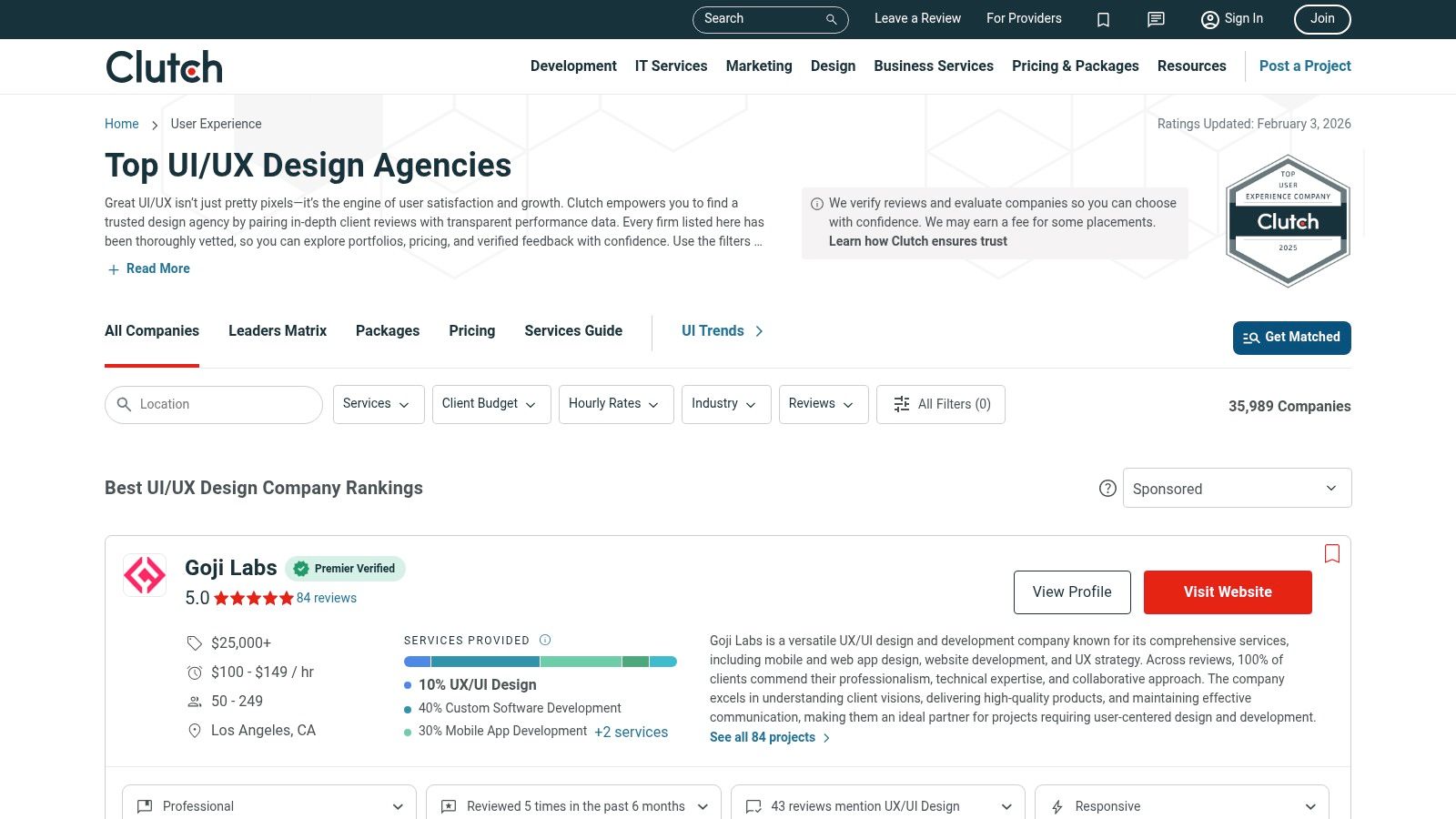
This focus on verified reviews allows businesses to move beyond marketing claims and see how an agency actually performs. The user experience on Clutch is centered around its powerful filtering system, enabling you to narrow down thousands of providers by specific criteria.
Key Features and How to Use Them
Clutch is free for businesses seeking services. The platform’s robust feature set is designed to streamline the vendor discovery process.
- Granular Filtering: You can sort agencies by location, hourly rate (e.g., $50 - $99/hr), project budget (e.g., $25,000+), and team size. This is crucial for matching your operational and financial requirements from the start.
- The Leaders Matrix: This proprietary tool plots agencies on a quadrant based on their "Ability to Deliver" and "Market Presence." It's an excellent visual starting point for identifying established market leaders or rising challengers in the UX design space.
- Industry and Service Focus: Filter by niche expertise, such as healthcare UX, fintech, or e-commerce. This ensures you find a partner who understands the unique challenges and user expectations of your industry. Applying these filters correctly is a key step, as a deep understanding of user interface design best practices often varies between sectors.
Pros and Cons
| Strengths (Pros) | Weaknesses (Cons) |
|---|---|
| Verified, In-Depth Reviews: Phone-verified interviews provide unparalleled insight into client experiences. | Sponsored Placements: Top spots in some lists are paid for, requiring critical evaluation of results. |
| Comprehensive Data: Detailed profiles with portfolios, pricing, and client lists aid thorough vetting. | Requires Diligence: The sheer volume of options can be overwhelming without a clear vetting strategy. |
| Niche Category Pages: Find specialists for specific needs like "Enterprise UX" or "Mobile App UX." | Mixed Vendor Feedback: Some agencies report a challenging experience with the platform itself. |
Pro Tip: Look beyond the overall rating. Read the full text of multiple reviews to understand an agency’s communication style, project management capabilities, and how they handle challenges. The details in these reviews are where the real insights are found.
Website: https://clutch.co/agencies/ui-ux
3. DesignRush
For companies that need to align their search for top UX design agencies with clear budgetary constraints, DesignRush provides a streamlined B2B marketplace. It excels at helping businesses quickly filter potential partners based on project cost, making it an excellent tool for setting and meeting stakeholder budget expectations from the outset. DesignRush curates agencies into specific categories, including a dedicated UI/UX section, and provides editorial rankings to help orient first-time buyers.
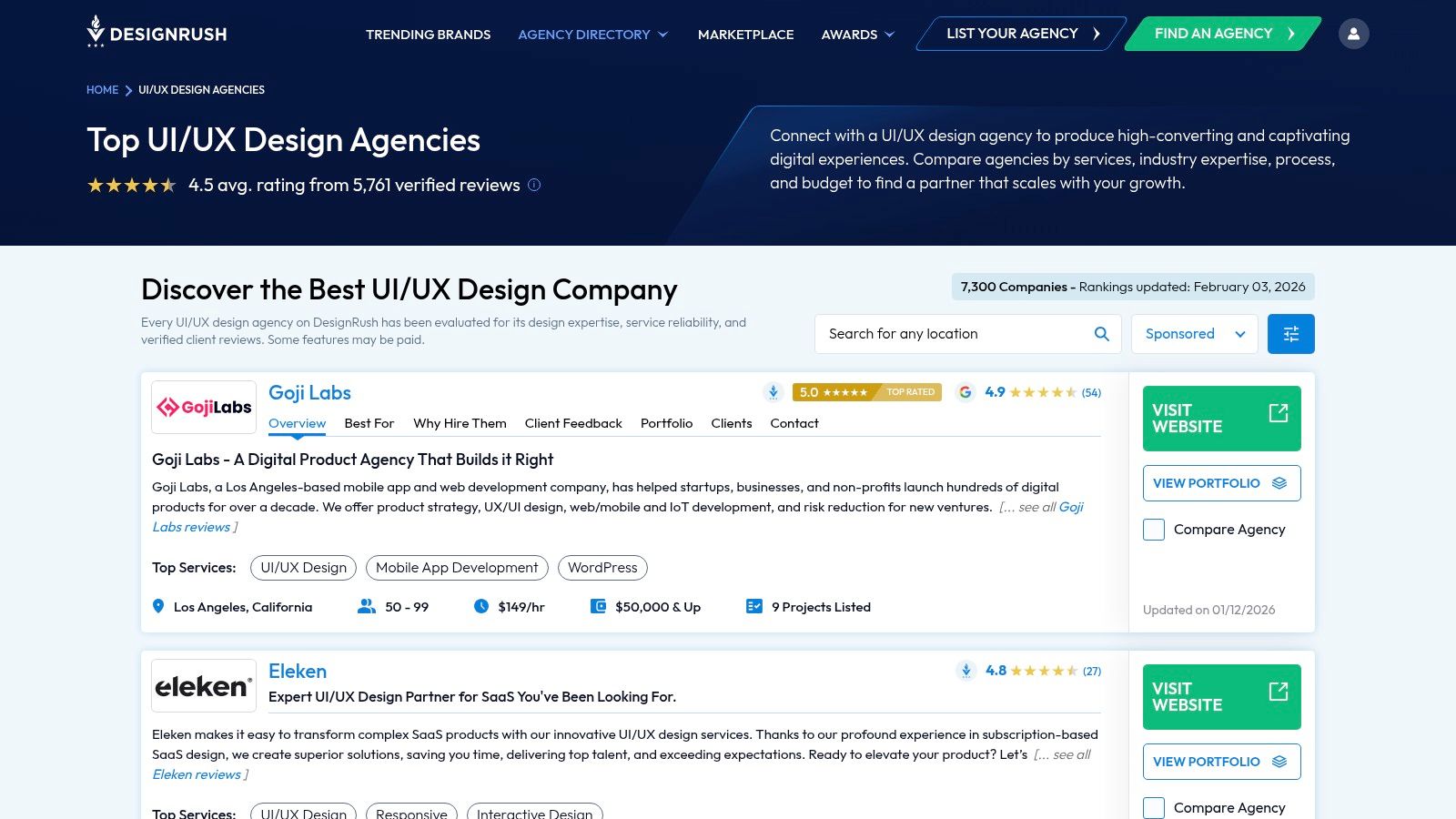
The platform’s user experience is built around practicality, allowing users to move from broad exploration to a qualified shortlist efficiently. Unlike platforms focused solely on client interviews, DesignRush blends verified reviews with its own editorial insights, offering a different but equally valuable perspective for vetting agencies.
Key Features and How to Use Them
DesignRush is free for businesses looking to hire an agency. Its features are designed to simplify the discovery process, particularly for those with specific financial and geographical requirements.
- Dedicated UI/UX Category with Budget Bands: This is the platform's standout feature. You can immediately filter agencies by project budget (e.g., $25,000–$50,000 or $50,000+), which is invaluable for eliminating options that don't align with your financial scope.
- Comprehensive Filtering: Beyond budget, you can narrow your search by location, client reviews, team size, and average hourly rate. This multi-filter capability lets you create a highly specific list of candidates that meet your operational needs.
- Editorial Rankings: DesignRush publishes its own rankings of top agencies based on a documented methodology. These lists can serve as a great starting point for identifying reputable firms, especially for businesses new to hiring design partners.
- Detailed Agency Profiles: Each profile includes a portfolio, a breakdown of key services, client lists, and leadership information. This allows for a quick but thorough assessment of an agency's capabilities and experience.
Pros and Cons
| Strengths (Pros) | Weaknesses (Cons) |
|---|---|
| Rapid Shortlisting by Budget: The ability to filter by project cost is a major time-saver. | Potential for Outdated Lists: Editorial rankings may not always reflect the latest market changes. |
| Clear Geographic Filtering: Easily find agencies in specific cities, states, or countries. | Sponsored Placements Possible: Some agencies may pay for enhanced visibility, requiring users to look critically. |
| Recognized Editorial Rankings: Provides a helpful, curated starting point for first-time buyers. | Review Depth Varies: The level of detail in client reviews is not as standardized as on some other platforms. |
Pro Tip: Use the budget and location filters first to create an initial shortlist. Then, dive into the individual profiles and portfolios of the top five to seven candidates to assess the quality of their work and their industry-specific experience.
Website: https://www.designrush.com/agency/ui-ux-design
4. GoodFirms
For businesses looking to quickly build a broad list of potential UX partners, GoodFirms is a comprehensive B2B research and review platform. Similar to its competitors, it offers a massive directory of service providers, but it excels in its ability to help users cast a wide net across numerous sub-verticals and price points. The platform uses a proprietary research methodology to rank companies, offering a structured starting point for your vendor search. It lists thousands of the top UX design agencies, providing ample choice for nearly any project requirement.
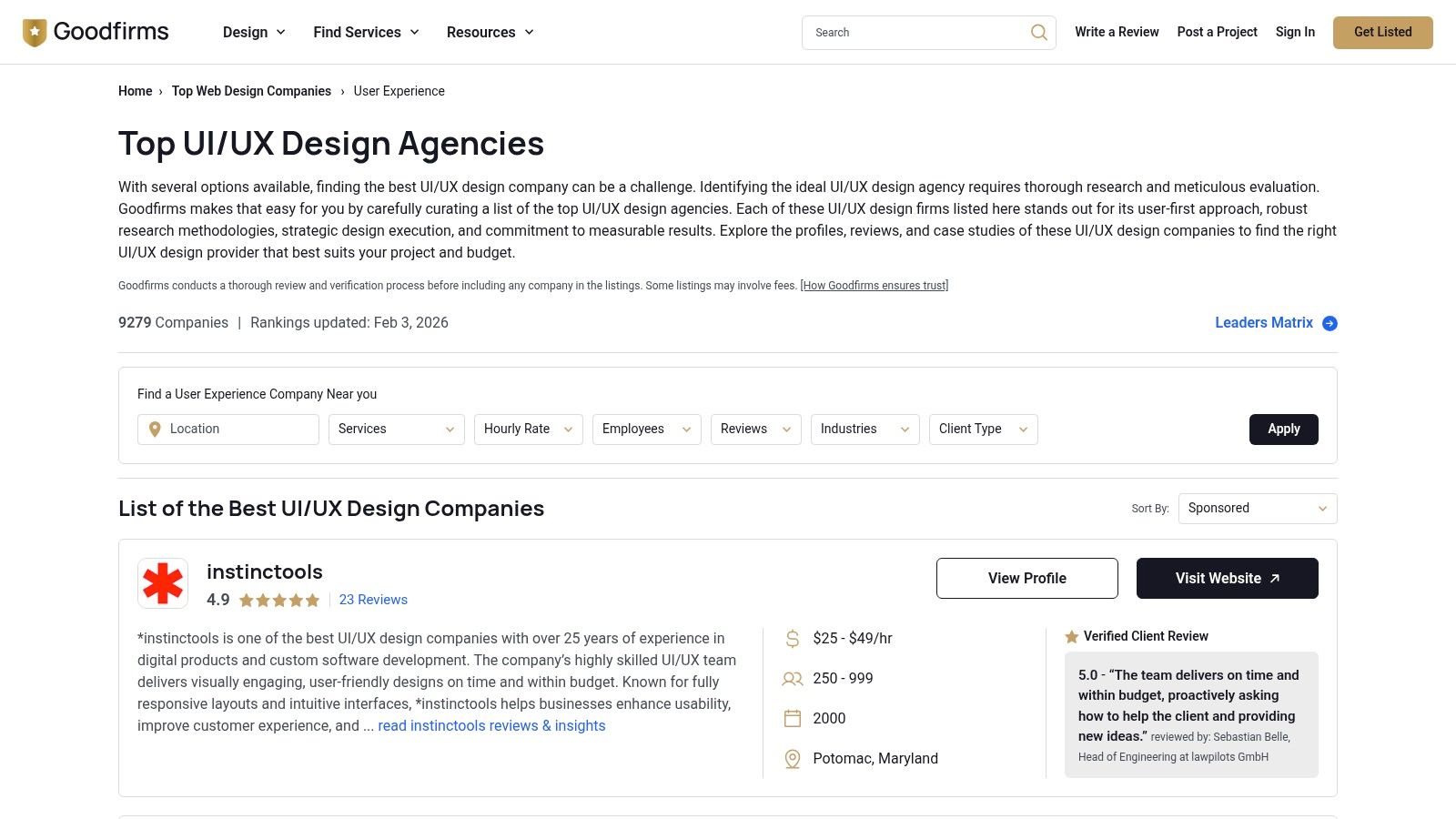
GoodFirms combines verified client reviews with its own market research to create agency scores and rankings. This hybrid approach helps businesses evaluate a firm’s credibility and capabilities, moving beyond simple marketing pitches to assess proven performance.
Key Features and How to Use Them
GoodFirms is free for businesses seeking agencies. Its platform is designed to facilitate efficient initial research and longlist creation.
- Leaders Matrix: This visualization tool ranks agencies based on their "Quality," "Reliability," and "Ability." It serves as an excellent visual guide to quickly identify well-regarded firms within the UX design landscape.
- Extensive Filters: Users can narrow their search by hourly rate, project budget, team size, location, and industry focus. This is essential for filtering the extensive directory down to a manageable list of relevant candidates that fit your specific operational and financial constraints.
- Personalized Shortlist: A standout feature is the ability to submit your project requirements and receive a custom-curated list of recommended agencies from the GoodFirms team. This can significantly accelerate the initial discovery phase. The process of evaluating this shortlist still requires diligence, which is a key part of how to choose a software development company that truly fits your needs.
- Verified Reviews and Portfolios: Each profile contains client reviews, detailed service descriptions, and case studies, allowing you to perform an initial screening before making contact.
Pros and Cons
| Strengths (Pros) | Weaknesses (Cons) |
|---|---|
| Broad Agency Selection: Ideal for building longlists across diverse sub-verticals and price points. | Variable Review Quality: The depth and quality of client reviews can differ significantly between profiles. |
| Personalized Shortlist Option: The platform can help speed up the discovery process significantly. | Sponsored Listings: Prominent placements can be purchased, so it's wise to compare across multiple sources. |
| Comprehensive Filtering: Robust filters help refine searches to find highly relevant agencies. | Overwhelming Choice: The vast number of listed firms can be difficult to navigate without a clear plan. |
Pro Tip: Use the personalized shortlist feature to get a running start, but don't rely on it exclusively. Cross-reference the recommendations with your own filtered searches and read the text of individual reviews to validate their communication and project management styles.
Website: https://www.goodfirms.co/directory/services/top-web-design-companies/user-experience
5. UpCity
For businesses that prioritize finding a local or nearshore partner, UpCity offers a marketplace with a strong U.S.-centric focus, making it an excellent resource for sourcing top UX design agencies within a specific geographic area. Unlike global platforms, UpCity excels at connecting clients with nearby providers, which can be a significant advantage for projects requiring in-person collaboration or alignment on time zones. The platform’s value is rooted in its city-level directory structure and its transparent presentation of agency credentials and service focuses.
UpCity functions as a B2B marketplace that provides detailed summaries, service tags, and indicative pricing, helping businesses quickly vet potential partners. Its structure is particularly useful for companies looking to hire agencies that offer a blend of UX design with broader marketing and web development services, as many listed providers offer bundled capabilities. This makes it a practical choice for organizations seeking a single partner for a multi-faceted digital project.
Key Features and How to Use Them
UpCity is free for businesses looking to hire an agency. Its features are designed to simplify the search for local and qualified creative partners.
- City-Level UX Lists: The core feature allows you to browse and compare agencies by major U.S. metropolitan areas (e.g., Charlotte, Chicago, New York). This is the ideal starting point if location is a key criterion in your search for top UX design agencies.
- Indicative Project Minimums: Profiles often display minimum project sizes (e.g., $5,000+) and typical retainer information. This financial transparency helps you quickly filter out agencies that are not aligned with your budget, saving time during the initial screening process.
- Service Tags and Filters: Agencies are tagged with their specific service offerings, such as "User Experience (UX)," "User Interface (UI)," and "Web Design." You can use these tags to quickly screen for providers that have the exact skill set your project requires.
- Editorial Hub and Resources: The platform includes a variety of buyer-focused educational content, offering guidance and best practices for selecting and collaborating with a design agency.
Pros and Cons
| Strengths (Pros) | Weaknesses (Cons) |
|---|---|
| Strong for Local Discovery: Unmatched for finding U.S.-based agencies by city, ideal for on-site needs. | Segmented Browsing: The city-based structure can make it cumbersome to compare agencies across regions. |
| Clear Pricing Indicators: Helps align budget expectations early with listed project minimums. | Paid Recognition Tiers: Some providers may have enhanced visibility due to paid tiers, so verify all claims. |
| Good for Bundled Services: Many listed agencies offer integrated marketing, web, and UX design services. | U.S. Focus: Less comprehensive for businesses seeking agency options in Europe, Asia, or other global markets. |
Pro Tip: Use the city-specific pages as your starting point, but don't stop there. Once you've identified a few promising local agencies, visit their individual websites to review their full portfolios and case studies. UpCity is an excellent discovery tool, but final vetting should always include a deep dive into an agency's direct work.
Website: https://upcity.com/ux/charlotte
6. Sortlist
For businesses that prefer a more guided, matchmaking approach, Sortlist offers a streamlined process to connect with top UX design agencies. Instead of leaving you to browse an endless directory, Sortlist’s core function is a project-briefing workflow. You submit your project requirements, and the platform’s algorithm and team deliver a curated shortlist of agencies that are a strong fit, saving significant time in the initial discovery phase. This concierge-style service is designed to reduce the noise and connect you directly with relevant partners.
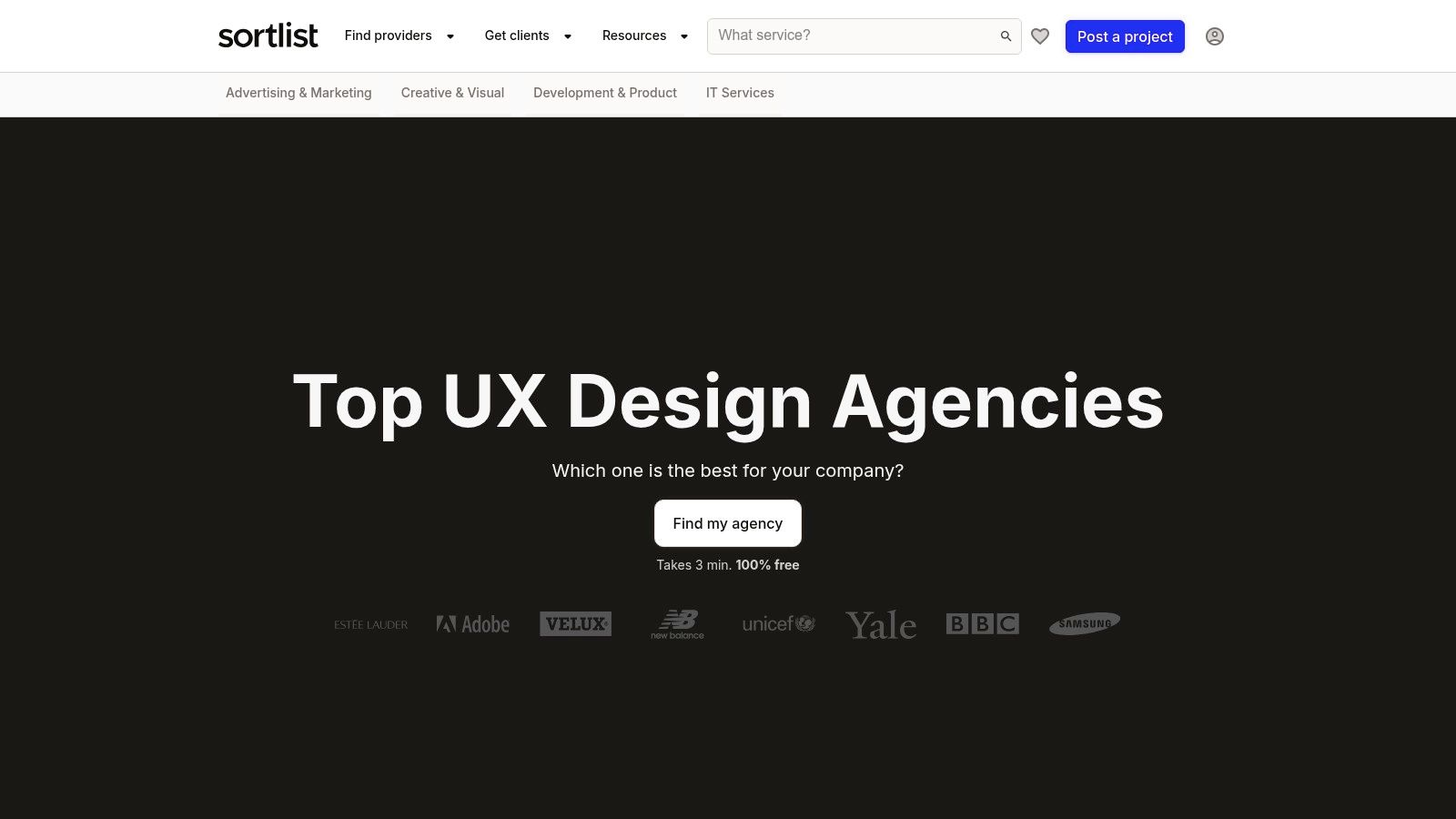
This model is particularly effective for teams who have a well-defined scope but lack the resources to conduct a wide-ranging market search. The emphasis on matching your specific brief to agency capabilities makes the process highly efficient, while visible minimum budgets on agency profiles provide crucial financial transparency from the very beginning.
Key Features and How to Use Them
Sortlist is free for businesses posting a project. Its value lies in turning your project needs into a qualified list of potential partners.
- Project Brief Workflow: The primary feature is a guided questionnaire where you detail your project scope, timeline, budget, and specific UX needs. The quality of your brief directly impacts the quality of the matches, so be as specific as possible.
- Concierge Matching Service: Once your brief is submitted, Sortlist's team and technology work to identify and present a handful of vetted agencies. This is ideal for quickly creating a shortlist without having to manually filter hundreds of profiles.
- Transparent Budgeting: Many agency profiles display a "Min. Budget," which is invaluable for pre-qualifying partners. This allows you to avoid introductory calls with agencies whose pricing structure is misaligned with your financial constraints.
- Agency Profiles with Reviews: Each matched agency comes with a detailed profile featuring their portfolio, client reviews, and areas of expertise, allowing you to conduct your due diligence on the curated options provided.
Pros and Cons
| Strengths (Pros) | Weaknesses (Cons) |
|---|---|
| Fast, Curated Matches: The brief-based system quickly delivers a vetted list of relevant agencies. | EU-Centric Supply: The platform has strong European roots, so you may need to verify US time-zone availability. |
| Transparent Starting Budgets: Visible minimum project costs help screen for financial fit early. | Requires Follow-Up: It’s wise to ask for US-specific case studies or references from the matched agencies. |
| Time-Saving Process: Significantly reduces the manual effort of searching and initial vetting. | Match Quality Varies: The success of the matches is highly dependent on the detail and clarity of your initial brief. |
Pro Tip: When you receive your agency shortlist, don't just review their portfolios. Schedule brief introductory calls and specifically ask how they would approach the challenges outlined in your project brief. Their initial strategic thinking is a great indicator of their suitability as a partner.
Website: https://www.sortlist.com/ux-design
7. Awwwards Directory (UX/UI)
For businesses where visual excellence and cutting-edge brand experience are paramount, the Awwwards Directory is an essential resource. Unlike traditional B2B marketplaces, Awwwards is an awards-driven platform that spotlights agencies and studios celebrated for their digital craft. Its value lies in curating design-forward shops with proven creative talent, making it the ideal starting point when the aesthetic quality of your user interface is as critical as its usability.
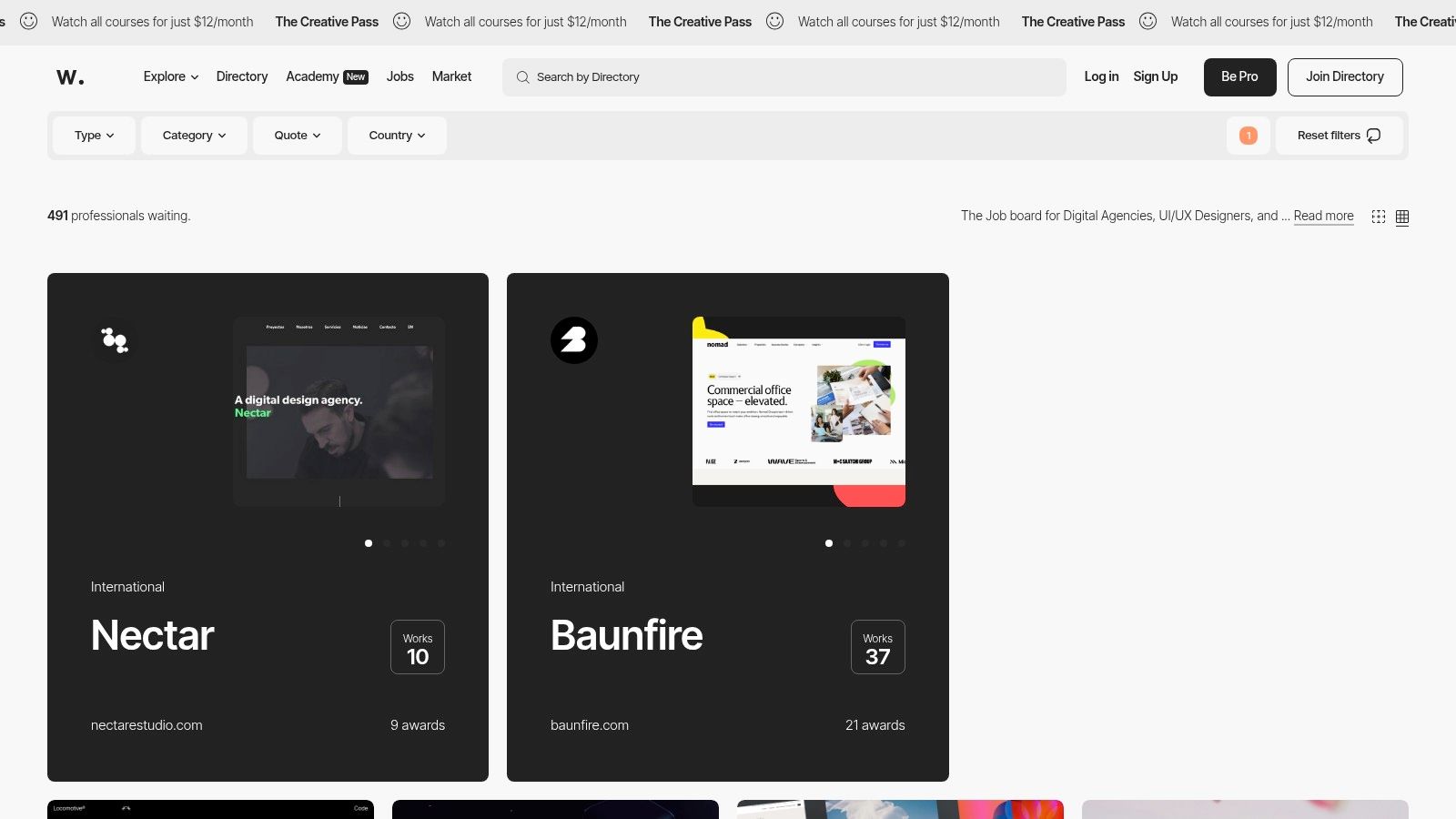
This focus on peer-reviewed design provides a strong signal of an agency's ability to deliver a polished, premium product. The user experience of the directory is built around visual discovery, emphasizing portfolios and accolades. This makes it a great tool for finding partners for high-impact marketing sites, experiential digital products, and brands that need to make a strong visual statement.
Key Features and How to Use Them
The directory is free to browse for businesses searching for agencies. Its features are designed to help you quickly identify visually exceptional partners.
- Award-Based Quality Signals: Agency profiles prominently display prestigious awards like "Site of the Day" (SOTD) or "Site of the Month" (SOTM). Use these badges as a quick filter to gauge an agency's level of creative execution and industry recognition.
- Targeted Filtering: You can easily narrow your search by country, budget brackets, and specific categories like "UX/UI." This allows you to find local talent or agencies that align with your project's financial scope from the outset.
- Portfolio-Centric Profiles: The directory emphasizes visual portfolios, allowing you to immerse yourself in an agency's past work. This visual-first approach helps you rapidly assess if their design style aligns with your brand's aesthetic.
Pros and Cons
| Strengths (Pros) | Weaknesses (Cons) |
|---|---|
| Proven Creative Quality: Excellent for shortlisting design-forward studios with validated talent. | Awards Bias: Many top UX research and product-focused agencies do not compete for visual design awards. |
| Quick Portfolio Assessment: Award histories and badges offer a fast way to evaluate design caliber. | Requires Deeper Vetting: You must validate an agency's UX research and process depth beyond their portfolio. |
| Discover Niche Creatives: Uncover specialized agencies known for innovative marketing and product sites. | Focus on Aesthetics: The platform may not fully represent agencies whose strengths are in strategy over visuals. |
Pro Tip: Use Awwwards to create a shortlist based on visual fit and creative prowess. Then, dive deeper into the websites of your top choices to investigate their case studies, client testimonials, and detailed UX process documentation. Look for evidence of user research, testing, and strategic thinking to complement their design skills.
Website: https://www.awwwards.com/directory/ux-ui/
Top 7 UX Design Agencies Comparison
| Service | Implementation complexity 🔄 | Resource requirements ⚡ | Expected outcomes 📊 | Ideal use cases 💡 | Key advantages ⭐ |
|---|---|---|---|---|---|
| Nerdify | Moderate — end‑to‑end product delivery and nearshore integration 🔄 | Full‑stack team; moderate client involvement; custom quoting required ⚡ | Production‑grade web & mobile products; measurable user growth in case studies 📊 | Startups/SMEs needing a single partner for design + dev + growth; nearshore staff augmentation 💡 | Nearshore/time‑zone alignment; transparent Slack/GitHub workflow; proven track record ⭐ |
| Clutch | Low — browse & filter marketplace; requires review validation 🔄 | Minimal internal effort; due diligence recommended ⚡ | Data‑driven shortlists with verified client reviews and rankings 📊 | US buyers wanting granular vendor data and verified references 💡 | Deep review depth; Leaders Matrix and robust filters; phone‑verified reviews ⭐ |
| DesignRush | Low — rapid shortlist by budget and editorial lists 🔄 | Low effort to filter by budget bands; quick screening ⚡ | Budget‑aligned agency shortlists and editorial orientation 📊 | First‑time buyers setting stakeholder budgets and geography filters 💡 | Clear budget tiers; editorial rankings; visible portfolios ⭐ |
| GoodFirms | Low–Moderate — large directory; personalized shortlist option 🔄 | Low client effort; may require sifting across many profiles ⚡ | Extensive longlists across sub‑verticals with verified reviews 📊 | Building broad vendor longlists across industries and price points 💡 | Leaders Matrix; personalized shortlist; wide coverage ⭐ |
| UpCity | Low — city/metro segmentation (extra clicks for multi‑region) 🔄 | Low; useful for local discovery; shows project minimums/retainers ⚡ | Local matches with indicative minimums and service tags 📊 | US buyers prioritizing nearby partners or combined marketing+UX services 💡 | City‑level discovery; retainer/minimum visibility; buyer resources ⭐ |
| Sortlist | Moderate — brief + concierge matching workflow 🔄 | Low effort for clients; platform curates matches; agencies pay to participate ⚡ | Curated, vetted agency matches with visible starting budgets 📊 | Buyers wanting fast, concierge‑style shortlists and transparent budgets 💡 | Concierge matching; visible minimum budgets; fast vetting ⭐ |
| Awwwards Directory (UX/UI) | Low — awards‑driven browse; requires UX process validation 🔄 | Low; emphasis on design portfolios; may need deeper UX checks ⚡ | High visual/creative quality selections; premium brand experiences 📊 | Projects prioritizing visual excellence, brand experience, and design‑forward studios 💡 | Award signals and badges; curated design‑led studios; strong portfolio emphasis ⭐ |
Beyond Directories: Partner with Nerdify for an Integrated Solution
Navigating the landscape of top UX design agencies can feel like an exhaustive research project. We've explored leading directories like Clutch and DesignRush, which are invaluable for initial discovery and vetting. However, the ultimate goal isn't just to find a designer; it's to build a successful digital product that drives business growth. This requires a seamless transition from pixel-perfect mockups to fully functional, high-performance code.
The challenge with the traditional directory approach is the fragmentation it creates. You might find a brilliant design firm on Awwwards, but then you're left to find a separate development team, a project manager to bridge the communication gap, and a marketing team to handle the launch. This multi-vendor shuffle introduces risks, delays, and communication overhead that can derail even the most promising projects.
From Vetting Vendors to Building a Partnership
The key takeaway from our deep dive is that the "best" agency is the one that aligns with your entire product lifecycle. For startups, SMEs, and even enterprise teams, an integrated partner who can manage the entire process from ideation to launch offers a significant strategic advantage. Instead of just delivering a Figma file, they deliver a market-ready product.
This is where a holistic model, like the one we practice at Nerdify, provides a clear alternative. We function as a cohesive product team, not just a service provider. Our approach consolidates world-class UX/UI design with robust web and mobile development under a single, collaborative roof.
Your Actionable Next Steps: A Strategic Checklist
As you move forward from research to action, here is a practical checklist to guide your decision-making process. Use these points to evaluate whether a directory-sourced agency or an integrated partner is the right fit for you.
Define Your True Scope: Is your primary need a UX audit and redesign, or do you require an end-to-end build? If you need development, QA, and deployment, an integrated team will streamline the process and reduce management friction.
Assess Communication and Collaboration Needs: How important is real-time collaboration? A nearshore partner like Nerdify, operating in a similar time zone and using shared channels like Slack, acts as a genuine extension of your in-house team, eliminating the lag associated with offshore options.
Evaluate Technical Integration Capabilities: A great design is only as good as its implementation. When vetting partners, ask about their technical processes. For instance, an advanced team should be able to work with sophisticated tools to maintain brand consistency programmatically. Inquire about their experience with systems like a brand styleguide API to ensure that every component, from buttons to banners, adheres to your brand guidelines automatically.
Calculate the Total Cost of Ownership: Don't just compare hourly rates. Factor in the hidden costs of managing multiple vendors, potential project delays from miscommunication, and the risk of a disjointed final product. An all-in-one team often provides a higher ROI by delivering a superior product faster.
Ultimately, choosing a partner to build your digital future is one of the most critical decisions you'll make. Directories are a fantastic starting point, but don't let your search end there. The most successful products emerge from deep, collaborative partnerships where design and development are two sides of the same coin. If you're ready to bypass the endless search and start building with a team that’s as invested in your success as you are, let’s connect.