What is a discovery phase: A Fast Guide to Validate Ideas and Launch Projects
So, you have a great idea for a new app or software product. But how do you get from a rough concept to a tangible, successful product without wasting time and money? The answer is the discovery phase.
Think of it as the strategic planning stage before a single line of code gets written. It’s where you do the essential groundwork—researching the market, understanding your users, and defining exactly what you’re going to build. It’s the difference between building on a solid foundation and building on quicksand.
What is a Project Discovery Phase, Really?
Imagine trying to cook a gourmet meal for the first time without a recipe. You might have a general idea of the ingredients, but the result would be chaotic. The discovery phase is your project's recipe—it turns a vague idea into a clear, step-by-step plan that everyone can follow.
This initial stage is a deep dive into the "who, what, and why" of your project. It's a collaborative process where your team and your development partner work together to ask the tough questions, challenge assumptions, and replace guesswork with solid data. The goal is simple: make sure the product you build actually solves a real problem for real people.
The Blueprint Analogy
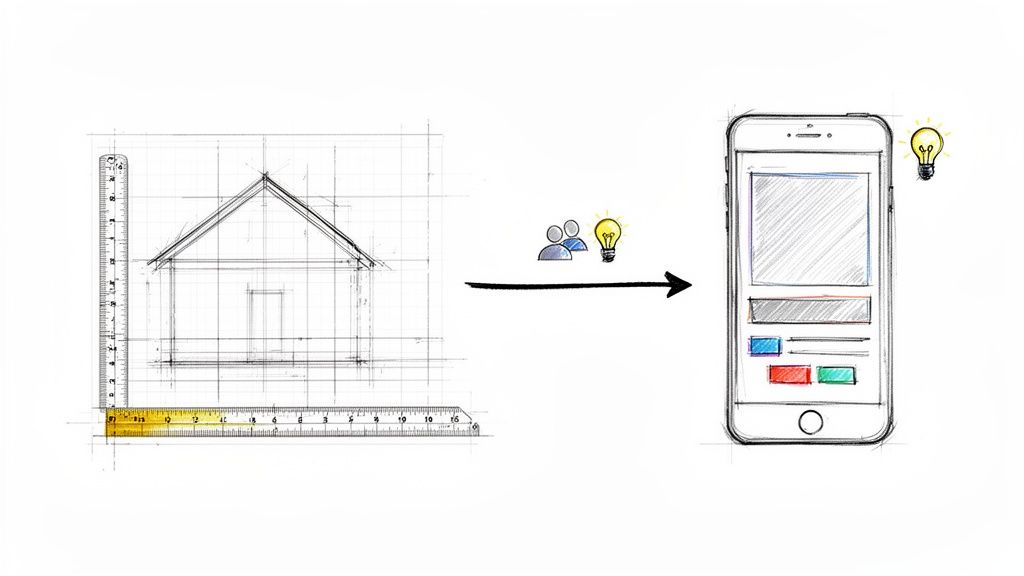
Here's the best way to think about it: you wouldn't hire a construction crew to build a skyscraper and just tell them to "start digging." First, an architect creates detailed blueprints mapping out every single detail, from the foundation to the windows to the plumbing. A discovery phase does the exact same thing for your software.
The discovery phase is the process of gathering and analyzing information about a project to define its goals, scope, and requirements. It’s an investment in clarity that prevents costly mistakes down the line.
By mapping everything out first, you can spot potential problems, refine your feature list, and get everyone—investors, designers, developers—on the same page. It’s all about creating a shared vision before the expensive work begins.
Why This Phase Matters So Much
Ultimately, this phase is about managing risk. It's far cheaper and easier to change a design on paper than it is to rebuild a feature that’s already been coded. While only about 30% of software projects succeed, those that invest in a thorough discovery process dramatically improve their odds. For a deeper look into this, check out these discovery phase insights.
This upfront effort sets the stage for success by:
- Validating the Idea: Does anyone actually want this? The discovery phase answers that critical question.
- Defining the Scope: It creates a clear roadmap of what will be included in the first version (and just as importantly, what won't).
- Aligning the Team: It gets everyone from the CEO to the junior developer rowing in the same direction.
- Providing Accurate Estimates: It allows your development partner to give you a realistic budget and timeline.
To put it all together, here’s a quick overview of what the discovery phase covers and why each part is so vital.
Discovery Phase at a Glance
| Component | Purpose | Key Benefit |
|---|---|---|
| Stakeholder Interviews | To understand business goals, expectations, and constraints from key decision-makers. | Aligns the project with core business objectives from day one. |
| User & Market Research | To identify the target audience, analyze competitors, and find market gaps. | Ensures you're building a product people actually need and want. |
| Technical Analysis | To evaluate existing systems, explore tech options, and identify potential roadblocks. | Prevents costly technical rework and ensures feasibility. |
| Scope & Feature Definition | To create a prioritized list of features for the Minimum Viable Product (MVP). | Focuses development efforts on what provides the most value first. |
| Prototyping & Wireframing | To create a visual representation of the product's user flow and interface. | Allows you to test and refine the user experience before development. |
| Project Roadmap | To outline the development timeline, key milestones, and required resources. | Provides a clear and realistic plan for budget and delivery. |
In short, the discovery phase is the most important investment you can make in your project’s future. It lays the groundwork for a smooth, efficient, and ultimately successful development process.
Why You Cannot Afford to Skip the Discovery Phase
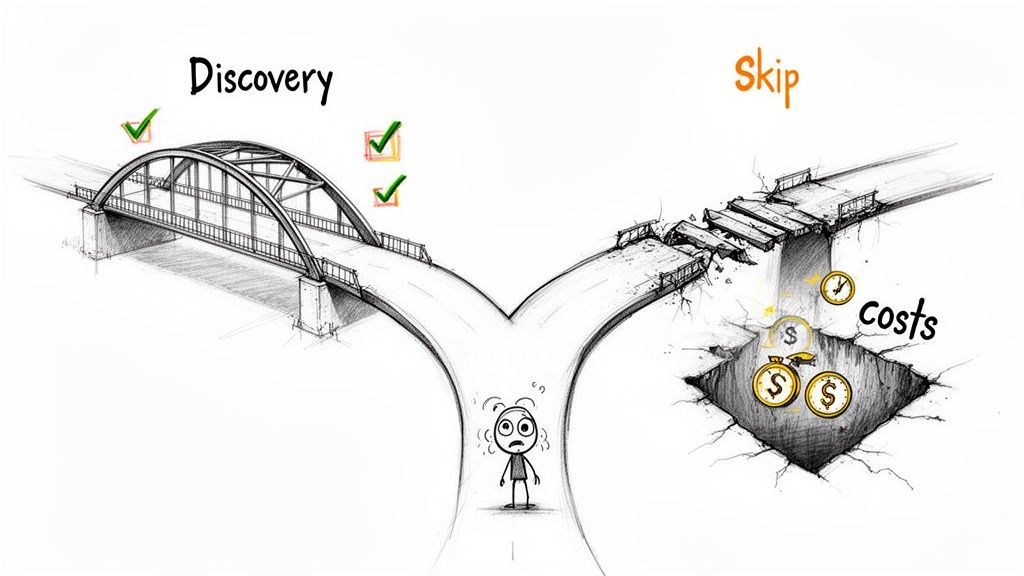
It’s always tempting to dive right into development. You’ve got a killer idea, a fire in your belly, and pressure from all sides to start building something. But treating the discovery phase as an optional line item is one of the most expensive mistakes you can make. It's a shortcut that almost always leads to a much longer, pricier, and more frustrating journey.
Skipping this critical prep work is like setting sail without a map or a compass. Sure, you're moving, but are you heading toward treasure or a storm? The consequences are predictable and often severe, blowing up your budget, derailing your timeline, and tanking your final product's chance of success.
The High Cost of Guesswork
When you skip discovery, your project is built on a foundation of pure guesswork. You assume you know what users want, you assume the tech is straightforward, and you assume every stakeholder is on the same page. Speaking from experience, these assumptions are almost always wrong.
This is where projects go off the rails, leading to all-too-common disasters:
- Massive Budget Overruns: A change that takes an hour to update in a planning document can take weeks to recode once development is underway. Those mid-stream changes are exponentially more expensive.
- Constant Delays: Vague requirements force developers to guess. This guesswork inevitably leads to rework, pushing deadlines back again and again.
- Building the Wrong Product: This is the biggest risk of all—sinking months of work and hundreds of thousands of dollars into a product nobody actually wants or needs.
The statistics on this are sobering. A lack of good discovery contributes to staggering failure rates. Over 90% of startups ultimately flop, and a primary reason is building something the market doesn't value. Looking at projects more broadly, 69% fail to meet their original goals because their scope was poorly defined from the start.
Averting Disaster with an Upfront Investment
The best way to think about the discovery phase is as an insurance policy for your project. It’s a relatively small, upfront investment of time and money that protects you from the catastrophic financial and reputational damage of a failed launch. It systematically de-risks the entire venture before the first line of code is written.
A discovery phase isn't an expense; it's a strategic investment in efficiency, clarity, and market success. It’s the single best way to protect your budget and ensure you build a product that delivers real value.
One of the most practical benefits is learning how to avoid scope creep. When project boundaries aren’t crystal clear from day one, new features and "nice-to-have" requests start piling up, completely derailing timelines and budgets. To get a handle on this, check out our guide on how to define project scope.
Connecting Discovery to Your Bottom Line
Every single activity in the discovery phase is designed to protect your return on investment (ROI). By validating your idea with real users before development, you confirm there’s a paying audience waiting. By mapping out the technical architecture, you prevent costly rebuilds down the road.
The process forces your team to stop and answer the tough questions:
- What specific problem are we solving?
- Who is our exact target customer?
- How will this product actually make money or achieve its core goal?
- What is the absolute minimum set of features we need to launch successfully?
Answering these questions early turns a vague concept into a viable business plan. It ensures every dollar you spend on development is laser-focused on features that matter to your users and your bottom line. No more wasted effort.
The Core Steps of a Thorough Discovery Phase
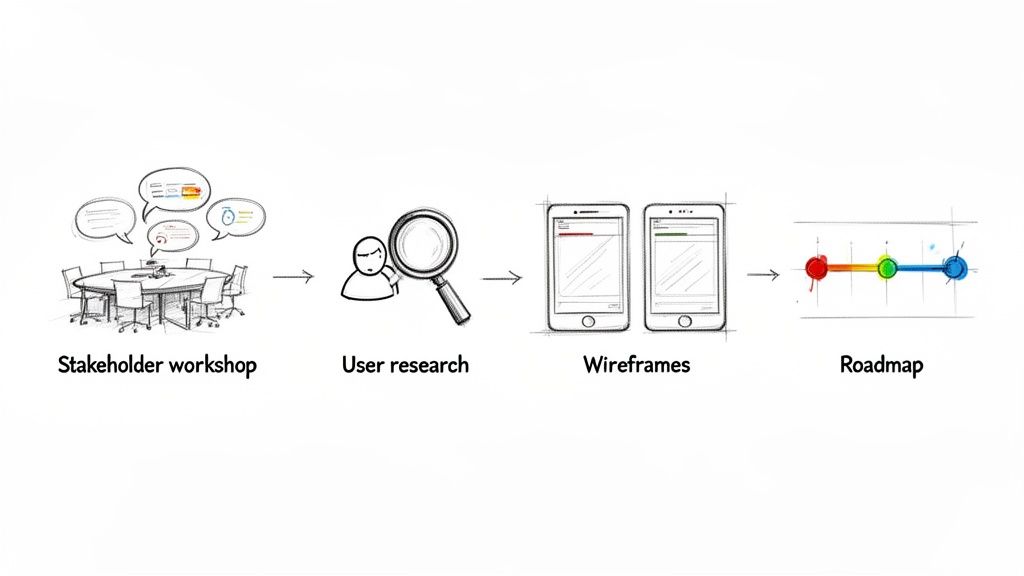
While the exact recipe can change depending on the project, a solid discovery phase always follows a logical path—from big, fuzzy ideas to a concrete, buildable plan. It’s a deliberate journey that turns a business vision into a detailed project blueprint, making sure every ounce of effort that follows is pointed in the right direction.
Think of it like building a house. You don't just start pouring concrete. First, you survey the land (the market), talk to the family about their needs (stakeholders), and draw up detailed architectural plans (the strategy). Each step builds on the last, systematically replacing assumptions with hard facts and clear direction.
Stage 1: Kickoff and Stakeholder Alignment
The whole process kicks off with a meeting, but this isn't your typical project intro. It's an intensive alignment session where we nail down the "why" behind the product. We get all the key players in a room—executives, marketers, subject matter experts—to forge a single, shared vision for what we're about to build.
The goal here is simple: get everyone to agree on what "done" and "successful" actually look like. We unpack the core business problem, set clear key performance indicators (KPIs), and get real about any constraints like budgets, technical hurdles, or non-negotiable deadlines. This first step is absolutely vital; it’s the compass that keeps the entire project from drifting off course.
Stage 2: Information Gathering and Deep Research
With the big-picture goals locked in, the team goes into deep-dive mode to understand the full context. This is where we gather all the raw materials needed to make smart, informed decisions later on. It’s not just one activity but several parallel streams of investigation that paint a complete picture of the landscape.
Typical research activities include:
- User Research: We get out there and talk to real people through interviews, surveys, and focus groups. The goal is to deeply understand their needs, frustrations, and daily habits. For a complete look at this process, check out our guide on how to conduct user research.
- Competitor Analysis: We put on our detective hats and see what competitors are doing right, where they’re dropping the ball, and what gaps we can exploit to build something much better.
- Market Analysis: We zoom out to look at the bigger picture—industry trends, new technologies, and any regulations that might affect the project.
This stage is all about listening. It’s about uncovering the truth about your users and the competitive world they live in. For complex projects, this often involves modelling business processes for AI transformation to map out existing workflows and pinpoint the best opportunities for innovation.
Stage 3: Analysis and Strategy Definition
Now we have a mountain of data. The next job is to make sense of it all and turn that raw information into actionable insights. This is the synthesis phase, where we connect the dots between business goals, user needs, and market realities to forge a coherent project strategy.
The team works together to spot patterns in the research, creating user personas to give our target audience a human face and mapping out user journeys to visualize how they'll interact with the product. It’s at this point that the product's unique value proposition really sharpens into focus.
This is where the project's true north is found. We stop asking what we can build and start focusing on what we should build to create the most value for both the business and its customers.
The outcome is a strategic vision everyone can rally behind. We now know exactly who we're building for, what problems we're solving, and how our solution will win.
Stage 4: Ideation and Solution Design
With a solid strategy in hand, the creative juices start flowing. This is where designers, strategists, and analysts collaborate to brainstorm and visualize what the solution will actually look and feel like. It’s where abstract requirements become tangible concepts.
We typically move from rough sketches to a polished, interactive model:
- Wireframes: These are the product's basic blueprints. Simple, black-and-white layouts that focus purely on structure, flow, and function without the distraction of colors or fonts.
- Mockups: Next, we add the visual layer. Mockups are static, high-fidelity designs that show what the final product will look like, complete with branding, typography, and imagery.
- Interactive Prototypes: Finally, we bring it to life. A clickable prototype simulates the real user experience, letting stakeholders click around, test the flows, and give concrete feedback before a single line of code is written.
This iterative process is key. It’s far easier (and cheaper) to tweak a prototype than it is to rebuild a finished feature.
Stage 5: Planning and Documentation
The final act of the discovery phase is to bring everything together. We consolidate all the research, designs, and strategic decisions into a set of clear, comprehensive documents that will serve as the roadmap for the development team.
This is where we create the project’s official blueprint. The documentation answers all the critical questions, removes ambiguity, and gives the engineering team everything they need for accurate estimates and a smooth build process.
To help you visualize what comes out of each stage, here's a quick breakdown of the typical deliverables.
Key Deliverables of Each Discovery Phase Step
This table shows the tangible outputs you should expect at the conclusion of each step, turning abstract processes into concrete results.
| Discovery Step | Primary Activities | Key Deliverable(s) |
|---|---|---|
| Kickoff & Alignment | Stakeholder interviews, goal setting, scope definition. | Project brief, defined business goals & KPIs, initial scope statement. |
| Research & Gathering | User interviews, competitor analysis, market research. | User personas, competitor matrix, market analysis report. |
| Analysis & Strategy | Data synthesis, journey mapping, value proposition design. | User journey maps, value proposition canvas, prioritized feature list. |
| Ideation & Design | Brainstorming, wireframing, prototyping, user testing. | Wireframes, high-fidelity mockups, interactive prototype. |
| Planning & Documentation | Feature specification, roadmap creation, technical review. | Technical specification document, project roadmap, cost and time estimates. |
Ultimately, these deliverables ensure there are no surprises. They transform the initial vision into a well-defined plan, perfectly setting the stage for an efficient and predictable development cycle.
Who's in the Room for a Project Discovery Phase?
A great discovery phase isn’t a one-person show. Think of it more like putting together a specialist crew for a heist movie—you need the people who know the vault (your team) working side-by-side with the people who know how to crack it (your development partner).
This mix of internal knowledge and external expertise is absolutely critical. Your team brings the business context; without them, the project is just an academic exercise. The agency brings technical and user-focused skills; without them, you might end up with a great idea that’s impossible to build or that no one wants to use. Together, they create a complete picture.
Your Internal Dream Team
On your side of the table, you need the folks who live and breathe your business. Their insights are what keep the project grounded in reality, ensuring the final product actually solves real-world problems.
You'll typically want these key players involved:
- The Product Owner or Project Sponsor: This is your visionary. They hold the ultimate authority, control the budget, and keep everyone focused on the strategic goal. They are the project's champion.
- Subject Matter Experts (SMEs): These are the people from the trenches. They know the day-to-day workflows, the customer complaints, and the operational headaches the new product needs to fix.
The Agency's Expert Crew
Your development partner will bring their own specialized team to the discovery sessions. Each person has a specific job, but they all work together to translate your vision into a concrete, buildable blueprint.
A project discovery phase is, at its heart, all about communication. Having the right people in the room ensures that business needs don't get lost in translation on their way to becoming technical requirements.
This collaborative approach is a cornerstone of modern development. Getting everyone aligned early on saves a massive amount of time and money by preventing misunderstandings down the road. It’s what separates products that hit the mark from those that miss it entirely. To learn more, check out these insights on software development collaboration.
Key Agency Roles and What They Do
While the exact lineup might change based on your project, you can almost always expect these experts to be part of the discovery team:
- Business Analyst (BA): The BA is your translator. They are masters at digging deep, asking the right questions, and turning complex business rules into crystal-clear instructions that developers can actually build from.
- UX/UI Designer: This person is the voice of your user. The UX (User Experience) side is all about making the product feel natural and easy to navigate. The UI (User Interface) side is about making it look great and feel on-brand.
- Solutions Architect or Tech Lead: This is your technical strategist. They look at what you want to achieve and figure out the best way to build it—choosing the right technology, designing the system architecture, and ensuring the final product will be secure and able to grow with you.
When this combined team works together, magic happens. Your Product Owner defines the why, the Business Analyst nails down the what, the UX/UI Designer figures out how it feels and looks, and the Solutions Architect confirms how we’ll build it. This dynamic is what powers a truly successful discovery phase.
What a Real-World Discovery Process Looks Like
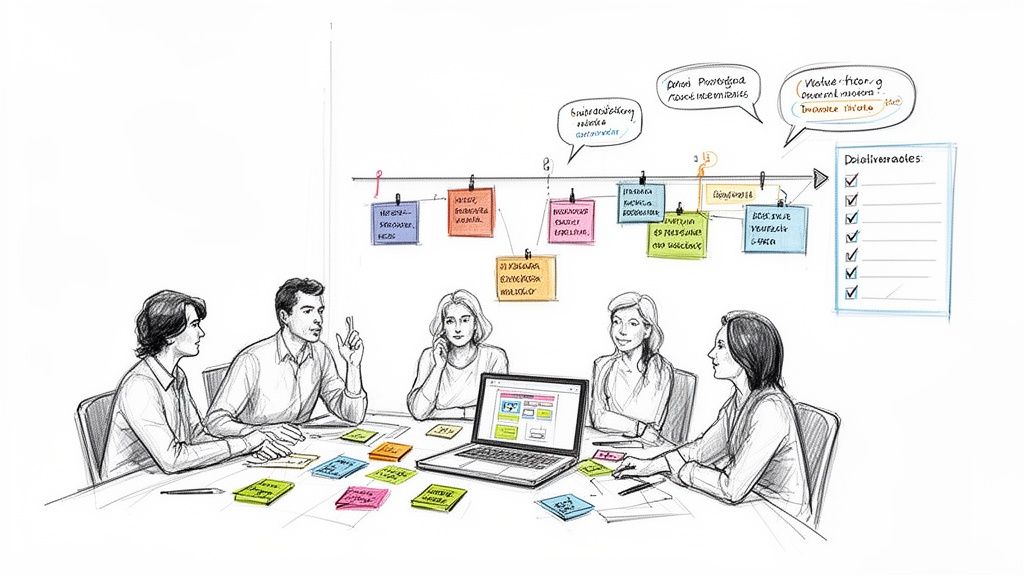
Theory is one thing, but seeing how a discovery phase actually plays out is another. Let’s walk through a tangible, real-world example of how a project moves from a simple idea to a fully-formed, actionable plan. It's the best way to really grasp what a discovery phase is.
Imagine a startup we'll call "WellFit." They want to build a new mobile app that connects users with certified nutritionists for personalized meal planning. The idea is solid, but the path from concept to code is filled with unknowns. That’s precisely where the discovery process kicks in.
Week 1: The Kickoff and Deep Dive
Everything starts with an intensive kickoff workshop. The WellFit CEO and their head of marketing sit down with our Business Analyst, a UX Designer, and a Solutions Architect. We don't just ask, "So, what do you want to build?" That’s a recipe for disaster. We dig much deeper.
Using collaboration tools like Miro, we start mapping out their core assumptions, business goals, and biggest fears. Key questions we focus on include:
- What is the one primary problem this app solves for your users?
- What does success look like one year after launch? How will you measure it?
- Who are your top competitors, and what are their biggest weaknesses we can exploit?
By the end of the week, we have a shared, crystal-clear understanding of the business vision. We've also scheduled interviews with potential users and a few nutritionists to see if our initial assumptions hold up in the real world.
Weeks 2-3: User Research and Prototyping
This is when we get out of the building. Our UX team sits down for one-on-one interviews with a dozen people from WellFit’s target demographic and several nutritionists. This is where the gold is. We uncovered a critical insight: users are completely overwhelmed by complex tracking apps and just want simple, direct guidance they can trust.
Armed with this feedback, our designer jumps into Figma to create low-fidelity wireframes. These aren’t pretty—they're just basic blueprints showing the app's core flow. We quickly turn these into a simple, clickable prototype and get it back in front of the same users. Their feedback is immediate and invaluable, showing us exactly which parts of the flow are confusing and which features they actually care about.
The goal of early prototyping isn’t to create a perfect design. It’s to fail fast and learn cheaply, making adjustments in hours that would take weeks to fix if the feature were already coded.
This tight feedback loop ensures the product is shaped by real user needs, not just our own assumptions in a conference room. We're building a solution people will actually want to use.
Week 4: Defining the Blueprint
With validated user flows and a prioritized feature list, the whole team reconvenes. The Solutions Architect evaluates the technical requirements, recommending a scalable cloud infrastructure and outlining potential third-party integrations, like payment gateways.
At the same time, our Business Analyst translates everything we’ve learned into a detailed project specification document. This becomes the project’s single source of truth, leaving zero room for ambiguity. A well-crafted plan is non-negotiable, and you can see just how detailed these blueprints need to be in this sample software requirements document.
This document clearly outlines every single feature planned for the initial release.
Week 5: The Final Roadmap and Presentation
In the final week, all the pieces come together. We present the WellFit team with a comprehensive package of deliverables that gives them total clarity:
- A Detailed Project Specification: A complete guide to the app's features and functionality.
- A High-Fidelity Clickable Prototype: A realistic, interactive model of the app they can use to impress investors.
- A Technical Architecture Plan: A blueprint for how the app will be built, ensuring it’s secure and can scale with their growth.
- A Project Roadmap: A clear timeline with key milestones and, most importantly, a precise, fixed-price budget for the development phase.
Now, WellFit has zero guesswork. They know exactly what they’re building, who they’re building it for, how long it will take, and precisely what it will cost. That is the true power of a discovery phase.
Key Questions to Ask Before Starting Discovery
Picking the right team for your discovery phase is one of the most important decisions you'll make. It sets the stage for everything that follows. You aren't just looking for a group of people who can code; you're looking for a strategic partner. Someone who will push back on your assumptions, spot risks you haven't seen, and help shape your vision into something real and ready for the market.
Think of it like hiring an architect to build your dream home. You wouldn't just ask if they can draw blueprints. You'd dig into their process, their communication style, and how they handle it when things inevitably go wrong. That same level of detail is needed here. The quality of their answers will tell you everything you need to know about their experience and whether they're truly in it with you.
Understanding Their Process and Methodology
First things first, you need to know how they actually do this. A vague answer here is a massive red flag. You're looking for a structured, repeatable process that shows they’ve been around the block a few times.
Here are a few questions to get you started:
- Can you walk me through your discovery process, step-by-step? A solid partner should be able to lay out their entire playbook, from the first stakeholder meeting all the way to the final roadmap presentation.
- What specific tools do you use for things like collaboration, research, and prototyping? This isn't just a technical question. It tells you if they’re using industry-standard tools like Miro for workshops, Figma for design, and Jira for keeping everything on track.
- How do you decide what features make it into the MVP? Their answer should be all about a data-backed approach—one that balances what users actually want with your business goals and what's technically possible.
Clarifying Deliverables and Outcomes
It's absolutely critical to know exactly what you’re getting for your money. The discovery phase shouldn't end with a handshake and a few good ideas; it should produce concrete assets that give you a crystal-clear path forward.
A well-run discovery phase doesn’t just end with a conversation; it ends with a comprehensive blueprint. You should walk away with a detailed plan that leaves no room for guessing and gives you a solid foundation for budgeting and development.
Ask these questions to get clarity on the final deliverables:
- What specific documents and assets will we have in our hands when this is over? You should expect a list including things like a detailed specification document, user personas, journey maps, clickable prototypes, and a technical architecture plan.
- How do you build your cost and timeline estimates, and how accurate are they? They should be able to clearly connect the dots, showing how the findings from discovery lead directly to a precise, reliable estimate for the full project.
Investing time upfront in a proper discovery phase can completely change the financial outcome of a project. While these engagements might take up about 20% of the total project length, they create a roadmap so clear that they can help prevent the staggering 45% budget overruns common in large software projects. You can discover more about successful project delivery and how it pays off.
Navigating Potential Challenges
Finally, you need to find out how they handle the tough stuff. What happens when there’s friction or an unexpected roadblock? Their answers here will show you their true problem-solving skills and how much they value transparency.
Don't be afraid to ask these hard-hitting questions:
- How do you handle disagreements over project scope or features? The right answer involves collaboration and data. A good partner will always bring the conversation back to the core business goals to find a solution.
- What happens if discovery shows our main idea isn't feasible or needs a major pivot? A truly great partner will see this as a win. They've just saved you from building the wrong thing. They should be ready to be honest and work with you to find a better way forward.
Got Questions? Let's Talk Specifics
Even when the process seems straightforward, some practical questions always pop up. Let's tackle the ones I hear most often to clear up any lingering doubts about how a discovery phase really works on the ground.
How Long Does This Actually Take?
There's no magic number here—it all comes down to the complexity of your project. For a straightforward mobile app with a tight feature set, you might be looking at a focused 2-4 week sprint. But for a sprawling enterprise system with tons of integrations, the discovery could easily stretch to 6-8 weeks or more.
Think of this timeline as an investment, not a cost. Every hour you spend clarifying the scope and poking holes in your assumptions now will pay you back tenfold with a smoother, faster, and more predictable development cycle down the road.
Is a Discovery Phase Overkill for Small Projects?
Nope, not at all. The scale of the discovery might shrink, but the fundamental questions it answers are just as crucial. Even for a seemingly simple project, you still need to know: Who is this for? What problem does it solve for them? And how will we know if we've succeeded?
For smaller projects, discovery might look like a condensed, high-intensity workshop over a week instead of a month-long deep dive. It’s about making sure even small bets are smart ones, so you don't waste time and money building something nobody actually needs.
A discovery phase isn’t about the size of the project; it’s about the size of the risk you’re willing to take. Skipping it on a "small" project is still a gamble.
What if We Discover the Idea Is a Dud?
Honestly? That’s one of the best possible outcomes. It means you found a fatal flaw before sinking a small fortune into building it. The process worked exactly as it should have, saving you from the costly mistake of developing the wrong product.
When this happens, you’ve got a few smart moves you can make:
- Pivot the idea. The research almost always uncovers other user needs or market gaps. You can use those insights to refocus your efforts on a more promising direction.
- Shrink the scope. Maybe the grand vision isn't viable, but a smaller, more focused version of it is. The discovery can help you find that minimal, valuable core.
- Scrap it. Pulling the plug is a perfectly valid and strategic business decision. The key difference is that you're making that call based on hard evidence, not a gut feeling.