Top 10 Landing Page Design Best Practices for 2025
Your landing page has one job: to convert visitors. Yet, countless pages fail, bleeding marketing budgets with high bounce rates and dismal engagement. The difference between a page that drives action and one that drives users away isn't magic; it's a specific set of strategic design and usability choices. A high-performing landing page is not the result of guesswork but the application of proven landing page design best practices.
This guide moves beyond generic advice to provide a comprehensive, actionable checklist. We will dissect the ten most critical elements that turn traffic into tangible growth, from establishing a clear value proposition to optimizing for lightning-fast load times. Each point is designed to be a mini-playbook, complete with implementation tips, real-world examples, and clear rationale to help you build pages that deliver measurable results. The goal isn't just to create a visually appealing page, but to engineer an experience that guides users seamlessly toward conversion.
These principles are universal, building upon the core tenets of user experience and persuasion. For an overarching understanding of website design focused on converting visitors into customers, including UX and branding insights, refer to this guide on effective website design principles that drive bookings. This listicle, however, focuses specifically on the high-stakes environment of a dedicated landing page. Whether you're a startup founder, a CTO managing a development team, or a marketer aiming to enhance digital outreach, the following best practices will provide the framework you need to fix what’s broken and build landing pages that consistently perform. Let's begin.
1. Clear and Compelling Value Proposition
Your value proposition is the single most important element on your landing page. It's a concise, powerful statement that instantly answers a visitor’s core question: “What’s in it for me?” This statement, typically placed front and center "above the fold," must communicate the unique benefit your product or service offers within the first five seconds of a visitor's arrival. A strong value proposition is the hook that prevents them from hitting the back button.
This element is foundational to all landing page design best practices because if users don't understand what you do and why it matters, no amount of clever design or persuasive copy will convince them to convert. It sets the stage for every other piece of information on the page.
How to Craft a Winning Value Proposition
A great value proposition focuses on the ultimate outcome for the user, not just the features of the product. Consider these iconic examples:
- Slack: “Where work happens.” (Outcome: A central hub for productivity.)
- Grammarly: “Great writing, simplified.” (Outcome: Effortless, high-quality communication.)
- Airbnb: “Belong anywhere.” (Outcome: An immersive, local travel experience.)
Notice how these examples are benefit-driven, jargon-free, and memorable. They create an immediate connection with the user’s goals.
Actionable Implementation Tips
To create a value proposition that resonates and drives action, follow these steps:
- Be Outcome-Focused: Instead of saying "Our software has a real-time collaboration feature," try "Finish projects twice as fast with your team."
- Use a Headline/Subheading Structure: Use a powerful main headline to grab attention, then a 2-3 sentence subheading to provide clarifying detail.
- Incorporate Power Words: Use words that evoke emotion or a strong benefit, like "Effortless," "Instantly," "Unlock," or "Master."
- Test Your Message: Before launching, run your proposed value proposition by members of your target audience. Ask them what they think your service does. If they can’t explain it clearly, it’s not strong enough.
A well-crafted value proposition is a cornerstone of conversion rate optimization. To explore this topic further, you can find a deeper dive into crafting messages that resonate by learning more about strategies to increase website conversions.
2. Strategic Use of Whitespace
Whitespace, or negative space, is the intentional empty area surrounding design elements on your landing page. It's not wasted space; it's a powerful design tool that reduces cognitive overload, improves readability, and guides the user’s eye toward the most important content, such as your value proposition and call to action. Proper use of whitespace creates a sense of sophistication and clarity, making your message feel more focused and accessible.

This element is one of the most fundamental landing page design best practices because it directly impacts visual hierarchy and user experience. By giving elements room to breathe, you prevent visual clutter and help visitors process information effortlessly, which is essential for keeping them engaged and moving them toward conversion.
How to Leverage Whitespace Effectively
Whitespace isn’t just about adding margins; it's about creating a balanced, uncluttered composition. Look at these examples to see it in action:
- Apple: Their product pages are famous for using vast amounts of negative space to make their products the undeniable hero of the page.
- Google: The classic homepage is the ultimate example of whitespace, focusing user attention on a single task: searching.
- Medium: Article layouts use generous spacing around text blocks and between paragraphs, making long-form content easy and enjoyable to read.
These examples show how whitespace can create a premium, user-friendly feel by eliminating distractions and emphasizing core content.
Actionable Implementation Tips
To apply whitespace strategically on your landing page, follow these guidelines:
- Group Related Elements: Use proximity and common spacing to visually connect related items, such as a feature description and its corresponding icon.
- Create Clear Separation: Increase the space between distinct sections of your page to signal a transition in topic or purpose.
- Prioritize Readability: Ensure there is ample space between lines of text (line-height) and around paragraphs to prevent walls of text.
- Balance Space and Content: While whitespace is crucial, avoid so much that users have to scroll excessively to find key information. The goal is balance, not emptiness.
Mastering whitespace is a core skill in user interface design. For a more comprehensive look at this topic, you can learn more about the best practices for user interface design.
3. Mobile-First Responsive Design
In an era where mobile traffic often surpasses desktop, designing for the smallest screen first is no longer optional; it’s a strategic necessity. Mobile-first responsive design is an approach where you create the experience for mobile devices initially, then progressively enhance it for larger screens like tablets and desktops. This ensures your core message and functionality are prioritized for the majority of users, preventing a cluttered or broken experience on smaller devices.
This methodology is a cornerstone of modern landing page design best practices because it directly impacts user experience, conversion rates, and SEO. Google’s mobile-first indexing means the mobile version of your page is what it uses for ranking, making a seamless mobile experience critical for visibility and performance. A clunky mobile page leads to high bounce rates and lost opportunities.
How to Implement Mobile-First Design
A true mobile-first approach is about more than just shrinking a desktop design. It’s about rethinking the entire user journey from a mobile perspective. Consider these leading examples that excel on any device:
- Stripe: Presents complex information with clean, readable typography and simple navigation that works flawlessly on mobile.
- Figma: The landing page adapts beautifully, ensuring its compelling visuals and clear calls-to-action are just as effective on a phone as on a widescreen monitor.
- Mailchimp: Known for its user-friendly design, Mailchimp's site is a masterclass in responsive principles, with scalable elements and intuitive mobile forms.
These examples demonstrate how starting with mobile constraints forces you to focus on what truly matters: clear messaging, easy navigation, and accessible conversion points.
Actionable Implementation Tips
To build a landing page that truly puts mobile users first, integrate these technical and design considerations:
- Prioritize Content: Start by designing for the smallest screen to force focus on the most essential content and calls-to-action.
- Use Flexible Grids: Implement CSS Grid or Flexbox to create layouts that fluidly adapt to different screen sizes without breaking.
- Optimize Touch Targets: Ensure all buttons, links, and form fields are large enough for easy tapping. A minimum size of 48x48 pixels is a common guideline.
- Test on Real Devices: Browser emulators are useful, but nothing beats testing on actual iPhones and Android devices to catch performance and rendering issues.
A fully responsive landing page guarantees a positive experience for every visitor, regardless of their device. To master this essential skill, you can explore a complete guide to the most current responsive design best practices.
4. Strategic Call-to-Action (CTA) Placement and Design
Your call-to-action (CTA) is the gateway to conversion. It’s the button or link that tells visitors exactly what you want them to do next. A well-designed CTA doesn't just ask for a click; it guides the user, eliminates friction, and makes the desired action feel like the logical next step in their journey. It bridges the gap between passive browsing and active engagement.
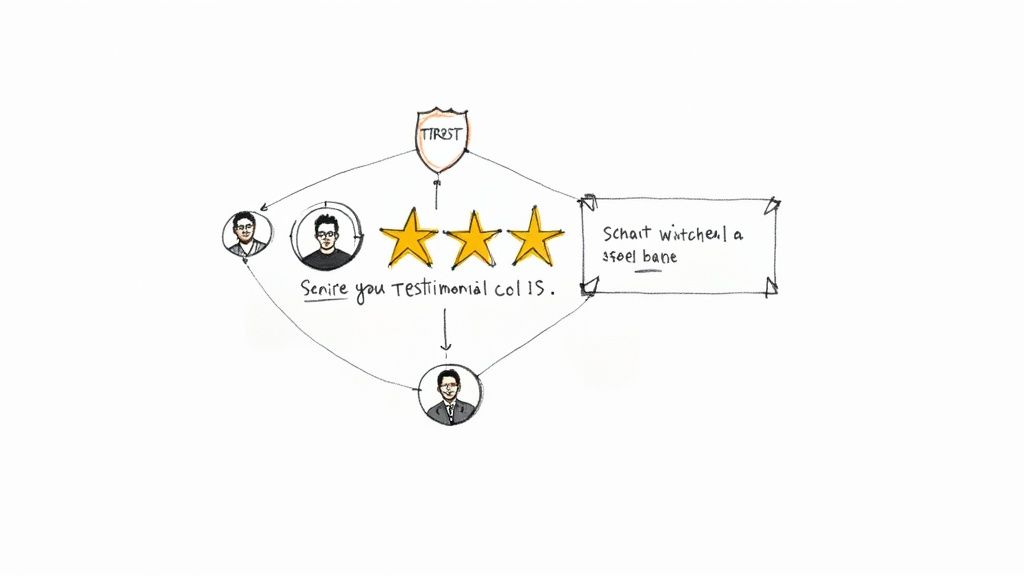
Without a clear, compelling, and strategically placed CTA, even the most persuasive landing page will fail. It is the single most critical interactive element, directly responsible for turning visitor interest into measurable results. This is a core tenet of landing page design best practices because it is the final instruction you give your audience.
How to Craft a Winning CTA
Effective CTAs are a blend of psychological triggers, clear design, and benefit-oriented copy. They stand out visually and communicate value instantly. Consider these powerful examples:
- Zoom: “Sign Up, It's Free” (Direct action combined with a powerful benefit: no cost.)
- Calendly: “Claim Your URL” (Creates a sense of ownership and urgency.)
- Netflix: “Join Free for a Month” (Removes risk and highlights the immediate reward.)
These examples use action verbs and focus on what the user gets, not what they have to give. They make the decision to click easy and appealing.
Actionable Implementation Tips
To design a CTA that drives conversions, focus on clarity, contrast, and context:
- Use First-Person, Action-Oriented Copy: Instead of a passive "Submit," use powerful phrases like "Claim My Free Trial" or "Start My Journey."
- Make it Visually Distinct: Your CTA button should use a contrasting color that pops against the background, but always ensure it passes accessibility standards for readability.
- Repeat Your CTA: Place your primary CTA above the fold and repeat it at natural endpoints throughout the page, especially after presenting key benefits or testimonials.
- Include a Secondary CTA: For visitors not ready to commit, offer a lower-commitment option like "Learn More" or "See a Demo" to keep them engaged. To ensure your CTAs are truly compelling, explore these effective call to action examples that convert.
5. Social Proof and Trust Signals
Humans are social creatures, and we often look to the actions and experiences of others to guide our own decisions. Social proof leverages this psychological principle by showing visitors that other people have already chosen and benefited from your offering. It’s a powerful tool that reduces friction and builds credibility by answering a visitor's subconscious question: “Can I trust this?”
These elements serve as a third-party endorsement, demonstrating that your product or service is legitimate, popular, and effective. Integrating social proof is a core component of landing page design best practices because it shifts the focus from your claims to real-world validation, making your promises more believable and compelling.
How to Build Trust with Social Proof
Effective social proof is specific, authentic, and relatable. Consider how these companies use it to build confidence:
- Salesforce: Prominently displays the logos of well-known clients like NBC and a majority of the Fortune 500, borrowing their established authority.
- Booking.com: Uses real-time social proof like "Booked 4 times in the last 6 hours" to create a sense of urgency and popularity.
- Zapier: Features compelling user statistics such as "Trusted by employees at 97% of the Fortune 500," quantifying their widespread adoption and reliability.
These examples work because they provide tangible evidence that other people, including respected brands, have made the same choice and found value.
Actionable Implementation Tips
To effectively integrate social proof and trust signals into your landing page, follow these steps:
- Showcase Quantified Results: Instead of a generic testimonial, use one that highlights a specific outcome, like "We increased our leads by 40% in the first quarter."
- Include Photos and Titles: Put a face and a professional title to your testimonials. This makes them more human and credible. Video testimonials are even more impactful.
- Use Trust Badges Strategically: Display security seals (like Norton or McAfee), payment provider logos (Visa, PayPal), and industry certifications near forms or CTAs to alleviate security concerns.
- Be Specific with Numbers: Don’t just say “many users.” Use precise figures like “Join 125,000+ businesses growing with us” to make your claim concrete and impressive.
By placing these trust-building elements near key decision points, such as a "Sign Up" button, you can effectively reduce visitor anxiety and significantly boost conversions.
6. Clear Visual Hierarchy and Information Architecture
Your landing page isn't a novel; it's a quick-glance billboard. A clear visual hierarchy and information architecture are the invisible forces that guide your visitor's eye, ensuring they consume information in the intended order of importance. This structure uses design principles like size, color, contrast, and spacing to create a path from your value proposition to your call to action. Without it, visitors are left to wander through a chaotic jumble of text and images, quickly becoming overwhelmed and clicking away.
This practice is fundamental to effective landing page design best practices because it directly impacts user comprehension and experience. A well-organized page feels intuitive and effortless to navigate, allowing visitors to scan for key information, understand the offer, and feel confident in their decision to convert. It transforms a wall of content into a logical, persuasive narrative.
How to Build a Logical Content Flow
Effective information architecture ensures every piece of content has a purpose and a place. It's about grouping related ideas and presenting them in a sequence that builds trust and understanding. Consider these excellent examples:
- HubSpot: Their landing pages master the H1 > H2 > H3 structure, creating a scannable outline that users can understand at a glance.
- Stripe: The site presents a logical flow, starting with the problem, introducing the solution, detailing the benefits, and leading seamlessly to a call to action.
- Notion: Notion’s website is a masterclass in organizing complex features into simple, digestible sections that are easy to explore.
These examples don't just present information; they strategically guide the user through a journey, making the complex feel simple and compelling.
Actionable Implementation Tips
To implement a strong visual and informational hierarchy, follow these guidelines:
- Use One H1 Tag: Your main headline (the H1) should be unique and encapsulate the page's core purpose.
- Follow a Heading Structure: Organize sub-topics logically using H2s, and further details under H3s. Never skip a level (e.g., from H1 to H3).
- One Idea Per Section: Dedicate each content block to a single, focused idea to avoid overwhelming the visitor.
- Leverage Lists and Spacing: Use bullet points and numbered lists to make complex information scannable. Use generous white space between sections to create visual separation and improve readability.
- Write Descriptive Headings: Your headings should act as signposts. Instead of a generic "Features," try "Everything You Need to Succeed."
7. High-Quality, Purpose-Driven Imagery and Video
Visual elements are often the first thing a visitor processes, making them a powerful tool for communication and persuasion. High-quality, purpose-driven imagery and video go beyond mere decoration; they should be strategically chosen to support your core message, demonstrate value, build an emotional connection, and guide the user’s eye toward your call to action. In a list of landing page design best practices, purposeful visuals are non-negotiable for capturing attention and conveying complex ideas instantly.
This element is crucial because visuals can communicate benefits far more quickly than text alone. A well-placed video can demonstrate a complex software feature in seconds, while authentic photography can build trust and relatability. When every visual serves a specific goal, it enhances the user experience and reinforces the value proposition.
How to Use Visuals Effectively
Effective visuals tell a story that aligns with your brand and offer. They should feel authentic and intentional, not like generic filler. Consider these excellent examples:
- Loom: Uses video extensively to demonstrate its own product in action, providing an immediate and clear understanding of its value.
- Airbnb: Features stunning, professional photography of unique properties, selling the experience and lifestyle, not just a room.
- Slack: Employs a mix of clean product screenshots and custom illustrations to create a friendly, organized, and professional brand identity.
These brands understand that every image and video must contribute directly to the goal of conversion, whether by explaining a feature, building trust, or creating desire.
Actionable Implementation Tips
To integrate visuals that convert, focus on both quality and strategic purpose:
- Prioritize Authenticity: Use genuine photos of your team, customers, or product over generic stock photos to build credibility and connection.
- Optimize for Performance: Compress images and use modern formats like WebP. Implement lazy loading for visuals that appear "below the fold" to ensure fast page load times.
- Keep Videos Concise: Aim for videos under two minutes. Host them on a dedicated platform like Wistia or Vimeo for reliable playback and analytics.
- Ensure Accessibility: Provide descriptive alt text for all images and include transcripts or captions for video content to make your page accessible to all users.
By selecting visuals that are both high-quality and strategically aligned with your message, you create a more engaging and persuasive landing page that effectively communicates value.
8. Minimal Form Fields and Progressive Profiling
Every field you add to a signup form creates friction and presents another reason for a potential lead to abandon the process. Asking for too much information upfront, especially from a new visitor, is one of the quickest ways to kill your conversion rate. The goal is to make the initial commitment as small and effortless as possible by only asking for absolutely essential information.
This minimalist approach is a cornerstone of landing page design best practices because it directly impacts your most important metric: conversions. By reducing the perceived effort required to sign up, you significantly increase the likelihood that a visitor will complete the form. You can always gather more information later, once trust has been established.
How to Reduce Form Friction
The core principle is to align the amount of information you request with the value you are offering. For a simple newsletter signup, an email address is sufficient. For a high-value demo or consultation, you can justify asking for a bit more. Consider these examples of streamlined forms:
- Mailchimp: Their initial signup often requires just an email and password, getting the user into the ecosystem quickly before asking for more profile details.
- HubSpot: A master of this technique, HubSpot uses progressive profiling on its forms. A first-time visitor might only be asked for their name and email. On their next visit, the form will recognize them and ask for their company name and size instead.
This gradual data collection respects the user's time and builds the relationship over multiple interactions rather than demanding everything at once.
Actionable Implementation Tips
To optimize your forms for maximum completion, apply these targeted strategies:
- Start with 3-4 Essential Fields: For most lead generation forms, Name, Email, and perhaps one other critical field is the maximum you should request initially.
- Use Smart Defaults and Autocomplete: Leverage browser capabilities to pre-fill common information like name or email to reduce typing effort.
- Implement Inline Validation: Provide real-time feedback as a user fills out the form. A green checkmark for a valid email is much better than a red error message after they hit "submit."
- Test Form Completion Rates: Use analytics to measure the impact of removing even a single field. The data will often show a surprising lift in conversions.
9. Fast Page Load Speed and Performance Optimization
In the digital world, speed is not a feature; it's a fundamental requirement. Fast page load speed is the practice of ensuring your landing page loads almost instantly for every visitor, regardless of their device or network connection. With user attention spans shrinking, even a one-second delay can lead to a significant drop in conversions. Slow-loading pages frustrate users, increase bounce rates, and directly harm your credibility before your message is even seen.
This element is crucial to landing page design best practices because it's the gatekeeper to your user experience. A visitor who leaves before your value proposition even appears is a lost opportunity. Search engines like Google also heavily prioritize performance, using Core Web Vitals as a key ranking factor, meaning a faster page can lead to better organic visibility.
How to Prioritize Performance
Top-performing companies treat speed as a core component of their user experience, not an afterthought. They understand that a seamless, quick interaction builds trust and keeps users engaged. Consider these examples:
- Google: The quintessential example of speed. The homepage is famously minimalist to deliver search results with minimal latency.
- Stripe: Known for its slick, developer-friendly experience, Stripe’s site loads incredibly fast globally, reflecting the reliability of its payment infrastructure.
- GitHub: Despite its complexity, GitHub’s pages are highly optimized for performance, ensuring developers can access code and collaborate without frustrating delays.
These sites prove that you don't have to sacrifice sophisticated design for speed; you just have to build performance into the design process from the start.
Actionable Implementation Tips
To ensure your landing page is a high-performance asset, focus on these technical optimizations:
- Compress and Optimize Images: Use modern formats like WebP with PNG fallbacks. Compress images to reduce file size without sacrificing noticeable quality.
- Implement Lazy Loading: Load images and videos only as the user scrolls down the page, prioritizing the content visible "above the fold."
- Minify Code: Remove unnecessary characters (like spaces and comments) from your HTML, CSS, and JavaScript files to reduce their size.
- Leverage a CDN: Use a Content Delivery Network (CDN) to store copies of your page on servers worldwide, delivering it to users from the geographically closest location.
- Monitor Core Web Vitals: Regularly use tools like Google PageSpeed Insights to test your LCP (Largest Contentful Paint), FID (First Input Delay), and CLS (Cumulative Layout Shift) and act on the recommendations.
10. Consistent Brand Identity and Visual Design System
Your landing page doesn't exist in a vacuum; it's a direct reflection of your brand. A consistent brand identity, governed by a visual design system, ensures every element from your color palette and typography to your imagery style works in harmony. This consistency is crucial for building brand recognition, establishing trust, and projecting a professional image that reassures visitors they are in the right place.
This element is one of the most fundamental landing page design best practices because it creates a seamless user experience. When a visitor clicks an ad with your branding and arrives on a page that looks and feels completely different, it creates cognitive dissonance and distrust. A cohesive design system ensures all landing pages, regardless of the campaign, feel like a natural extension of your brand.
How to Implement a Cohesive Design System
A design system is a collection of reusable components, guided by clear standards, that can be assembled to build any number of applications. It’s the single source of truth for your brand's visual language. Consider these well-documented examples:
- Google Material Design: A comprehensive system that unifies the user experience across all of Google's products.
- Shopify Polaris: A well-documented system that ensures a consistent and accessible experience for all Shopify merchants.
- IBM Carbon Design System: An open-source system for products and digital experiences, demonstrating enterprise-scale consistency.
These systems go beyond a simple style guide; they provide the building blocks for creating consistent, high-quality user interfaces efficiently.
Actionable Implementation Tips
To establish a design system that reinforces your brand on every landing page, follow these steps:
- Document Your Core Elements: Specify your exact brand colors with hex codes, define font families, weights, and sizes for headings and body text, and establish a clear spacing scale (e.g., 8px, 16px, 24px) for margins and padding.
- Create Reusable Components: Build and document templates for common elements like buttons, forms, headers, and footers. This ensures consistency and speeds up development.
- Establish Clear Guidelines: Create a "dos and don'ts" section for using brand elements like your logo, imagery, and tone of voice to prevent misapplication.
- Use Centralized Tools: Leverage design tools like Figma to create a shared library of components and styles that your entire team can access and use. This becomes your single source of truth.
Top 10 Landing Page Best Practices Comparison
| Item | Implementation Complexity 🔄 | Resource Requirements ⚡ | Expected Outcomes ⭐ / 📊 | Ideal Use Cases 💡 | Key Advantages ⭐ |
|---|---|---|---|---|---|
| Clear and Compelling Value Proposition | Medium 🔄 — research + iteration | Low–Medium ⚡ — copywriting & user testing | High ⭐⭐⭐ — faster attention, lower bounce | Above-the-fold for landing pages, ads | Immediate clarity; guides user journey |
| Strategic Use of Whitespace | Low–Medium 🔄 — design discipline | Low ⚡ — designer time, QA | Medium ⭐⭐ — improved readability & perceived quality | Brand sites, content pages, product detail pages | Reduces clutter; boosts comprehension |
| Mobile-First Responsive Design | High 🔄 — planning, responsive patterns | Medium–High ⚡ — dev time, device testing | High ⭐⭐⭐ — better mobile conversions & SEO | Mobile-heavy audiences, SaaS, e‑commerce | Broad reach; SEO and UX benefits |
| Strategic CTA Placement and Design | Medium 🔄 — placement + testing | Low–Medium ⚡ — design + A/B testing | Very High ⭐⭐⭐ — direct conversion uplift | Lead gen, pricing pages, checkout flows | Drives conversions; easy measurable wins |
| Social Proof and Trust Signals | Medium 🔄 — collection + validation | Medium ⚡ — outreach, content curation | High ⭐⭐⭐ — increases credibility and conversions | New visitors, high‑value purchases, B2B SaaS | Reduces skepticism; builds trust quickly |
| Clear Visual Hierarchy & IA | Medium 🔄 — content strategy + layout | Medium ⚡ — UX/content work | High ⭐⭐⭐ — faster comprehension, more engagement | Content-rich pages, product storytelling | Improves scannability; supports SEO |
| High-Quality, Purpose-Driven Imagery & Video | Medium–High 🔄 — production + optimization | High ⚡ — photography, video hosting | High ⭐⭐⭐ — increases engagement and conversions | Product demos, brand storytelling, landing hero sections | Emotional connection; clearer product demos |
| Minimal Form Fields & Progressive Profiling | Medium 🔄 — logic + CRM integration | Medium ⚡ — dev & marketing automation | High ⭐⭐⭐ — higher completion, better lead flow | Signups, onboarding, lead capture forms | Less friction; improved completion rates |
| Fast Page Load Speed & Performance Optimization | High 🔄 — technical tuning & monitoring | Medium–High ⚡ — infra, dev time, tools | Very High ⭐⭐⭐ — better SEO, lower bounce, higher conversions | High‑traffic sites, global audiences, mobile | Direct impact on revenue and UX |
| Consistent Brand Identity & Design System | High 🔄 — governance + documentation | High ⚡ — design system build & upkeep | High ⭐⭐⭐ — recognition, faster production | Enterprise brands, multi-campaign organizations | Consistency, efficiency, cross‑team alignment |
Turn Your Insights into High-Converting Pages
You have now journeyed through the essential building blocks of a high-performing landing page. We have explored ten critical components, moving from the foundational clarity of your value proposition and the structural integrity of your visual hierarchy to the technical precision of mobile-first design and lightning-fast page speed. Each principle, from strategic CTA design to the trust-building power of social proof, represents a vital lever you can pull to influence user behavior and drive conversions.
However, the true mastery of landing page design best practices doesn't come from just knowing these rules. It comes from understanding that they are not a static checklist but a dynamic framework for a continuous cycle of creation, testing, and optimization. Your landing page is not a monument to be built and left untouched; it is a living, breathing digital asset that must adapt to user feedback, market changes, and evolving business goals.
From Knowledge to Action: Your Next Steps
The difference between an average landing page and a truly exceptional one lies in the deliberate application of these insights. Merely understanding the importance of a clear CTA or responsive design isn't enough. The goal is to move from passive knowledge to active, strategic implementation.
Here is a practical roadmap to get you started:
- Conduct a Comprehensive Audit: Use the ten points in this article as a scorecard for your existing landing pages. Where are the biggest gaps? Identify the low-hanging fruit, the quick wins that can deliver an immediate impact, such as simplifying a form or enhancing your social proof.
- Prioritize with Purpose: You don't need to overhaul everything at once. Focus your efforts where they will matter most. If your mobile bounce rate is sky-high, mobile-first optimization is your top priority. If user testing reveals confusion about your offer, refining your value proposition and visual hierarchy should come first.
- Establish a Testing Culture: A/B testing isn't just a tactic; it's a mindset. Commit to testing one key element at a time. Change a headline, test a new CTA color, or experiment with a different hero image. Let the data, not just your gut feeling, guide your decisions and prove what truly resonates with your audience.
The True Value of Exceptional Landing Page Design
Ultimately, excelling at landing page design is about more than just boosting conversion rates. It is about creating a seamless, intuitive, and trustworthy experience for your visitors. It’s about respecting their time by delivering information clearly and efficiently. It’s about building brand credibility with every pixel and every line of code. When you master these principles, you do more than just capture leads; you build relationships.
The journey to creating the perfect landing page is iterative. It requires a blend of creativity, analytical rigor, and a deep empathy for the end-user. The landing page design best practices we've covered provide the blueprint. Now it's your turn to build something that not only converts but also connects, convinces, and truly serves your audience. Start small, test relentlessly, and never stop refining your approach.