Your Guide to a Bulletproof Software Development Contract Template
A solid software development contract is easily the most critical document for your project's success. Think of it as the foundational blueprint that aligns everyone's expectations, spells out exactly what gets delivered, and protects both you and your development partner from expensive misunderstandings later on.
Why Your Project Needs More Than a Generic Contract
It’s tempting to just grab the first free template you find online, fill in a few names, and call it a day. I’ve seen that movie before, and it rarely ends well. Generic contracts are almost always full of vague language and completely miss the specific complexities that come with building software.
That kind of ambiguity is a direct path to scope creep, blown budgets, and nasty disputes over who actually owns the intellectual property.
A well-crafted agreement, on the other hand, is so much more than a legal formality—it’s a powerful project management tool. It forces you to turn abstract ideas into a concrete plan, making sure everyone is on the same page from the very beginning. This clarity becomes even more crucial when you're working with nearshore teams, where precise communication can make or break the entire collaboration.
The High Stakes of Vague Agreements
Let’s be honest: building software is complicated, and things can go sideways. The entire contracting process has evolved to deal with these risks head-on. According to the well-known CHAOS Report, a sobering 31% of software projects are considered a clear success. A huge 52% are challenged by delays or budget issues, and 17% just fail outright.
Those numbers should tell you everything you need to know. A detailed software development agreement isn't an optional extra; it's a fundamental business necessity. You can get more background on how these project realities have shaped modern legal frameworks for development.
This guide will help you see your contract in a new light. It's not a hurdle to clear; it’s the bedrock of a transparent, trusting, and successful partnership.
A great contract doesn't just protect you when things go wrong. It actively prevents things from going wrong in the first place by forcing clarity and mutual understanding.
To give you a bird's-eye view, here's a quick rundown of the essential clauses and the common headaches they help you avoid.
Key Contract Clauses and Their Impact
| Contract Section | Risk Mitigated | Impact if Ignored |
|---|---|---|
| Intellectual Property | Ambiguity over who owns the final code and design assets. | You could lose ownership of your core product or face future legal battles. |
| Payment Terms | Disputes over invoicing, payment triggers, and late fees. | Cash flow problems, work stoppages, and a soured relationship. |
| Change Requests | Uncontrolled scope creep that inflates timelines and budgets. | The project never ends, and costs spiral out of control. |
| Warranties | Receiving a buggy or non-functional final product. | You're left with a broken application and no recourse to get it fixed. |
| Termination Clause | Being stuck in a partnership that is no longer working. | Wasted time, money, and being legally tied to an underperforming team. |
Getting these clauses right from the start is what separates a smooth project from a disaster.
Our downloadable software development contract template is your starting point. Throughout this guide, we’ll walk through how to customize this document clause by clause, turning it into a powerful framework that fits your project's specific needs. We’ll unpack the real-world risks and give you practical advice to build a contract that truly protects your vision, budget, and timeline.
Breaking Down the Core Contract Clauses
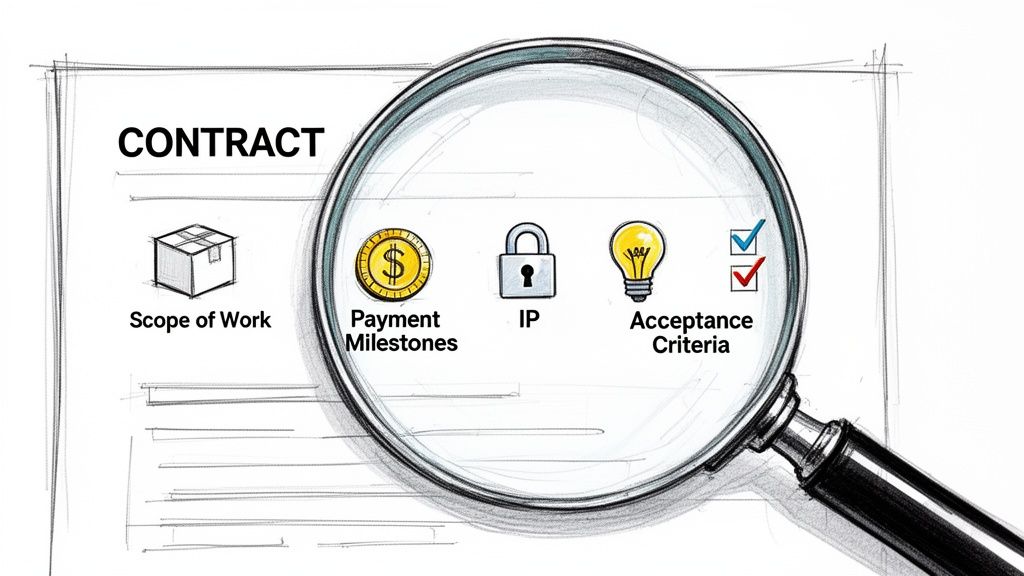
A software development contract is much more than a legal hoop to jump through. Think of it as the operational playbook for your entire project. Every single clause has a job to do, turning your big ideas into a concrete plan everyone agrees on.
So, let's pull apart the most critical sections of our software development contract template. This isn't about becoming a lawyer overnight; it's about understanding how these clauses work in the real world to stop scope creep dead in its tracks, protect your code, and make sure you're paying for real, tangible progress.
Scope of Work That Prevents Confusion
The Scope of Work (SOW), which usually lives as an appendix to the main contract, is the absolute heart of your agreement. I've seen more projects go off the rails because of a weak SOW than for any other reason. It’s the number one cause of endless revisions and blown budgets. You have to be meticulous here.
A solid SOW needs to nail down:
- Project Goals and Objectives: What problem are you actually solving? Don't just say "build an app." Be specific: "Develop a customer-facing iOS app to streamline the online ordering process and reduce cart abandonment by 15%."
- Deliverables: Make a list of every single thing you expect to receive. This means the source code, yes, but also the compiled apps, design files, technical documentation, and even user manuals.
- Features and Functionality: Break it all down. Instead of a vague "user login," your SOW should specify "user registration via email/password, Google Sign-In, and a password recovery flow."
- Technical Specifications: Get nerdy. Detail the tech stack (React Native for mobile, Node.js for the backend), target platforms (iOS 15+, Android 11+), and any key third-party integrations, like using Stripe for payments.
- Exclusions: Just as important is calling out what’s not included. A simple line like, "This SOW does not include a web-based admin panel or ongoing server maintenance post-launch," can save you a world of headaches later.
A strong Scope of Work leaves no room for assumptions. If a feature isn't explicitly documented, you should assume it's not being built. Ambiguity is the enemy of on-time, on-budget delivery.
This document is your best defense against scope creep. For a much deeper dive, take a look at our guide on creating a comprehensive sample software requirements document.
Payment Milestones Aligned with Progress
How and when you pay your development team has a massive impact on the project's momentum and keeps everyone accountable. The key is to tie payments directly to the completion of real, verifiable milestones.
Steer clear of vague payment schedules like "50% upfront, 50% on completion." This model is risky for you and gives the developer very little incentive to show you incremental progress along the way.
A much smarter approach is linking payments to things you can actually see and touch.
Sample Milestone Structure
| Milestone | Deliverable | Payment |
|---|---|---|
| Milestone 1 | UI/UX Wireframes & Prototype Approval | 15% |
| Milestone 2 | Front-End Development Completion (Core Screens) | 25% |
| Milestone 3 | Back-End API & Database Schema Finalization | 25% |
| Milestone 4 | User Acceptance Testing (UAT) Pass | 25% |
| Milestone 5 | Final Deployment to App Stores | 10% |
This approach sets up a natural rhythm of delivery, review, and payment. It keeps both sides laser-focused on the next tangible goal, making the whole process feel more transparent and under control.
Intellectual Property Ownership Defined
For any company, but especially a startup whose entire valuation might be tied to its code, this clause is completely non-negotiable. The contract must state, without a shred of doubt, who owns the final product.
In a standard "work for hire" agreement, the rule is simple: the client paying the bills owns the custom code written specifically for their project.
But there's a nuance. Developers almost always use pre-existing tools, code libraries, or their own internal frameworks to build things faster and better. The contract needs to address this head-on:
- Client Owns: All the custom code, unique designs, and project-specific assets created for you.
- Developer Retains: Ownership of their own pre-existing tools and generic code libraries they bring to the table.
- Client is Granted: A permanent, royalty-free license to use the developer's pre-existing code as part of the final product.
This arrangement gives you full ownership of your unique product while allowing the developer to keep the rights to their foundational tools. If you're a startup looking for venture capital, having a clean IP ownership clause is one of the first things investors will check.
Acceptance Criteria That Eliminates Guesswork
How do you know when a feature is truly "done"? The acceptance criteria clause is what takes all the subjectivity out of the review process. It defines the specific, testable conditions that a deliverable must meet to be considered complete.
This section should also outline the Acceptance Testing Period (e.g., "The Client has 10 business days to review deliverables") and spell out the process for reporting bugs or asking for changes.
For example, the acceptance criteria for that user login feature we mentioned might look like this:
- A new user can successfully register with a valid email and strong password.
- The system correctly validates email formats and enforces password rules.
- An existing user can log in with their correct credentials.
- The system shows a specific error message if login credentials are incorrect.
- The "Forgot Password" link successfully sends a reset email to the user.
By defining "done" with this level of precision, you create a clear, objective finish line. This is how you prevent those late-stage arguments and ensure the final product works exactly the way you planned.
Making the Template Your Own: A Practical Guide
A downloadable software development contract template is a fantastic shortcut, but it's really just a foundation. The real work—and where you protect yourself—is in tailoring that document to the specific realities of your project. No two software builds are ever the same, and your contract should reflect that.
Think of it this way: you wouldn't wear a "one-size-fits-all" suit to a critical investor meeting. The same logic applies here. A customized contract anticipates the specific risks, outlines the actual working relationship, and turns a generic form into a powerful tool for getting the project done right.
First, Match the Contract to Your Engagement Model
How you plan to pay and work with your developers is the single biggest factor that shapes the contract. The two most common models—Fixed-Price and Time & Materials—require fundamentally different agreements.
Fixed-Price Contracts
This is your go-to when the project scope is buttoned up and crystal clear. I'm talking about projects where you've documented every feature, screen, and function. Think of a simple marketing website or a mobile app with a very specific, limited feature set.
- Best for: Projects where you know exactly what you need and the requirements aren't going to change.
- What to customize: The Scope of Work (SOW) needs to be airtight and incredibly detailed. Your payment schedule should be tied to concrete, verifiable deliverables, not just time. The change request clause is also crucial here; it needs to be firm, stating that any new idea will trigger a formal change order with new costs and timelines.
A classic fixed-price project for an e-commerce app, for instance, would list everything from "user account creation with social login" to "Stripe payment gateway integration" in the SOW, leaving no ambiguity. Getting this right from the start is vital, which is why we have a whole guide on how to properly define your project scope.
Time and Materials (T&M) Contracts
This model is built for flexibility. It's the right choice for complex, long-term projects where requirements will naturally evolve. If you're building a groundbreaking SaaS platform or working in agile sprints where the path forward is discovered along the way, T&M is your friend.
- Best for: Projects with a fluid scope, agile development cycles, or when you're simply augmenting your in-house team.
- What to customize: Forget the rigid SOW. Here, the contract focuses on defining roles, rates (e.g., Senior Developer at $X/hour, QA Tester at $Y/hour), and reporting procedures. You'll want to include clauses that mandate regular progress reviews and outline a clear process for adjusting priorities, maybe after every two-week sprint.
For a T&M contract building a new software platform, you'd specify the exact team makeup and their rates. The understanding is that the feature roadmap will be refined as you get user feedback and market data.
Special Considerations for Startups and Nearshore Teams
Beyond the payment model, your own company’s situation changes what needs to be in the contract. Startups and businesses working with remote teams have very different pressure points to address.
For a startup, the intellectual property clause isn't just legal boilerplate; it's a core part of the company's valuation. Vague IP language is a huge red flag for investors down the line.
Startups need to be ruthless about IP protection. The contract must state, without any ambiguity, that all custom code is a "work for hire" and that complete ownership transfers to you upon payment. You also want to make sure the developer only retains rights to their pre-existing tools or libraries, and that you get a permanent, non-revocable license to use them in your product.
For businesses managing nearshore or offshore teams, the contract is less about code and more about communication. It's about bridging cultural and time zone gaps.
Your agreement should spell out the ground rules:
- Communication Tools: Mandate the use of specific platforms like Slack for daily chats, Jira for tasks, and weekly video calls for sync-ups.
- Working Hours: Be explicit about time zone overlap (e.g., "The development team will ensure a minimum of 4 hours of overlap with the client's 9 AM - 5 PM EST business hours").
- Reporting: Require daily stand-up notes in a shared channel and a formal weekly progress summary.
These aren't just minor preferences; they are the gears that make a remote partnership run smoothly. And for projects evolving into ongoing services, it's often wise to look at templates for more specialized Software Licensing (SaaS) Agreements to cover those unique operational needs.
Your Pre-Customization Checklist
Before you start filling in the blanks on that template, pause and ask yourself these five questions. The answers will be your guide.
- How clear is my scope? On a scale of 1-10, is it a 2 (we have a vague idea) or a 10 (it's fully documented)? This immediately points you toward T&M or Fixed-Price.
- Is this IP our secret sauce? Is the software we're building a core asset that gives us a competitive edge? If yes, that IP clause is your number one priority.
- Where is the team located? If they're in another country, you need to add those detailed communication and collaboration protocols.
- What happens after launch? Will we need the developer for bug fixes, maintenance, or new features? This tells you whether you need a strong warranty clause or a separate support agreement.
- Are we handling sensitive data? If the app will process personal user information or payment details, you need to bulk up the data protection and confidentiality sections.
Going through this exercise shifts the process from just filling out a form to strategically planning for your project's success.
Handling Advanced Clauses and Special Scenarios
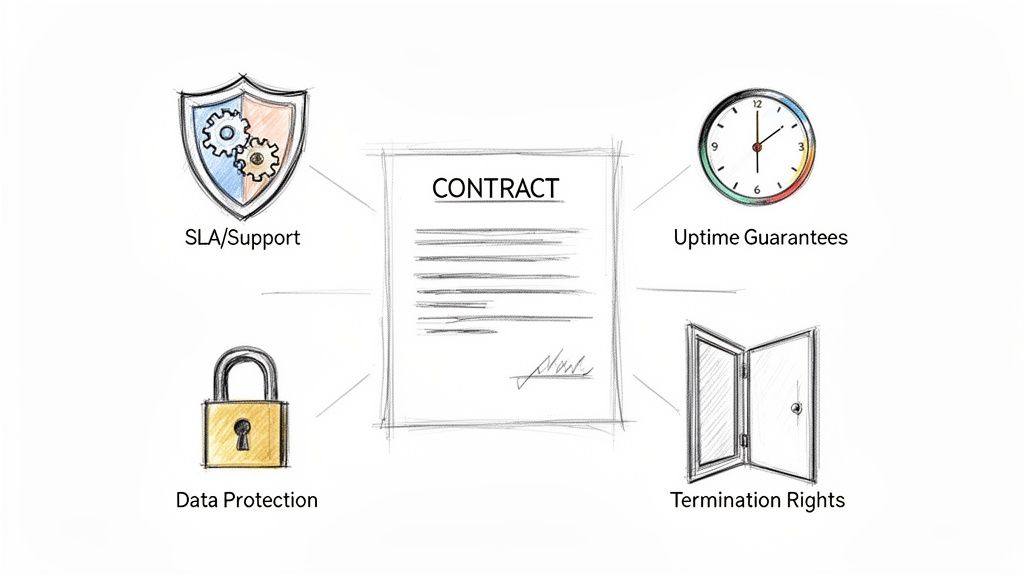
Alright, you've nailed down the core of your agreement—the scope, payment, and timeline. Now it’s time to dig into the "what-if" scenarios. These are the clauses that manage life after launch, handle unexpected twists, and set the ground rules for an ongoing service.
Think of these advanced clauses as the difference between a simple project plan and a durable framework for a genuine partnership. They're your safety net, providing clear instructions for when things don't go exactly as planned.
Defining Service Level Agreements (SLAs)
If your project is a SaaS product, a customer-facing web app, or anything else that needs to stay online and perform well, a Service Level Agreement (SLA) is absolutely essential. This clause isn't about the initial build; it’s about the developer's commitment to keeping the software running smoothly after it’s live.
An SLA isn't just a vague promise of "support." It’s a set of hard, measurable guarantees.
You’ll want to pin down specific metrics, such as:
- Uptime Guarantee: This is the big one. A common standard is 99.9% uptime, which sounds great but still allows for about 43 minutes of downtime a month. Know what that number really means for your business.
- Response Time: When a critical issue pops up, how fast will the team even acknowledge it? A good starting point is, "Acknowledge critical bug reports within 1 hour."
- Resolution Time: Acknowledging a problem is one thing, fixing it is another. Specify something like, "Resolve critical, system-down issues within 4 hours."
Without a clear SLA, you have no contractual leg to stand on if your application is sluggish or constantly crashing. It makes reliability an official expectation.
Understanding Post-Launch Warranties
What happens when a nasty bug crawls out of the woodwork two weeks after you’ve signed off on the project? This is where a warranty clause—sometimes called a "bug-fix period"—saves the day. It’s the developer’s promise that the code they delivered is free from major defects for a set amount of time.
This warranty window typically lasts from 30 to 90 days after launch. During this period, the developer agrees to fix any bugs found in the original code at no extra charge. The key here is to clearly define what counts as a "bug" (an error in the delivered code) versus a "new feature" (anything not in the original scope).
A warranty clause is your protection against a product that only looks good on the surface. It ensures the code is truly robust and performs as expected in the real world, not just in a sterile testing environment.
This gives you crucial peace of mind and holds the developer accountable for the quality of their work right after deployment. How you structure payments can also play a role here, which we cover in our guide to software development pricing models.
Addressing Data Protection and GDPR
In this day and age, handling user data is a massive responsibility. If your software will collect, store, or process any personal information—from email addresses to browsing habits—you need a rock-solid data protection clause.
This section must clearly outline who is responsible for what when it comes to data security and compliance with regulations like GDPR or CCPA. It should specify the security measures being taken, like data encryption and access controls, and detail the protocol for a data breach. The goal is to get it in writing that the developer will use industry-standard security practices to protect user data from any unauthorized access.
Navigating Termination Rights
Nobody goes into a project expecting it to fail, but a well-written termination clause is your essential exit strategy. It creates a clear, predictable process for parting ways if the relationship sours or your business needs to pivot.
You’ll typically see two types of termination:
- Termination for Cause: This is for when one party breaks the contract—the client doesn't pay, or the developer stops delivering. The clause should define what a "breach" is and include a "cure period" (e.g., 15 days) for the offending party to fix the problem before the contract is terminated.
- Termination for Convenience: This is a lifesaver, especially for startups. It allows either party to end the contract for any reason, no breach necessary, just by giving written notice (usually 30 days). This provides the flexibility you need if your strategy changes or the project just isn't viable anymore.
Crucially, the termination clause must also spell out what happens next. It needs to detail final payments for completed work and the orderly handover of all project assets and source code. This simple step prevents a messy, emotional breakup and ensures a professional conclusion, no matter the circumstances.
Sealing the Deal: Negotiation and Signing
Once you’ve got your template ironed out, you head to the negotiation table. This isn't about arm-wrestling your developer into submission; it's where you both build the rulebook for your partnership. A collaborative spirit here is everything—it really sets the tone for the entire project.
Think of it as crafting a win-win scenario. The whole point is to adjust the terms until both sides feel their interests are protected and they’re genuinely motivated to create something great. Your best tools in this phase are open communication and a real willingness to find that middle ground.
Smart Plays for Startups and Nearshore Teams
Your company’s situation completely changes your negotiation playbook. A lean startup trying to move at lightning speed has very different priorities than a larger company managing a team several time zones away.
For Startups: Juggling Speed and Safety
As a startup, you live and die by your intellectual property. It’s often your most valuable asset.
- Own Your IP: Push hard for a "work for hire" clause. This makes it crystal clear that you, the client, own every line of custom code created. This isn't just a nice-to-have; it's a must-have for any future investor conversations.
- Build in an Exit Hatch: A "termination for convenience" clause is your best friend. The startup world pivots on a dime. This clause gives you a no-fault way out if your business goals change, so you aren't stuck paying for a project that no longer makes sense.
- Keep Changes Agile: Don't get bogged down in a clunky change request process. Agree on a lightweight system to document and approve scope adjustments. Something as simple as a dedicated channel in your project management tool can keep things moving without sacrificing accountability.
For Companies Working with Nearshore Developers
When your team is remote, the contract has to be more than a legal doc—it's your communication bible. You're not just aligning on code; you're aligning on culture and expectations.
When you're managing a nearshore team, the contract has to do more than just outline deliverables. It needs to spell out exactly how you'll communicate. Defining working hours, expected response times, and meeting schedules prevents the small misunderstandings that can quietly sink a project.
Here's how to bake those expectations right into the agreement:
- Mandate Time Zone Overlap: Don't leave collaboration to chance. Specify a minimum number of overlapping work hours—say, "4 hours daily"—to guarantee you have time for real-time problem-solving.
- Codify Communication Tools: Be explicit. Name the platforms you’ll use (like Slack or Jira) and set clear requirements for daily stand-ups or weekly progress reports. This turns a vague hope for good communication into a contractual duty.
The Final Pre-Signing Checklist
Before anyone picks up a pen, do one last, careful pass. This is your final opportunity to spot mistakes, clear up any fuzzy language, and make sure the document is a perfect snapshot of your agreement. This step locks in the contract as the single source of truth.
- Check Your Attachments: Is the final Statement of Work (SOW) actually attached? Are all the other documents, like wireframes or tech specs, included and correctly referenced?
- Confirm the Details: Read through every name, date, and payment figure one more time. A single typo in a bank account number can cause massive headaches and delays.
- Read It Out Loud: It feels a little silly, but trust me, it works. Reading every clause aloud forces you to slow down and catch awkward phrasing that your eyes might just skim over.
- Lock Down the Version: Make sure this is the final, final version and that all old drafts are put away. Using a good contract management system is key to keeping track of versions and ensuring everyone is working from the correct document.
- Get a Legal Once-Over: If you can, have a lawyer take a final look, especially if you made significant changes during negotiations. A small legal fee now can save you from a huge problem later.
Once you’ve ticked these boxes, you can sign with confidence, knowing you've built a solid foundation for a successful project.
Got Questions About Your Development Contract?
Diving into a software development contract can feel like you're learning a new language. Let's break down some of the most common questions that pop up, so you can feel confident you're getting the details right.
SOW vs. MSA: What’s the Real Difference?
It helps to think of a Master Service Agreement (MSA) and a Statement of Work (SOW) as two parts of a whole.
The MSA is the big-picture agreement. It's the foundation of your entire relationship with a development partner, setting the ground rules that will apply to every project you do together. Think of it as the constitution for your collaboration, covering the heavy-hitting stuff like confidentiality, liability, and how payments will generally be handled. You usually sign this once.
An SOW, on the other hand, gets into the nitty-gritty of a single project. It lives under the umbrella of the MSA and details the specific scope, deliverables, timelines, and costs for that one engagement. You’ll get a new SOW for each new project, but the MSA keeps the overall relationship consistent.
Who Owns the Code We’re Paying For?
This is a big one, and the answer should be clear: you, the client, should own the intellectual property (IP) for the custom code you paid to have built. This is typically handled with a "Work for Hire" clause in the contract. It’s a legal way of saying that once the final invoice is paid, all rights to the custom work transfer directly to you.
But there’s a nuance here. Most development shops have a toolbox of pre-existing code, internal frameworks, and libraries they use to work more efficiently. They rightfully retain ownership of those tools.
A fair contract will grant you a permanent, royalty-free license to use their pre-existing code only as it’s integrated into your final product. This is a standard and fair approach that protects everyone.
What Happens When We Need to Change Something?
Let’s be honest—scope changes are practically guaranteed. The key isn’t to prevent them but to manage them properly. That’s where a formal Change Request Process comes in, and it needs to be clearly defined in your contract.
Here's how it works: any requested change gets put into writing. This document, often called a "Change Order," spells out the new work, how it will affect the timeline, and what it will cost. The critical part? Both you and the developer have to sign off on this before any new work starts. This simple process is your best defense against scope creep and surprise invoices.
Are E-Signatures Actually Legit?
Absolutely. Electronic signatures are legally binding for business contracts across the globe, including in the U.S. and the E.U.
When you use a trusted service like DocuSign or Adobe Sign, you’re not just getting a digital autograph. You’re getting a secure, verifiable audit trail that shows exactly who signed the document and when. It’s the modern, efficient, and standard way to get your development contract finalized.